Quick Answer: Needle bearings are roller bearings with slender cylindrical rollers that fit a small radial cross-section while carrying high radial loads. Their main types and features differ by raceway design, internal construction and load direction: cage assemblies, drawn cup, machined ring, full-complement, sealed, self-aligning, thrust, combined and track roller designs. Radial loads dominate most types, while axial loads need thrust or combined bearings. Selection depends on space, shaft raceway condition, load direction, speed, lubrication, clearance and precision.
A needle bearing is often chosen when a conventional ball or roller bearing would take too much radial space. The name covers several designs, and their differences affect load direction, raceway preparation, sealing, speed and installation. This article compares the main needle bearing types and the features that matter when matching one to a compact assembly.
What Are Needle Bearings?
Needle bearings are roller bearings whose rolling elements are cylindrical and slender relative to their diameter. That shape allows a small radial cross-section while keeping a high radial load capacity in arrangements where radial installation space is limited. The rollers run between raceways and distribute load across a narrow envelope, so the surrounding shaft and housing often set the practical limit.
Most needle bearings support radial load. When a position must also carry axial load, the designer needs a needle roller thrust bearing or a combined bearing rather than a radial-only type. Needle bearings can use a cage that separates and guides the rollers, or a full-complement layout without a cage. They may also be supplied with or without an inner ring, with a drawn cup or a machined outer ring, and with or without seals.
Core Features That Distinguish Needle Bearing Types
The type name is only a starting point. The features below change the bearing envelope, the preparation of adjacent parts and the safe operating range.
| Feature | Effect on type selection |
|---|---|
| Radial cross-section | Needle bearings are chosen when radial space is the limiting design factor. A smaller section usually means less space for rings, seals or cage features. |
| Internal design | A caged bearing separates and guides the rollers. A full-complement bearing uses more rollers without a cage and is oriented toward higher radial capacity and stiffness. |
| Raceway configuration | Some types use the shaft and housing bore directly as raceways. Others use a drawn cup, a machined outer ring or a separate inner ring. |
| Load direction | Radial-only types, thrust types and combined radial and axial types serve different support roles and are not interchangeable by envelope alone. |
| Sealing and lubrication | RS and 2RS seals help retain lubricant and exclude contaminants. Allowable speed and temperature still need a check in the product data. |
| Precision and clearance | Clearance and precision suffixes affect running accuracy, internal fit and suitability for the application. |
Cage and clearance suffixes are part of the selection, not decoration. TN denotes a nylon cage guided by the rolling elements, while M denotes a machined brass cage guided by the rolling elements. C3 means radial internal clearance greater than Normal, and C4 means clearance greater than C3. P5 is a higher precision grade than P6, and P6 is higher than Normal. A suffix can change internal clearance, running accuracy or cage material, so it must be read with the size and series.
Not every needle bearing type is available with all seals, cages, clearances or precision grades. The priority among these features also changes with load direction, shaft hardness, housing design, speed, lubrication and alignment requirements.
Needle Roller and Cage Assemblies
Needle roller and cage assemblies contain only needle rollers and a cage. They have no inner ring and no outer ring. The shaft surface and the housing bore surface act directly as raceways, which is how this type achieves a very small radial section. The trade-off is that both surfaces must meet hardness, surface finish, dimensional and geometric accuracy requirements.
ISO 3030:2022 specifies boundary dimensions, cage width tolerances, roller set bore functional inspection and recommended raceway tolerances for this type. Use the assembly when the shaft and housing bore can be prepared as qualified raceways. If either surface cannot serve as a raceway, a drawn cup bearing, a machined-ring bearing or an inner-ring version is the safer route.
Drawn Cup Needle Roller Bearings
Drawn cup needle roller bearings use a thin-walled drawn outer cup. The cup gives a very small radial section height and is commonly selected when the housing bore cannot act directly as a raceway but the arrangement still needs to be compact and economical. The HK series denotes open drawn cup bearings, and the BK series denotes closed-end drawn cup bearings. A closed end can close the shaft end, reduce lubricant leakage and protect the rolling system from contaminants and moisture.
These bearings usually run directly on the shaft. If the shaft cannot be hardened and ground, a separate inner ring can be used. ISO 3245:2023 specifies boundary dimensions, preferred sizes, chamfers, closed-end thickness and tolerances for drawn cup needle roller bearings without an inner ring.
A representative HK 2216 bearing is single-row, open and supplied without an inner ring. Its roller set bore is 22 mm, its outside diameter is 28 mm and its width is 16 mm. The basic dynamic load rating is 13 kN, the basic static load rating is 22.4 kN, the reference speed is 11,000 r/min and the limiting speed is 12,000 r/min. The cage is steel. Ratings and speeds are product-specific, so the same envelope in another series still needs a data check.
Machined-Ring Needle Roller Bearings
Machined-ring needle roller bearings use a solid machined outer ring rather than a thin drawn cup. They suit positions that need higher stiffness, precision or load capacity than a thin-walled drawn cup arrangement can provide. Machined-ring products are commonly made from carbon chromium bearing steel and can be supplied with or without outer-ring flanges and with or without inner rings.
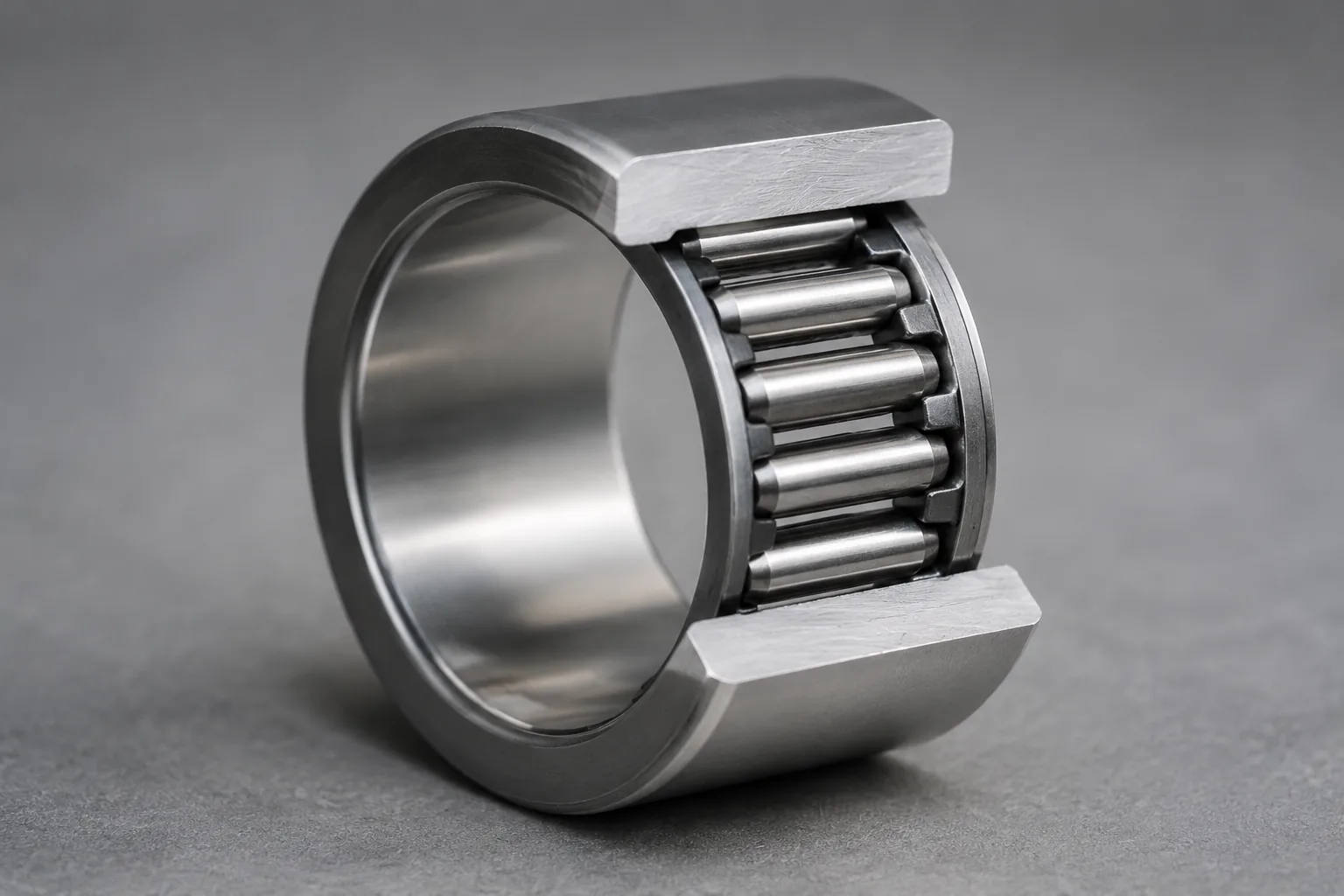
A version with an inner ring is suitable when the shaft cannot be machined into a hardened, ground raceway. A version without an inner ring allows a larger shaft diameter and higher shaft-system stiffness, but the shaft itself must form a qualified raceway. Common series include NK, NKS and RNA without an inner ring, and NKI, NKIS and NA with an inner ring. ISO 1206:2023 specifies boundary dimensions and GPS tolerances, and Amendment 1:2024 also applies.
Full-Complement Needle Roller Bearings
Full-complement needle roller bearings do not use a cage. More needle rollers can be arranged in the same space, so the design is generally oriented toward higher radial load capacity and stiffness than a caged design of comparable envelope. The V suffix is used for full-complement designs without a cage.
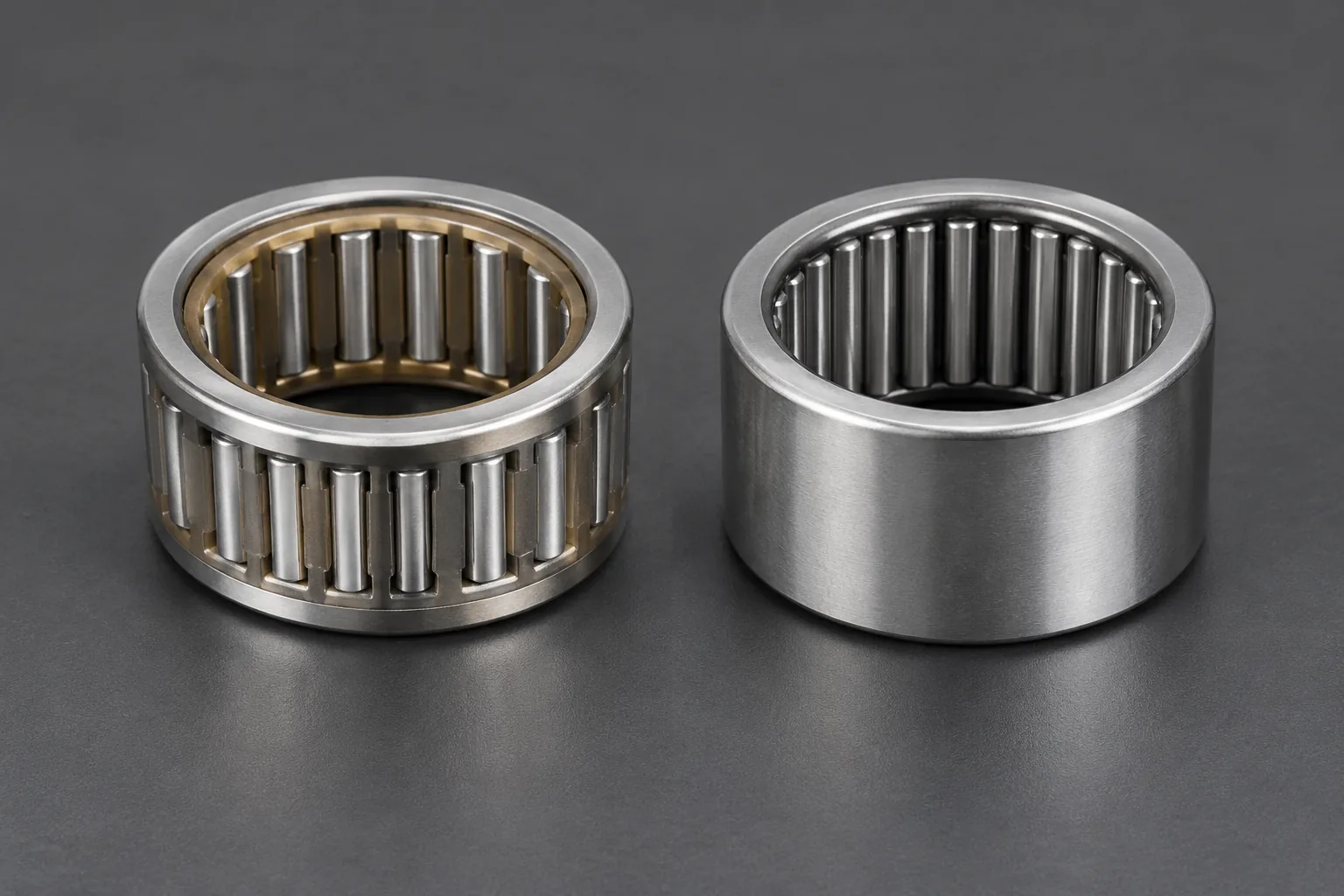
Selection must follow the rated speed and lubrication requirements for the specific bearing. A caged bearing and a full-complement bearing should not be interchanged by envelope dimensions alone, because the missing cage changes roller count, friction, lubricant flow and speed capability.
Sealed Needle Roller Bearings
In sealed needle bearings, RS generally indicates a single-side seal and 2RS generally indicates double-side sealing. These seals are commonly described as steel sheet with synthetic rubber. The NA49..-RSR designation denotes a single-side contact seal, while NA49..-2RSR denotes a double-side contact seal.
Seals help retain lubricant and block contaminants, but they also affect drag and heat. The allowable speed and temperature must be verified from the product data for the exact bearing. A sealed bearing is not automatically a substitute for a sealed housing or a clean operating environment.
Self-Aligning Needle Roller Bearings
Self-aligning needle roller bearings form a separate needle bearing category. They are intended for positions that need to compensate for certain mounting errors or shaft deflection. The self-aligning feature is not common to all needle bearings, and the permissible misalignment and load capacity must be confirmed for the specific series.
Specify a self-aligning type only when the application needs misalignment compensation and the selected series is rated for it. A standard radial needle bearing should not be treated as self-aligning.
Needle Roller Thrust Bearings
Needle roller thrust bearings arrange needle rollers circumferentially in a flat cage to carry axial load rather than radial load. The AXK designation covers needle roller and cage thrust assemblies. The AXW designation covers thrust needle roller bearings with a centering flange.
The design can provide high stiffness and carry heavy axial and peak loads in a small axial space. When adjacent component faces can serve as raceways, the required space can approach that of a plain thrust washer. ISO 3031:2021 specifies dimensions, tolerances and inspection methods for thrust needle roller and cage assemblies and thrust washers. A thrust bearing is not a substitute for a radial needle bearing when radial support is required.
Combined Needle Roller Bearings
Combined needle roller bearings pair a radial needle roller bearing with a thrust bearing so one position can support radial and axial load at the same time. They are useful where radial space is limited but axial location or axial load support is also needed. Main forms include needle roller/angular-contact ball bearings, needle roller/thrust ball bearings and needle roller/cylindrical roller thrust bearings.
The NKIA 59 series carries axial load in one direction, while the NKIB 59 series provides two-direction axial location. Confirm axial load direction, magnitude and required axial clearance in the product data before selecting a combined bearing.
Needle Roller Bearing Track Rollers
Needle roller bearing track rollers include yoke-type and stud-type designs. They are used to roll along guideways, cams or track surfaces rather than to act as a fixed shaft support. The outer ring profile and mounting method differ between the two designs, so the surrounding structure decides which one fits.
ISO 7063:2018 specifies dimensional characteristics, boundary dimensions and tolerances for this category. The standard was confirmed in 2024. Track roller selection still needs a check of radial load, axial guidance, surface condition and lubrication at the track contact.
Common Series, Suffixes, and Standards Reference
Series names are useful shorthand, but they do not replace a dimensional and feature check. Drawn cup types use HK open and BK closed series. Machined-ring types use NK, NKS and RNA without an inner ring, and NKI, NKIS and NA with an inner ring. Thrust types include AXK assemblies and AXW bearings with a centering flange. Combined types include NKIA 59 for one-direction axial load and NKIB 59 for two-direction axial location. Track rollers are grouped as yoke type and stud type.
| Designation | Meaning to verify |
|---|---|
| V | Full-complement design without a cage. |
| ZW | Double-row design, for example NA69..-ZW. |
| TN | Nylon cage guided by the rolling elements. |
| M | Machined brass cage guided by the rolling elements. |
| C3 | Radial internal clearance greater than Normal. |
| C4 | Radial internal clearance greater than C3. |
| P5 and P6 | Precision grades. P5 is higher than P6, and P6 is higher than Normal. |
| RS and 2RS | Single-side and double-side seals. |
Relevant ISO standards include ISO 3030:2022 for needle roller and cage assemblies, ISO 3245:2023 for drawn cup bearings without an inner ring, ISO 1206:2023 with Amendment 1:2024 for machined-ring bearings, ISO 3096:2018 for finished steel needle rollers, ISO 3031:2021 for thrust assemblies and thrust washers, and ISO 7063:2018 for track rollers. ISO 3096:2018 was published in July 2018 and confirmed in 2024. ISO/TC 4/SC 5 Roller Bearings is responsible for the related roller bearing standards.
Suffix meanings can vary by manufacturer. Use the specific designation table and product data for the bearing being ordered, especially when several suffixes appear together.
Selection Checklist: Matching Needle Bearing Type to Application
Use the checklist below to narrow the type before checking a specific series.
- Define load direction. Decide whether the position carries radial load only, axial load only, or combined radial and axial load.
- Measure the available space. Check both radial and axial space, and establish whether the housing bore or shaft can serve as a raceway.
- Decide on an inner ring. Confirm whether the shaft can be hardened, ground and qualified as a raceway, or whether an inner ring is required.
- Compare caged and full-complement designs. Balance load capacity and stiffness against speed capability and lubrication needs.
- Choose drawn cup or machined ring. Match the outer ring type to housing support, stiffness, precision and load requirements.
- Confirm sealing and operating limits. Check seal type, lubrication, speed, temperature, misalignment, clearance and precision class.
- Verify the data. Check dimensions, tolerances, load ratings and suffix meanings against the applicable standard and the product data for the exact bearing.
Conclusion
Needle bearing types and features are defined by the whole interface, not by the roller shape alone. The same small radial envelope can hide a cage assembly, a drawn cup bearing, a machined-ring bearing, a full-complement design, a sealed variant, a thrust bearing, a combined bearing or a track roller. The right choice follows load direction, raceway condition, available space, speed, lubrication, clearance and precision.
A safe next step is to define the load case and inspect the shaft and housing before comparing series. If the shaft cannot act as a raceway, include an inner ring or change the outer ring type. If axial load is present, move to a thrust or combined design. Confirm the final dimensions, ratings and suffix meanings in the product data for the exact bearing.
FAQs
Q1: What is the difference between needle roller and cage assemblies and drawn cup needle roller bearings?
A: A needle roller and cage assembly contains only rollers and a cage, so the shaft and housing bore act as raceways. A drawn cup bearing adds a thin-walled outer cup, which allows the housing bore to avoid raceway duty while keeping a small radial section.
Q2: Do needle roller and cage assemblies include inner or outer rings?
A: No. A needle roller and cage assembly has no inner ring and no outer ring. The shaft surface and housing bore must provide the raceways, so their hardness, finish and geometry are part of the bearing function.
Q3: When should a needle bearing have an inner ring?
A: Use an inner ring when the shaft cannot be hardened, ground and finished as a qualified raceway. A without-inner-ring version can allow a larger shaft and higher stiffness, but only if the shaft itself meets the raceway requirements.
Q4: Are needle bearings for radial loads or axial loads?
A: Most needle bearings carry radial load. Axial load requires a needle roller thrust bearing or a combined bearing, and the axial load direction and magnitude must be checked for the selected series.
Q5: What do HK and BK mean in drawn cup needle bearings?
A: HK denotes an open drawn cup bearing. BK denotes a closed-end drawn cup bearing, which can close the shaft end and help retain lubricant and exclude contaminants.
Q6: What does the V suffix mean on a needle bearing?
A: V denotes a full-complement design without a cage. It generally offers more rollers and higher radial capacity in the same space, but speed and lubrication limits must be checked for that bearing.
Q7: What do RS and 2RS mean on sealed needle bearings?
A: RS generally indicates a single-side seal, and 2RS generally indicates double-side sealing. Seals help retain lubricant and block contaminants, but they can reduce the allowable speed and temperature range.
Q8: Are needle bearings self-aligning?
A: No. Self-aligning capability belongs to specific self-aligning needle roller bearing series. A standard radial needle bearing should not be treated as self-aligning unless the selected series is rated for misalignment compensation.
Q9: What ISO standards apply to needle roller bearings?
A: Relevant standards include ISO 3030:2022 for cage assemblies, ISO 3245:2023 for drawn cup bearings without an inner ring, ISO 1206:2023 with Amendment 1:2024 for machined-ring bearings, ISO 3096:2018 for finished steel needle rollers, ISO 3031:2021 for thrust assemblies and thrust washers, and ISO 7063:2018 for track rollers.
Q10: Can caged and full-complement needle bearings be interchanged by size alone?
A: No. A caged and a full-complement bearing of the same envelope can differ in roller count, speed capability, friction and lubrication demand. Use the ratings and operating limits for the exact bearing.
Q11: What is a combined needle roller bearing?
A: A combined needle roller bearing supports radial and axial load in one position by pairing a radial needle bearing with a thrust bearing. Confirm axial load direction, magnitude and clearance before selection.