Quick Answer: Wheel hub diagnosis matches noise and play symptoms to likely causes, then confirms the fault with a road test, a lift inspection, and the correct play or runout measurement. A hum, rumble, or roar that changes with steering or load can point to a hub bearing; grinding can indicate rolling-element or race damage. Clicking, vibration, brake pulsation, and ABS warnings can also come from CV joints, tires, brakes, axle-nut clamping, or sensor faults.
Wheel hub diagnosis is a process of elimination. A bearing noise can resemble tire noise, a CV joint can click like a failing hub, and a brake or ABS fault can appear after a hub repair. The useful approach is to match the symptom to the conditions that produce it, then confirm the fault with a mechanical check and the vehicle-specific limit.
This guide covers passenger-car and commercial wheel-end diagnosis. It starts with road-test clues, moves to lift checks and dial-indicator measurement, explains why published limits differ by vehicle, axle, and wheel-end design, and then covers ABS encoder and sensor faults, installation-related damage, commercial wheel-end checks, and replacement decisions.
Road-Test Clues in Wheel Hub Diagnosis
Use a safe road at low and moderate speed, within traffic and vehicle limits. Listen while driving straight, during gentle left and right steering, during acceleration, during coast, and during braking. Note when the sound appears, changes, or disappears.
A continuous hum, rumble, or roar present while driving straight and worsening with slight steering or load transfer can come from a wheel hub bearing. The same noise can also come from a tire, uneven tire wear, road-surface texture, or another wheel-end fault, so the road test narrows the search rather than proving the part.
Timken technical guidance notes that when the noise is lighter on one side, the bearing on the opposite side may be the faulty one. That observation is only a clue; confirm the suspected side with a lift inspection and, where specified, a dial indicator measurement.
Hum, Rumble, or Roar That Changes With Steering and Load
Gentle steering transfers load across the front or rear wheel ends. A bearing noise that becomes louder or quieter as the wheel is loaded can support a hub-bearing diagnosis, especially when the sound is present while driving straight and follows load transfer rather than road surface.
The symptom alone does not identify the failed side or prove bearing damage. Confirm the suspected side with a lift inspection and, where the vehicle procedure requires it, a dial indicator measurement.
Grinding and Mechanical Damage
Grinding during turns or load transfer may indicate mechanical damage to rolling elements or races. It is harsher than a steady hum and often changes with wheel speed rather than engine speed.
Grinding noises require closer inspection because continued operation can worsen wheel-end damage and affect related components. Keep this symptom separate from normal brake-pad contact noise and from tire-related noise; both can be present at the same wheel.
Clicking, Clunking, and Vibration That May Have Another Cause
Clicking, popping, or snapping during tight turns does not by itself prove a wheel hub bearing is bad. It may come from excessive end play caused by insufficient bearing clamp or from a worn outer CV joint.
Clunking when changing direction, accelerating, or coasting is more often associated with CV joints, universal joints, or differential backlash than with a wheel hub bearing. Constant-speed vibration is also not a typical hub-bearing symptom; tire runout, tire imbalance, and worn suspension parts are more common causes.
Severe bearing play can increase brake-disc runout and cause brake-pedal pulsation, pull, or uneven pad and disc wear. Caliper and disc faults are still more common causes of those brake symptoms, so the brake system must be checked as well.
None of these clues justifies replacing a hub on its own. Use the comparison below to keep the symptom groups distinct.
| Symptom | More likely cause to check first | Confirming check |
|---|---|---|
| Continuous hum, rumble, or roar while driving straight that changes with steering or load | Hub bearing, tire, or other wheel-end fault | Road test, lift check, dial indicator where specified |
| Grinding during turns or load transfer | Rolling-element or race damage | Lift inspection and hub rotation after brake isolation |
| Clicking, popping, or snapping on tight turns | Outer CV joint or excessive bearing end play from insufficient clamp | CV joint inspection and hub play measurement |
| Clunk when changing direction, accelerating, or coasting | CV joint, universal joint, or differential backlash | Driveline inspection |
| Constant-speed vibration | Tire runout, tire imbalance, or worn suspension | Tire and suspension check |
| Brake-pedal pulsation, pull, or uneven pad wear | Caliper or brake-disc fault; severe bearing play can contribute | Brake inspection plus hub runout check |
How to Inspect a Wheel Hub on the Lift
A lift inspection is the mechanical part of wheel hub diagnosis. Raise the wheel and support the vehicle at the maker’s lifting points. Check wheel play, roughness during rotation, and abnormal noise, then isolate the brake components when needed.
A loose hub is not automatically caused by internal bearing damage. A loose or incorrectly clamped axle nut can also produce play, so check the axle-nut condition and clamping before condemning the bearing.
Manual Rock-and-Rotate Check
Grip the wheel at the 3 o’clock and 9 o’clock positions, push and pull, and rock the wheel to check for play. Repeat at the 12 o’clock and 6 o’clock positions to check the other plane.
Rotate the wheel through a full turn while listening and feeling for roughness, binding, or abnormal noise. A torque wrench and a dial indicator with a magnetic base are further checking tools when the vehicle procedure requires measurement.
Isolating Brake Drag and Noise
Brake pads and discs can create drag or noise that confuses a bearing check. When the service procedure allows, remove the caliper bracket and brake disc, then rotate the hub by hand to isolate bearing roughness, play, or noise.
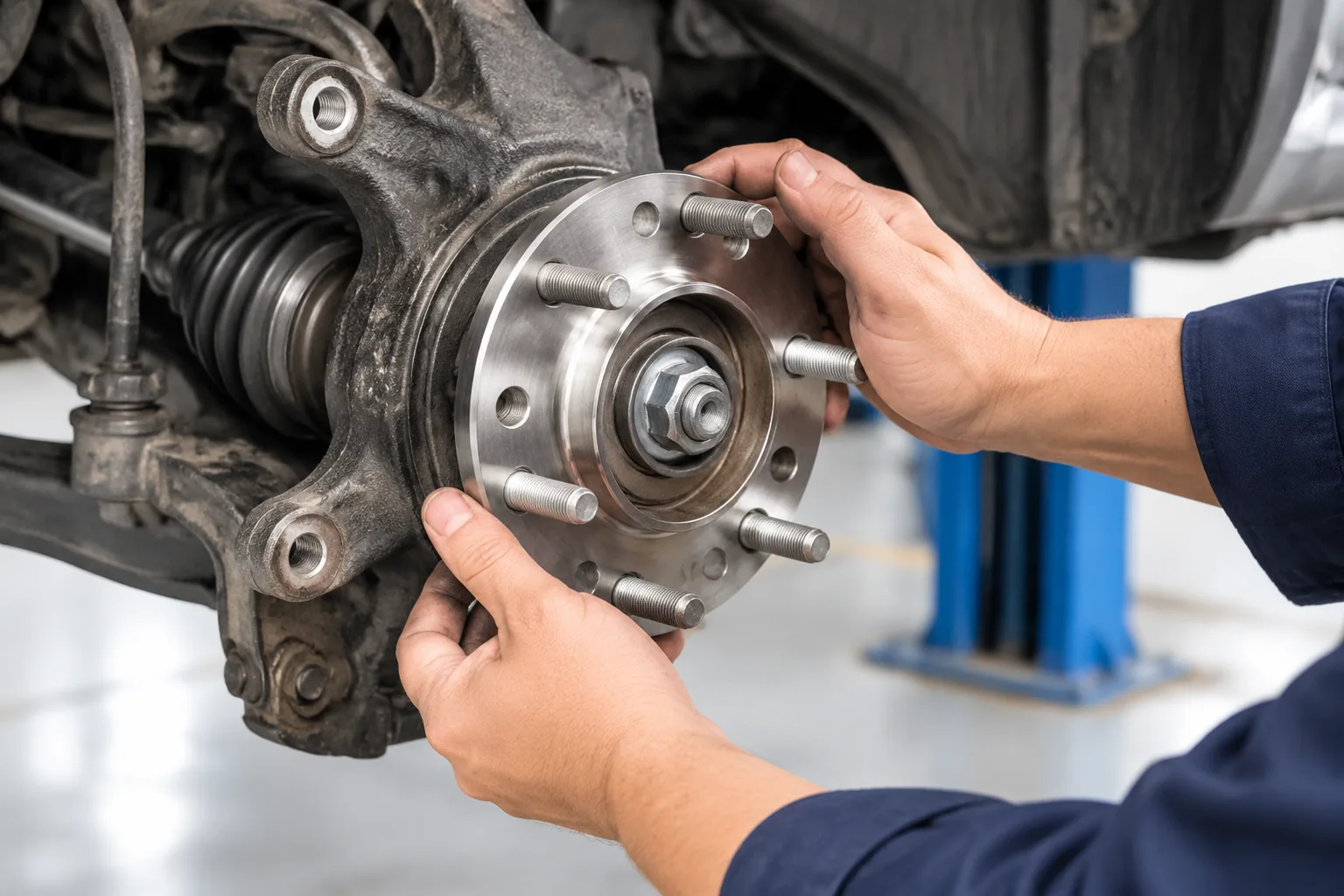
Roughness, looseness, or bearing noise during hand rotation indicates bearing damage and a need for replacement. Brake component removal must follow the vehicle maker’s safety and tightening procedure.
Dial Indicator Measurement
For a measured check, follow the procedure that applies to the wheel end. In the Timken medium-vehicle procedure, clean the mounting face of burrs, nicks, and debris before measurement, then mount a dial indicator with a magnetic base to measure total hub displacement.
Push and pull the hub about 90 degrees in each direction at least five times so the bearing seats fully before reading the indicator. Under that procedure, total indicator displacement over 0.004 in (0.1016 mm) requires replacement of the hub bearing assembly.
That value applies only to the products covered by that procedure. It is not a universal limit for every vehicle or wheel-end design.
OEM Play and Runout Limits: Why One Number Does Not Fit All
Bearing play limits and measurement methods differ by manufacturer, vehicle, and wheel-end design. A specification written for one hub, axle, or service procedure cannot be averaged with another or treated as a general tolerance.
The table below keeps each published value attached to its model, measurement method, and required action.
| Source and scope | Measurement | Published limit | Required action |
|---|---|---|---|
| Subaru service bulletin 06-92-24R; 2019-2024 Subaru Ascent front wheel hub bearings; issued July 31, 2024, revised March 17, 2025 | Dial indicator, front hub bearing axial play | 0.05 mm (0.002 in) | Replace the front hub bearing if the limit is exceeded |
| Tesla Model 3 service information | Hand-loaded angular free play; no pry bar or other tool | 1 degree total, plus or minus 0.5 degree | No more than the stated angular free play is allowed |
| New Flyer service manual bulletin SMB-149 | Total hub displacement | 0.010 in (0.25 mm) | Replace the entire hub assembly; integrated unit has no separately serviceable internal parts |
| BMW service bulletin SI B34 01 14, February 2019 version; vehicles with standard non-drilled, non-ceramic brake discs | Wheel-bearing hub runout | 0.025 mm | Replace the wheel bearing if runout is over the limit |
| BMW SI B34 01 14 diagnostic points | Brake-disc runout and disc thickness variation | 0.070 mm runout; 0.030 mm thickness variation | Use as diagnostic points in the brake-vibration process |
| Timken medium-vehicle procedure | Total hub displacement with magnetic-base dial indicator | Over 0.004 in (0.1016 mm) | Replace the hub bearing assembly under that procedure |
In the BMW process, wheel-bearing hub runout over 0.025 mm requires wheel bearing replacement. BMW explains that brake-disc lateral runout can cause light pad contact once per revolution. Over time, that contact can form thin spots and uneven wear that appear as brake-pedal pulsation. The 0.070 mm disc runout and 0.030 mm thickness variation values are diagnostic points in that process, not bearing-play limits.
These values are examples of OEM-specific limits. Do not average them, convert them into a single general tolerance, or apply them to a different vehicle. Use the procedure and specification for the wheel end being serviced.
Can an ABS Fault Come From the Hub?
An integrated hub can carry a magnetic encoder ring on the bearing back. The wheel-speed sensor reads that ring and produces a pulse frequency proportional to wheel speed, which is sent to the ABS or vehicle dynamics module.
An ABS warning light does not necessarily mean the wheel bearing is mechanically damaged. Possible faults include the wheel-speed sensor, sensor air gap, wiring connection, magnetic encoder ring, and metal particles or other contamination.
In a MOOG example for 2005-2014 Subaru Legacy and Outback, rust on the steering knuckle or backing plate can prevent the hub from seating fully. That increases the sensor-to-encoder air gap enough to trigger a fault code.
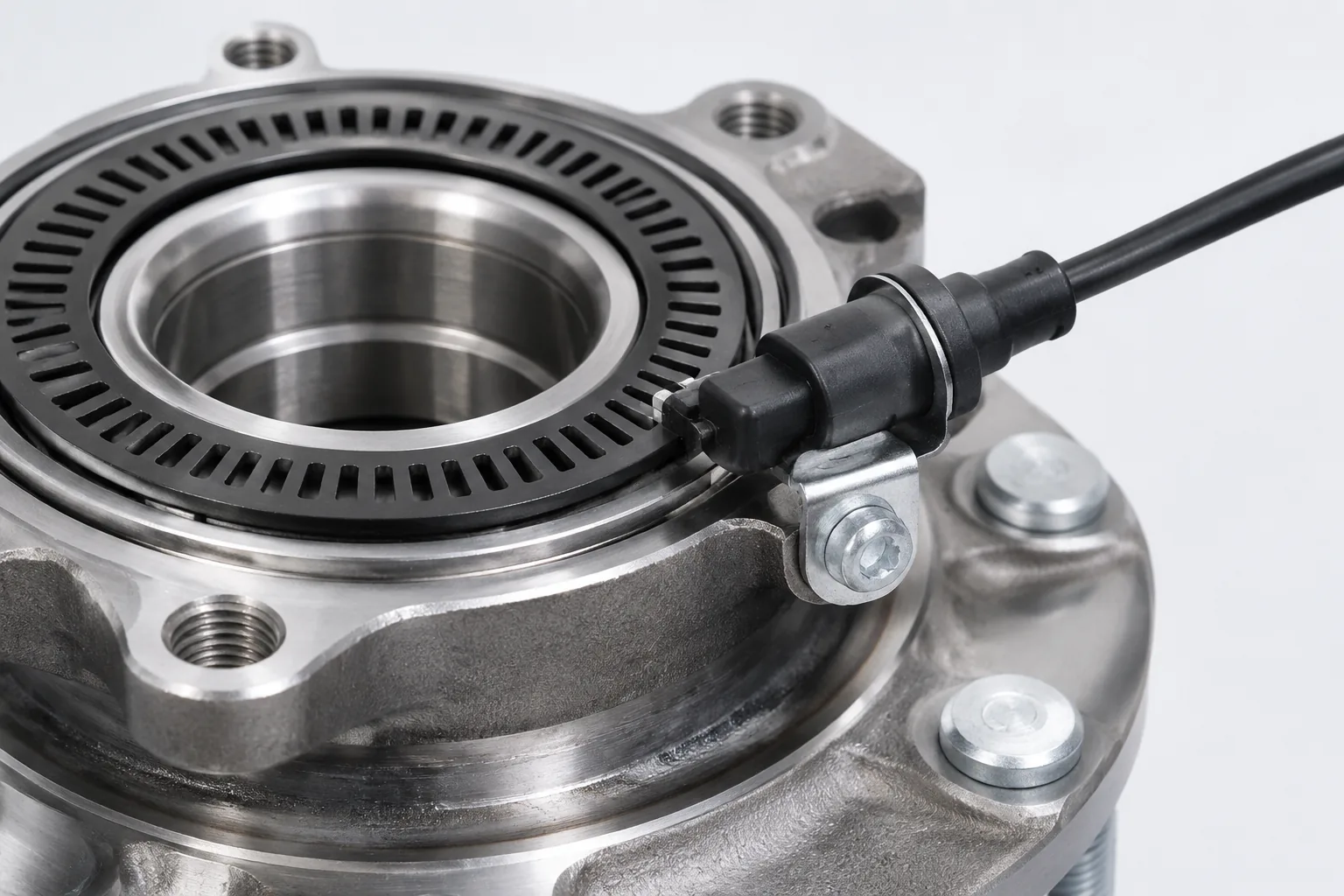
Iron filings, dirt, grease, and rust debris on the magnetic encoder ring or sensor tip can disturb the magnetic field and make wheel-speed pulses irregular or absent. Check sensor condition, air gap, hub seating, contamination, wiring, and codes before condemning the bearing.
ABS diagnosis must follow the vehicle maker’s scan-tool and sensor-gap procedure. A wheel-speed code does not prove bearing mechanical failure, and a mechanically noisy bearing may not yet have set an ABS code.
What Installation Errors and Damage Patterns Cause Hub Failure?
Loss of bearing retention is a major cause of wheel hub damage. Incorrect axle-nut torque, failure of the nut locking feature, or the nut backing out can change the bearing internal setting and cause misalignment, vibration, noise, and accelerated wear.
For a split hub and bearing design, inspect the hub journal outside diameter for grooves or heat discoloration that suggest the inner ring has rotated on the hub. If this damage is present, replace the hub rather than only the bearing.
Integrated hub and bearing assemblies should not be disassembled and reassembled. Incorrect reassembly can cause wheel-end failure.
ISO 15243:2017 classifies rolling-bearing damage and failure modes by visible characteristics and possible root causes. The standard is the second edition, published in March 2017, and was reaffirmed in 2022. When visible damage features cannot reliably identify the root cause, ISO 15243:2017 calls for further investigation such as sectioning, metallographic or electron microscopy, chemical analysis, and spectral analysis.
Separate installation-related play from bearing race damage. If the axle nut or hub journal is the real fault, replacing the bearing alone will not correct the wheel end.
How Are Commercial Vehicle Wheel Ends Diagnosed?
Commercial adjustable wheel ends use bearing end play as the adjustment target, while sealed integrated hubs are generally non-serviceable units. Keep the two designs separate when choosing a specification.
TMC Recommended Practice RP 618B applies to conventional double-nut or single-nut systems on steer, drive, and trailer axles and targets 0.001-0.005 in (0.025-0.127 mm) bearing end play. Timken recommends verifying end play with a dial indicator after bearing adjustment and cites the TMC RP 618 range for adjustable wheel ends.
Check the wheel end for field damage signs:
- Discolored or burnt hub-cap window.
- Low lubricant level.
- Oil leakage on the inner or outer side of the hub or tire.
- Abnormal tire wear.
- Smoke at the wheel end.
- Unusually high hub-cap temperature.
Keep the commercial end-play range separate from passenger-car hub limits. The TMC range does not apply to every sealed passenger hub, and an integrated commercial hub with no serviceable internal parts is replaced as an assembly when outside its specified limit.
When Should a Hub Assembly Be Replaced Rather Than Repaired?
Replace the wheel hub bearing or hub assembly when measured play or runout exceeds the applicable OEM specification, when hand rotation after brake isolation shows roughness or bearing noise, or when the encoder ring or hub journal is damaged.
Distinguish integrated hubs from split hub-and-bearing designs. Integrated units are replaced as assemblies. A split design may allow bearing-only replacement only when the hub journal is serviceable.
A suspect wheel end should not be left with excessive play or continuing bearing noise. Have it inspected and repaired before further use.
Tie the final decision back to wheel hub diagnosis: confirm the fault with a road test, lift check, measurement, ABS check when relevant, and the correct OEM procedure. Do not replace a hub solely because of one symptom when CV joint, tire, brake, suspension, axle-nut, or ABS sensor faults have not been ruled out.
Conclusion
Wheel hub diagnosis follows a practical order: road-test the noise and load behavior, inspect on a lift, isolate the brakes, measure play or runout to the OEM limit, check ABS encoder and sensor conditions, and review installation history. This order matters because bearing noise, CV joint noise, tire vibration, brake pulsation, and ABS faults can overlap.
If play, roughness, noise, or runout exceeds the applicable specification, replace the correct hub or bearing assembly and verify the axle-nut torque and sensor air gap. A wheel end with excessive play or continuing bearing noise should be inspected and repaired before further use.
FAQs
Q1: What does a bad wheel hub bearing sound like?
A: A bad wheel hub bearing commonly produces a continuous hum, rumble, or roar while driving straight that changes with gentle steering or load transfer. Grinding can suggest rolling-element or race damage, while clicking on tight turns can also come from an outer CV joint or incorrect bearing clamp.
Q2: Can a bad wheel bearing cause brake pedal pulsation?
A: Yes, severe bearing play can increase brake-disc runout and contribute to pedal pulsation, pull, or uneven pad and disc wear. Caliper and brake-disc faults are more common causes, so the brake system must also be checked.
Q3: Does an ABS light always mean the wheel bearing is bad?
A: No. An ABS warning can come from the wheel-speed sensor, sensor air gap, wiring, magnetic encoder ring, or contamination. Rust that prevents full hub seating and metal debris on the encoder can trigger codes without mechanical bearing failure.
Q4: How much wheel bearing play is too much?
A: There is no single universal limit; the limit depends on the vehicle and measurement method. Examples include 0.05 mm axial play for 2019-2024 Subaru Ascent front hub bearings, 1 degree total angular free play for Tesla Model 3 hand-loaded checks, and 0.010 in (0.25 mm) total hub displacement for New Flyer SMB-149. Use the OEM procedure and do not apply one value to another vehicle.
Q5: Can a loose axle nut cause wheel hub play?
A: Yes. Loss of bearing retention from incorrect axle-nut torque, a failed locking feature, or nut backing out can change the bearing setting and produce play, noise, or vibration. Check the axle nut and hub journal before assuming internal bearing damage.
Q6: Are integrated wheel hub assemblies serviceable?
A: Integrated hub and bearing assemblies are generally non-serviceable and should not be disassembled and reassembled. Replace the assembly when it exceeds the applicable specification or shows internal damage.
Q7: How do you check a wheel bearing on a lift?
A: Rock the wheel at the 3 o’clock and 9 o’clock positions, then at 12 o’clock and 6 o’clock, and rotate it through a full turn while feeling for roughness or play. Remove the caliper bracket and disc when the procedure allows to isolate brake drag, then use a dial indicator when the OEM procedure requires a measured limit.
Q8: Is clicking on turns always a wheel bearing?
A: No. Clicking, popping, or snapping on tight turns can come from excessive bearing end play caused by insufficient clamp or from a worn outer CV joint. Use the lift check, measurement, and CV-joint inspection before replacing the hub bearing.