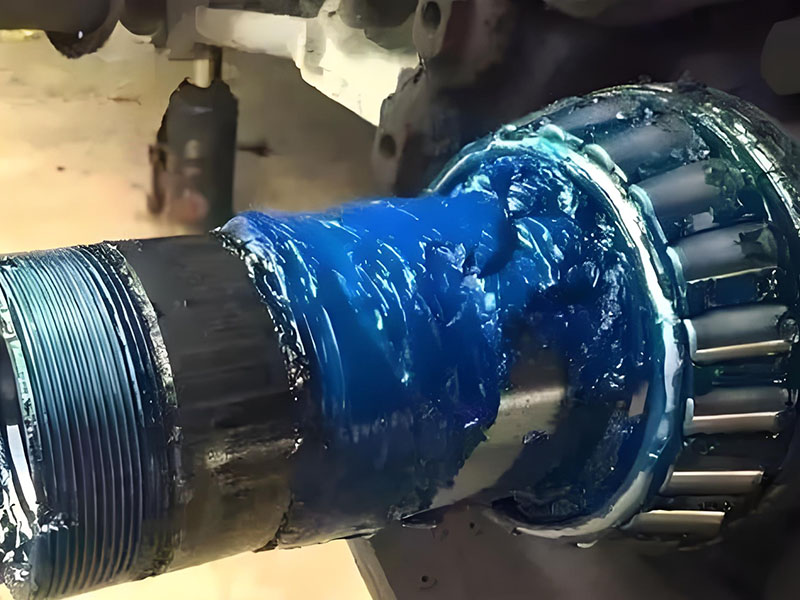
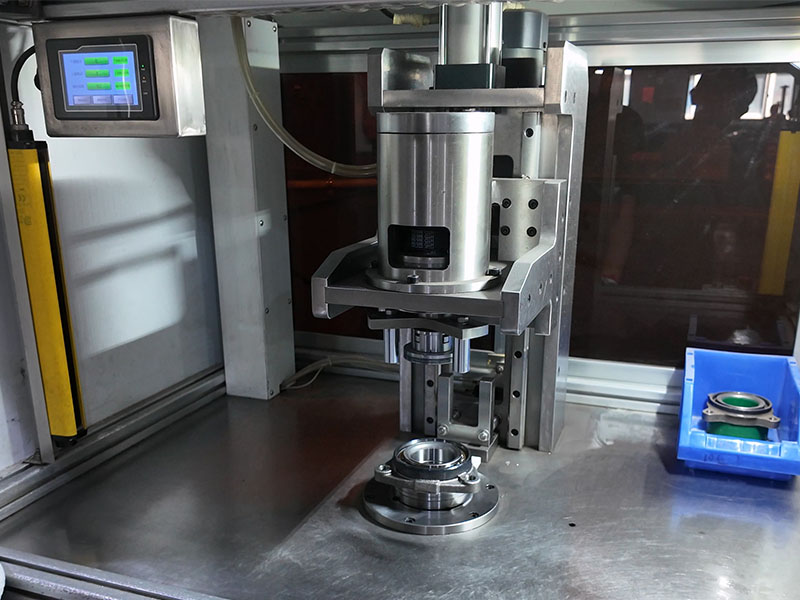
You have just replaced a worn or noisy wheel hub assembly on your car. After reassembling the wheel, lowering the vehicle, and starting the engine, the amber ABS warning light remains illuminated on your dashboard. Why does this happen? The anti-lock braking system (ABS) monitors wheel speed through sensors mounted near each wheel hub. When you replace a hub, you disturb the wheel speed sensor, its wiring, and the encoder ring (tone ring) inside the hub. Any misalignment, damage, or contamination will trigger an ABS fault code and turn on the warning light. DUHUI lists seven proven causes and their fixes, helping you diagnose the problem without unnecessary part replacement.
ABS Sensor Not Fully Seated
The wheel speed sensor slides into a mounting bore on the steering knuckle or hub assembly. Its tip must be positioned at a precise distance from the encoder ring — typically 0.3 to 1.5 mm depending on the vehicle. If the sensor is not fully seated, the air gap increases beyond tolerance. The magnetic field weakens, and the ABS module receives an intermittent or missing signal. This often happens when dirt, rust, or a damaged O-ring prevents the sensor from clicking into its final position.
Fix:
- Remove the wheel and the sensor mounting bolt.
- Pull the sensor straight out. Clean the bore with a round brush or compressed air. Remove any rust or debris.
- Inspect the sensor O-ring. If cracked or swollen, replace the sensor.
- Apply a thin film of dielectric grease to the O-ring. Push the sensor firmly until it bottoms out and the mounting hole aligns.
- Reinstall the bolt and torque to manufacturer specification (usually 8-12 Nm).
Damaged or Pinched Wheel Speed Sensor Wire
The wheel speed sensor wire runs from the hub to the engine bay or chassis harness. During hub replacement, the wire can be stretched, pinched between suspension arms, or cut by a spinning axle shaft or brake shield. Even a small cut in the insulation allows moisture ingress, causing corrosion and intermittent shorts. A fully severed wire will create an open circuit, storing a diagnostic trouble code (DTC) such as C0035 (right front wheel speed sensor circuit).
Fix:
- Visually trace the entire sensor wire from the connector to the sensor body.
- Look for cuts, exposed copper strands, crushed sections, or heat damage.
- If damage is minor (insulation only), wrap with high-quality electrical tape and secure the wire away from moving parts.
- If copper wires are exposed or the cable is crushed, replace the sensor or the repair pigtail. Do not use butt connectors on ABS wires unless they are sealed and crimped with proper tools — resistance changes can affect the signal.
Wrong Wheel Hub for the Vehicle
Not every wheel hub includes an ABS encoder ring. Some economy aftermarket hubs omit the magnetic ring entirely. Others may have an encoder ring with a different number of magnetic poles than the original vehicle specification. For example, an original hub might have 48 poles, while an incorrect replacement has 44 poles. The ABS module expects a specific frequency per wheel revolution. A mismatch causes the module to see an implausible speed reading and set a fault code like C003A (wheel speed sensor signal amplitude/performance).
Fix:
- Compare the removed hub with the new one. Look for the encoder ring — a grey or black magnetic strip embedded in the inner race or a separate metal ring with teeth.
- Verify the part number against the original equipment (OE) number. Do not rely solely on vehicle fitment listings.
- Purchase hubs from manufacturers that specify ABS compatibility and encoder ring pole count. DUHUI Bearing provides exact OE match for encoder configuration.
Contaminated or Dirty ABS Sensor Tip
The tip of a wheel speed sensor is magnetic. It attracts metallic particles — brake dust, iron filings from worn bearings, or steel shavings from previous hub failure. These particles bridge the sensor tip and reduce its ability to detect the encoder ring’s magnetic field changes. The result is a low or erratic signal. Contamination is especially common after replacing a hub that had a failed bearing, as metal debris may have spread inside the knuckle.
Fix:
- Remove the sensor from the hub.
- Wipe the sensor tip with a clean, lint-free cloth. Do not use brake cleaner or carburetor cleaner — these solvents can melt the plastic sensor housing or damage the internal coil.
- If metallic particles are stuck firmly, use a plastic pick to scrape them gently. Do not use a metal tool that could scratch the tip.
- If contamination persists or the sensor tip is cracked, replace the sensor.
Loose Wheel Bearing After Installation
The wheel hub assembly is clamped to the steering knuckle by an axle nut (for bolt-on hubs) or by a spindle nut (for press-in bearings). If the axle nut is under-torqued, the hub has excessive end play — typically more than 0.05 mm. This movement changes the distance between the sensor tip and the encoder ring as the wheel rotates. The ABS module sees a fluctuating air gap and interprets it as a wheel speed signal dropout. Loose hub mounting bolts (the three or four bolts on the back of the knuckle) can also allow the entire hub to shift slightly.
Fix:
- Lift the vehicle and try to rock the wheel at 12 and 6 o’clock positions. Play indicates a loose bearing or hub.
- Retorque the axle nut to the factory specification using a calibrated torque wrench. Common torque values range from 150 Nm (110 lb-ft) for small cars to 250 Nm (185 lb-ft) for trucks.
- Check the three or four hub mounting bolts. Torque them to 65-90 Nm depending on the vehicle.
- If the hub was a press-fit type, ensure it was pressed fully into the knuckle. An incomplete press will leave axial play.
Faulty Tone Ring or Encoder Ring on the New Hub
The encoder ring (tone ring) is a precision magnetic pattern embedded into the hub bearing’s inner race. It can be damaged during manufacturing, shipping, or improper installation. Common defects include missing magnetic poles, cracks from pressing the hub incorrectly, or demagnetization due to a strong external magnetic field. A defective encoder ring produces a wheel speed signal that drops to zero at certain rotation angles or jumps erratically. Unlike a sensor failure, an encoder ring failure will usually show a pattern — the speed reading will be normal for part of the wheel revolution and then disappear.
Fix:
- The only reliable solution is to replace the hub with a new unit from a quality manufacturer. Cheap unbranded hubs often have poorly magnetized or misaligned encoder rings.
- Before replacement, use a diagnostic scan tool with live data. Spin the wheel by hand while monitoring the wheel speed sensor reading for that corner. If the reading drops to zero every full rotation, the encoder ring has a dead spot.
- When installing the new hub, never hammer directly on the encoder ring area. Press or bolt the hub using proper tools.
ABS Electrical Connector Left Unplugged or Loose
During wheel hub replacement, most technicians disconnect the ABS sensor electrical connector to free the hub or to allow suspension movement. It is easy to forget to reconnect the plug, especially when working under time pressure. A partially connected plug may pass a visual inspection but fail electrically. Vibration from driving can also cause a loose connector to separate after a few miles, suddenly turning on the ABS light. Corrosion on the terminals is another common issue, particularly in regions where roads are salted in winter.
Fix:
- Locate the ABS sensor connector near the wheel well. It is usually a 2-pin (passive sensor) or 3-pin (active sensor) sealed connector.
- Unplug it, inspect the terminals for green corrosion or bent pins. Clean corrosion with electrical contact cleaner and a small brush.
- Push the connector together firmly until you feel or hear a click. Many connectors have a locking tab that must snap into place.
- Secure the connector to its bracket or clip to prevent movement. Use a zip tie if the original clip is broken.
Frequently Asked Questions
1. Will the ABS light turn off by itself after fixing the problem?
In most vehicles, the ABS light does not reset immediately. The system performs a self-test each time you start the engine and drive above a threshold speed (usually 10-20 mph). Once the ABS module receives valid, consistent signals from all four wheel speed sensors for a full drive cycle, the light will turn off. If the light remains on after driving for one mile, use an OBD2 scanner to clear the fault codes manually.
2. Do I need to clear ABS codes with a scanner after a wheel hub replacement?
Not always, but it is recommended. Some vehicles store a permanent fault code even after the problem is fixed. The light may stay on until a scanner sends a clear command. A basic OBD2 scanner that reads ABS codes costs $30-50 and pays for itself quickly.
3. How can I tell if the encoder ring or the sensor is bad without a scanner?
Swap the suspect sensor with the sensor from the opposite wheel (if identical). If the problem moves to the other wheel, the sensor is bad. If the problem stays on the same wheel, the encoder ring or hub is likely defective. This test works only on vehicles where left and right sensors are identical.
4. Can a new wheel hub cause ABS activation without a warning light?
Yes. A defective encoder ring can produce a signal that drops out intermittently. The ABS module may not set a code immediately but will activate the ABS pump unnecessarily when braking on clean pavement. You may feel a pulsing brake pedal without wheel lockup. This is a sign to inspect the hub and encoder ring.
5. What diagnostic trouble codes are most common after a hub replacement?
C0035, C0040, C0045, C0050 (left/right front/rear wheel speed sensor circuit). C003A (wheel speed sensor signal amplitude/performance). P0500 (vehicle speed sensor — often triggered by a missing signal from one wheel).
6. Does replacing a wheel hub require a professional alignment or calibration?
Most vehicles with passive (2-wire) ABS sensors do not require any calibration. However, some modern vehicles with active (3-wire) sensors and integrated wheel speed sensors into the stability control system may need a zero-point calibration using a scan tool. Check your vehicle service manual. Replacing a hub does not affect toe, camber, or caster, so a wheel alignment is not necessary unless suspension components were loosened.
7. How long should I wait before assuming the ABS light will not go off?
Drive the vehicle for 5-10 minutes, including stops and turns, reaching at least 30 mph. If the light remains on after that, a fault is still present. Do not ignore the light — the ABS will be disabled, but your base brakes will still work normally.
8. Can a wheel speed sensor be tested with a multimeter?
Yes. For a passive (2-wire) sensor, set the multimeter to AC voltage. Spin the wheel by hand. A good sensor produces 0.1 to 1.0 volts AC depending on speed. For an active (3-wire) sensor, measure the signal wire with a scope or a multimeter that reads frequency. Most DIYers are better off using a scan tool with live data.
9. Is it safe to drive with the ABS light on after a hub replacement?
Yes, it is safe in terms of normal braking. The base hydraulic braking system remains fully functional. However, the ABS will not engage during emergency braking or on slippery surfaces. You may experience wheel lockup. Get the issue diagnosed promptly, especially if you drive in rain, snow, or ice conditions.
Conclusion
An illuminated ABS light after a wheel hub replacement is a common but solvable problem. The seven causes covered in this article — unseated sensor, damaged wire, wrong hub, contaminated tip, loose bearing, faulty encoder ring, and disconnected connector — account for over 95% of post-replacement ABS faults. Begin your diagnosis with the simplest checks: visually inspect the connector, clean the sensor tip, and verify the axle nut torque. Use a diagnostic scanner to read the exact fault code. Do not assume the new hub is defective without testing; many “faulty hub” returns are actually installation errors. By following the fixes outlined above, you can resolve the ABS light without unnecessary parts replacement. For reliable wheel hubs that meet original ABS specifications, DUHUI Bearing manufactures each unit with precision encoder rings and 100% signal testing before shipment.