Quick Answer: Knuckle bore distortion is a loss of roundness, size, or alignment in a steering-knuckle bore. Impact, incorrect bearing pressing, fastener clamp load, heat or hammer damage, and higher EV joint loads can all contribute to bore distortion. An out-of-round bearing bore can stop the bearing from seating correctly and cause repeat wheel-bearing failure. The vehicle manufacturer’s service manual sets the governing limit; measurement decides whether the knuckle is replaced.
Knuckle bore distortion is often discussed as if it were one problem. In practice, the term covers two separate service situations: the wheel-bearing bore that carries the hub bearing outer ring, and the ball-joint bore or pinch-bolt ear that locates the ball-joint stud. They share a name, but they fail differently and lead to different repair decisions.
For a bearing bore, the practical question is whether the bore still holds the outer ring with the correct fit, roundness, and alignment. For a ball-joint bore, the question is whether the taper and clamping ear still lock the stud and allow normal steering travel. In both cases, the decision is measure, compare with the vehicle manufacturer’s limit, then repair or replace.
What Knuckle Bore Distortion Means
Knuckle bore distortion is out-of-roundness, oversize, deflection, or local deformation of a bore in the steering knuckle used to locate a hub bearing, ball joint, or bushing.
The same term covers two failure modes that should not be mixed:
- Wheel-bearing bore or bearing seat: the bore into which the bearing outer ring or hub assembly is pressed. Distortion here affects bearing fit, internal clearance, heat, drag, and repeat bearing failure.
- Ball-joint bore: the tapered hole or the pinch-bolt ear bore that clamps the ball-joint stud. Distortion here affects stud locking, steering bind, and pinch-ear or bolt damage.
They share a name but not a failure mode or a repair decision. A distorted bore is also not the same as normal wear or a worn bearing. Wear removes material gradually; distortion changes shape, size, or alignment, and it may be present even when the bearing itself looks serviceable.
Roundness has a defined vocabulary. ISO 12181-1:2011, Geometrical product specifications (GPS) – Roundness – Part 1: Vocabulary and parameters of roundness, was developed by ISO/TC 213, first published in April 2011, and confirmed in 2021. The companion standard ISO 12181-2:2011 defines specification operators for roundness of integral features, meaning a complete roundness profile. Those definitions matter because a single diameter reading does not describe out-of-roundness.
What Causes Knuckle Bore Distortion
Knuckle bore distortion is usually the result of a mechanical event or an assembly load, not a single wear process. More than one cause can be present on the same knuckle, so inspection should test the bore rather than assume one origin.
Impact Damage and Curb Strikes
Technical material MI-20-011-03-01-E (2020) identifies curb strikes, severe impact from an accident, and incorrect pressing of the bearing as events that can push a steering-knuckle bore outside specification. A road hazard or collision is therefore a check-worthy event, not proof that the knuckle is distorted. Impact creates suspicion; measurement decides.
Bearing Pressing and Installation Errors
Pressing a wheel bearing in without proper support, or loading the wrong component during installation, can deform the bore or the bearing outer-ring seat. The same technical material lists incorrect pressing alongside impact as a cause of the bore going out of specification. The practical control is correct support and correct pressing force direction. No specific press force is given here because the correct value is application-specific and belongs to the vehicle manufacturer’s procedure.
Clamp Load From Hub Bearing Fasteners
Clamp load is a separate mechanism from impact. When a hub bearing is fastened to the steering knuckle, the fastener clamp load deforms the bearing outer ring. SAE paper 2017-01-2521, The Effect of Outer Ring Distortion on Wheel Bearing Friction Torque, published 17 September 2017 by GM LLC, describes this effect and links the resulting outer-ring distortion to seal performance and friction torque.
The knuckle bore and the joint geometry control how that clamp load is distributed into the outer ring. This mechanism occurs at normal assembly torque, not only after a road event, which is why a knuckle can be distorted without any visible impact damage.
Heat, Hammering, and Ball Joint Service Damage
Technical bulletin TSB-20-018-01-01-E, whose scope is specific rear-wheel-drive Ford E-Series and F-Series applications, states that using heat, hammering, or blunt force during disassembly and assembly can warp or deform the knuckle bore or the spindle ears. When deformation, out-of-roundness, or tapered-seat damage is found, the knuckle is replaced.
After ball-joint work, check three things: bore roundness, taper condition, and ear condition. These checks belong together because a deformed ear can change clamp load on the taper even when the bore diameter itself looks acceptable.
Higher EV Loads and Clamp Force
SAE paper 2025-01-0367, Design Considerations for Wheel Bearing Outer Ring for Electric Vehicles, published 15 September 2025 by GM LLC, ILJIN USA Corp., and ILJIN Global, examines the bearing-to-knuckle joint for electric vehicles. Higher EV mass and torque raise loads at that joint, and higher clamp force can reduce outer-ring roundness, permanently increase drag, and shorten bearing life. The paper compares M12 and M14 mounting bolts, joint assembly stiffness, knuckle bolt pitch circle diameter (PCD), and outer-ring flange thickness. These are design levers, not a claim that every EV knuckle distorts. The added load is a reason to question design margin, not a diagnosis by itself.
How a Distorted Bore Affects the Wheel Bearing
The damage chain starts at the interface. When an outer ring is installed with an interference fit in a housing, out-of-roundness in the housing transfers to the bearing raceway and affects running accuracy. The bearing can be round on the bench and still run out of shape once it is pressed into a distorted bore.
Failure diagnosis guidance describes the next step in the chain: an out-of-round or distorted housing reduces internal clearance, raises preload and operating temperature, and can produce two load zones about 180 degrees apart on the outer ring. The bearing is then running in a condition it was not designed to tolerate.
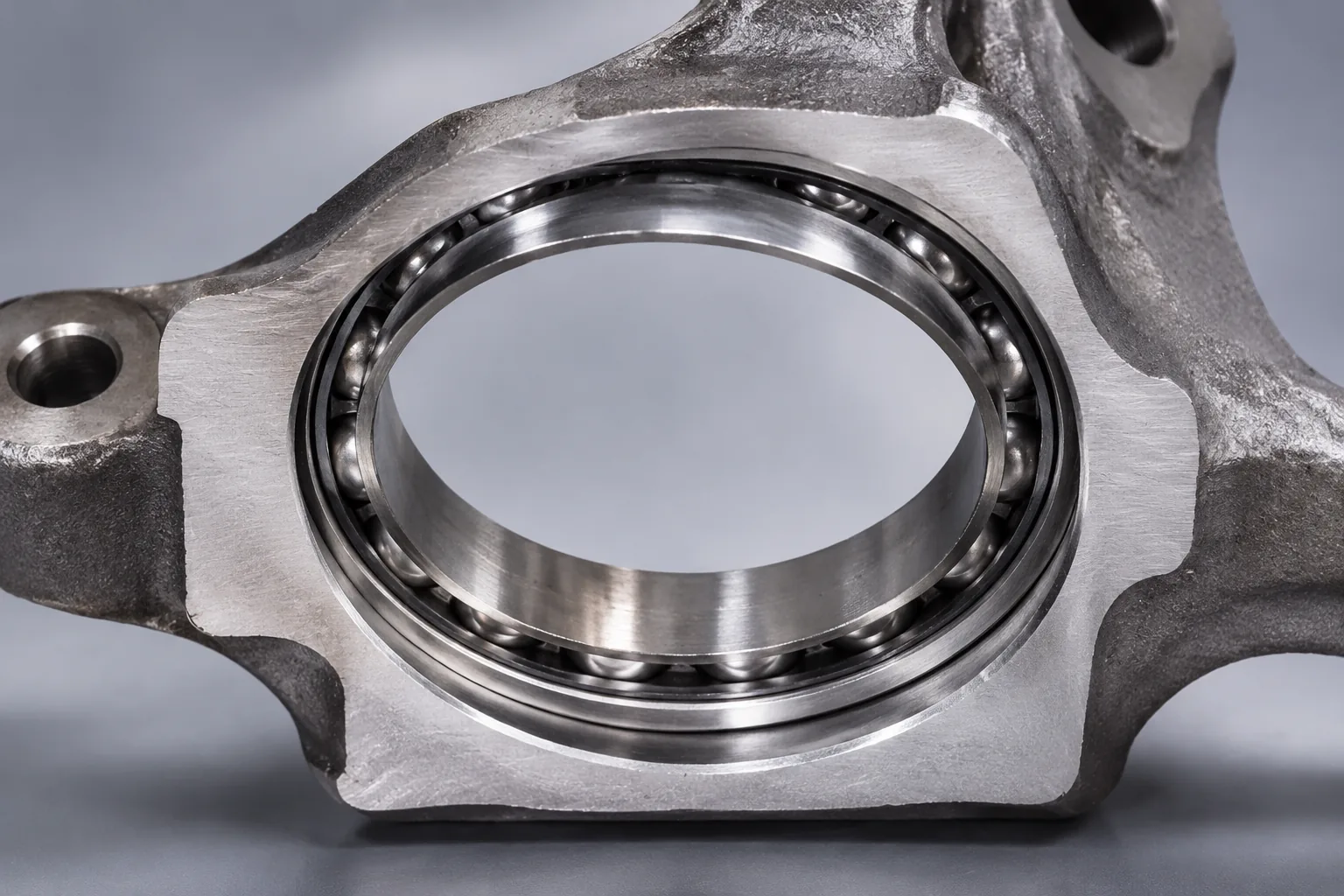
Service guidance links an out-of-round bearing bore to a hub or bearing that will not seat correctly and to multiple repeat wheel-bearing failures. That is why a bearing replaced on a distorted knuckle can fail again: the new bearing is being installed into the same out-of-shape seat. The fault is not necessarily the replacement bearing.
These are general bearing engineering principles, not vehicle-specific limits. The amount of distortion that matters, and the fit and clearance values that apply, remain application-specific.
Symptoms and Failure Patterns
The two distortion families call for different diagnostic paths. The table below compares the bearing bore with the ball-joint and pinch-bolt bore.
| Bore family | Typical indicators | What to check |
|---|---|---|
| Wheel-bearing bore | Repeat wheel-bearing failure on the same corner; a hub or bearing that will not seat correctly; heat, preload, and drag effects | Bore roundness, diameter, taper, and seating marks; compare with the OEM limit |
| Ball-joint or pinch-bolt bore | Memory steer (poor steering-wheel return, a tight or sticky center, greater effort to turn the knuckle); pinch-bolt damage | Taper condition, ear condition, stud locking, and steering travel |
Bearing-bore indicators include repeat wheel bearing failure on the same corner, a hub or bearing that will not seat correctly, and the heat, preload, and drag effects described above. A repeat failure on one corner is more informative than a single failure with no pattern.
Ball-joint and pinch-bolt indicators come from technical bulletin TSB-20-018-01-01-E: memory steer, meaning poor steering-wheel return, a tight or sticky center position, and greater effort to turn the knuckle. The bulletin links these to a binding ball joint, reduced travel, and incorrect installation. Installation document K500169 also warns that knuckle distortion can lead to pinch-bolt breakage.
Memory steer belongs to the ball-joint and pinch-bolt context, not the wheel-bearing bore. Other causes of repeat bearing failure and steering bind also exist, so inspection is required before condemning the knuckle. A symptom points to inspection; it does not by itself prove distortion.
How to Measure and Inspect Knuckle Bore Distortion
Set the inspection order: clean, inspect visually, measure with the correct instrument, then compare with the vehicle manufacturer’s limit. Skipping the first step can turn grease or rust into a false diameter reading.
Cleaning and Visual Inspection
Remove grease, dirt, and rust before inspection. Then inspect for cracks, grooves, and gouges as part of the same check. A crack or deep groove changes the decision even if the measured diameter is close to nominal.
Measuring With a Tubular Inside Micrometer or Tapered Bore Gauge
Use a tubular inside micrometer for the bearing bore and a tapered bore gauge for the tapered ball-joint hole. Take readings at more than one position and direction so out-of-roundness and taper are captured, not just a single diameter. A bore can pass a two-point diameter check and still be out of round.
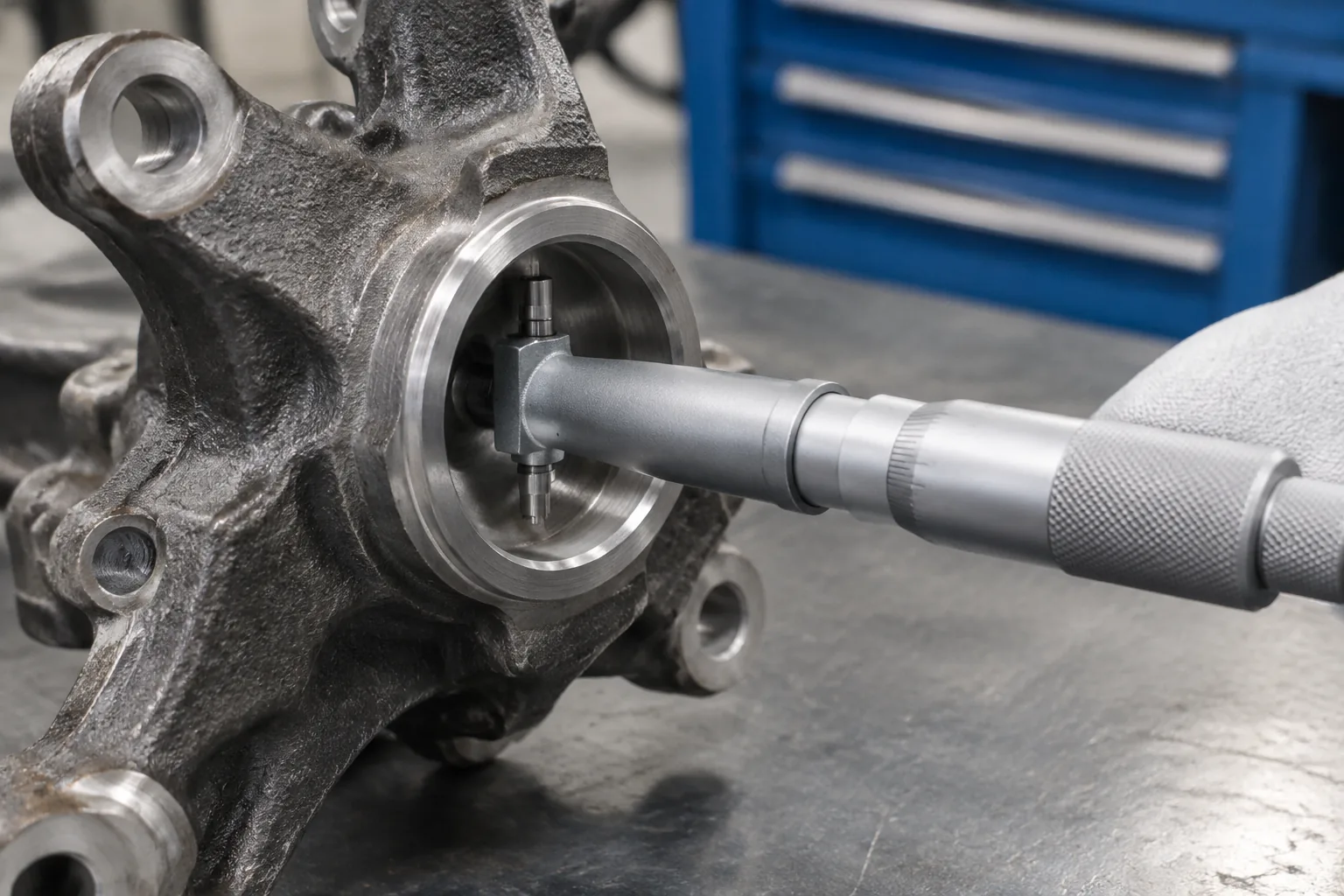
The roundness definition in ISO 12181-1:2011 and the specification operators in ISO 12181-2:2011 provide the vocabulary for that check. For integral features, the relevant question is the complete roundness profile, not one chord or one diameter.
The 0.25 mm (0.010 in) Reference and Its Limits
When no vehicle-specific OEM limit is available, aftermarket service guidance treats a bore deviation of about 0.25 mm (0.010 in) or more, measured with an inside micrometer, as general grounds to replace the knuckle. That figure is aftermarket service guidance, not a universal OEM scrap limit.
The vehicle manufacturer’s service manual governs the final decision. Bore diameter, interference fit, roundness, and replacement conditions are vehicle-specific. Do not apply the 0.25 mm figure to a vehicle that has its own published limit.
Production Measurement Example
Production metrology shows how a bore can be measured in series. A BLUM-Novotest BG60 bore gauge lists a minimum bore of 3 mm, a standard measuring head range of 3-200 mm, 0.15 um resolution, IP68 protection, and 12-bit data resolution. Its published application material shows a steering knuckle bore.
This is an example of production measurement capability, not a requirement for workshop inspection. A workshop can perform the same decision with a suitable inside micrometer and the OEM limit.
Repair or Replace: Decision Rules
For the ball-joint bore, installation document K500169 requires replacing the steering knuckle when the ball-joint tapered hole is found to be out of round. For the bearing bore, service guidance recommends replacing the knuckle when the bore is confirmed out of round, because a distorted bore cannot hold the bearing correctly.
Use this decision sequence:
- Confirm distortion by measurement, not by symptom alone.
- Compare the result with the OEM limit for that vehicle.
- Replace the knuckle rather than refit a bearing into a distorted bore.
The safety stake is practical: continuing to run a distorted joint risks repeat bearing failure and, per document K500169, pinch-bolt breakage. A bore that measures within the OEM limit and shows no cracks, grooves, or taper damage is handled per the OEM procedure, not automatically replaced. Local repair or resizing of the bore is outside the sourced scope and is not recommended here.
Preventing Distortion During Service
Support the knuckle correctly and press the bearing by the proper component so the bore is not loaded in a way that deforms it. Avoid heat, hammering, and blunt force on the knuckle during ball-joint and bearing work. Technical bulletin TSB-20-018-01-01-E identifies those practices as knuckle-distorting service practices.
Use the specified fastener size and tighten to the specified torque so clamp load stays within the joint design. Papers 2017-01-2521 and 2025-01-0367 both show that clamp force at the bearing-to-knuckle joint deforms the outer ring. No universal press force, torque value, or bolt size is given here; follow the OEM procedure for the vehicle.
Recheck bore condition after any impact event or after a bearing that was pressed in incorrectly. Early measurement is more useful than discovering the same fault after a second bearing failure.
Conclusion
Knuckle bore distortion has distinct causes – impact, incorrect pressing, clamp load, heat and hammer damage, and higher EV joint loads – a known damage mechanism through the outer ring, and separate symptom families for the bearing bore and the ball-joint bore. The practical rule set is consistent: measure before condemning, use a tubular inside micrometer or tapered bore gauge, apply the OEM limit first, and use the 0.25 mm (0.010 in) aftermarket reference only when no OEM limit exists.
Replace the knuckle when the bore is out of round. Before ordering a replacement bearing or knuckle, verify the bore and the OEM specification for that vehicle. That step protects the new part and the driver.
FAQs
Q1: What is knuckle bore distortion?
A: It is a loss of roundness, size, or alignment in a bore of the steering knuckle. The term covers the wheel-bearing bore, where the outer ring is seated, and the ball-joint bore or pinch-bolt ear. The first affects bearing fit, clearance, heat, and repeat failure; the second affects stud locking, steering bind, and ear damage.
Q2: How much knuckle bore distortion is too much?
A: Start with the vehicle manufacturer’s limit. When no OEM limit is available, aftermarket service guidance treats a deviation of about 0.25 mm (0.010 in) or more, measured with an inside micrometer, as general grounds to replace the knuckle. That figure is not a universal scrap limit.
Q3: Can a distorted knuckle bore cause repeated wheel bearing failures?
A: Yes. Under interference fit, housing out-of-roundness transfers to the bearing raceway. An out-of-round housing reduces internal clearance, raises preload and operating temperature, and can create two load zones about 180 degrees apart. Service guidance links a distorted bearing bore to repeat wheel-bearing failure because the replacement bearing is seated in the same distorted bore.
Q4: Does knuckle bore distortion cause memory steer?
A: Memory steer is associated with the ball-joint and pinch-bolt bore case, not the wheel-bearing bore. Technical bulletin TSB-20-018-01-01-E describes poor steering-wheel return, a tight center, and greater effort to turn the knuckle on RWD Ford E-Series and F-Series applications. A bearing-bore problem is more likely to show as repeat bearing failure or a hub that will not seat.
Q5: Can a distorted steering knuckle bore be repaired, or must the knuckle be replaced?
A: For a ball-joint tapered hole found out of round, installation document K500169 requires steering-knuckle replacement. For a bearing bore confirmed out of round, service guidance also recommends replacement because the bore cannot hold the bearing correctly. No sourced repair or resizing method is presented here; a bore within the OEM limit and free of cracks, grooves, or taper damage is handled per the OEM procedure.