Quick Answer: A spherical roller bearing is used in heavy rotating equipment that combines high radial loads with axial loads in either direction, shock or vibration, and shaft deflection or mounting misalignment. Typical duties include crushers, vibrating screens, gearboxes, paper machines, steel plant equipment, conveyors, wind turbine main shafts, pumps and fans. It is not a pure thrust bearing; thrust-dominated work calls for a spherical roller thrust bearing.
A spherical roller bearing sits between a shaft and a housing in equipment where load, misalignment and dirt rarely arrive one at a time. The design is often chosen when a cylindrical or deep-groove bearing would be overloaded, when the shaft bends under load, or when the housing cannot be aligned perfectly. This guide explains the duties it fits, the applications where it is common, and the checks that prevent a wrong selection.
Core Uses of a Spherical Roller Bearing
The core use is a bearing position that must carry heavy radial load while also handling axial load in either direction and some misalignment. Common sectors include mining, vibratory equipment, gearboxes, paper machines, steel plants, material handling, wind turbines, pumps, fans, marine propulsion and printing machinery. The bearing is not a pure axial-load product; when thrust dominates, a spherical roller thrust bearing is the correct family.
Suitability still depends on load magnitude and direction, speed, lubrication, clearance, sealing and mounting. A bearing that fits one crusher position may be wrong for a high-speed fan or a lightly loaded pump.
Why Spherical Roller Bearings Fit These Applications
The fit comes from the rolling geometry and the way the bearing distributes load. It is not simply a heavy-duty label; each feature answers a specific operating condition.
Combined Radial and Bidirectional Axial Load Capacity
Two rows of symmetrical or barrel rollers run in a spherical outer raceway and two inner raceways. That arrangement lets the bearing carry heavy radial loads, axial loads in both directions and combined radial-axial loads. Axial capacity is secondary to radial capacity, so the bearing should not be treated as a drop-in replacement for a pure thrust bearing.
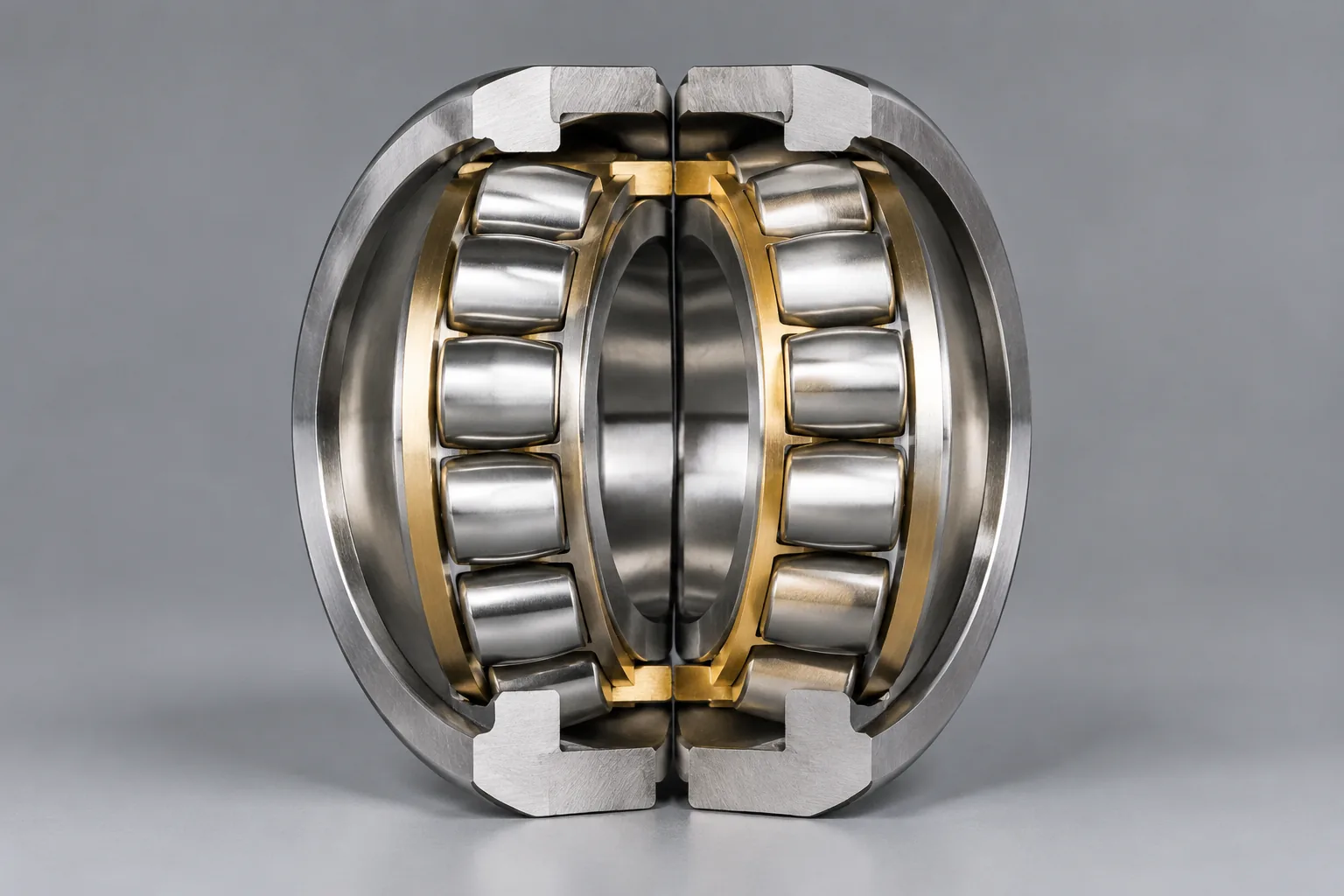
Scale matters. A 23180 CC/W33 example has a 400 mm bore, 650 mm outside diameter and 200 mm width, with a basic dynamic load rating of 4,864 kN. The W33 suffix indicates relubrication features. Those figures apply to that size; they do not transfer to every spherical roller bearing.
Confirm the actual radial and axial ratings from the selected bearing datasheet, especially when axial load is continuous or acts in one direction for long periods.
Misalignment and Shaft Deflection Compensation
The spherical outer raceway allows the inner ring and roller assembly to tilt relative to the outer ring. This compensates angular misalignment caused by housing installation error or shaft bending, which is why the bearing appears in long shafts, paper machines, fans, conveyors and other deflection-prone equipment.
Typical compensation is about 1° to 2.5°, depending on series, size and load. A sealed bearing example can compensate about 0.5° without increased friction or reduced life. Those are examples, not a universal limit.
Use the published limit for the exact part. Misalignment capability does not replace proper shaft and housing alignment; if the angle is excessive, redesign the arrangement or choose a different bearing type.
Shock, Vibration and Contaminated Heavy-Duty Service
Spherical roller bearings are common in equipment with impact loads, high vibration and dirty environments, particularly mining and vibratory machinery. Vibratory applications may need a vibration-specific bearing design and higher radial internal clearance rather than a standard bearing selected only by bore size.
Vibratory-application bearings are typically supplied with C4 radial internal clearance; typical uses include vibrating screens, compactors and road rollers. Sealed spherical roller bearings are also used in harsh continuous-casting environments where contamination and high load capacity occur together.
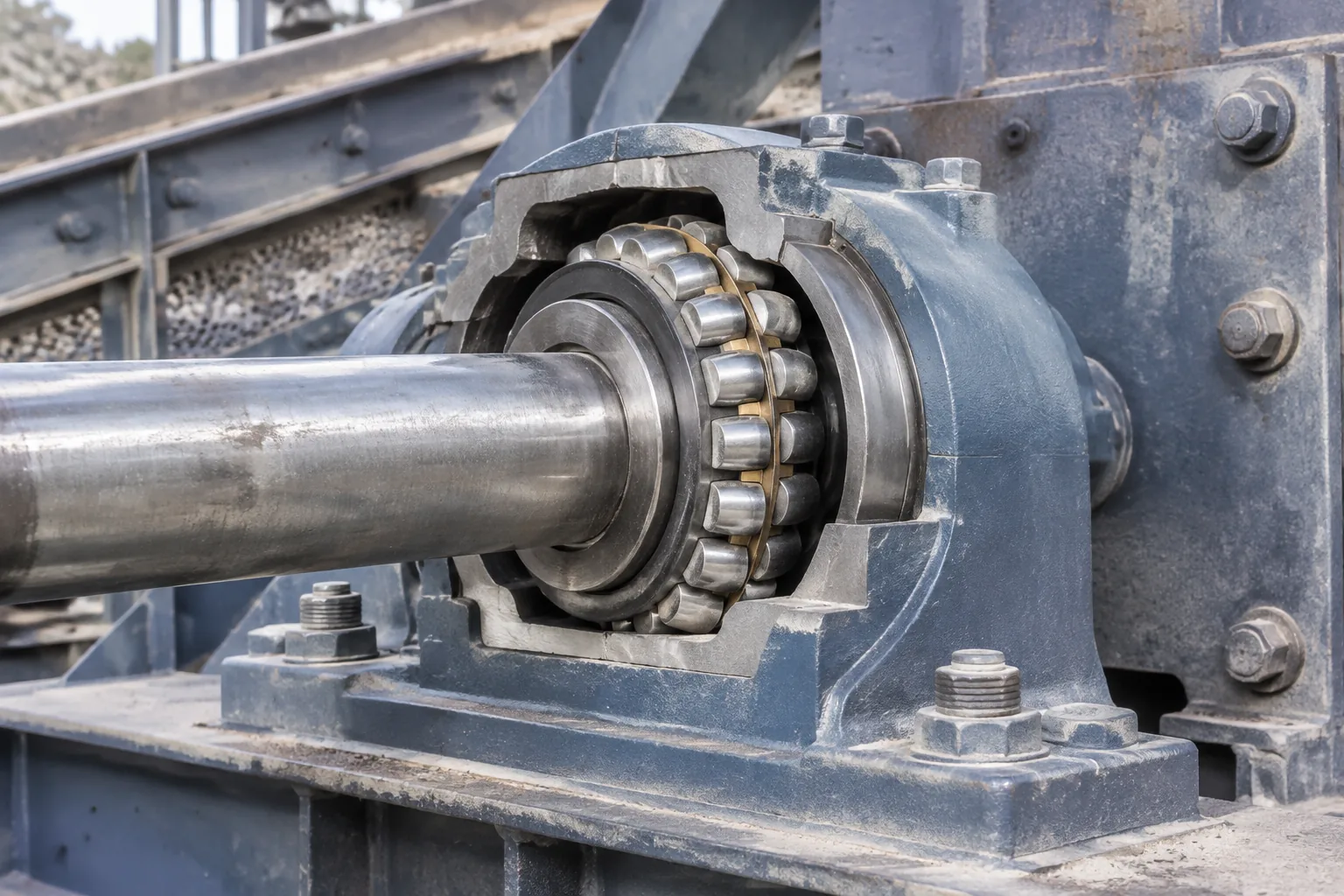
Standard bearings are not automatically vibratory grade. Specify the correct design, clearance and sealing for the duty. If contamination is heavy and sealing or lubrication is inadequate, even a high-load bearing can fail early.
Typical Applications by Industry
The industries below are grouped by the equipment duty and the load pattern that makes a spherical roller bearing a practical choice. The list is not a ranking; the correct bearing still depends on the actual load spectrum, speed, clearance, sealing and mounting.
Mining, Quarrying, Aggregates and Cement
Used in jaw crushers, pulverizing equipment, shaker screens and conveyors. Cement and aggregate equipment includes crushers, extruders, air preheaters and centrifugal separators. The common duty is high radial and impact load, dust, vibration and shaft misalignment. Specify sealing and lubrication for dust and contamination; a bearing that is correctly sized but poorly protected will not reach its expected life.
Vibratory Screens, Compactors and Rollers
Used in vibrating screens, compactors and road rollers. These duties combine heavy loads, shaft deflection, misalignment and high vibration. Vibratory-grade bearings may use a special internal design and C4 clearance. Confirm that the bearing is a vibration-duty design, not merely a standard bearing with high clearance.
Gearboxes, Industrial Drives, Fans and Blowers
Used in gear drives, reducers, large industrial transmission shafts, fans and blowers. Gear mesh and fan shafts create heavy radial loads, axial loads, shock and shaft deflection. These applications often require checks of lubrication, cooling and mounting fit. Confirm the actual load spectrum and speed before selecting series, clearance and cage type.
Paper Machines
Used in paper machine rolls and dryer cylinder bearing positions. Long shaft spans create deflection, while paper machines also impose heavy loads and elevated temperatures. Paper-industry-specific solutions may cover large bearings with an outside diameter of 320 mm and above. High-temperature operation requires checking lubricant, clearance and heat stability.
Steel Production and Continuous Casting
Used in continuous casters, rolling mills, converters and cooling beds. Duty includes heavy loads, high temperature, shock, inadequate lubrication, contamination and axial thrust. Sealed spherical roller bearings are used in continuous casters where a harsh environment and high load capacity are both required. Verify sealing, lubrication and thermal limits for the specific caster or mill position.
Material Handling, Cranes and Lifting Equipment
Used in conveyor pulleys, elevators, overhead cranes, hoist ways and drilling-machine winches. These positions often combine heavy radial loads with misalignment or shaft deflection. Bearing selection should account for shock loading during starting, stopping and lifting.
Wind Turbine Main Shafts
Used in wind turbine main shafts where heavy loads, combined loads and shaft deflection occur. Some bearing makers list main shafts as a common application and offer enhanced designs for that duty. Turbine main-shaft use requires application-specific validation, not a generic bearing swap. Confirm the turbine design, load case and lubrication concept before specifying a bearing.
Pumps and Compressors
Radial spherical roller bearings are used in heavy-duty, usually low-speed centrifugal pumps because of their high radial and axial capacity and misalignment tolerance. In pumps, higher speed may be possible when lubrication and cooling are adequate. Compressor and pump shafts may also impose combined loads and deflection.
Pump guidance for minimum equivalent load gives Pm = 0.01 C0. With oil lubrication and suitable speed conditions, Pm = 0.003 C0 may be used as a lower calculation starting point. Check speed, lubrication, cooling and minimum load; do not generalize one pump experience to all pump types.
Marine Propulsion and Maritime Equipment
Marine propulsion is one application area for spherical roller bearings. Spherical roller thrust bearings are used in water jets, thrusters and azimuth thrusters; that is a different bearing type from the radial spherical roller bearing discussed here. Keep the distinction clear so the wrong product family is not selected.
Printing and Coating Machinery
Used in printing press plate cylinders, blanket cylinders, perforating machines, cutting machines and slitting machines. Some printing-machinery bearings use special suffixes such as VA759 and VA760. These uses combine radial loads, alignment needs and printing-machine precision requirements. Confirm the machine builder’s specification before substituting a standard suffix.
How to Match a Spherical Roller Bearing to the Application
After the application is identified, the selection should move from duty to bearing detail. The following checks prevent a bearing that is strong enough in theory but wrong in service.
Check Load Direction, Load Magnitude and Speed
Confirm whether the dominant load is radial, axial or combined, and whether axial load acts in one or both directions. Check for shock loads, vibration and shaft deflection. Use bearing rating calculations rather than sizing by bore alone. ISO 281:2007 covers dynamic load ratings and rating life calculation for rolling bearings. Use the actual load spectrum and speed profile; a single nominal load may be insufficient.
Check Misalignment and Mounting Method
Estimate angular misalignment from shaft deflection and housing installation error. Confirm the allowable misalignment for the chosen series, size, load and seal design. Tapered-bore bearings can be mounted with adapter or withdrawal sleeves.
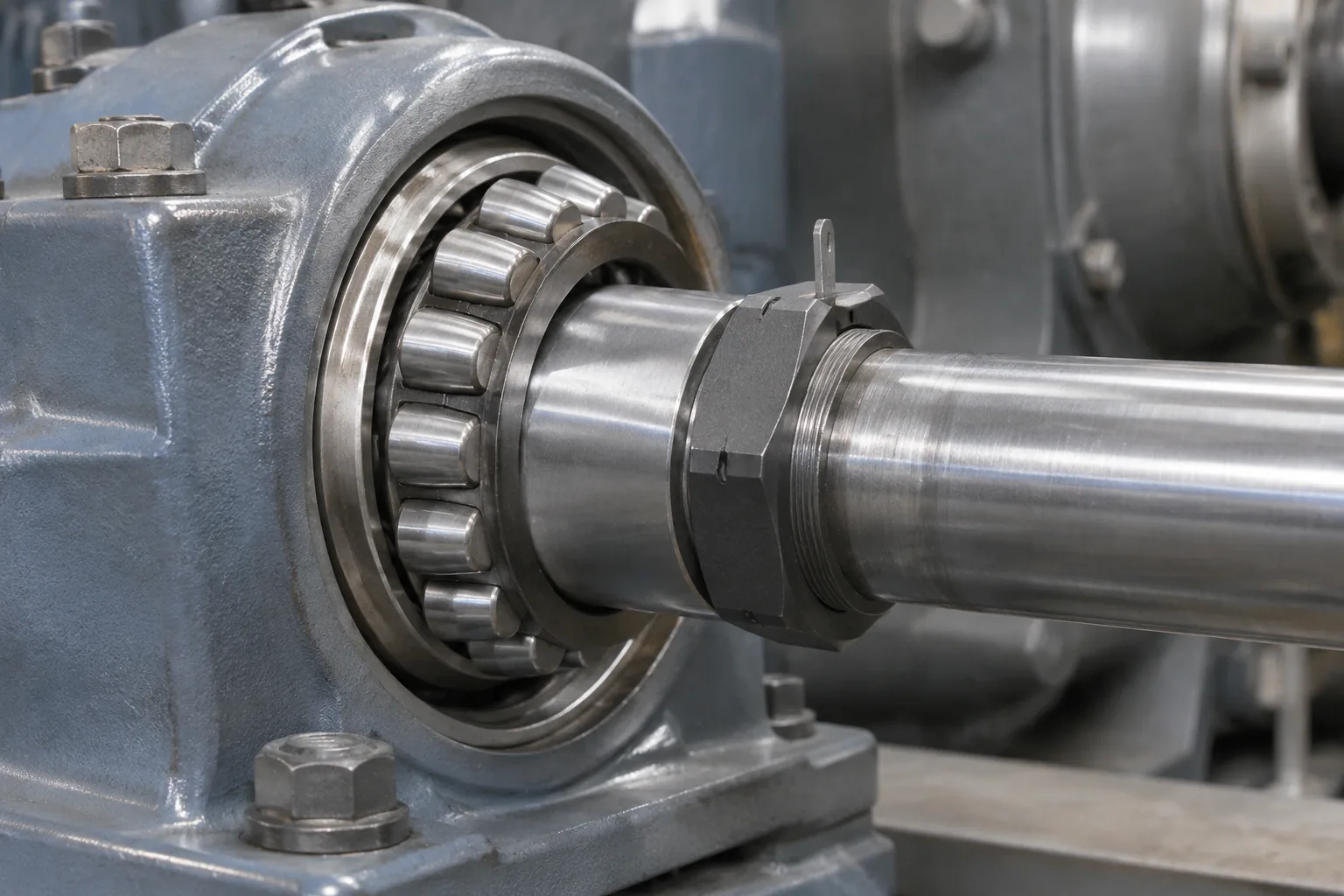
Typical compensation is about 1° to 2.5°, and a sealed example can handle about 0.5°. Standard tapered bores commonly use a 1:12 taper with a K suffix; 240 and 241 series with a K30 suffix use a 1:30 taper. Do not use misalignment capability to excuse poor alignment practice.
Check Clearance, Cage, Sealing and Lubrication
Radial internal clearance must match the application. Common options include normal, C2, C3, C4 and C5. Cage type affects load, speed and lubrication behavior. Sealing and relubrication features matter in dusty, wet or high-temperature service.
Common structure designations include EA, C and CD with pressed steel cages and CA with a machined brass cage. Some high-capacity series offer high-temperature dimensional stability up to 200°C. Confirm clearance, cage and seal availability from the actual manufacturer’s catalog.
Check Size Series and Boundary Dimensions
Use standard boundary dimensions and the required bore range to narrow the series. Series choice affects load capacity, width and permissible speed. A representative high-capacity range covers series 213, 222, 223, 230, 231, 232, 239, 240 and 241 for shaft diameters from 40 mm to 420 mm. ISO 15:2017 specifies preferred boundary dimensions for radial bearings. Verify the final series and size against both load rating and mounting envelope.
When a Spherical Roller Bearing Is Not the Right Choice
- If the application is dominated by pure axial load, specify a spherical roller thrust bearing instead of a radial spherical roller bearing.
- If the application requires sliding contact rather than rolling contact, a spherical plain bearing is a different product.
- If misalignment exceeds the allowable angle, redesign the shaft or housing arrangement rather than forcing a spherical roller bearing into service.
- If lubrication, sealing or cooling cannot be maintained, a higher-load bearing may still fail early.
Radial spherical roller bearings can take axial load in both directions, but that does not make them general-purpose thrust bearings.
Installation and Maintenance Factors That Affect Use
- Correct mounting matters. Tapered-bore bearings often use adapter or withdrawal sleeves and require proper drive-up.
- Lubrication type, quantity and relubrication interval determine whether the bearing achieves its rated life.
- Sealing protects the bearing in dusty, wet or process-contaminated environments.
- Condition monitoring helps detect misalignment, lubrication failure and fatigue damage before failure.
Use the manufacturer’s mounting, clearance and lubrication instructions for the selected bearing. A bearing that is correct on paper can still fail if fit, cleanliness or lubricant condition is wrong.
Bottom Line
A spherical roller bearing is used where heavy radial loads, bidirectional axial loads, shock or vibration and misalignment occur together. The clearest application fit is heavy rotating equipment such as crushers, screens, gearboxes, paper machines, steel equipment, conveyors, wind turbines, pumps and fans. Before specifying, confirm load direction, misalignment, speed, clearance, cage, sealing and lubrication; for pure thrust duty, use a thrust bearing type.
Conclusion
The value of a spherical roller bearing is that a single bearing position can carry combined radial and axial load while tolerating a defined amount of shaft deflection or housing misalignment, which often removes the need for an extra bearing position or a more elaborate housing arrangement. That advantage only holds inside published limits: axial capacity is secondary to radial capacity, the angle must stay within the value allowed for the exact series, size, load and seal design, and the lubricant and sealing must suit the surrounding environment.
Work from the load case rather than the bore size. Confirm the load spectrum and speed, estimate misalignment from shaft deflection and housing error, then fix clearance, cage, sealing and size series so the radial rating and the mounting envelope both work. When thrust dominates, change family to a spherical roller thrust bearing instead of pushing a radial spherical roller bearing past its axial capability.
FAQs
Q1: Can a spherical roller bearing carry axial load?
A: Yes. A radial spherical roller bearing can carry axial load in both directions and combined radial-axial loads. It is not intended as a pure thrust bearing; very large thrust-dominated duties use a spherical roller thrust bearing.
Q2: What misalignment can a spherical roller bearing handle?
A: Typical compensation is about 1° to 2.5°, depending on series, size and load. A sealed example can handle about 0.5°. Use the specific manufacturer’s limit for the exact bearing and confirm that shaft and housing alignment are still correct.
Q3: When should C4 clearance be used?
A: C4 clearance is used in vibration-duty applications such as vibrating screens, compactors and road rollers when the bearing design calls for it. Do not select C4 only because the application is heavy; clearance must match the thermal and load conditions.
Q4: What is the difference between a spherical roller bearing and a spherical roller thrust bearing?
A: The radial spherical roller bearing carries heavy radial loads with bidirectional axial capability and misalignment tolerance. The spherical roller thrust bearing is designed mainly for very large thrust loads and can take limited radial load.
Q5: Are spherical roller bearings used in wind turbine main shafts?
A: Yes. Some bearing makers list wind turbine main shafts as a common application and offer enhanced designs for that duty. Main-shaft selection still requires turbine-specific load and lubrication validation.