Quick Answer: Most common pillow block bearing failures trace back to lubrication problems, contamination, misalignment, incorrect shaft fit, installation damage, excessive load or speed, corrosion, electrical erosion, or a mismatched replacement insert. Visible damage often hides the original cause, so diagnosis should review operating conditions, maintenance history, alignment, and sealing. Correct the root cause before replacing the unit, and confirm torque, tolerance, temperature, and relubrication values against the exact pillow block and its manufacturer instructions.
A pillow block, also called a plummer block, is a bearing housing assembly that holds and protects the bearing, supports the shaft, and fixes the unit to a mounting surface. When a unit becomes noisy, runs hot, or loosens, the bearing may not be the only problem. The housing, seal, shaft fit, lubrication path, and mounting surface all affect how long the unit lasts. This guide covers common pillow block bearing failures, the evidence each one leaves, and the checks that help avoid repeat failures.
Why Pillow Block Bearings Fail: Start With Root-Cause Analysis
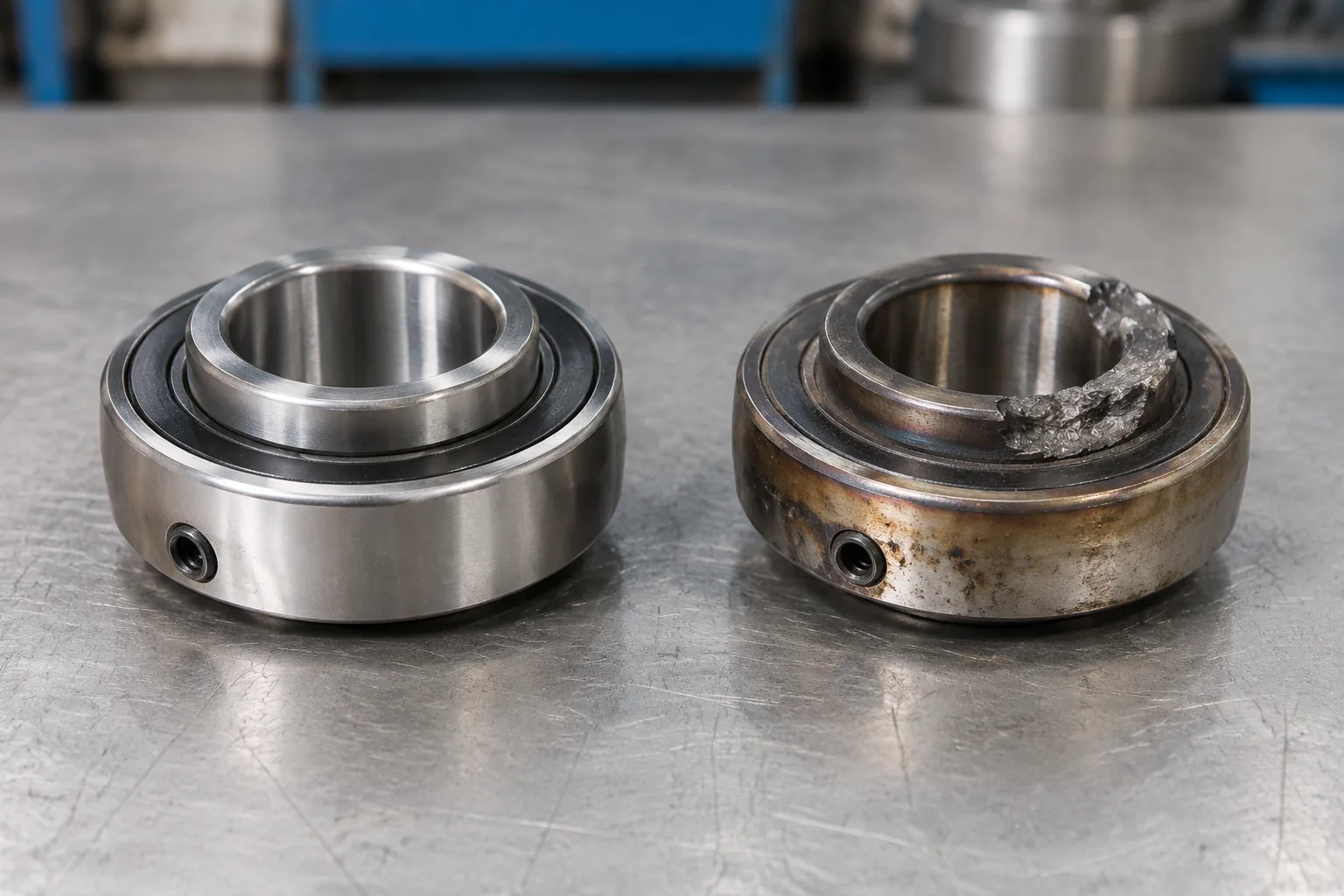
Visible damage is not the same as the original failure. A bearing may keep running after initial damage and produce secondary damage that obscures the first cause. That is why failure analysis should consider operating conditions, maintenance history, lubrication records, alignment, shaft fit, load, speed, contamination, and shutdown conditions, not appearance alone.
ISO 15243:2017 provides a useful framework. It classifies in-service rolling-bearing damage into six main groups: rolling contact fatigue, wear, corrosion, electrical erosion, plastic deformation, and cracking or fracture. The standard was published in March 2017, confirmed in 2022, and remains the current published edition, although it is listed as due for revision.
Use those groups to organize diagnosis before choosing a corrective action. If a unit fails early or repeatedly, replacing the bearing without correcting the underlying cause often leads to the same failure again.
1. Incorrect Or Insufficient Lubrication
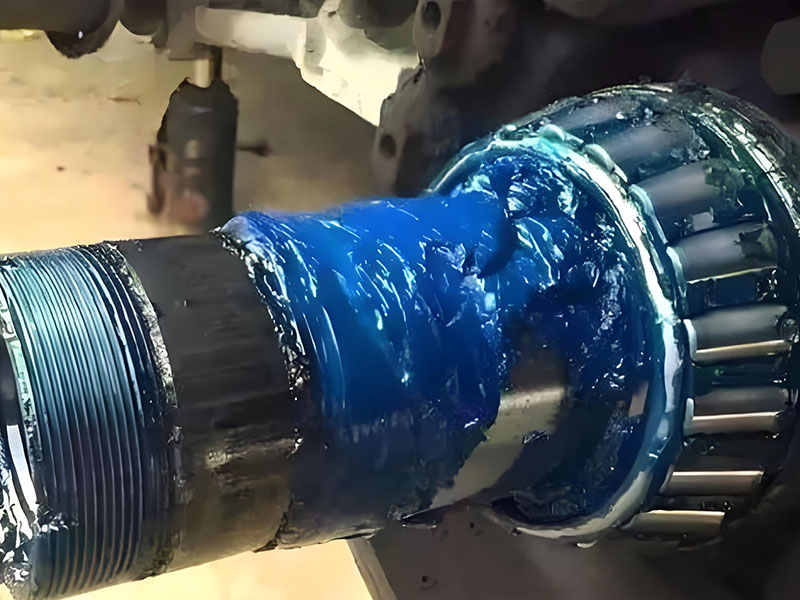
Lubrication problems are among the most common causes of bearing damage, alongside contamination. The problem may be too little lubricant, incorrect viscosity or consistency, unsuitable additives, degraded lubricant, or water or other fluids in the lubricant.
- Too little lubricant can raise bearing temperature because the lubricant film is too thin.
- Too much grease can also raise temperature through grease churning and overheating.
- Wrong or degraded lubricant can fail to separate rolling surfaces or protect them from corrosion.
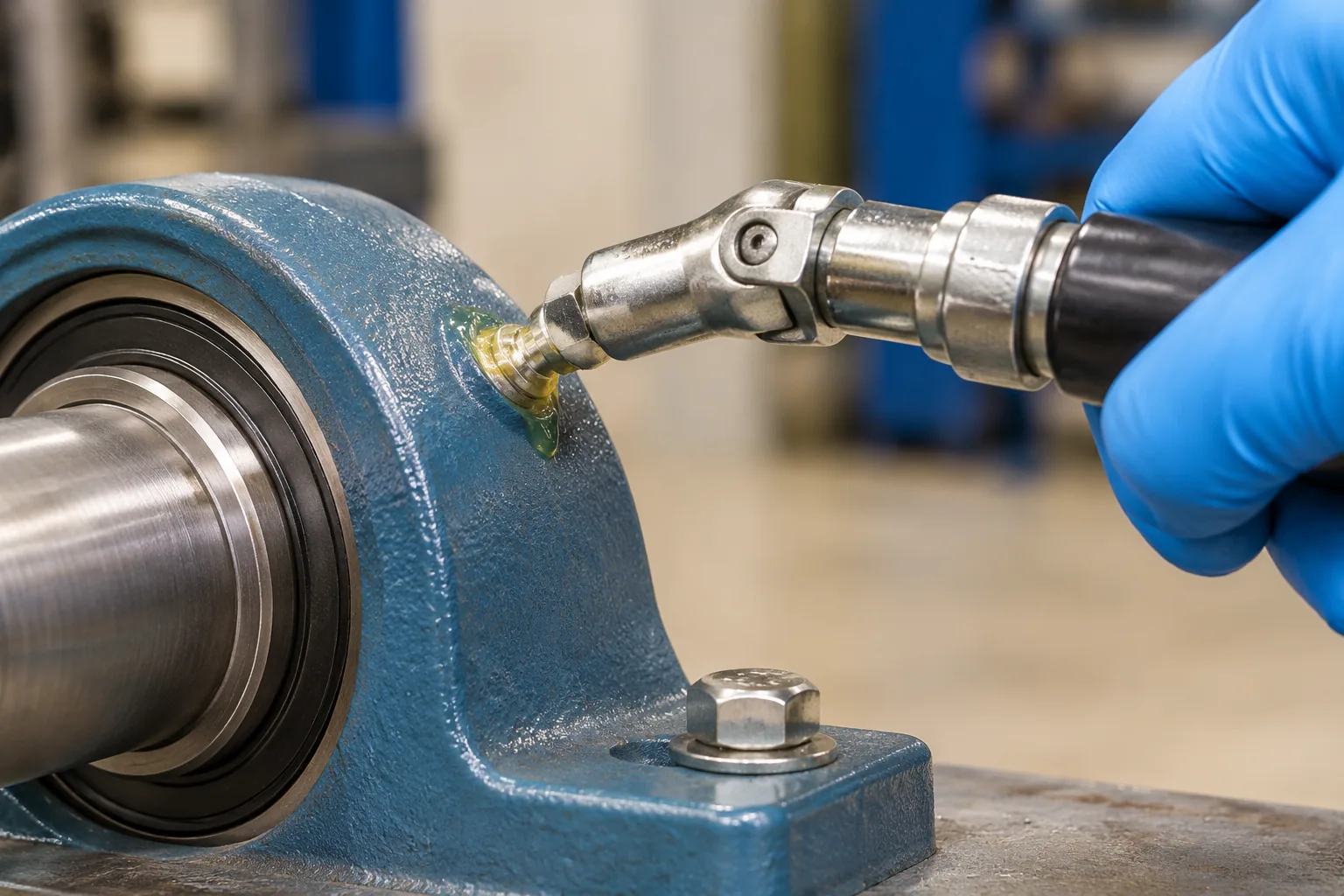
Set relubrication intervals according to speed, load, temperature, contamination, washdown exposure, and the equipment manufacturer instructions. Do not assume that adding more grease is always safer.
Product guidance varies. One housed ball-bearing guidance recommends no routine relubrication for normal indoor service, two or three times per year outdoors, monthly under severe outdoor exposure, and weekly in high-contamination or washdown service. Grease is added until the first indication of purging appears. Those are starting guidelines for that product line, not universal intervals.
Separate tapered-roller housed-unit instructions state that those units should not operate above 250°F (121°C). That limit applies to the covered products and should not be generalized to every pillow block.
2. Contamination And Seal Failure
Solid particles can indent or abrade rolling surfaces, while water can degrade lubricant and promote corrosion. Recognized causes include solid-contaminant ingress, water ingress, contaminated lubricant, ineffective sealing, and insufficient filtration.
Surface-initiated fatigue often begins when poor lubrication or poor cleanliness produces metal-to-metal contact, or when solid contaminants are repeatedly rolled through the contact zone. Microcracks and microspalls can then develop into visible fatigue damage.
Keep shafts, housings, tools, grease fittings, and lubricant containers clean during installation and maintenance. Select seals for the actual dust, moisture, chemical, and washdown exposure. Inspect seals and shorten relubrication intervals when contamination is present.
3. Misalignment And Distorted Housings
Misalignment can come from an uneven or contaminated mounting surface, incorrect positioning of the two bearing housings, shaft deflection, or housing distortion caused by tightening mounting bolts against an unflat base.
A self-aligning insert has finite angular capacity. It is intended to accommodate normal shaft deflection, not to compensate for poor installation. Pillow-block alignment should still be accurate.
Mount pillow blocks on a rigid, level, clean, well-supported surface. Remove burrs and debris, use full-support shims where required, align the shaft and housings before final tightening, and confirm that tightening the base bolts does not distort the housing.
Manufacturer procedures show why the capacity must be matched to the product. One alignment procedure for certain mounted spherical-roller pillow blocks uses measurements at the 12/6 o’clock and 3/9 o’clock positions to verify alignment within the product’s ±0.5° capability. For a 5-7/16-inch example in that procedure, the permitted measured difference is 0.080 in. Another manufacturer specifies ±2° misalignment for certain housed spherical-roller units offered in pillow-block sizes from 1-7/16 to 4-15/16 in. These values are product-specific and should not be presented as the capacity of all pillow blocks.
4. Incorrect Shaft Fit And Loose Locking System
An undersized, worn, tapered, burred, or out-of-round shaft can allow the inner ring to creep. Incorrect set-screw torque or an improperly installed eccentric collar, adapter sleeve, or tapered locking system can also permit movement or damage the ring.
Measure the shaft at several axial and circumferential positions, compare it with the bearing manufacturer’s tolerance table, and tighten the locking device with a calibrated torque wrench using the value for the exact bearing series.
Published values are product data, not generic specifications. One housed ball-unit tolerance table for normal service gives nominal to -0.0005 in. (-0.013 mm) for shafts from 1/2 to 1-15/16 in., nominal to -0.0010 in. (-0.025 mm) for 2 to 3-15/16 in., and nominal to -0.0015 in. (-0.038 mm) above 4 in. The same guidance says to reduce those tolerances by half for heavy loads, high speeds, or vertical shafts.
Set-screw torque also varies. One housed-unit catalog lists 155 in-lb for a 5/16-in. standard-steel set screw, 275 in-lb for 3/8 in., and 425 in-lb for 7/16 in. Stainless-steel inserts use lower values. These figures apply to that product data and must not be used as universal torque values.
5. Installation And Handling Damage
Hammer blows transmitted through the rolling elements can dent raceways and produce brinelling-type damage. Other documented installation damage includes deformed cages, cracked rings caused by cocked installation, and damaged faces caused by hardened drivers.
Apply installation force only to the ring being fitted, use the correct press sleeve or manufacturer-approved mounting tool, and do not transmit force through the balls or rollers. Avoid excessive mounting force, open-flame heating, welding housed units, and using damaged units.
6. Excessive Load, Shock, Vibration, Or Speed
Excessive load, excessive speed, fluctuating load or speed, vibration, and shaft or housing deflection are recognized damage causes. These conditions can accelerate fatigue, wear, plastic deformation, and loosening.
Check radial and axial loads, shock factors, belt or chain tension, shaft deflection, and operating speed against the exact unit’s catalog ratings. Do not select a pillow block only by bore diameter, because a unit that fits the shaft may still be unsuitable for the load, speed, or shock condition.
One bearing manufacturer reports that fatigue accelerated by high stress or a temporary overload may occur after only 5% to 10% of the calculated modified rating life, L10mh. That figure is a warning about overload severity, not a service-life prediction for every application.
7. Corrosion During Operation Or Shutdown
Moisture ingress, washdown water, condensation, incompatible chemicals, and long idle periods can corrode rolling surfaces and degrade grease.
Use an environment-appropriate seal and housing material, prevent direct high-pressure wash spray at the seals, purge contaminated grease where the unit design permits it, and protect idle equipment against condensation. When a bearing will remain out of operation for an extended period, add grease as recommended by the manufacturer to help prevent corrosion.
8. Electrical Erosion In VFD-Driven Equipment
Motors driven by modern variable-speed drives can experience bearing failure within only a few months when high-frequency currents discharge through the bearings and progressively erode the raceways. Electrical erosion is therefore a specific concern for VFD-driven equipment, not a general explanation for every pillow block failure.
Mitigation can include proper high-frequency grounding paths, symmetrical motor cables, inverter output filtering where required, and insulated bearing arrangements to interrupt current paths. Shaft-grounding devices may also be used where specified by the motor or drive manufacturer. Follow that manufacturer’s instructions rather than applying a generic electrical fix.
9. Incorrect Replacement Insert
A replacement insert and housing should come from the same manufacturer because housing fits and spherical outer-ring designs can differ. Relubrication grooves and holes are not positioned identically by every manufacturer. If the insert’s lubrication feature does not align with the housing passage, grease will not reach the bearing.
Confirm that the anti-rotation pin engages the housing slot. Excessive force during insert installation can brinell the raceway. When compatibility, lubrication passage alignment, and anti-rotation engagement are confirmed, replacing only a compatible mounted-bearing insert can cost 30% to 40% less than replacing the complete unit.
Prevention Checklist For Pillow Block Bearing Reliability
- Verify shaft condition and fit before mounting. Measure at multiple axial and circumferential positions and compare with the exact unit’s tolerance table.
- Use the correct locking device and calibrated torque for the exact bearing series.
- Mount on a rigid, level, clean, well-supported surface and check alignment before final tightening.
- Use the specified lubricant, quantity, and relubrication interval for the actual speed, load, temperature, contamination, and washdown conditions.
- Select and inspect seals for the actual dust, moisture, chemical, and washdown exposure.
- Monitor for overheating, abnormal vibration, noise, looseness, and grease condition.
- Protect idle equipment from condensation and corrosion.
- Control VFD-related shaft currents where applicable.
- Use compatible replacement inserts and verify lubrication passages and anti-rotation features.
Use the checklist during commissioning and maintenance, with values taken from the exact unit’s instructions. It does not replace OEM installation, lubrication, or maintenance requirements.
Replacement Decisions: Insert Or Complete Unit
Use failure analysis to determine whether the insert, housing, seal, shaft fit, or lubrication path caused or contributed to the failure. When replacing only the insert, use a compatible insert from the same manufacturer as the housing where required.
Verify lubrication groove and hole alignment, anti-rotation pin engagement, and correct installation force. Compare the cost of a compatible insert replacement with a complete unit replacement; insert-only replacement can cost 30% to 40% less when compatibility is confirmed.
Where the housing bore, seal seat, or shaft seating is damaged, follow the unit manufacturer’s replacement criteria. An insert alone may not restore correct fit or sealing.
Key Takeaways
- Most pillow block bearing failures are linked to lubrication, contamination, misalignment, incorrect fit or locking, installation damage, excessive load or speed, corrosion, electrical erosion, or incorrect replacement.
- Root-cause analysis matters because visible damage may not show the original cause.
- Product-specific values for torque, tolerance, temperature, relubrication, and misalignment must be confirmed against the exact unit.
- A practical prevention program combines correct selection, clean installation, alignment checks, lubrication discipline, seal inspection, condition monitoring, and compatible replacement parts.
Conclusion
Common pillow block bearing failures rarely have a single universal cause. Lubrication, contamination, alignment, shaft fit, locking, installation, load, speed, corrosion, electrical erosion, and replacement compatibility all leave different evidence, and the visible damage may not be the original failure. Diagnose the cause before replacing the unit, then confirm every torque, tolerance, temperature, relubrication interval, and misalignment limit against the exact pillow block and its manufacturer instructions. That approach gives the replacement a better chance of lasting.
FAQs
Q1: What are the most common causes of pillow block bearing failure?
A: The most common causes are lubrication problems and contamination, followed by misalignment, incorrect shaft fit or locking, installation damage, excessive load or speed, corrosion, electrical erosion, and a mismatched replacement insert. Because secondary damage can hide the original cause, confirm the operating conditions and maintenance history before choosing a fix.
Q2: How often should pillow block bearings be relubricated?
A: Relubrication frequency depends on the exact unit, grease, speed, load, temperature, contamination, and washdown exposure. One housed ball-bearing guidance ranges from no routine relubrication indoors to weekly service in high-contamination or washdown conditions. Treat such examples as product-specific starting points and follow the equipment manufacturer’s schedule.
Q3: Can I replace only the bearing insert instead of the complete unit?
A: Yes, if the housing is sound and the replacement insert is compatible. Use an insert from the same manufacturer as the housing where required, verify lubrication groove and hole alignment, confirm anti-rotation pin engagement, and install without excessive force. Insert-only replacement can cost 30% to 40% less than a complete unit when those conditions are met.
Q4: Do self-aligning pillow blocks correct all misalignment?
A: No. A self-aligning insert has finite angular capacity and is intended to accommodate normal shaft deflection, not poor installation. Check the mounting surface, housing position, and shaft alignment before final tightening, and use the exact unit’s specified misalignment limit.
Q5: What causes a pillow block bearing to overheat?
A: Overheating can come from too little grease, too much grease, the wrong lubricant, contamination, misalignment, excessive load or speed, or a seal problem. Check the lubricant condition and quantity, alignment, shaft fit, and operating load against the unit’s ratings before changing the bearing.
Q6: Are published shaft tolerances and set-screw torque values universal?
A: No. Published shaft tolerances and set-screw torque values are product data tied to specific series, sizes, and materials. One catalog may list 155 in-lb, 275 in-lb, and 425 in-lb for different set screws, while another series uses different values. Use the table for the exact bearing and locking device.