Quick Answer: Ball bearings improve machinery performance by replacing sliding friction with rolling contact between hardened balls and raceways. Lower friction torque means less heat, and less heat supports higher rotational speed, steadier precision, quieter running, and longer calculated life. Deep groove and angular contact designs also carry combined radial and axial loads in a compact envelope. How much of each benefit a machine actually gains depends on bearing type, size, preload, lubrication, sealing, and the operating duty cycle.
Machinery performance is usually limited by heat, not by the motor. Every bearing that separates a rotating shaft from its housing either adds friction or removes it, and that single choice propagates into speed limits, temperature rise, positioning accuracy, noise, and how often the equipment has to be serviced. This article explains where ball bearings create those gains, and where the gains stop.
What Ball Bearings Do in a Machine
A ball bearing is a rolling bearing that uses spherical rolling elements. The inner ring turns with the shaft, the outer ring stays with the housing, and the balls and cage carry the load while holding the two rings apart. That separation converts sliding resistance into low rolling resistance, which is why a shaft can turn faster with less drive energy and less heat.
The defining feature is point contact: each ball touches the raceway over a small elliptical area. Roller bearings use line contact instead. Point contact gives ball bearings lower friction and quieter running; line contact gives roller bearings higher stiffness under heavy load. Both traits come from the same geometry, so neither type wins on every metric.
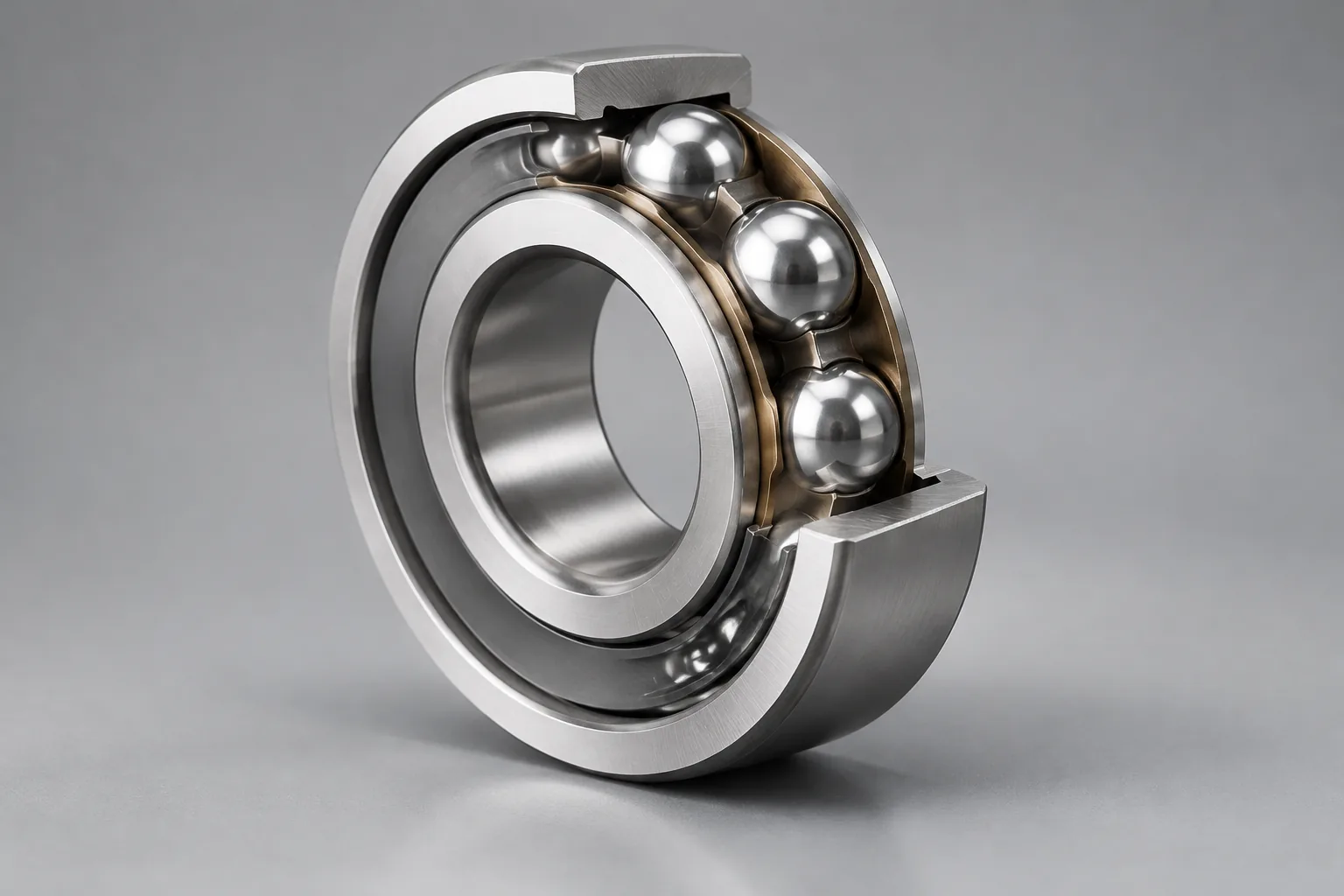
Two designs dominate general machinery. Deep groove ball bearings are the workhorse and accept radial load plus axial load in both directions. Angular contact ball bearings are built for combined loads and high-speed spindles. Ball bearings are estimated to account for about 70% of global bearing usage, which reflects how often this geometry fits electric motors, transmissions, pumps, general industrial machinery, and machine tool spindles.
The Friction-Heat-Speed-Life Link
Friction inside a bearing appears as heat, and a speed limit is largely a heat limit. Once the bearing runs hotter than the lubricant and the running clearance can tolerate, the original design point no longer holds.
Temperature rise does not stay local. It reduces lubricant viscosity, thins the lubricant film, increases friction further, and closes running clearance as the inner ring grows thermally. In severe cases the bearing can seize. That chain is why speed capability is quoted together with a lubrication and cooling method rather than as one isolated number.
Cooling therefore belongs to the bearing specification, not to the machine design alone. Depending on the application, higher speed may require circulating oil, housing heat dissipation, or directed air cooling. Lower friction at the source is the other half of the answer, because heat that is never generated does not need to be removed.
How Ball Bearings Reduce Friction and Energy Consumption
A ball bearing typically produces lower friction torque than a roller bearing of the same size. Single-row bearings also generate less friction heat than double-row or multi-row bearings, which matters in high-speed equipment where every watt of loss has to be cooled.
Designers also tune the internals. A low-torque ball bearing can be built with fewer balls, optimized ball diameter, revised raceway dimensions, controlled internal clearance, and a special resin cage.
In one hybrid-transmission design, those measures cut friction loss by 50% to 65% against conventional bearings, a gain tied directly to fuel efficiency and lower emissions. That range belongs to that design and that duty cycle, not to ball bearings in general.
The exception deserves equal billing: very high-load or high-stiffness applications may still favor roller bearings despite their higher friction, because friction is only one term in the selection equation.
How Ball Bearings Enable Higher Rotational Speed
Lower friction torque buys speed. Less heat per revolution means a higher permissible rotational speed before the lubricant or the clearance becomes the limiting factor.
- Ceramic hybrid bearings: silicon nitride balls allow higher speed and lower operating temperature than all-steel bearings. Ceramic rolling elements show about 29% of the thermal expansion of steel, so preload changes less as the rings warm.
- Super-precision angular contact designs: one current spindle series delivers up to 20% higher speed and up to 20% lower friction torque than its predecessor, with standard sizes from 40 mm to 160 mm bore in ISO 70 and 719 dimension series. Lower friction can also reduce lubrication and cooling demand, and in some applications removes the need for a dedicated cooling circuit.
- Lubrication method: grease-lubricated bearings typically reach only 65% to 80% of the oil-lubrication speed limit, while circulating oil carries heat away and supports higher speed.
These gains are conditional. Cage design, lubricant, cooling, seal type, preload, and precision class all move the achievable speed. Contact seals add torque and lower the limiting speed, so a sealed bearing may not reach the same ceiling as an open one.
How Ball Bearings Support Radial and Axial Loads
Load direction decides the design. A single-row deep groove ball bearing carries radial load as its main duty and can also take axial load in both directions, which lets one compact part locate a shaft and support combined duty in motors, transmissions, pumps, and general machinery.
Angular contact ball bearings go further. Their raceways are offset along the axis, so the line of contact is angled and the bearing is built for combined radial and axial load. Contact angle sets the split: in machine tool spindle ranges using 15°, 20°, or 25°, a 15° design favors radial load, while a 25° design suits combined loads.
Load magnitude, direction, arrangement, preload, and required stiffness have to be checked before a deep groove or angular contact design is fixed.
How Ball Bearings Improve Precision and Stiffness
Stiffness is load divided by elastic displacement. Preload is the standard way to raise it, and preloaded bearings are routine practice in machine tool applications because a stiff shaft holds position under cutting force.
Speed usually erodes that stiffness, and hybrid bearings erode it more slowly. In one high-speed internal grinding spindle example, hybrid ceramic ball bearings retained 70% of static stiffness at 40,000 r/min, against 61% for all-steel bearings. Higher dynamic stiffness limits shaft displacement and stabilizes machining.
Mounting predictability comes from standardization. ISO 492:2023 specifies dimensional and geometrical tolerances for radial rolling bearings; the sixth edition was published in August 2023. Standardized interfaces let a precision bearing seat predictably in a shaft and housing, and make replacement predictable as well.
Two limits apply. Preload must be correct: too little leaves the shaft loose, while too much adds friction and heat and shortens life. And ball bearings are not automatically stiffer than roller bearings; roller bearings generally have higher stiffness because of their rolling-contact conditions.
How Ball Bearings Reduce Vibration and Noise
Ball bearings are commonly chosen where noise and vibration matter, especially against roller bearings in applications that suit ball geometry. Smooth raceways, ball quality, cage design, lubrication, and contamination control all feed into that behavior.
Preload helps too. In vibration-sensitive applications, a ball bearing with the correct axial preload can reduce vibration from varying compliance to a negligible level. Without the right preload, the same bearing can contribute vibration of its own.
No specific noise reduction can be promised without application data. Mounting, alignment, contamination, and system resonance can dominate the result.
How Ball Bearings Contribute to Longer Service Life
Calculated life is a planning number, not a guarantee. ISO 281:2007 defines the calculation of basic dynamic load ratings and rating life, and the basic rating life corresponds to 90% reliability. The standard was published in February 2007 and confirmed as still valid in 2021.
The modified rating life can include lubrication condition, lubricant contamination, fatigue load, and a different reliability target. Sealing and lubrication feed the same result in practice: a seal that keeps contamination out and grease in preserves the film the calculation assumes.
Inputs matter. Load, speed, lubrication, contamination, and reliability target each shift the answer, and installation, alignment, and operating practice can push real life away from the calculated value in either direction.
How Ball Bearings Help Make Machinery Compact and Lightweight
Combining duties reduces part count. A deep groove or angular contact ball bearing that carries radial and axial load in one compact envelope can replace a wider arrangement and free space in the housing.
Internal design does the rest. A deep groove ball bearing developed for electric-vehicle drive units, announced on 26 March 2025, uses a narrow combined plastic cage to shrink outer diameter by about 10% and weight by 51% against conventional products, while supporting lower friction and higher speed. Smaller bearings mean smaller drive units, less material, and more packaging freedom.
Those percentages belong to that design. Whether a compact bearing suits a given machine depends on its load rating, speed rating, lubrication, sealing, and duty cycle.
How Sealing and Lubrication Protect Ball Bearing Performance
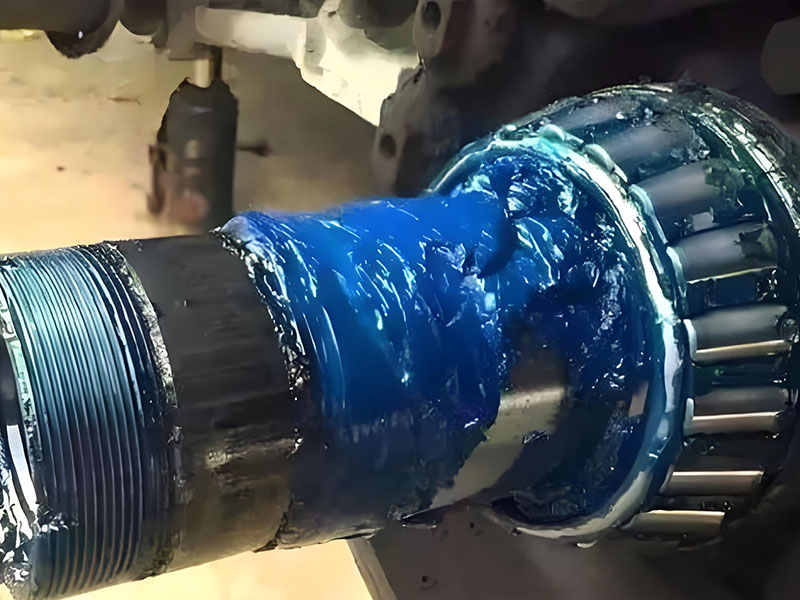
Seals and shields keep foreign matter out and help hold lubricant in. A prelubricated sealed ball bearing filled with long-life grease often needs no separate sealing or protective device in the surrounding machine, which simplifies the housing and reduces assembly steps.
The trade-off is friction. Contact seals add torque and reduce the limiting speed, so protection, lubricant retention, friction, and speed have to be balanced rather than maximized together.
Lubrication choice sets the ceiling. Grease is simple and stays in place but generally reaches only 65% to 80% of the oil-lubrication speed limit; circulating oil also carries heat away and therefore supports higher speed.
Where Ball Bearing Improvements Matter Most
The same bearing property shows up differently by machine:
| Application | Benefit that matters most |
|---|---|
| Electric motors | Lower friction torque and quieter running at steady speed |
| Transmissions and EV drive units | Efficiency, compact size, and higher speed in a small envelope |
| Pumps and general industrial machinery | Contamination protection and lubricant retention over long duty |
| Machine tool spindles | Speed, stiffness, and precision under preload |
This mapping is illustrative. Final selection still needs load, speed, environment, life target, and maintenance data from the actual application.
Selection Trade-offs: When Ball Bearings Are Not Automatically the Best Choice
Ball bearings are generally favored for lower friction, higher speed, and lower noise. They are not the automatic choice for maximum stiffness: roller bearings generally provide higher stiffness because of their line-contact rolling conditions.
Selection is a balance among load, speed, stiffness, temperature, lubrication, sealing, and required life. Choosing on one metric alone – the lowest friction figure, the highest speed rating, or the smallest envelope – usually moves the problem somewhere else in the machine.
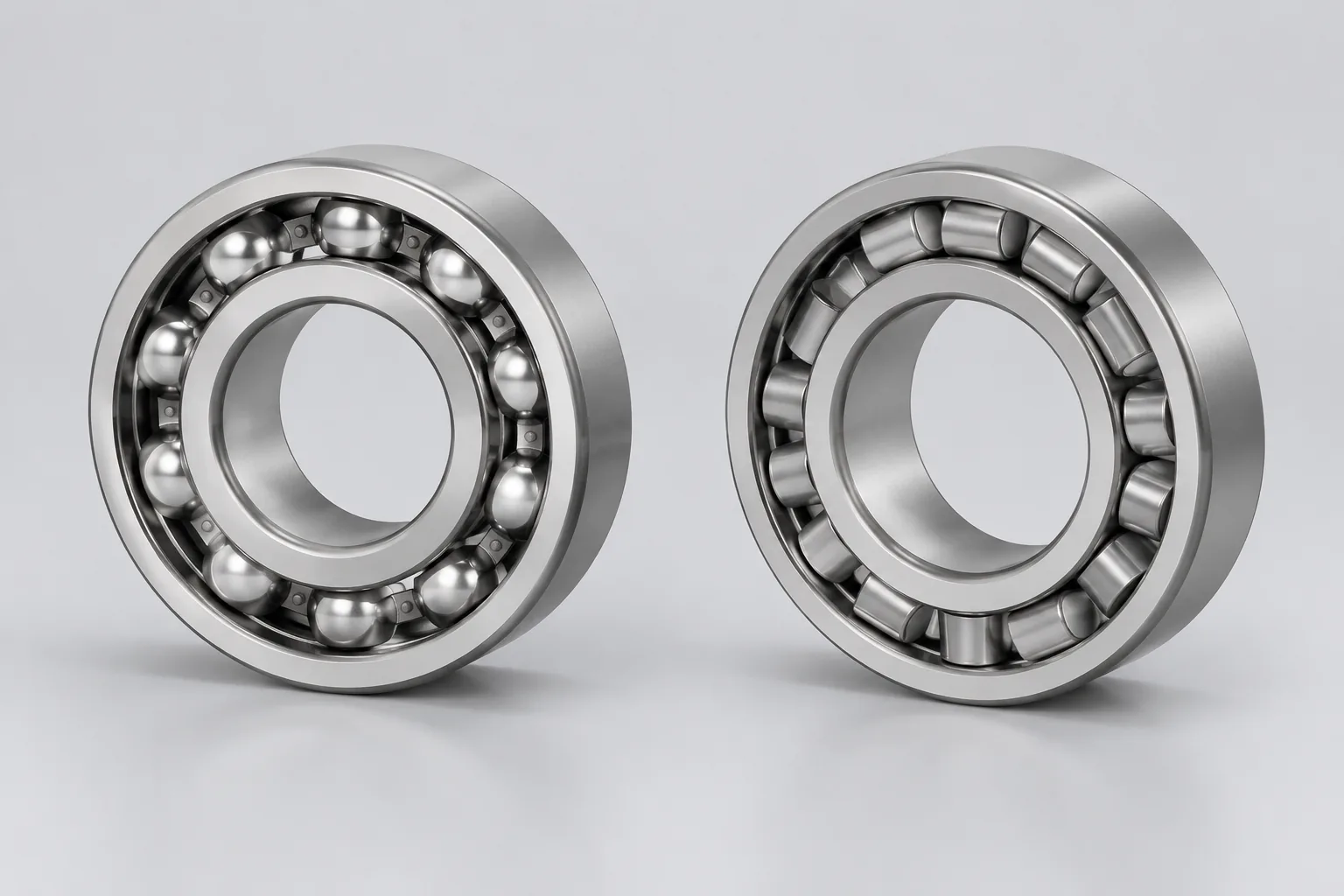
Heavy-load, high-stiffness, or shock-loaded applications may need a roller bearing or a different arrangement entirely.
A Practical Specification Checklist for Better Machinery Performance
Before a bearing is fixed for a machine, the specification should answer these questions:
- Load: radial and axial magnitude and direction, including shock and continuous duty.
- Speed and duty cycle: continuous and peak speed, run time, and start-stop frequency.
- Lubrication and sealing: grease or oil, relubrication access, and the contamination level the seal must handle.
- Temperature: ambient and operating temperature, plus the heat the housing can dissipate.
- Precision, preload, stiffness, and vibration or noise limits where the application depends on them.
- Reliability target: use the ISO 281 rating-life calculation with lubrication and contamination factors that match the real duty.
- Mounting and interchangeability: ISO 492 dimensional and tolerance references where fit and replacement matter.
- Confirmation: final load ratings, speed ratings, and available configurations checked with the bearing manufacturer.
Conclusion
Ball bearings improve machinery performance through one mechanism and several consequences. Point contact between balls and raceways lowers friction torque, and lower friction means less heat, higher permissible speed, quieter running, steadier precision under preload, and longer calculated life, all inside an envelope that can also carry combined radial and axial load.
The gains remain conditional, and the conditions are the specification: type, size, contact angle, preload, lubrication, sealing, and the real duty cycle. Where stiffness or shock load leads the requirement, a roller bearing can still be the correct answer. A practical next step is to write down the load, speed, temperature, lubrication, and reliability inputs before comparing bearing types, then confirm ratings and available configurations for the chosen design.
FAQs
Q1: What is the main performance advantage of ball bearings?
A: The main advantage is a combination of lower friction torque, higher speed capability, and lower noise than roller bearings in suitable applications. Point-contact geometry is the basis for all three, but load magnitude and stiffness requirements still have to be checked before the design is fixed.
Q2: Can ball bearings carry both radial and axial loads?
A: A single-row deep groove ball bearing carries radial load as its main duty and can also accept axial load in both directions. Angular contact ball bearings are built specifically for combined radial and axial loads, and their axial capacity rises as the contact angle increases, for example from a 15° radial-leaning design toward a 25° design for combined duty.
Q3: Are ceramic ball bearings better for high-speed machinery?
A: Hybrid bearings with silicon nitride ceramic balls can support higher speed and lower operating temperature than all-steel bearings in high-speed applications. Ceramic rolling elements show about 29% of the thermal expansion of steel, which reduces sensitivity to ring temperature difference and preload change. The benefit still depends on cage, lubricant, cooling, and precision class.
Q4: Do sealed ball bearings reduce maximum speed?
A: Contact seals increase friction torque and can reduce the limiting speed compared with open bearings. Sealed bearings return contamination protection and lubricant retention, and a prelubricated sealed unit may remove the need for separate sealing in the housing, so the choice is a trade-off between protection and speed rather than a single best answer.
Q5: How is ball bearing service life calculated?
A: ISO 281 defines the methods for basic dynamic load ratings and rating life, and the basic rating life corresponds to 90% reliability. A modified life can account for lubrication condition, lubricant contamination, fatigue load, and a different reliability target. The result is a planning value that assumes correct installation, alignment, and lubrication.
Q6: When should a roller bearing be chosen instead of a ball bearing?
A: A roller bearing is generally the better fit when higher stiffness or heavy load capacity is the primary requirement, because line contact spreads load over a larger area. Compare load, speed, stiffness, temperature, lubrication, sealing, and required life together before deciding, since a ball bearing still wins on friction, speed ceiling, and noise in many applications.