Quick Answer: Crane slewing bearings are large rolling-element bearings that connect a crane’s rotating upper structure to its chassis or base and carry axial, radial and tilting-moment loads during full-circle slewing. They combine raceways, mounting holes and often gear teeth in one unit, so selection depends on the load spectrum, mounting interface and lubrication plan. Correct installation and periodic grease replenishment protect the raceways and gears.
A crane’s ability to pick, swing and spot a load depends on the joint between the rotating upper structure and the base. That joint is the slewing bearing, and it works under combined loads while the crane is in motion. Buyers, designers and maintenance teams need to understand how the bearing is built, what it can carry, where it is used and what keeps it serviceable.
What Is a Crane Slewing Bearing?
A crane slewing bearing is a large rolling bearing installed between the crane’s rotating superstructure and its undercarriage, base frame or mast. It allows the upper structure to turn through a full circle while supporting the loads transferred from the jib, load and counterweight.
Unlike a simple radial bearing, a slewing ring carries axial load, radial load and tilting moment at the same time. The tilting moment is often the decisive load in crane applications because it grows with working radius and lifted load.
The same component appears under several names. Slewing ring, slewing ring bearing and turntable bearing are generally equivalent terms. The exact configuration, however, can differ, so ordering should use the drawing and part number rather than the name alone.
A crane slewing bearing differs from an ordinary bearing in scale and integration. It usually has a large diameter and a relatively thin section, mounting holes in the inner and outer rings, and often gear teeth cut into one ring. Those features let it serve as both a structural joint and a drive interface. Diameters range from compact rings for light loader cranes to large rings for tower, port and heavy mobile cranes, with the exact size fixed by the crane design.
Key Structural Features of Crane Slewing Bearings
The structure of a crane slewing bearing can be read through four features: the rolling element and raceway arrangement, the gear option, the sealing and lubrication system, and the mounting interface. Each feature affects capacity, stiffness, maintenance and installation.
Rolling Element and Raceway Configurations
Several arrangements are common, and each makes a different trade-off between capacity, stiffness, section height and cost.
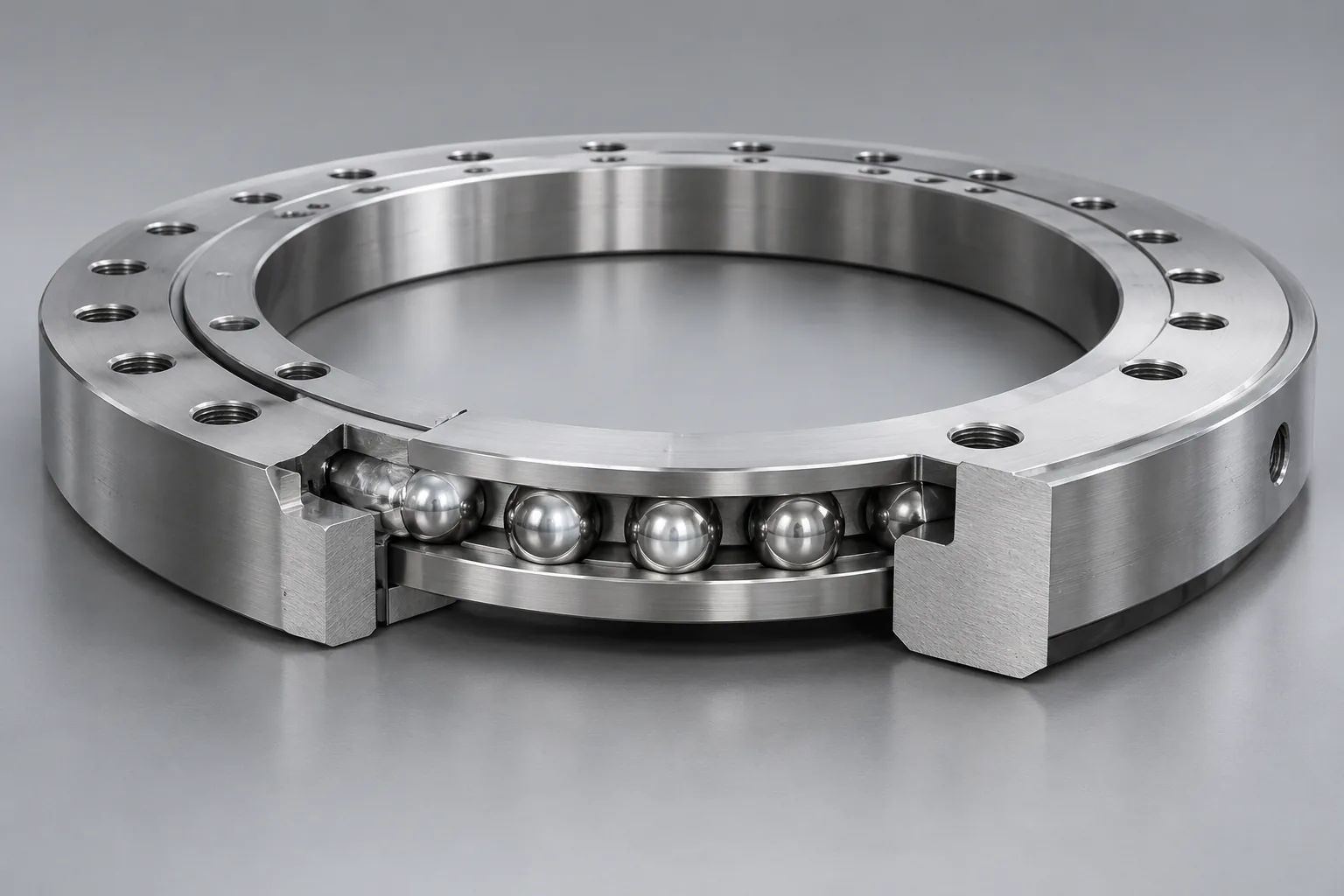
- Single-row four-point contact ball: the balls contact the raceway at four points, so one row can take axial load in both directions, radial load and tilting moment. The design is compact and is often used in small and medium crane slewing applications.
- Double-row ball: two rows of balls and a wider raceway generally give higher capacity than a single-row ball design. It suits applications where loads are heavier but a roller bearing is not required.
- Crossed roller: cylindrical rollers arranged at right angles in one row provide high stiffness and good tilting-moment resistance in a relatively compact section.
- Three-row roller: separate roller rows carry axial and radial loads, giving high capacity and strong resistance to tilting moment. This arrangement is used for heavy cranes and demanding duty cycles.
Published load ratings and tilting-moment capacities differ by series and size. Compare candidate bearings on the same load case rather than assuming that one type is stronger in every application. The final choice depends on lifting capacity, working radius, tilting moment and the crane’s load spectrum.
Gear Options: External, Internal and Non-Geared
A slewing bearing may be supplied without teeth, with external teeth on the outer ring, or with internal teeth on the inner ring. The slewing drive pinion meshes with the ring gear and turns the upper structure.
A geared bearing integrates the drive interface with the load-carrying ring. That integration can reduce the number of separate components and simplify the mounting arrangement. The gear teeth are commonly induction hardened to improve wear resistance, but the required hardness, case depth and tooth module are specified for the individual drive and must be confirmed on the drawing.
Sealing and Lubrication Design
Seals keep grease in and contaminants out. Lip seals and labyrinth seals are common. A lip seal wipes the sealing surface and retains grease, while a labyrinth seal creates a tortuous path that slows dust and water ingress. The seal choice should match the working environment, especially for outdoor, washdown and marine duty.
Grease nipples and internal channels deliver lubricant to the raceways. Some designs also provide separate lubrication points for the gear teeth. Sealing and lubrication design directly affect maintenance intervals and service life, because contaminated or starved raceways wear faster. Grease replenishment intervals are not universal; they depend on duty cycle, environment, seal type and grease specification. Published crane-bearing maintenance guides commonly give intervals in the range of 50 to 200 operating hours, with shorter intervals for roller bearings and severe contamination, but the guides differ. The bearing manufacturer’s schedule for the specific bearing and application should govern.
Mounting and Interface Features
The inner and outer rings carry mounting holes. A locating spigot or counterbore centers the ring on the crane structure, and the bolt circle and hole size must match the interface. These features transfer the bearing loads into the crane frame and must be checked before installation.
Rings and gears are made from heat-treated alloy steels. The exact grade, hardness and case depth should be taken from the manufacturer’s drawing and not assumed from a product photo. Surface coatings or plating can improve corrosion resistance for outdoor and marine applications, but they do not replace correct sealing and grease selection.
Key Performance Benefits of Crane Slewing Bearings
A well-selected slewing bearing gives crane designers and operators several practical benefits:
- Combined load capacity in a limited section: the ring carries axial, radial and tilting-moment loads without a large stack of separate bearings.
- Simplified structure: one integrated component replaces a multi-part combination and reduces the number of interfaces between the rotating platform and the chassis.
- Smooth full-circle motion: the bearing allows continuous rotation, and the slewing drive can position the jib or load with controlled motion.
- Integrated protection: seals and lubrication channels help keep the raceways and gears supplied with grease and protected from contaminants.
- Life-cycle value: when the load case, installation and maintenance are correct, the bearing can deliver a long service interval and avoid premature replacement.
These benefits depend on correct load calculation, flat and rigid mounting surfaces, specified bolt preload, and lubrication at the recommended intervals. A bearing that is oversized for the load but poorly installed can still fail early.
Uses of Crane Slewing Bearings by Crane Type
The same bearing family serves many crane classes, but the load case and the installation details change with the machine.
Tower Cranes
In a top-slewing tower crane, the slewing bearing sits between the rotating turntable and the mast or slewing platform. In a bottom-slewing design, the slewing mechanism is arranged near the base, so the bearing location and load path differ. Both arrangements must manage lifted load, wind load and tilting moment while allowing the jib to be positioned accurately.
Gear backlash and smooth rotation matter for load spotting. Excessive backlash can make the jib harder to control, while tight or damaged teeth increase drive load. Inspectors should check gear condition together with raceway behavior.
Mobile, All-Terrain and Crawler Cranes
Mobile, all-terrain and crawler cranes place the slewing bearing between the rotating superstructure and the carrier frame. Working radius changes the tilting moment, so the bearing must be rated for the crane’s load chart, not just its maximum lift.
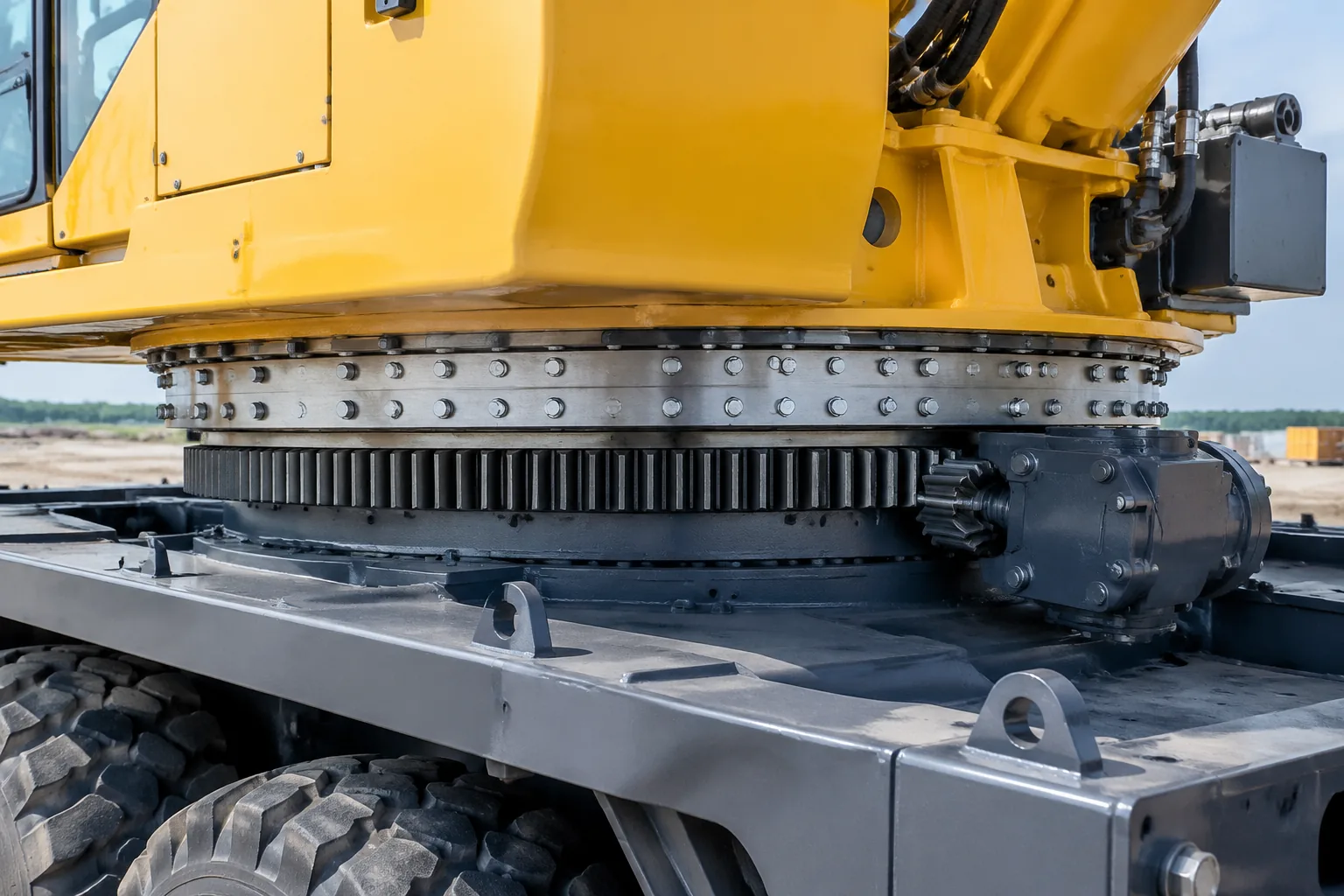
Transport limits and stability make compact section height and low weight valuable. The bearing and its mounting must also tolerate the shock and vibration that come with travel and uneven ground.
Marine and Port Cranes
Ship cranes, deck cranes and port cranes use slewing bearings in harsh conditions. Salt water, humidity and wind-driven spray raise the risk of corrosion and seal damage, so coating, seal selection and grease choice deserve close attention.
Continuous duty puts a premium on maintenance access. Grease points should be reachable, and the maintenance plan should account for the actual operating hours and exposure rather than a generic schedule.
Truck-Mounted and Light-Duty Cranes
Loader cranes and small knuckle-boom cranes often use compact slewing rings, sometimes with external or internal gearing. Space and cost constraints favor simple, well-protected designs that fit the truck chassis and the outrigger arrangement.
The duty cycle can still be demanding because the crane may operate frequently at short radius. The load case should include the outrigger support, boom position and attachment weight, not only the rated lift.
How to Select a Crane Slewing Bearing: Key Considerations
Selection starts with the crane’s load case, not with a product listing. The following points should be settled before a bearing is quoted or ordered.
- Load calculation: define axial load, radial load and tilting moment for static and dynamic conditions. Include the load spectrum, safety factors and the effect of working radius.
- Bearing type: choose between ball and roller designs, single-row and multi-row arrangements, and geared or non-geared rings. Confirm gear type, tooth count and permissible backlash with the drive supplier.
- Mounting interface: check hole size, hole pattern, locating spigot, bolt grade and preload requirements. The mounting surface must be flat and stiff enough for the ring.
- Environment: account for dust, moisture, marine corrosion, washdown and operating temperature. These factors affect seals, coatings and grease selection.
- Acceptance requirements: agree the applicable technical requirements, inspection items and factory records with the supplier. The records should be traceable to the delivered bearing. For marine-crane slewing bearings, ISO 16123:2025 covers classification, designation, inspection, testing, marking, packaging, transport, storage, installation and maintenance. BS EN 13001-3-4:2018 addresses crane-bearing safety requirements and proof of competence and is used with BS EN 13001-1 and BS EN 13001-2.
- Information package: provide the supplier with loads, duty cycle, interface drawing, gear data and environmental conditions. Missing data usually leads to a conservative or mismatched selection.
Installation, Lubrication and Maintenance Essentials
Premature slewing bearing failures are often linked to installation or maintenance rather than to the ring alone. The following practices reduce that risk.
Mounting and bolting. The mounting faces must be clean, flat and rigid. Poor flatness or soft mounting can distort the rings and concentrate raceway loads. Use the specified bolt grade and preload, and re-tighten the bolts after the initial run-in period and at the recommended intervals.
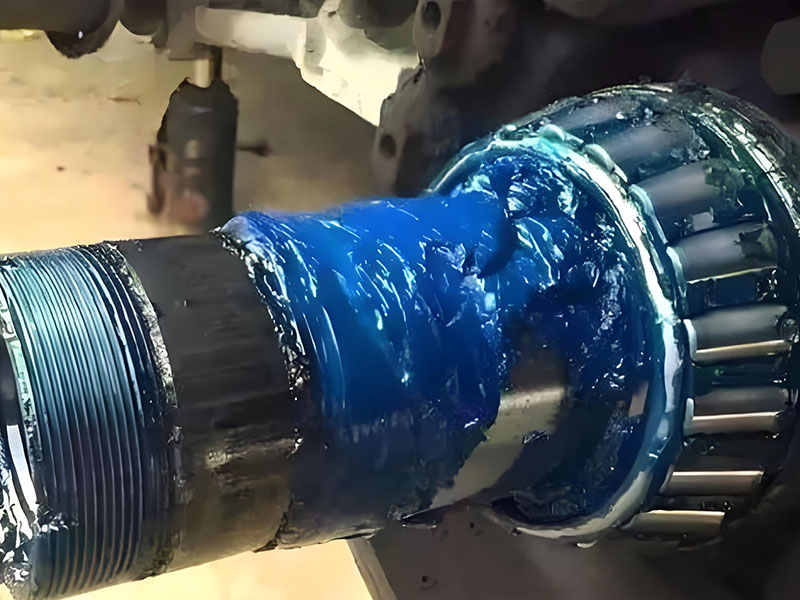
Lubrication. Apply the specified grease before operation. Replenish through the grease points while turning the crane slowly so the grease spreads across the raceway. Lubricate the gear teeth separately with the recommended gear grease. Keep seals protected during lifting and alignment.
Inspection. A practical inspection looks for changes in behavior and condition:
- abnormal noise or clicking during slewing;
- vibration or uneven rotation;
- a change in gear backlash or tooth contact;
- damaged, displaced or leaking seals;
- loose or corroded mounting bolts.
Common failure modes include raceway spalling or indentation, gear tooth wear or breakage, seal failure, contamination, lubricant breakdown and bolt loosening. These symptoms indicate that diagnosis is needed; they do not by themselves prove a single cause.
Replace the bearing when tilting clearance, noise, vibration or gear condition exceed the manufacturer’s limits, or when inspection shows raceway damage that cannot be corrected. Before replacement, confirm the part number, gear data, mounting dimensions and crane load chart. Exact installation tolerances, bolt torque values and lubrication intervals vary by bearing size and crane design. Use the bearing manufacturer’s technical file and the crane builder’s requirements rather than generic values.
What to Confirm Before Ordering or Replacing a Slewing Bearing
A replacement order should be built from verified machine data, not from a photo or a nominal size.
- Old bearing identification: record the part number, drawing number if visible, gear type, tooth count, overall dimensions and mounting hole pattern.
- Interface dimensions: measure the spigot diameter, bolt hole size and bolt circle. Check that the new ring will fit the existing structure without modification.
- Load and duty: confirm that the crane’s load chart, working radius and duty cycle still match the original design. A bearing with the same dimensions but a different rating is not automatically interchangeable.
- Quality records: ask for inspection records and material traceability for the delivered bearing.
- Supply details: discuss customization options, marking and delivery planning after the specification is confirmed.
If the old bearing is unmarked, measure the mounting interface and count the gear teeth. Do not infer interchangeability from dimensions alone, because raceway type, heat treatment, gear data and load rating can differ between visually similar rings.
Conclusion
Crane slewing bearings are the structural and rotational interface between a crane’s upper structure and its base. Their key features are the rolling element and raceway arrangement, the gear option, the sealing and lubrication system, and the mounting interface. Those features deliver combined load capacity, a compact structure, smooth full-circle motion and maintainable service life.
The benefits depend on the bearing matching the crane’s load case. Tower cranes, mobile cranes, marine and port cranes, and truck-mounted cranes each place different demands on capacity, corrosion protection and maintenance access. Before ordering, confirm the load spectrum, interface dimensions, gear data and inspection records. During service, keep the mounting bolts preloaded, grease the raceways and gears on schedule, and investigate changes in noise, vibration or backlash early.
For a reliable replacement or new design, start with the crane’s actual duty and interface drawing, then select the crane slewing bearing that meets those conditions.
FAQs
Q1: What is the difference between a slewing bearing and a slewing ring?
A: They generally refer to the same component. Slewing ring, slewing ring bearing and turntable bearing are common names for a large rolling bearing that connects a rotating structure to a base. When ordering, use the drawing and part number rather than the name alone.
Q2: How often should a crane slewing bearing be lubricated?
A: Follow the bearing manufacturer’s schedule for the specific size, seal and grease. Dust, water, marine exposure, high duty cycles and washdown usually call for more frequent inspection and replenishment. Check that grease reaches the raceway and gear teeth, and look for leakage or dry seals.
Q3: What causes a crane slewing bearing to fail?
A: Common causes include raceway wear or spalling, contamination, inadequate or unsuitable grease, seal damage, bolt loosening, overload and gear wear. Noise, vibration, a change in tilting clearance and uneven rotation are symptoms that require inspection, not proof of a single cause.
Q4: Can a slewing bearing be repaired?
A: Minor issues such as damaged seals, blocked grease passages or loose bolts may be serviceable. Raceway spalling, cracked rings or broken gear teeth usually require replacement. Do not weld or re-machine a loaded raceway without the manufacturer’s approval.
Q5: How do I identify the correct replacement slewing bearing?
A: Use the old bearing’s part number, drawing number, gear type and tooth count, overall dimensions, mounting hole pattern and spigot size. Confirm the crane’s load chart and duty. Dimensions alone do not prove interchangeability because load rating, heat treatment and gear data can differ.
Q6: What should be checked before installing a new slewing bearing?
A: Check the mounting faces for cleanliness, flatness and rigidity; confirm the bolt grade and preload; verify the hole pattern and spigot fit; and apply the specified grease. Keep the seal protected during lifting and alignment.
Q7: Is a four-point contact ball bearing suitable for heavy crane loads?
A: It can suit many small and medium crane slewing applications because it carries combined loads in a compact section. Heavy cranes with high tilting moments often use double-row ball, crossed roller or three-row roller designs. The decision should follow the calculated load case and the manufacturer’s rating, not the bearing type name alone.