Quick Answer: Choose spur gears when simplicity, low cost, and the absence of axial thrust matter most, and the drive can tolerate more mesh noise. Choose helical gears when smoother, quieter running or higher torque density in a compact envelope justifies axial thrust and thrust-capable bearings. Both transmit motion between parallel shafts; the right choice depends on load, speed, noise targets, space, and duty cycle.
Helical vs. spur gears is a choice between two parallel-shaft solutions that look similar on a drawing and behave differently in service. Both transmit rotation and torque through meshing teeth. The decision usually turns on how much noise the application can accept, how much load must fit inside a given envelope, whether the bearing arrangement can carry axial thrust, and how much the drive may cost. The comparison below follows those criteria in the order they typically decide a design.
Quick Comparison: Helical vs. Spur Gears at a Glance
The table summarizes directional tendencies rather than measured values. Absolute noise, efficiency, and cost figures depend on module, accuracy grade, material, lubrication, and the surrounding housing, so they should be confirmed for the specific drive.
| Criterion | Spur gears | Helical gears |
|---|---|---|
| Tooth form | Teeth parallel to the shaft axis | Teeth cut at a helix angle |
| Shaft arrangement | Parallel shafts | Parallel shafts, with crossed-axis variants used in some layouts |
| Tooth engagement | Full face width engages at once | Engagement builds gradually along the tooth |
| Smoothness and noise tendency | Stronger mesh excitation, especially at higher speed | Smoother engagement, lower noise tendency at comparable conditions |
| Load capacity for a given envelope | Lower torque density | Higher torque density through greater contact ratio |
| Efficiency | Simple transmission path with low sliding complexity | High, but axial load and bearing losses can reduce net efficiency |
| Axial load | No inherent axial thrust | Produces axial thrust that bearings or an opposed helix must react |
| Manufacturing cost | Generally lower and simpler to inspect | Generally higher, with added bearing and housing cost |
| Typical use | Low-to-medium speed, cost-sensitive, simple drives | Higher speed, noise-sensitive, high-load compact drives |
What Are Spur Gears?
Spur gears are cylindrical gears whose teeth run parallel to the shaft. Because the teeth are straight, the full face width comes into contact at the same moment, which makes the geometry simple to cut, measure, and inspect.
- Simple geometry and mature manufacturing keep spur gears widely available in standard sizes and modules.
- No inherent axial thrust, so bearings mainly carry radial load.
- Generally high efficiency because the transmission path is direct and sliding complexity is low.
- Commonly used in low-to-medium speed, cost-sensitive, and simple-drive applications.
Two conditions favor a spur design: noise and vibration are not the dominant constraint, and the bearing arrangement should stay free of added axial load. The exception is a high-speed or noise-sensitive system, where spur gears may need extra mitigation such as higher accuracy grade, stiffer housings, or acoustic treatment, and may still not match a helical pair.
What Are Helical Gears?
Helical gears use teeth cut at an angle to the shaft. Instead of meeting the mating tooth across the whole face width at once, contact builds up gradually and several teeth share the load, which smooths the transfer of torque.
- Gradual engagement reduces the impact at tooth entry and usually gives smoother, quieter running.
- Higher load capacity for a given size because the contact ratio is greater.
- Axial thrust is unavoidable and must be managed by thrust-capable bearings or an opposed helix arrangement.
- More complex manufacture, which typically raises unit cost.
Helical gears suit higher speed, higher load, or noise-sensitive applications, provided the bearing arrangement can react thrust. Where thrust capacity is impractical or the cost premium cannot be justified, a spur design remains the more economical answer.
How Tooth Geometry Changes Performance
The difference starts at the contact line. A spur tooth enters and leaves mesh abruptly, so the load steps from zero to full value within a short arc of rotation. A helical tooth enters gradually, and the overlapping contact means the transmitted load is shared and released in smaller increments.
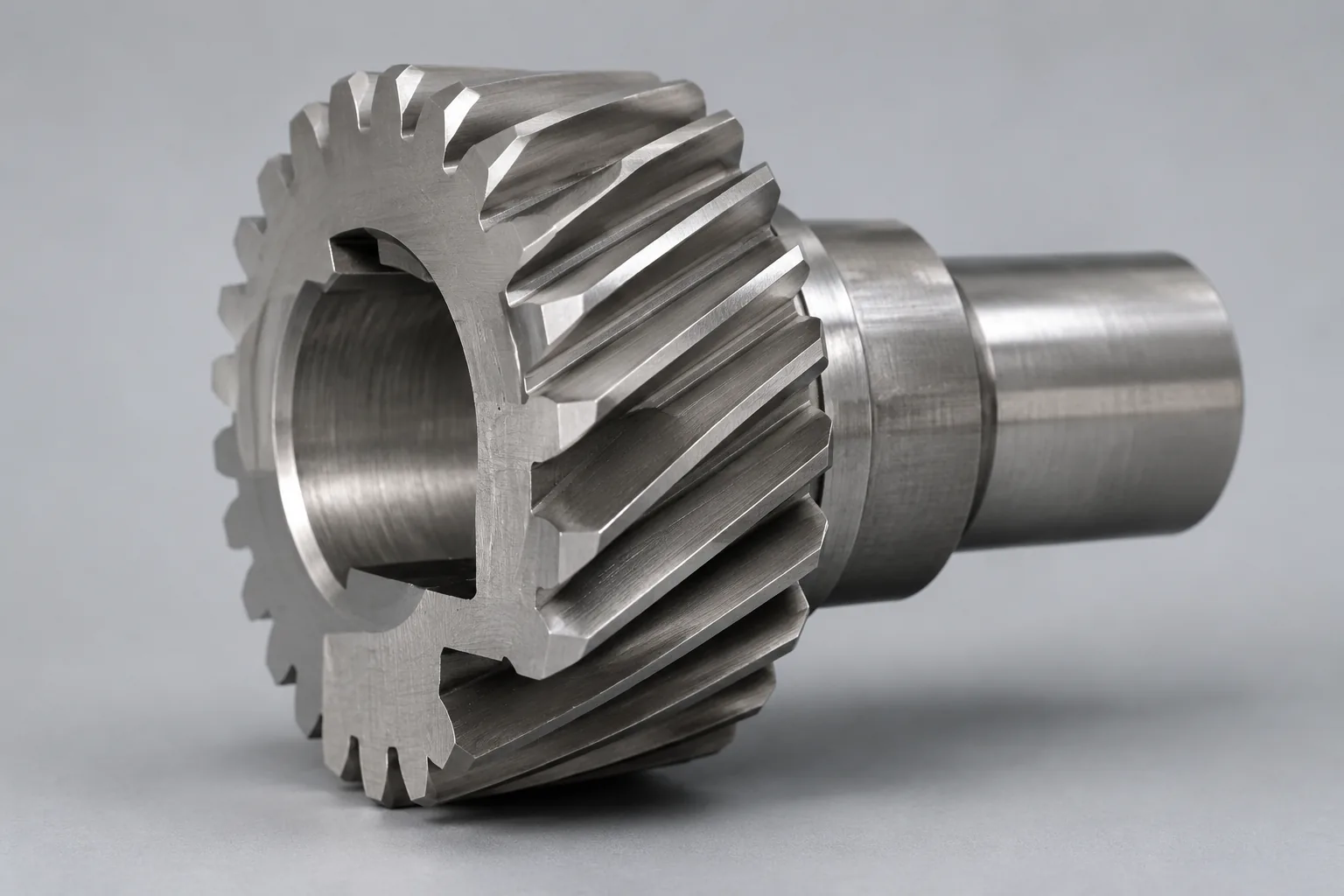
Contact ratio is the practical measure of how many tooth pairs share load at a given moment. A higher contact ratio spreads the same torque over more contact area, which lowers local stress and reduces the vibration excitation that produces mesh noise. Face width, the axial length of the tooth, also matters: a wider face carries more load but increases misalignment sensitivity and packaging size. These relationships can be described without equations, and the final numbers belong in the gear design calculation for the specific application.
Noise, Vibration, and Operating Smoothness
Spur gears tend to produce stronger mesh excitation because the whole tooth engages at once, and the effect becomes more noticeable as pitch line speed rises. Helical gears soften that impact and usually run smoother, which is why noise-limited drives often move to a helical design.
Tooth type is only one input. Noise depends on speed, load, accuracy grade, housing stiffness, mounting alignment, and lubrication as much as on the gear form. A well-aligned, accurately cut spur pair can run quietly in a stiff housing, while a misaligned helical pair can generate both noise and uneven tooth contact. Compare alternatives under the same speed, load, and mounting conditions, and treat qualitative expectations as a starting point rather than a guarantee.
Load Capacity, Efficiency, and Durability
Helical gears share load across more teeth in contact, so a compact helical pair can carry more torque than a spur pair of similar envelope size. Spur gears offer a simple, efficient transmission path in return. For helical gears, the axial load adds bearing losses, so net efficiency is application-specific and should be judged on the complete drive rather than on the gear pair alone.
Durability depends on material, heat treatment, accuracy grade, lubrication, and alignment. Uneven tooth contact concentrates stress at the tooth ends, and inadequate or zero backlash can compound the problem. Either gear form can be durable when the housing, lubrication, and alignment support it.
Axial Loads and Bearing Selection
This is the criterion that most often decides the design. A spur gear produces no inherent axial thrust, so shaft support can stay simple. A helical gear pushes along its shaft, and the direction of that thrust depends on the hand of the helix and the direction of rotation.
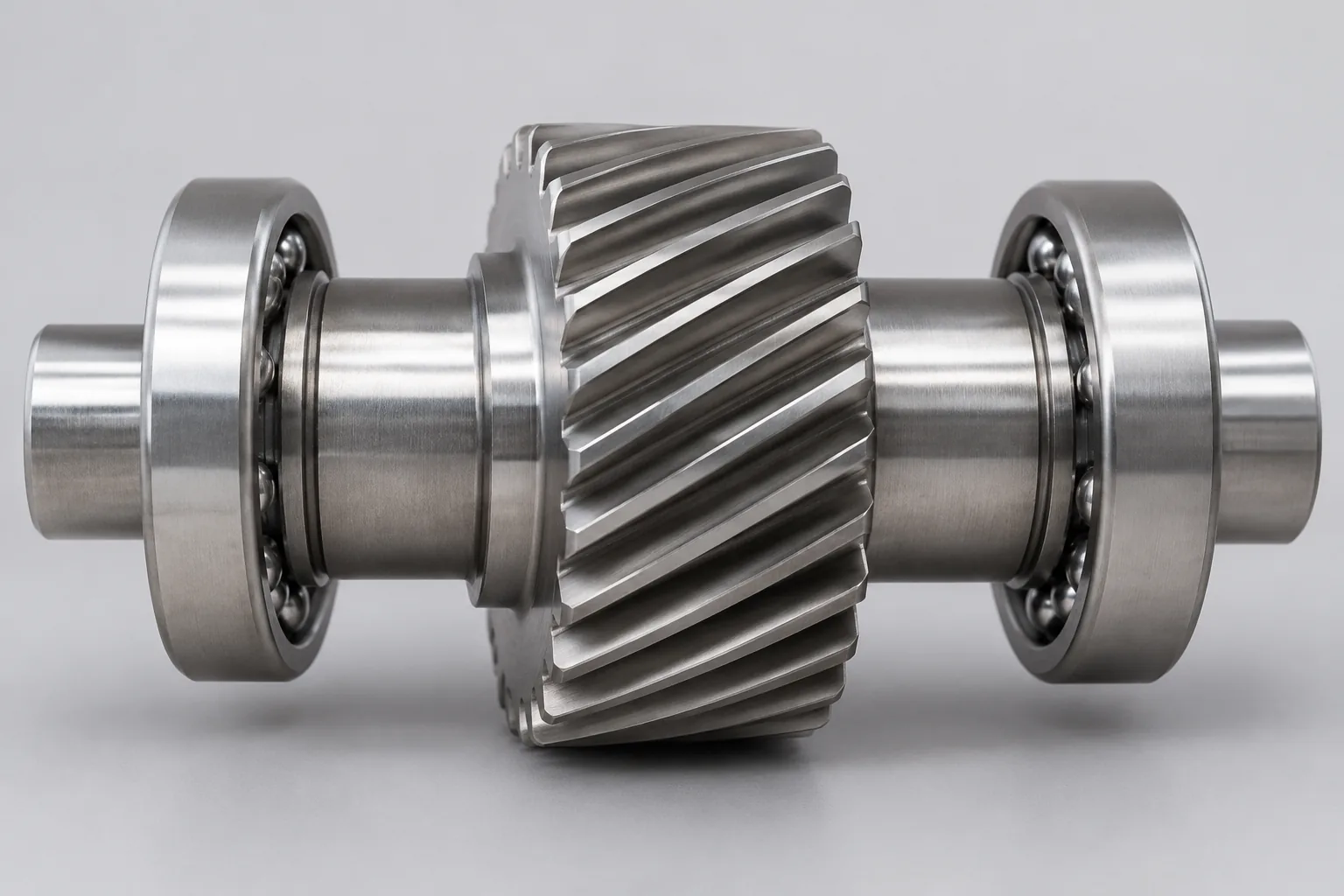
- Thrust must be reacted by thrust-capable bearings, stiffer housings, and a sealing arrangement that tolerates the resulting shaft movement.
- Opposed helix pairs, including double-helical or herringbone forms, combine right-hand and left-hand teeth so the axial forces largely cancel.
- Opposed arrangements and larger bearings add cost and packaging complexity compared with a plain spur layout.
Choose thrust-capable bearings when helical gears run in high-load or continuous-duty systems. Low-load helical drives may tolerate simpler bearing arrangements, but that must be verified for the actual duty cycle rather than assumed.
Related Bearing Consideration: Axial Thrust in Helical Drives
Bearing selection is where a gear comparison becomes a system comparison. Combined radial and axial load changes bearing type, bearing life, and the stiffness the housing must provide. Two gear options that look similar on a torque basis can differ once the extra bearing capacity, housing material, and seal design are counted. Bearing life should be checked before committing to a helical layout, and the bearing choice belongs in the total cost comparison rather than in a separate purchasing decision.
Cost, Manufacturing, and Availability
Spur gears are generally simpler to cut, inspect, and source, which usually keeps unit cost lower. Helical gears require more complex manufacturing and typically carry a cost premium, and the drive also needs thrust-capable bearings and sometimes a stiffer housing.
- Unit price is only part of the comparison; bearings, housings, seals, and noise treatment belong in the same calculation.
- Availability, lead time, tooling, and minimum order quantity can matter as much as the quoted price, especially for replacements and low-volume builds.
- Total system cost favors the spur option when the application can accept its noise level without extra treatment.
Speed, Size, and Packaging Trade-offs
Helical gears are often favored where high speed and high load must fit into a compact envelope, because greater contact ratio raises torque density. Spur gears may be adequate and more economical in lower-speed designs with space to spare.
The packaging advantage is not automatic. Axial bearings, thrust shoulders, and a more complex housing consume space that a spur layout can use for a wider gear. Evaluate the gear and its shaft support as one package before assuming the helical option is smaller overall.
Spur Gear Advantages and Limitations
Advantages: simple geometry, high efficiency, lower cost, wide availability, and no inherent axial thrust. Spur gears are easy to inspect and straightforward to replace in standard sizes.
Limitations: stronger mesh excitation and higher noise tendency at speed, less smooth engagement, and a larger envelope for high-load duties. These limits can often be managed with accuracy grade and housing design, but they cannot be removed by tooth type alone.
Helical Gear Advantages and Limitations
Advantages: smoother operation, lower noise tendency, and higher load capacity in a compact package, which supports higher speed and continuous duty.
Limitations: axial thrust, more complex bearings and housings, and higher manufacturing cost. The thrust path must be designed deliberately, and bearing life must be confirmed for the duty cycle.
When to Choose Spur Gears
Choose spur gears when cost, simplicity, and availability dominate the decision, and when axial thrust must be avoided altogether.
- The drive can tolerate spur-gear noise and vibration without extra acoustic treatment.
- The bearing arrangement should remain simple and radial-load focused.
- Space allows a straightforward parallel-shaft layout.
- Speed is low to moderate and the load profile is steady rather than shock-heavy.
When to Choose Helical Gears
Choose helical gears when smoothness, noise reduction, or high load density in a small envelope is the priority.
- Thrust-capable bearings or an opposed helix arrangement are feasible within the housing.
- The cost premium is justified by noise limits, load requirements, or packaging constraints.
- Speed is higher or the drive runs continuously, and bearing life has been verified for the axial load.
Selection Checklist for Your Application
Work through the list before fixing the gear type. Each item can change the answer on its own.
- Torque and load profile: continuous, peak, shock, and reversing loads.
- Speed and duty cycle: mesh frequency, lubrication, and thermal limits.
- Noise and vibration targets: acceptable sound level and the isolation the housing can provide.
- Space and weight: gear diameter, face width, and the envelope needed for bearings.
- Axial-load tolerance: bearing type, housing stiffness, and sealing arrangement.
- Cost and availability: unit cost, tooling, lead time, and total system cost.
- Maintenance: lubrication access, inspection intervals, and replacement strategy.
Common Misconceptions
- Helical gears are not automatically the better choice. They win only when their smoothness or torque density is worth the thrust and cost they add.
- Spur gears are not limited to low-quality or low-load systems. Accurate spur pairs serve demanding drives where noise is controlled by other means.
- Noise differences depend heavily on speed, accuracy, mounting, and lubrication, not on tooth form alone.
- Higher load capacity does not guarantee lower total system cost once bearings, housings, and sealing are included.
Conclusion
The helical vs. spur gears decision is a trade between smoothness and simplicity. Spur gears keep the drive efficient, economical, and free of inherent axial thrust, which suits lower-speed and cost-sensitive layouts. Helical gears deliver smoother running and more torque density in a compact envelope, at the price of axial thrust, thrust-capable bearings, and higher manufacturing cost. Start from the load profile and noise target, confirm the bearing arrangement can carry the resulting loads, then compare total system cost rather than unit price. Where the duty cycle is unusual or the axial load is significant, verify the final selection against the equipment manufacturer’s specification before ordering.
FAQs
Q1: Are helical gears always quieter than spur gears?
A: No. Helical teeth engage gradually, which usually reduces mesh impact and noise at comparable speed and load, but measured noise depends on accuracy grade, housing stiffness, alignment, lubrication, and background noise. A poorly aligned or inadequately lubricated helical pair can be louder than a well-made spur pair.
Q2: Do helical gears require thrust bearings?
A: They generate axial thrust, so the shaft support must be able to react it. Options include thrust-capable bearings, an opposed helix arrangement such as a double-helical pair, or a bearing set rated for the combined radial and axial load. Low-load drives may tolerate simpler arrangements, but that must be verified for the specific duty.
Q3: Are spur gears more efficient than helical gears?
A: Spur gears usually have a direct, efficient transmission path. Helical gears also run at high efficiency, but the axial load adds bearing losses that reduce net efficiency. The difference is application-specific and is often smaller than losses from lubrication, alignment, and bearing selection.
Q4: Which type is cheaper, helical or spur gears?
A: Spur gears are generally less expensive to manufacture because the tooth form is simpler to cut and inspect. Helical gears usually carry a cost premium, and the total cost also includes thrust-capable bearings, a stiffer housing, and any noise treatment. Unit price alone is a poor comparison.
Q5: Can spur gears be replaced directly with helical gears?
A: Not as a drop-in swap. Helical gears change the axial load path, so bearings, housing, and sealing must be reviewed, and center distance, ratio, and mounting must match the design. Any replacement should be confirmed against the equipment manufacturer’s specification.
Q6: What applications typically use spur gears?
A: Low-to-medium speed drives, cost-sensitive machinery, and simple parallel-shaft layouts, including pumps, conveyors, and similar equipment where modest noise is acceptable and axial thrust should be avoided.
Q7: What applications typically use helical gears?
A: Higher-speed or continuous-duty drives, noise-sensitive equipment, and compact high-torque gearboxes where axial thrust can be handled by suitable bearings, as is common in automotive and industrial transmissions.