Quick Answer: Choosing the right polyurethane roller starts with the application, not a hardness number alone. Define the roller’s job, calculate the load on each roller, record speed, duty cycle, temperature, and chemical exposure, then specify hardness with its scale and test method, load ratings, dimensions, core, bearing, bond, and compliance documents. The result should be a verifiable specification and validation plan, not a single material grade.
Polyurethane rollers are industrial rollers with a polyurethane cover bonded to a metal or plastic core. Buyers may also call them urethane rollers or roller covers. Two rollers with the same hardness can behave differently when load, speed, heat, moisture, or core design changes. The selection process below turns those variables into an RFQ and a finished-roller validation plan.
Start With the Roller’s Function and Operating Conditions
Begin with what the roller does and what happens if it fails. A drive roller needs traction; an idler or guide roller needs low rolling resistance and stable tracking; a pinch or feed roller needs controlled contact pressure. Record the consequence of failure so the validation effort matches the risk.
- Roller role: drive, idler, guide, pinch, or feed.
- Load: normal load, peak or shock load, radial and tangential load, and off-center load on each roller.
- Motion: rpm or linear speed, daily run time, start-stop frequency, and reversals.
- Environment: temperature, humidity, hot water or steam, washdown, oil, chemicals, food contact, antistatic needs, dust, and abrasives.
Where off-center load, shock, frequent starts, or manual handling exists, record the peak condition separately from normal running. A low-risk, low-speed, non-critical roller may use a simplified selection process, but its dimensions and bearing interface still need confirmation.
Do Not Select Polyurethane Rollers by Shore Hardness Alone
Shore hardness is an indentation test under a defined indenter and load. It is useful, but it does not by itself predict load capacity, abrasion life, or heat generation.
ASTM D2240-15(2021) states that hardness has no simple relationship to basic physical properties and that different hardness scales cannot be converted directly. ASTM D2240 Type A and Type D are common polyurethane hardness scales. A purchase specification should state both the value and the scale, for example 90 Shore A, plus the test method.
Hardness is a trade-off among grip, conformity, deflection, stiffness, and wear resistance. Softer polyurethane can improve traction and conformity; harder grades can reduce deflection and improve wear resistance. Neither choice is complete without load and heat data.
- One cast urethane range covers 50A, 60A, 70A, 80A, 90A, 50D, 60D, 70D, and 82D. Its 90A grade lists 6,063 psi ultimate tensile strength; its 82D grade lists 8,200 psi.
- A 55 Shore A grade, E855AB3 EXP, is described as high grip. A 93A/49D grade, 58277, emphasizes chemical and abrasion resistance. A 95A/50D grade, 58246, emphasizes high stiffness, chemical resistance, and oil resistance.
- Published guide-roller data show a 98 Shore A FPU series rated to 100 kg, a 92 Shore A FPTH series rated to 290 kg, and a 92 Shore A FTH series rated to 150 kg. Hardness alone does not set capacity.
Translate Grip and Deflection Needs Into a Hardness Range
For a drive or grip roller, define the friction needed and the acceptable slip. The tread deforms at the contact area to generate traction and spread load. For a guide or idler, focus on rolling resistance, contact deflection, and smooth running. Ask for hardness, tensile or modulus, compression set, and dynamic heat data together.
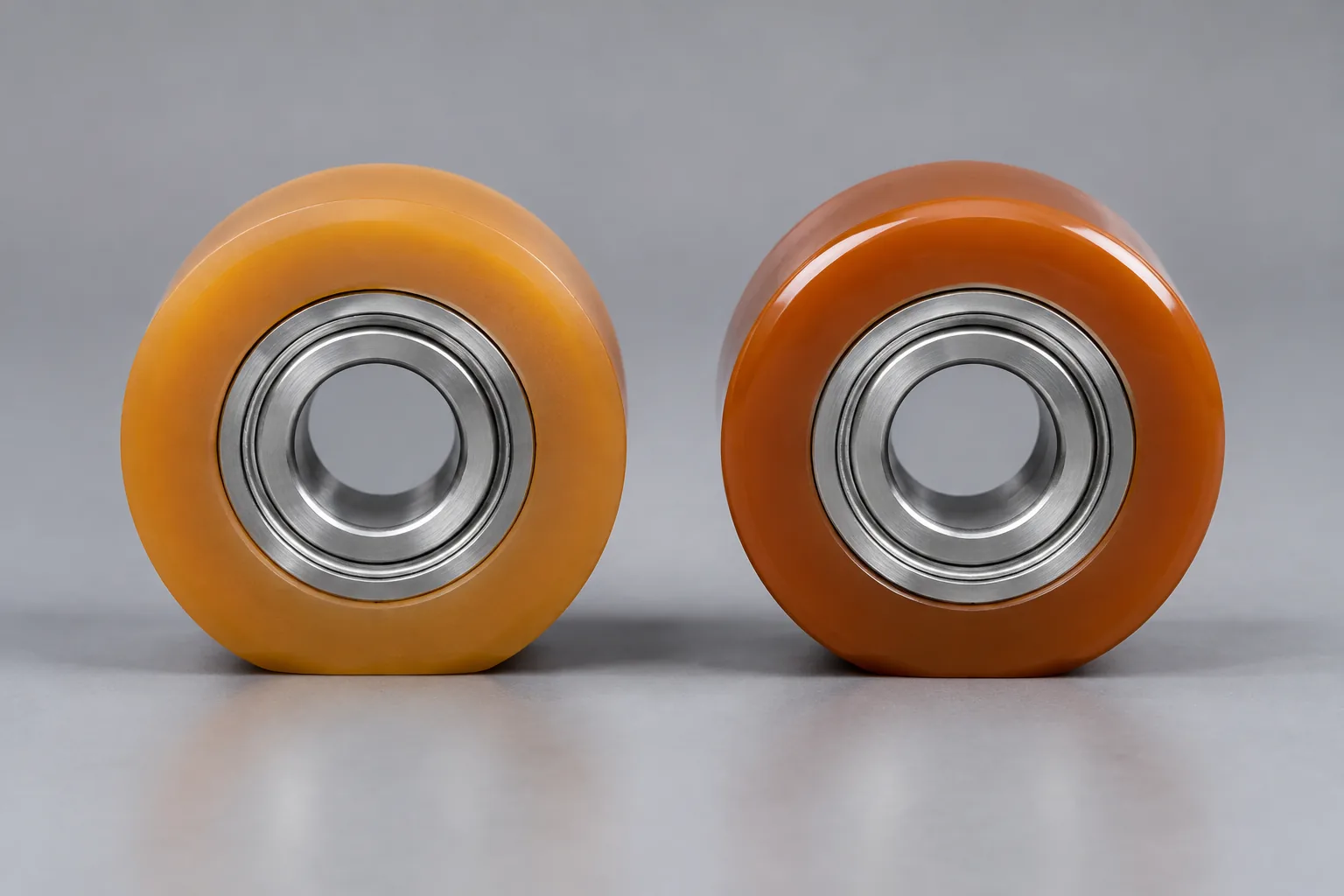
The TPU examples show the trade-off: a 55 Shore A grade is positioned for high grip, while harder grades are positioned for wear, chemical resistance, and stiffness. High grip, soft covers, and thin covers need extra checks on compression and heat generation.
Account for Cover Thickness and Hardness Measurement
Cover thickness changes what a durometer reads. A roller manufacturer notes that when elastomer thickness is below 0.250 inch (6.35 mm), durometer readings are usually slightly higher. Control the instrument, operator, measurement location, and roller surface temperature. Put the hardness test location and cover thickness on the drawing.
Calculate Load per Roller and Request Static, Dynamic, and Peak Ratings
Use the load on each roller, not the machine’s total weight. Include uneven load sharing, shock, starts and stops, off-center loading, and a safety factor. Ask for static load, dynamic load, and allowable peak load as separate figures.
- Published examples: 98 Shore A FPU at 100 kg, 92 Shore A FPTH at 290 kg, and 92 Shore A FTH at 150 kg.
- A 92 Shore A molded polyurethane roller, RE.G5, uses a steel core and ball bearing.
- One guide-roller design bonds the tread directly to the ball bearing.
Confirm load ratings with core material, bearing type, bond system, and allowable drive torque. On a multi-roller machine with uneven distribution, check the worst-loaded roller. A static pinch roller may put compression set first, but it still needs a peak load check.
For Continuous Operation, Check Speed, Heat, and Compression Set
At higher speed or continuous duty, cyclic deformation creates hysteresis heat. That heat can raise temperature, age the material, and drive fatigue. Static compression data alone is not enough.
Request dynamic compression, heat-generation, or full-roller bench data. For static compression, assess compression set at the actual compression ratio, temperature, and time.
- ASTM D623 compares heat generation and fatigue under dynamic compressive strain, and it notes that accelerated tests do not equal field life.
- ASTM D395-18(2025) measures the ability to retain elasticity after long compression, using constant-force and constant-deflection methods. ASTM notes that it mainly applies to static stress; dynamic duty is better served by compression flex or hysteresis testing.
- A 92 Shore A RE.G5 roller at 4 km/h on a smooth floor with an 80 x 70 mm size needs about 10 N of push at 1,000 N load and about 51 N at 4,000 N. Published guidance suggests a single-wheel moving force below 50 N for a four-wheel cart and below 30 N for frequent manual handling.
Add dynamic heat validation for high linear speed, high load, frequent starts and stops, or continuous multi-shift operation. Low-speed intermittent duty may need less dynamic testing, but check starting torque and bearing life.
Choose Polyester or Polyether Polyurethane for Moisture and Chemical Exposure
Polyester polyurethane usually favors higher mechanical properties, heat resistance, and mineral-oil resistance. Polyether polyurethane usually favors hydrolysis resistance, low-temperature flexibility, and resistance to microbial degradation. For wet, hot-water, steam, or frequent washdown service, start with a polyether grade or a supplier-confirmed hydrolysis-resistant grade.
TPU technical data state that polyester TPU in long-term hot water, steam, or tropical humid conditions can suffer irreversible hydrolysis and lose mechanical performance, while polyether TPU has higher hydrolysis resistance. The same data list higher mechanical properties, heat resistance, and mineral-oil resistance for polyester polyol TPU, and hydrolysis resistance, low-temperature flexibility, and microbial resistance for polyether polyol TPU.
Published roller data state that a 92 Shore A RE.G5 polyurethane roller suits atmospheric conditions, alcohols, and glycols, but is not recommended for organic acids, inorganic acids, alkaline solutions, or saturated steam.
List the chemical name, concentration, contact temperature, contact time, and cleaning frequency. Do not accept ‘chemical resistant’ as a complete specification. Swelling and loss of dimensional tolerance can indicate solvent attack.
Confirm the Complete Roller Temperature Limit, Not a Generic Material Range
The roller limit is the lowest allowable temperature among the polyurethane, core, bond layer, and bearing grease. Ask for the continuous temperature, short-term peak temperature, and allowable temperature rise for the specific grade and complete construction.
One guide-roller range using two 92A TPU variants and one 98A TPU grade lists a working temperature of -20°C to +70°C, with short-time exposure to +90°C. A roller manufacturer recommends recording roller surface temperature during hardness testing and keeping instrument, operator, and procedure consistent.
High-temperature processes, hot-air drying, steam cleaning, or high-speed continuous running need full-roller thermal validation. Short-term excursions are acceptable only when the polyurethane, bond, core, and bearing are all confirmed for that condition.
Define Wear, Tear, and Chemical Resistance by Test Method
For wear, ask for the test method and a volume-loss value or abrasion index. For cuts, chips, or sharp edges, compare tear strength using the same method and specimen type. Confirm chemical compatibility for each actual medium.
- ASTM D5963-22 uses a rotating drum abrasion machine for vulcanized rubber and thermoplastic elastomers. Results can be reported as volume loss in mm³ or as an abrasion index; with volume loss, a lower number means better abrasion resistance. ASTM warns that the result does not equal product wear life in service.
- ASTM D624-00(2020) measures tear strength of vulcanized rubber and thermoplastic elastomers. Results depend on specimen shape, stress distribution, strain rate, and specimen dimensions, so comparisons need the same method and specimen type.
Abrasive dust, debris, sharp edges, slurry, or high sliding friction should trigger both abrasion and tear requirements. Clean, smooth, low-sliding duty may need less abrasion testing, but the basic wear grade still needs confirmation.
Specify Dimensions, Core, Bearing, and Bond in the Drawing
The dimensional specification should include outside diameter, cover width, cover thickness, bore or bearing model, runout, cylindricity, surface roughness, and dynamic balance grade. Core material, surface treatment, bonding system, and allowable drive torque are part of the load specification, not secondary details.
Require a minimum peel strength or bond strength between cover and core, plus the inspection method. A 92 Shore A RE.G5 roller uses a steel core, molded polyurethane, and ball bearings and is positioned for heavy loads and continuous movement. One guide-roller design states that its tread is firmly bonded directly to the ball bearing.
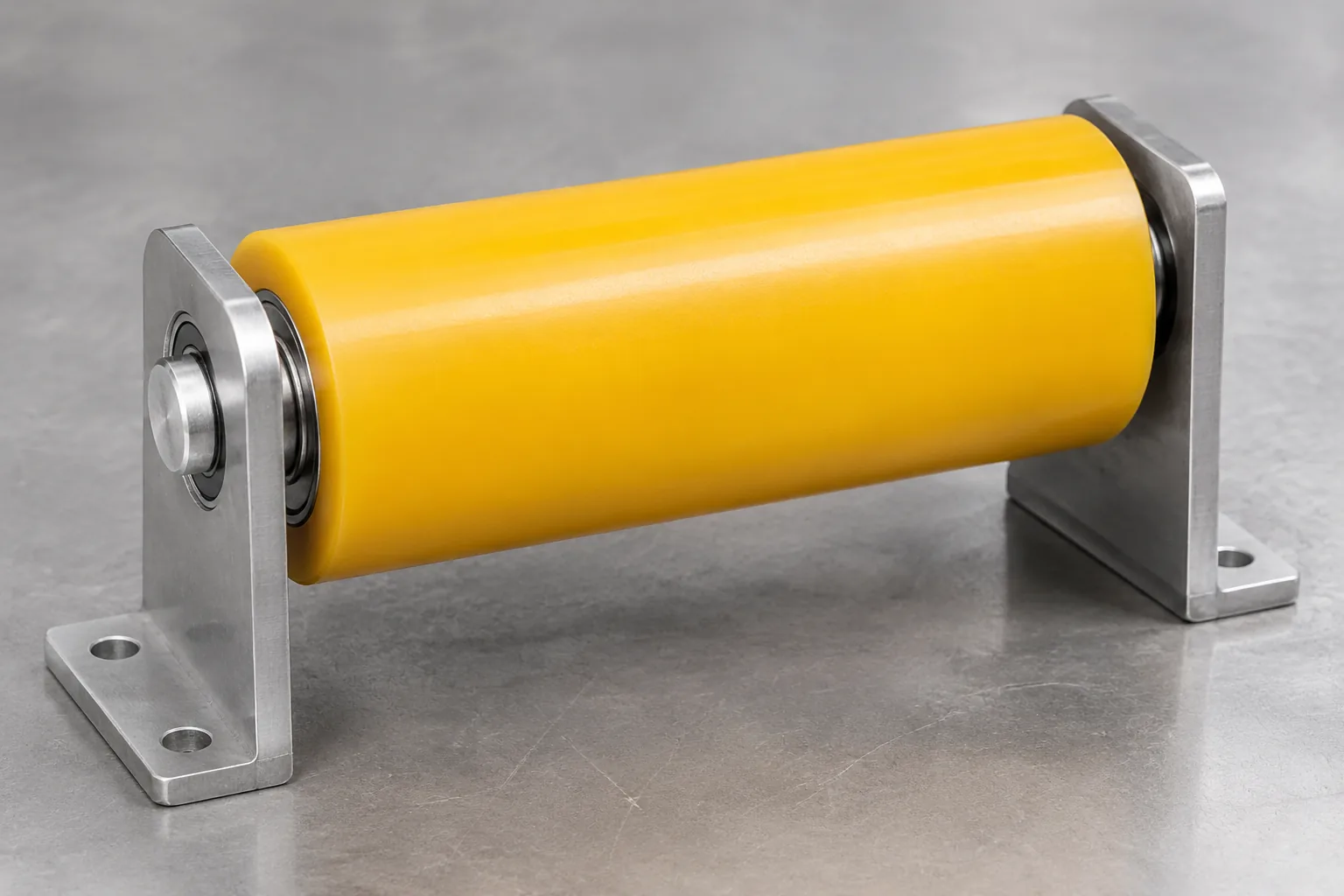
Drive rollers, high-torque applications, and frequent starts and stops need extra attention to bond strength and allowable torque. A low-torque idler may have a simpler bond requirement, but the cover must still be checked for delamination.
Handle Food Contact, Antistatic, and Regulatory Compliance
Do not select a food-equipment roller only because a material is described as ‘FDA polyurethane’. Ask for a compliance statement that matches the specific formulation, color, and production batch to the intended use.
The U.S. FDA food-contact rules associate polyurethane resins with 21 CFR 175.105 and 21 CFR 177.1680, and the intended use and conditions still have to match those rules. For antistatic or conductive duty, write a measurable surface-resistance or volume-resistance range, the test method, the grounding path, and the humidity condition. Published catalogue data show that some TPU guide rollers are available in conductive versions, but not every polyurethane series offers that option. Confirm FDA, EU food-contact, RoHS, or REACH documents for the target market.
Direct food contact, indirect food contact, frequent washing, and high-temperature washing need different compliance and material validation. Non-food and non-antistatic applications should not be over-specified, because unnecessary requirements can narrow the material choice.
Build an RFQ Checklist and Validate the Finished Roller
Use a written RFQ that lists:
- Normal and peak load on each roller, plus the safety factor.
- Speed in rpm or linear speed, daily run time, and start-stop frequency.
- Operating temperature, peak temperature, and allowable temperature rise.
- Shore hardness value and scale, with the test method.
- Allowable compression or contact deflection.
- ASTM D395 compression set, ASTM D623 dynamic heat or fatigue data, ASTM D5963 volume loss, and ASTM D624 tear strength where applicable.
- Polyester or polyether formulation and the specific grade.
- Contact media, concentration, temperature, and cleaning cycle.
- Outside diameter, width, cover thickness, runout, cylindricity, and surface roughness.
- Core material, bearing, bonding method, and allowable drive torque.
- FDA, EU food-contact, RoHS, or REACH documents as applicable.
Require datasheets, test reports, dimensional inspection reports, and compliance statements. For critical applications, validate a sample or first article at the actual load, speed, and duty cycle on a bench or in a controlled field trial. Inspect wear, surface finish, bond integrity, and runout against the documented specification. If the supplier cannot provide dynamic data, require full-roller bench testing or a controlled field test.
Low-risk standard rollers may use the supplier’s standard specification and routine inspection, with less special testing.
Avoid Common Selection Mistakes
Common errors include:
- Selecting by Shore hardness alone and ignoring load, heat, and wear testing.
- Using total machine weight instead of the actual load on each roller, and ignoring off-center load or shock.
- Quoting a generic polyurethane temperature range instead of the complete roller’s lowest limit.
- Treating ‘FDA polyurethane’ or ‘antistatic’ as a finished-roller compliance claim without formulation, batch, and resistance test evidence.
- Ignoring cover thickness effects on hardness readings, and ignoring how core, bearing, and bond limit load.
Watch for excessive deflection, flat spots, chunking, debonding, cracking, swelling, or loss of dimensional tolerance. Record load, speed, duty cycle, temperature, fluids, and service history when a roller fails. These risks rise in high-speed, continuous, wet-wash, food-contact, and heavy-load applications.
Conclusion
Choosing the right polyurethane rollers is a specification task, not a hardness lookup. Match the roller to its function, calculate load per roller, define speed and duty, check heat and compression set, select polyester or polyether for the environment, confirm the complete temperature limit, and write wear, tear, dimension, core, bearing, bond, and compliance requirements into the RFQ. Then validate the finished roller under real load, speed, and duty. That process gives buyers and engineers a defensible choice and a clear path to approval.
FAQs
Q1: Can I specify only a Shore hardness such as 90 Shore A without other performance data?
A: No. 90 Shore A defines a hardness value only when the scale and test method are stated, and ASTM D2240-15(2021) notes that hardness does not have a simple relationship to basic physical properties. Add load, speed, heat, compression set, wear, and application data to the specification.
Q2: Why does the same polyurethane grade read harder on a thin cover?
A: A thin cover can give a higher durometer reading because the measurement is influenced by the layer thickness and the underlying core. When elastomer thickness is below 0.250 inch (6.35 mm), readings are usually slightly higher. Record the location, thickness, instrument, operator, and surface temperature.
Q3: Should I use the machine’s total weight or the load on each roller?
A: Use the load on each roller. Total machine weight does not show how load is shared, and it hides off-center load, shock, starts, stops, and the worst-loaded roller. Ask for separate static, dynamic, and allowable peak ratings with a safety factor.
Q4: For hot-water washdown, should I choose polyester or polyether polyurethane?
A: Start with polyether polyurethane or a supplier-confirmed hydrolysis-resistant grade. Polyester TPU can suffer irreversible hydrolysis in long-term hot water, steam, or tropical humid conditions. Confirm the specific grade, chemical concentration, contact temperature, contact time, and cleaning frequency.
Q5: How do I determine the allowable temperature range for a polyurethane roller?
A: Use the lowest limit among the polyurethane, core, bond layer, and bearing grease, not a generic material range. Ask for continuous temperature, short-term peak temperature, and allowable temperature rise for the specific grade and complete roller. Include friction heat and process radiant heat in the check.
Q6: What tests should I request for a continuously running roller?
A: Request dynamic compression, heat-generation, or full-roller bench data, plus compression-set data at the actual compression ratio, temperature, and time. ASTM D623 covers dynamic compressive heat and fatigue, and ASTM D395-18(2025) covers compression set mainly under static stress. Validate the finished roller at real load, speed, and duty.
Q7: Does an FDA-listed polyurethane mean the finished roller can contact food directly?
A: Not by itself. The U.S. FDA food-contact rules associate polyurethane resins with 21 CFR 175.105 and 21 CFR 177.1680, and the intended use and conditions still have to match those rules. Ask for a compliance statement for the specific formulation, color, and production batch.
Q8: How should I specify an antistatic or conductive polyurethane roller?
A: State a measurable surface-resistance or volume-resistance range, the test method, the grounding path, and the humidity condition. Do not use ‘antistatic’ as a complete requirement. Confirm that the selected polyurethane series actually offers a conductive version, because not every series does.
Q9: What dimensions, core, and bonding requirements belong on the drawing?
A: Include outside diameter, cover width, cover thickness, bore or bearing model, runout, cylindricity, surface roughness, and dynamic balance grade. Also specify core material, surface treatment, bonding system, allowable drive torque, and the minimum peel or bond strength with its inspection method.
Q10: Why do rollers with the same hardness last differently on different machines?
A: Same hardness does not mean same load capacity, heat generation, wear resistance, or bond performance. Differences in load per roller, speed, duty cycle, temperature, moisture, chemicals, core design, and bearing selection can change life. Compare the full specification and validate under the actual operating conditions.