Quick Answer: A bushing is a replaceable tubular bearing element that provides a sliding surface between a shaft and its housing, a pin and a hole, or another pair of moving parts. It carries load, guides movement, and absorbs wear so the shaft or housing can stay in service. Bushings may be metallic, sintered, polymer, or composite, and may run lubricated or self-lubricating.
A bushing looks like a simple tube, yet it decides how a joint wears, how a shaft is located, and how often a machine must be taken out of service. Buyers meet the part under several names and in several constructions, and the differences matter once load, speed, lubrication, or contamination change. The sections below set out what a bushing is, how it works, which forms and materials are common, how lubrication and self-lubrication change the decision, and which selection parameters, standards, and maintenance checks matter.
Bushing Definition and Terminology
In mechanical engineering, a bushing is a cylindrical sleeve fitted into a bored component to give a shaft, pin, or plunger a wear-resistant sliding surface. ISO 4378-1:2024 calls a plain bearing bush (also bearing bush or bush) a replaceable tubular bearing element: its bore, its outside surface, or both act as the sliding face of a plain bearing. That standard treats a plain bearing as a bearing whose relative motion takes place by sliding.
Bushing vs. Bush vs. Sleeve Bearing vs. Plain Bearing
In everyday trade use, bushing, bush, bearing bush, and sleeve bearing are treated as synonyms. Manufacturer glossaries describe plain bearings as cylindrical components with no moving parts, and list bush, bushing, and sleeve bearing among the common names for them.
The strict reading is narrower. A plain bearing is the broader bearing type that carries load through a sliding interface, while the bushing is the replaceable tubular element that supplies that interface. A flanged housing bore with a pressed-in sleeve is a plain bearing assembly; the sleeve itself is the bushing. Keeping the distinction clear avoids confusion when a drawing calls out a bearing but the part to be replaced is only the liner.
What a Bushing Does in an Assembly
A bushing sits between a shaft and a housing, a pin and a hole, or any other pair of parts that move relative to each other. Its jobs are practical rather than decorative:
- Provide a controlled sliding surface that supports the moving part.
- Reduce friction and wear at the joint.
- Guide or position a shaft within its housing.
- Act as the replaceable wear part so the shaft or housing can stay in service.
Load direction decides the geometry. A cylindrical plain bearing mainly carries radial load, while a flanged version uses its flange face for axial location and can take some axial load as well. When wear on a journal bearing reaches a defined limit, the bearing alone can be replaced, leaving the surrounding housing structure in place.
Electrical Bushing: A Different Meaning
The same English word describes a completely different product in electrical work. A transformer bushing is an insulating device that lets a conductor pass safely through a grounded enclosure and connect to the equipment inside. IEC 60137:2017 covers insulating bushings for alternating voltages above 1,000 V in three-phase systems from 15 Hz to 60 Hz.
Electrical and mechanical bushings share a name and nothing else: function, materials, testing, and standards all differ. In written English, qualify the term as mechanical bushing or electrical bushing whenever the context could be read either way, and never apply mechanical selection rules to an electrical component.
How Bushings Work
A bushing works by allowing one surface to slide over another under load, with a lubricant, a low-friction material, or a combination of both keeping the two surfaces apart. Everything else about the part follows from that principle.
Sliding Contact Instead of Rolling Elements
A typical bushing contains no rolling elements and no cage. Motion occurs by sliding between the shaft and the bushing bore, which spreads load over a contact area rather than concentrating it at a few rolling contacts. Ball and roller bearings work the other way, transmitting load through rolling elements that separate the rings.
Sliding contact suits rotational, oscillating, reciprocating, and linear movement, depending on the design. It also makes the bushing quiet, compact, and tolerant of shock, at the cost of higher friction at start-up and a stronger dependence on lubrication and surface finish.
Load Paths: Radial, Axial, and Combined Loads
Radial load is the main case for a cylindrical sleeve bushing: the shaft pushes sideways against the bore. A flanged bushing adds a shoulder that can locate the part axially and carry some axial thrust, but only within the flange geometry and pressure limits the product allows. A spherical bushing or spherical plain bearing adds a curved sliding pair that accommodates limited angular misalignment, which helps where shaft and housing alignment cannot be held tightly.
Why Replaceable Wear Parts Matter
Bushings are often designed as the sacrificial component in a joint. Replacing a worn sleeve costs far less than replacing a shaft, a housing, or a complete assembly, and it keeps the harder, more expensive parts within tolerance.
There is no universal service life. Wear depends on load, sliding speed, motion pattern, temperature, contamination, lubrication, and shaft condition, so a replacement interval has to come from measured clearance or the manufacturer’s wear limit for that specific application.
Common Bushing Types and Configurations
Most bushings in catalogue listings fall into a small number of geometric families. The shape decides how the part is retained, which loads it can take, and how it is installed.
Sleeve or Straight Bushing
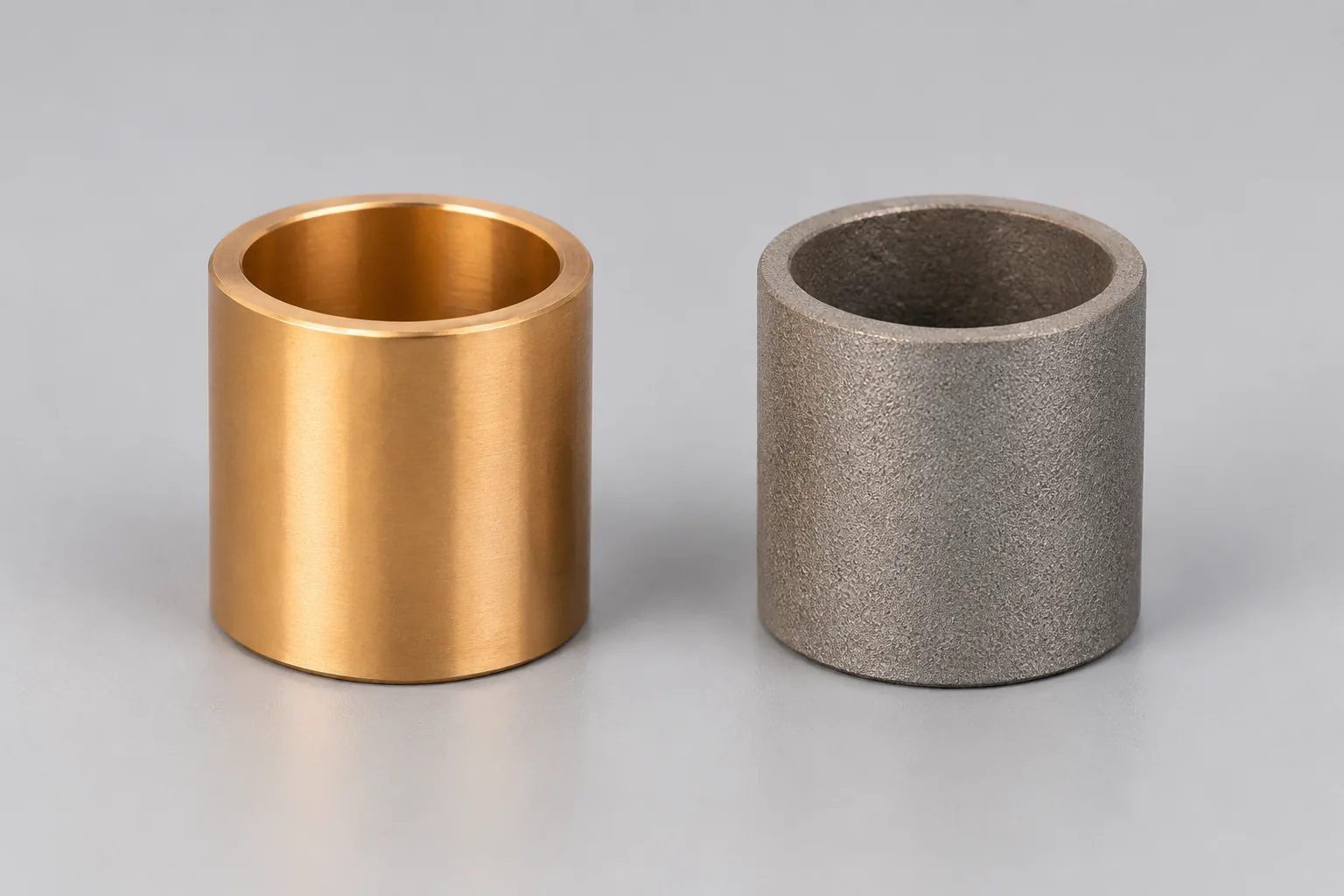
A straight bushing is a plain cylinder with no flange. It primarily supports radial load, and axial location is provided by other components such as shoulders, collars, or thrust washers. Straight bushes are the default choice for simple bores where space is limited and the surrounding design already controls end position.
Flanged Bushing
A flanged bushing carries a shoulder at one end. The flange locates the part axially, resists pull-through during assembly, and can take some axial load, which is why flanged forms appear in press-fit and reamed applications. SAE AS14238D covers flanged, press-fit, ream-type sleeve bushings and was revised in 2017 and reconfirmed in 2023.
Wrapped, Solid, and Split Bushings
These three terms describe how the wall is built rather than how the part looks from outside.
- Wrapped bushings are formed from single-layer or multilayer bearing material strip, usually with a seam, and ISO 4378-1:2024 gives the formal definition.
- Solid bushings are one-piece parts made from solid metal, sintered metal, or polymer.
- Split bushings have an opening or split structure that eases assembly and, in some designs, allows the bore to close down on the shaft.
SAE J835 sets out standard and key dimensions, measurement methods, and tolerances for split-type bushings, which is useful when a drawing must be checked against a supplier’s data sheet.
Spherical Bushings and Bearings
A spherical bushing uses a curved sliding pair, usually a ball with a matching socket, to compensate for limited angular misalignment. It is the practical answer when a shaft and housing cannot be aligned closely, or when a structure deflects under load. The trade-off is that the spherical pair must still be sealed and lubricated correctly for the environment it works in.
Bushing Materials and Construction
Material choice controls load capacity, permissible speed, lubrication needs, corrosion resistance, temperature range, and even the installation method. Two bushings with identical dimensions can behave very differently once the application moves away from the catalogue’s reference conditions.
Copper Alloys and Bronze Bushings
Solid bronze and copper-alloy bushings are the traditional choice for lubricated plain bearings, and they can be supplied with oil holes and oil grooves to feed the sliding surface. They tolerate heat, carry high pressure, and take a firm press fit. ISO 4379:2024 applies to cylindrical and flanged solid single-metal copper-alloy bushings with inside diameters from 6 mm to 200 mm; it was published in December 2024 as the fourth edition.
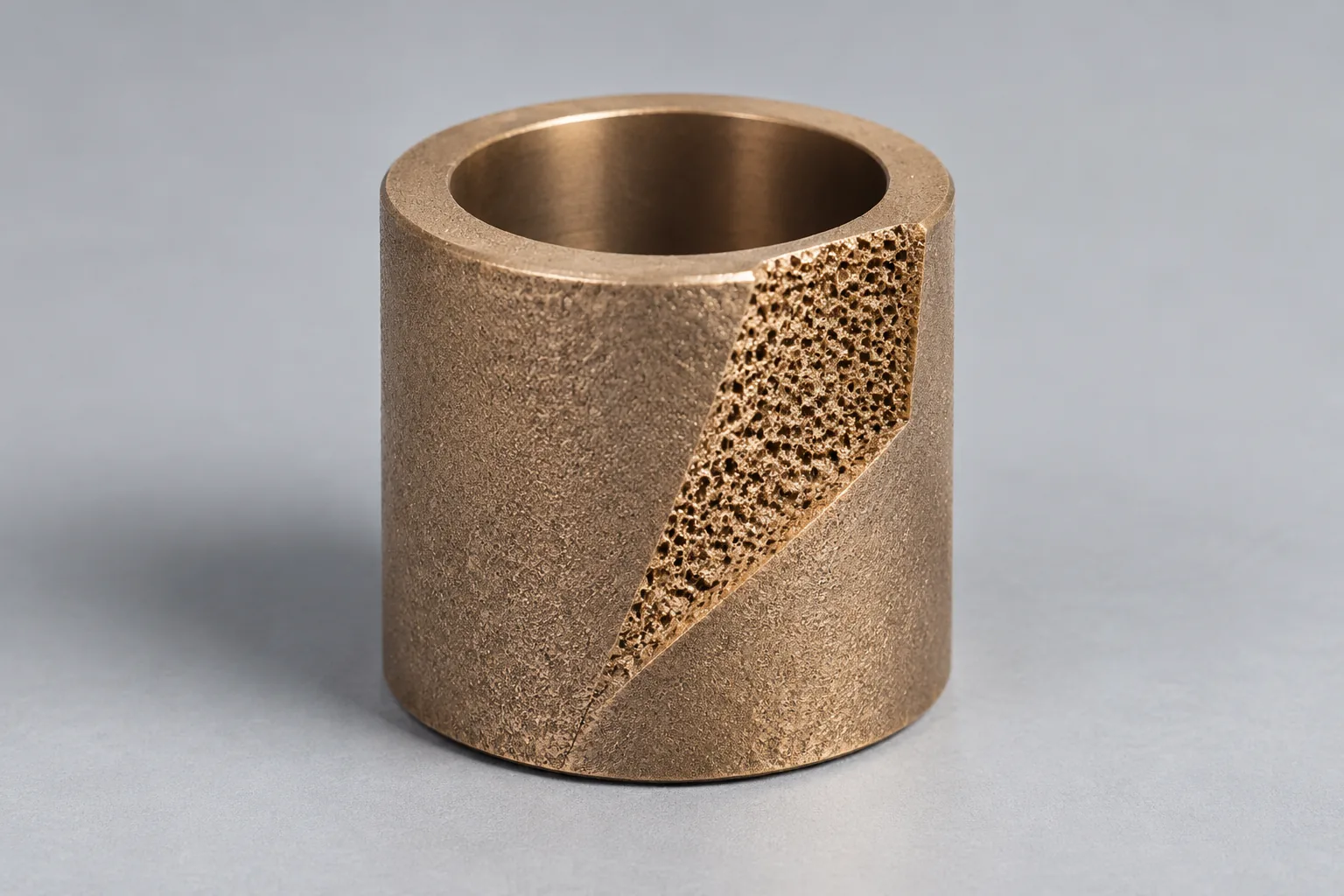
Sintered Metal Bushings
Sintered bushings are pressed and sintered from metal powder, leaving a controlled pore structure that can hold lubricating oil. An oil-impregnated sintered bushing releases oil from those pores during running and reabsorbs it when the shaft stops, which makes it a convenient low-maintenance option for light to moderate duties. ISO 2795:2020 gives dimensions and tolerances for two sintered forms: cylindrical and flanged bushings with a 1 mm to 60 mm inside diameter, plus spherical bearings with a 1 mm to 20 mm inside diameter. The 2020 edition was reconfirmed in 2025.
Metal-Polymer Composite Bushings
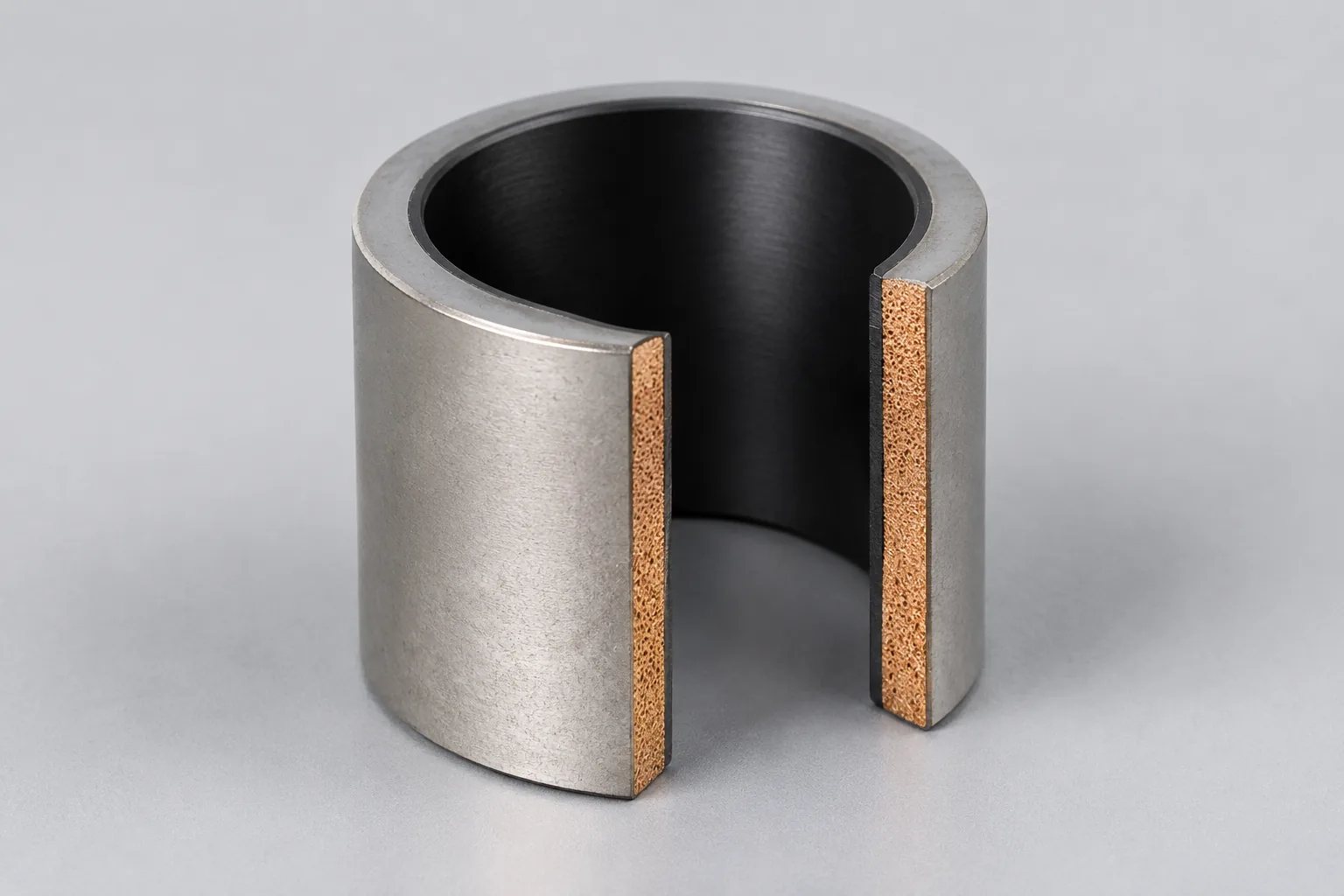
Metal-polymer bushings combine structural strength with a low-friction sliding face. A typical build is a steel or bronze backing, a sintered bronze porous interlayer, and a low-friction surface layer containing PTFE with fillers or a thermoplastic material. The backing carries the load and holds the press fit, the porous layer anchors the sliding layer, and the surface layer controls friction and wear.
Engineering Plastic and Polymer Composite Bushings
Engineering plastic bushings are usually formulated from a resin with reinforcing fibers and solid lubricants. That combination can deliver low friction, corrosion resistance, and running without external lubrication, and it keeps weight down.
Published values for commercial polymer bushing lines show how wide the envelope is. Dynamic steel-on-polymer friction coefficients of roughly 0.06 to 0.40 appear for some grades, long-term service temperatures of about 176-482°F (80-250°C) and short-term peaks of 248-599°F (120-315°C) are quoted for some materials, and press-fit installation in an H7 housing bore with interference up to 2% of the bushing inside diameter is specified for one product family. These are product-specific figures, not industry-wide limits, and the final inside diameter is formed after pressing.
Fiber-Reinforced and PTFE Composite Bushings
Fiber-reinforced composites suit applications that need corrosion resistance, electrical insulation, vibration damping, or lower mass. PTFE composite plain bearings are usually specified where no lubricant is permitted or where relubrication is impractical, while POM composite types usually need initial lubrication at assembly. The distinction matters during commissioning: a bearing that runs dry by design and one that must be primed before start-up look identical on the shelf.
Thermoplastic Bushing Standards
ISO 16287:2021 sets dimensions and tolerances for insert-type thermoplastic bushings made to interchange dimensionally with ISO 3547-1 wrapped bushings. Reinforced plastics fall outside its scope, so a glass-filled or fiber-reinforced grade has to be checked against the supplier’s own drawing.
Lubrication and Self-Lubricating Bushings
Lubrication is where most bushing decisions succeed or fail. The four categories below describe how the lubricant reaches the sliding surface.
Lubricated, Pre-Lubricated, Oil-Impregnated, and Self-Lubricating Bushings
- Lubricated bushings rely on an oil, grease, or fluid film and usually carry oil holes, grooves, or lubrication pockets.
- Pre-lubricated bushings receive initial lubricant at assembly, with possible replenishment at maintenance intervals.
- Oil-impregnated bushings are sintered parts whose pores hold oil for the life of the part.
- Self-lubricating bushings contain PTFE or solid lubricants in the material or surface layer and normally need no regular external lubrication.
For wrapped bushings, ISO 3547-3:2017 covers lubrication holes, lubrication grooves, and lubrication pockets, which lets a designer specify a feature position rather than leaving it to the supplier.
What Self-Lubricating Does and Does Not Mean
Self-lubricating does not mean zero friction, and it does not mean the bushing will never wear. It means the sliding surface carries its own lubricant, so no grease nipple or oil line is required. Wear still depends on shaft material and finish, load, speed, motion type, temperature, dirt, and chemical contact. Confirm the application limits before assuming maintenance-free operation, and avoid promising unlimited dry running without application-specific validation.
Key Selection Parameters for Bushings
Selection is a matching exercise between the application and the material, not a search for the hardest or cheapest part. The checks below cover the parameters that change the answer most often.
Load, Speed, Motion, and PV Value
- Confirm whether the load is radial, axial, or combined.
- Check static load, dynamic load, and the surface pressure over the projected area.
- Check rotational speed, sliding speed, and whether motion is rotating, oscillating, reciprocating, or linear.
- Calculate the PV value, the product of surface pressure P and sliding speed V, which is commonly used to judge whether a plain bearing material suits a given duty.
A bushing that runs well at high load and low speed can fail quickly at the same load with continuous rotation, because heat generation rises with sliding speed.
Shaft, Housing, Clearance, and Installation Fit
Shaft material, hardness, surface roughness, and surface treatment all influence wear. So do bearing clearance, housing fit, and the actual inside diameter after press fitting. ISO 12129-1:2024 sets out fit systems for metallic plain bearings in general engineering, covering average relative bearing clearances from 0.56‰ to 3.15‰, and ISO 12129-2:2019 covers geometric tolerances and surface roughness for shafts, flanges, and thrust rings in plain bearing assemblies.
With press-fit polymer bushings, the housing bore and the interference determine the finished bore, so the clearance cannot be confirmed until the part is installed. Always confirm installation instructions with the bushing manufacturer rather than assuming a fit from another material.
Temperature, Environment, and Maintenance Requirements
- Check operating temperature, temperature rise, and thermal expansion of both bushing and housing.
- Check water, dust, abrasive particles, corrosive chemicals, food-contact requirements, and outdoor exposure.
- Confirm whether grease or oil is allowed and what maintenance interval is acceptable.
- Check noise, vibration, weight, electrical insulation, and conductivity requirements.
Bushing vs. Rolling-Element Bearing: When Bushings Are Considered
A bushing is a plain bearing and contains no rolling elements. That single difference explains most of the selection logic. Composite plain bearings are well matched to heavy loads, low-speed rotation or oscillation, cramped installation space, and duties where lubrication is marginal or fluids are banned.
Rolling-element bearings generally offer lower starting friction and tighter control of shaft position at higher speeds, but they need more radial space, sealing, and a stiffer housing. Final selection still depends on load, speed, duty cycle, environment, and maintenance strategy, so neither family can be called universally better.
Standards and Specifications to Check
Standards define terminology, dimensions, tolerances, and inspection methods, and they help a buyer compare offers from different suppliers. Confirm the current edition and scope before specifying a bushing, because a standard written for one material or construction does not automatically cover another.
| Standard | Scope |
|---|---|
| ISO 4378-1:2024 | Plain bearing terminology, design, materials, and classification, including bush, plain bearing, journal bearing, thrust bearing, inside diameter, outside diameter, and clearance. |
| ISO 4379:2024 | Cylindrical and flanged solid single-metal copper-alloy bushings, inside diameter 6 mm to 200 mm, fourth edition, December 2024. |
| ISO 3547-1:2018, ISO 3547-3:2017, ISO 3547-4:2017 | Wrapped bushing dimensions and marking, lubrication holes and grooves, and materials. |
| ISO 2795:2020 | Sintered bushing dimensions and tolerances, reconfirmed in 2025. |
| ISO 16287:2021 | Insert-type thermoplastic bushing dimensions and tolerances, interchangeable with ISO 3547-1 wrapped bushings; reinforced plastics excluded. |
| ISO 12129-1:2024 and ISO 12129-2:2019 | Fit systems for metallic plain bearings, and geometric tolerances and surface roughness of shafts, flanges, and thrust rings. |
| ISO 12301:2007 | Geometry and material quality inspection, covering solid metal bushings up to 230 mm outside diameter and solid polymer bushings up to 200 mm inside diameter. |
| SAE J835 | Split-type bushing dimensions, key dimensions, measurement methods, and tolerances. |
| SAE AS14238D | Flanged, press-fit, ream-type sleeve bushings, revised in 2017 and reconfirmed in 2023. |
Installation, Maintenance, and Replacement Basics
Installation method affects clearance and final bore geometry, especially with press-fit bushings. A sleeve pressed into an undersized or rough bore can close down on the shaft, and a sleeve pressed in at an angle can misalign the whole joint. Clean and deburr the mating parts, inspect the shaft for scoring and wear steps, and use the specified driver or press adaptor rather than a hammer.
During replacement, check four things before fitting the new part: shaft condition, housing condition, lubrication condition, and contamination. Replacement should be based on the manufacturer’s wear limit or on measured clearance, not only on visible damage, because a bushing can be worn out of tolerance while still looking intact.
Follow the bushing manufacturer’s installation and maintenance instructions, including any specified housing bore, interference, and run-in procedure.
Key Takeaways
- A bushing is a replaceable tubular sliding bearing element used in mechanical assemblies, not a rolling bearing.
- Load, motion, speed, PV value, shaft and housing condition, temperature, contamination, and lubrication decide the correct type and material.
- Bushing, bush, sleeve bearing, and plain bearing are related terms, but the plain bearing is the broader assembly and the bushing is the replaceable element.
- Electrical bushings are a separate product category and must not be confused with mechanical bushings.
Conclusion
Knowing what a bushing is only gets a buyer halfway. The practical decision comes from matching a straight, flanged, wrapped, solid, split, or spherical bushing to the load direction, the motion, the speed, and the space available, then choosing a bronze, sintered, polymer, or composite material that can survive the temperature, contamination, and lubrication conditions of that joint. A bushing is inexpensive compared with the shaft and housing around it, which is exactly why it should be specified with measured data rather than guesswork. Confirm clearance after installation, check the mating surfaces during every replacement, and follow the manufacturer’s limits for the specific part before returning the assembly to service.
FAQs
Q1: Is a bushing the same thing as a bearing?
A: A bushing is a type of plain bearing, but the terms are not exact equivalents. The plain bearing is the broader assembly that carries load through sliding contact, and the bushing is the replaceable tubular element that supplies the sliding surface. A rolling-element bearing works through rolling contact and belongs to a different product family.
Q2: How can I tell whether a bushing is worn?
A: Watch for excessive noise, vibration, shaft movement or looseness, and local heat at the joint. None of these symptoms proves the bushing alone has failed, so confirm with a dimensional check of clearance and a look at shaft finish, lubrication condition, and contamination before replacing parts.
Q3: Do self-lubricating bushings need any maintenance?
A: They normally need no regular external lubrication, but that does not make them maintenance-free in every application. Shaft material and finish, load, speed, motion pattern, temperature, dirt, and chemical exposure still limit life, so confirm the application limits before assuming dry running is acceptable.
Q4: Can a worn bushing be replaced with a rolling-element bearing?
A: Only if the housing, shaft, sealing, and available space were designed for it. A bushing depends on a sliding film and often on a press fit in a bored housing, while a rolling bearing needs different seat geometry, sealing, and clearance. Substituting one family for the other changes load paths and alignment and should be engineered rather than improvised.
Q5: What causes a new bushing to fail early?
A: Ineffective lubrication, contamination, incorrect fit, misalignment, and a shaft surface that is too rough, too soft, or already damaged are the usual causes. Check all of them before fitting the replacement, because the same conditions will damage the new part in the same way.
Q6: When is a bronze bushing a better choice than a polymer bushing?
A: Bronze suits lubricated, higher-pressure duties where an oil hole or groove can feed the sliding surface and the housing can take a metallic press fit. Polymer and composite bushings suit low-maintenance designs, corrosive or dry running conditions, and lower weight, but their pressure and speed limits are product-specific and must be checked against the supplier’s data.