When inspecting an engine drive belt system, two components often cause confusion: the tensioner pulley and the idler pulley. They look similar, they both rotate, and they are typically positioned along the same belt path. But their roles in the system are fundamentally different.
One common question among vehicle owners is whether a squeaking or chirping noise signals a failing tensioner pulley or a bad idler pulley. This article explains the differences between these two components, covering their functions, design characteristics, failure symptoms, maintenance requirements, and replacement considerations.
Understanding the distinction between a tensioner pulley and an idler pulley helps vehicle owners diagnose problems more accurately, avoid unnecessary part replacements, and make informed maintenance decisions.
Quick Comparison: Tensioner Pulley vs Idler Pulley
The table below provides a side-by-side comparison of tensioner pulleys and idler pulleys across six key dimensions.
| Comparison Aspect | Tensioner Pulley | Idler Pulley |
|---|---|---|
| Role | Active – Applies and maintains belt tension | Passive – Guides the belt along its path |
| Core Function | Applies tension, automatically compensates for belt stretch, temperature changes, and accessory load fluctuations | Guides the belt around obstacles, increases wrap angle on driven pulleys |
| Design | Complex assembly: pulley, bearing, movable arm, and internal tension mechanism (spring or hydraulic) | Simple structure: pulley body and press-in bearing, mounted via a single fixing bolt |
| Adjustability | Self-adjusting – internal spring or hydraulic piston applies dynamic pressure and compensates for tension variations | Fixed – installed in a static position with no adjustment capability |
| Typical Failure Mode | Multiple failure sources: bearing wear, spring fatigue, arm binding, or hydraulic leakage | Primarily bearing wear – high-pitched whine or grinding noise that increases with engine speed |
| Interchangeability | Cannot be interchanged — a tensioner pulley is mounted on a movable arm, while an idler pulley is bolted directly to a fixed mounting point | |
What is a Tensioner Pulley?
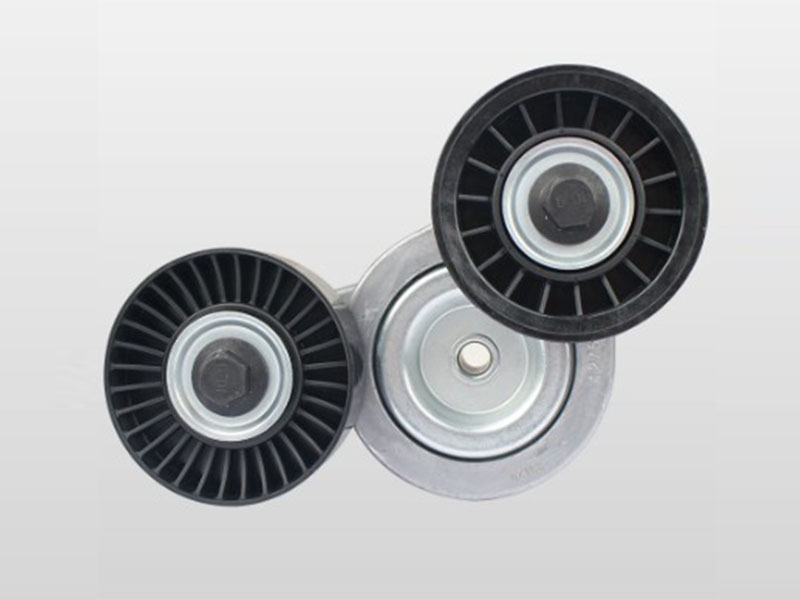
A tensioner pulley is an active adjustment device that applies and maintains a constant, calibrated load on a drive belt through a spring-loaded or hydraulic mechanism. Unlike a passive guide, the tensioner pulley continuously exerts pressure on the belt, keeping it at the appropriate tension level regardless of operating conditions.
The primary function of a tensioner pulley is to prevent belt slippage and detachment. It ensures that the belt remains tight enough to transfer power efficiently from the crankshaft to accessories such as the alternator, water pump, and air-conditioning compressor.
Automatic Compensation Mechanism
A tensioner pulley provides automatic tension compensation. As a belt gradually stretches over time due to normal wear and as thermal expansion changes belt length across operating temperatures, the tensioner automatically adjusts. It also responds to fluctuations in accessory load — for example, when the air-conditioning compressor engages or disengages — maintaining consistent tension at all times.
Design and Types
A tensioner pulley is a complete assembly rather than just a standalone pulley. It typically includes:
- A pulley wheel mounted on a bearing
- A movable tensioner arm
- A spring case or hydraulic actuator housing
- Internal tension mechanism (coil spring or hydraulic piston)
Tensioner pulleys fall into two main categories:
- Mechanical tensioner: Uses a spiral spring to apply tension. Some are manually adjustable (requiring a wrench to set tension), while others are fully automatic.
- Hydraulic tensioner: Uses a hydraulic piston to provide more precise tension control.
In terms of materials, steel is the most common choice for high-performance applications due to its durability and low coefficient of friction, which helps reduce wear on the belt. Some applications use polymer or aluminum tensioner pulleys for weight reduction.
Failure Symptoms
A failing tensioner pulley typically exhibits one or more of the following signs:
- Unusual noises – Squeaking, chirping, rattling, or grinding sounds from the belt area.
- Tensioner arm bouncing – Any abnormal chattering or bouncing of the tensioner arm under normal operation indicates the tensioner has already failed and should be replaced.
- Improper belt tracking – Belt runs off-center, sits at the edge of the pulley, or flips off the tensioner entirely.
- Tension loss – Belt squeals during acceleration, or an accessory stops working due to insufficient belt grip.
- Belt wear – Premature belt cracking, fraying, or glazing on the contact surface.
When inspecting a tensioner, remove the belt and rotate the pulley by hand. If the pulley spins more than two rotations freely with no resistance, the grease has dried out and replacement is required.
Service Life and Replacement
Tensioner pulleys typically last between 60,000 and 100,000 miles (approximately 96,000 to 160,000 km), depending on operating conditions and component quality. A tensioner is a wear item — its internal components degrade with age and mileage.
Many manufacturers recommend inspecting the tensioner, along with other serpentine system components, at 60,000 miles and replacing worn components by 90,000 miles or as advised by the vehicle manufacturer. Professional technicians suggest replacing a tensioner pulley whenever a timing belt or serpentine belt is replaced.
What is an Idler Pulley?
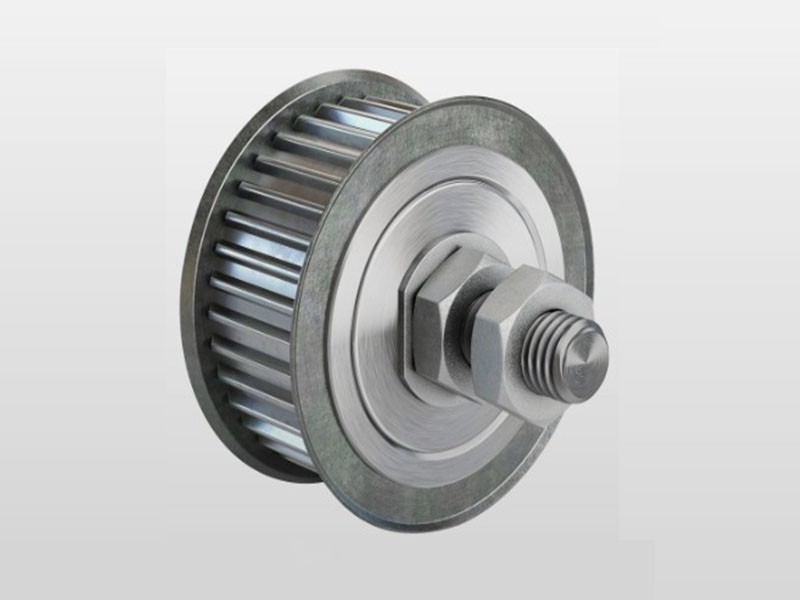
An idler pulley is a passive guide wheel that is bolted to a fixed mounting point on the engine. Unlike a tensioner pulley, an idler pulley does not apply any tension to the belt. Instead, its sole responsibility is to guide the belt along the correct path.
The belt loops under or around the idler pulley, creating a continuous loop that allows the belt to move freely while maintaining proper alignment. Idler pulleys also increase wrap angle — the amount of belt contact around a driven pulley — which improves power transmission efficiency and reduces the risk of slippage.
A vehicle can have more than one idler pulley, depending on the size of the engine and the length of the belt routing. Additional idler pulleys are often used to navigate around obstacles in the engine bay where a straight belt path is not feasible.
Design and Materials
An idler pulley has a simple construction: it consists of a pulley wheel and a press-in bearing assembled as a single unit. The pulley is mounted via a single fixing bolt directly to a fixed bracket or engine block.
The choice of materials depends on the application. High-load scenarios call for hardened steel or stainless steel for maximum durability. For standard passenger vehicles where weight reduction and noise control are priorities, polymer or aluminum idler pulleys are common.
Failure Symptoms
An idler pulley that is approaching end-of-life typically shows these signs:
- High-pitched squealing or whining – A sharp noise, most noticeable at idle or low speeds.
- Visible wear indicators – Reddish-brown dust around the pulley suggests bearing wear (worn metal particles mixed with grease). Surface discoloration may be caused by intermittent seizure of the pulley bearing.
- Excessive play – Rocking the pulley back and forth should produce no side-to-side movement.
- Belt abnormalities – Premature belt wear, fraying on the edges, or visible grooves in the belt surface.
When the belt is removed, spin the idler pulley by hand. If it spins freely for more than one to two revolutions with no resistance, the bearing grease has dried out — a sign that failure is imminent. If it will not spin at all or rotates with a gritty, grinding sensation, the bearing has already failed.
Service Life and Replacement
Idler pulleys should be inspected every 60,000 miles (about 96,000 km) and replaced as part of preventive maintenance by approximately 90,000 miles. The Detroit Diesel Series 40 operator’s manual recommends replacing idler pulleys every 60,000 miles of vehicle operation, regardless of apparent condition. Replacement intervals vary by application, typically falling within the 50,000 to 100,000 mile range.
Tensioner Pulley vs Idler Pulley: Key Differences
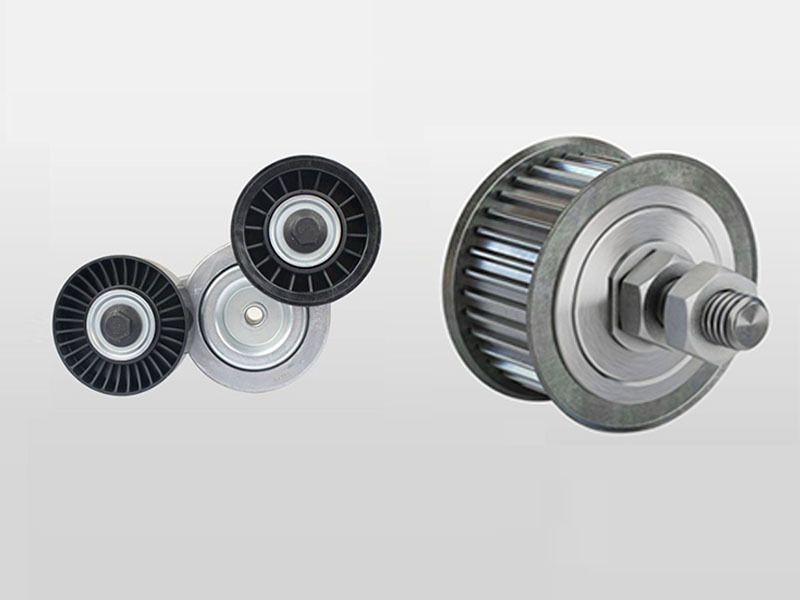
Difference 1: Functional Positioning
The most fundamental difference between these two components lies in what they do.
A tensioner pulley is active. It continuously applies force to the belt through a spring or hydraulic mechanism. When the belt stretches with age, the tensioner automatically takes up the slack. When accessory loads change, the tensioner responds instantly to maintain proper belt grip. Without a functioning tensioner, the belt will slip, squeal, and eventually fail to drive accessories properly.
An idler pulley is passive. It does not exert any force on the belt. Its role is strictly that of a guide — it changes the belt’s direction, helps the belt navigate around obstacles in the engine bay, and increases the wrap angle on driven pulleys to improve power transmission efficiency. The idler pulley simply rotates as the belt passes over it.
Difference 2: Design and Structure
Tensioner pulley design is substantially more complex. It is not merely a pulley — it is a complete assembly that includes:
- A pulley and bearing
- A movable tensioner arm that pivots around a fixed point
- A spring case or hydraulic actuator housing
- Internal tensioning components (coil spring or hydraulic piston)
- Stops that limit the arm’s range of motion
The tensioner pulley mounts onto this movable arm. The entire assembly is designed to rotate and articulate as spring force or hydraulic pressure is applied.
Idler pulley design is simple. It consists only of a pulley wheel and a press-in bearing. The pulley is secured by a single bolt directly to a fixed mounting bracket on the engine block or timing cover. Once installed, it does not move. This simplicity makes idler pulleys less expensive to manufacture and easier to replace than tensioner assemblies.
A practical way to distinguish them: look for the elongated slot on the mounting point. A tensioner pulley has an elongated slot that allows the clamping bolt to move throughout the adjustment range, while an idler pulley has a standard round hole for clamping.
Difference 3: Failure Characteristics and Diagnosis
Idler Pulley Failure Characteristics:
The failure source for an idler pulley is almost exclusively bearing wear. A pressed-in sealed bearing is fitted into the pulley body. When the seal fails or normal wear progresses, the bearing becomes dry and begins to degrade.
- Typical noise: High-pitched whine or continuous grinding noise that becomes more pronounced as engine RPM increases.
- Hand-spin test: Remove the belt and spin the idler pulley by hand. A normal pulley feels lubricated and tight, stopping within half a turn. If it spins freely more than 1–2 rotations, the grease is gone — replacement is needed. If it will not spin or has a gritty feel, immediate replacement is required.
Tensioner Pulley Failure Characteristics:
The failure source for a tensioner pulley can be one of several possibilities:
- Bearing failure — Produces a high-pitched whine similar to a bad idler pulley.
- Spring fatigue or hydraulic leakage — Results in insufficient tension, causing belt slippage, squealing, and potential accessory failure.
- Arm binding or bushing wear — Causes notchy movement when the tensioner arm is rotated through its range.
- Visual inspection: With the engine off, rotate the tensioner arm from stop to stop using a breaker bar or wrench. The arm should move smoothly through its entire range with no sticking or roughness. Any abnormal chattering or bouncing of the tensioner arm under normal operation indicates the tensioner has already failed.
- Belt tracking: Check whether the belt runs off-center on the tensioner pulley. Misalignment often points to bushing wear within the tensioner.
Difference 4: Maintenance and Replacement Rules
Maintenance Rules for Idler Pulleys:
| Aspect | Detail |
|---|---|
| Replacement trigger | Immediate replacement when bearing wear symptoms appear |
| Preventive inspection | Inspect at 60,000 miles; replace by 90,000 miles |
| Replacement method | Can be replaced independently; DIY-friendly, typically 30–60 minutes |
| Part cost range | $25–100, depending on brand and material |
Maintenance Rules for Tensioner Pulleys:
| Aspect | Detail |
|---|---|
| Replacement trigger | Immediate replacement when any symptom appears (bearing wear, spring fatigue, hydraulic leakage, arm binding) |
| Preventive inspection | Inspect at 60,000 miles; consider replacement at 90,000 miles |
| Replacement method | On some vehicles, the pulley cannot be replaced separately — the entire tensioner assembly must be replaced |
| Part cost range | $50–150; assemblies are typically more expensive than idler pulleys |
Difference 5: Simultaneous Replacement Considerations
Do both need to be replaced at the same time?
The answer depends on the system involved.
Timing belt system (timing system): Mandatory simultaneous replacement. When replacing a timing belt, the timing belt tensioner and all timing system idler pulleys must be replaced together. This is a requirement found in most OEM service manuals and is not an upsell — it is a critical safety measure. All timing components wear in a synchronized pattern under the same demanding conditions. Leaving any original component in place will place excessive stress on newly installed parts, increasing the risk of premature failure or, in an interference engine, catastrophic engine damage.
Serpentine belt system (accessory drive system): Strongly recommended simultaneous replacement. The tensioner, idler pulleys, and belt work together as a cohesive unit. A stretched belt accelerates tensioner wear, and a weak tensioner causes excessive belt vibration, shortening belt life. When any one of these components fails, the others are likely near the end of their service lives as well. Many vehicle owners report that replacing only the belt or only one pulley often leads to failure of the remaining components within a few months. The most economical long-term strategy is to replace the entire set — belt, tensioner assembly, and all idler pulleys — at the same time.
Difference 6: Replacement Cost Comparison
| Component | Typical Cost Range (Parts + Labor) |
|---|---|
| Idler Pulley (standalone) | $80–200 |
| Idler Pulley (full replacement, including belt and related work) | $151–320 |
| Tensioner Pulley Assembly (drive belt tensioner, parts + labor) | $125–380 |
| Tensioner Pulley Assembly (labor portion) | $83–104 |
| Tensioner Pulley Assembly (parts portion) | $158–177 |
These figures are approximate and vary significantly by vehicle make, model, engine configuration, and local labor rates. However, the general trend holds: tensioner pulley replacement costs are typically higher than idler pulley replacement costs, due to the more complex assembly involved and the additional labor required for disassembly and reassembly of surrounding components.
Summary and Key Takeaways
Tensioner pulleys and idler pulleys are both essential components in belt-driven systems, yet they serve fundamentally different roles — one is active, one is passive; one manages tension, the other guides the path.
The simplest way to distinguish them on an engine: look for movement. If the pulley is mounted on a movable arm that uses spring or hydraulic force to push against the belt, it is a tensioner pulley. If the pulley is bolted directly to a fixed point with no movement capability, it is an idler pulley.
For timing belt systems, the rule is absolute: replace the timing belt, tensioner, and all idler pulleys together — no exceptions. For serpentine belt systems, while the requirement is less strict, replacing the belt, tensioner assembly, and all idler pulleys simultaneously is the most cost-effective preventive maintenance strategy over the long term.
When purchasing replacement parts, always reference the OEM part number for the specific component. Do not assume that pulleys with a similar appearance are interchangeable — they are not.
Frequently Asked Questions
Q1: Can a tensioner pulley and an idler pulley be swapped or interchanged?
A: No, they cannot be interchanged. Even if two pulleys appear identical in diameter and bearing size, their mounting bases and operating mechanisms are entirely different. A tensioner pulley is mounted on a movable spring-loaded or hydraulic arm, while an idler pulley is bolted directly to a fixed engine mount. There is one partial exception: on older engines equipped with a manual adjustment tensioner (where tension is set by tightening a bolt rather than an automatic spring), the pulley itself may be interchangeable with an idler pulley. However, on modern engines with automatic tensioners, the two components typically differ in dimensions and should never be swapped.
Q2: Can I continue driving if a tensioner pulley or idler pulley is failing?
A: No, continued driving is not recommended. Failure to address a failing pulley carries significant risk. For timing system pulley failure on an interference engine (most modern engines), a seized idler pulley or tensioner will cause the timing belt to jump teeth or break, resulting in pistons striking open valves and often catastrophic engine damage. For accessory drive system pulley failure, a seized bearing will snap the serpentine belt almost immediately, causing loss of alternator, water pump, AC compressor, and power steering. The vehicle will likely become undriveable within minutes.
Q3: When replacing a belt, should the tensioner pulley and idler pulleys also be replaced?
A: Different rules apply to different systems. For timing belt systems, mandatory simultaneous replacement of the timing belt, tensioner, and all idler pulleys is required by virtually every OEM service manual. For accessory drive / serpentine belt systems, strong recommendation to replace the belt, tensioner assembly, and all idler pulleys together. A weak tensioner will accelerate new belt wear, and a worn idler bearing can seize causing belt failure shortly after replacement.
Q4: How long do tensioner pulleys and idler pulleys typically last?
A: Design life for both components is similar, typically 60,000 to 100,000 miles (approximately 96,000 to 160,000 km). Most industry sources recommend a full system inspection at 60,000 miles and preventive replacement by 90,000 miles. Actual service life varies based on manufacturing quality, operating environment (temperature extremes, dust, humidity), and driving conditions. Tensioner springs and hydraulic seals degrade with both mileage and age.
Q5: How can I tell if a pulley is in good condition or about to fail, just by spinning it by hand?
A: The hand-spin test is a reliable diagnostic method. Normal: spins with light resistance, stops within half a turn, feels lubricated and tight — healthy. Warning: spins freely more than 1–2 rotations with no resistance — grease has dried, bearing will fail soon. Emergency: will not spin at all, or spins with a gritty, grinding, or notchy feel — bearing has failed structurally, immediate replacement required.
Q6: Which is better — a plastic idler pulley or a metal one?
A: Both have valid applications; the correct choice is the one specified by the OEM. Metal pulleys (steel or aluminum) offer higher durability and a lower coefficient of friction, making them suitable for high-load and high-performance applications. Polymer/composite pulleys are lighter, quieter, and less expensive to manufacture, meeting the requirements of most standard passenger vehicles. Always purchase replacement components based on OEM part number specifications, not based on material preferences alone.
Q7: Why does reddish-brown “rust” sometimes appear around a tensioner or idler pulley?
A: This is typically not ordinary rust. The reddish-brown substance is a combination of lubricating grease mixed with fine metal particles generated by bearing wear. As the bearing’s internal rolling elements and raceways wear down, microscopic metal particles are produced and blend with the grease, creating a characteristic red-brown color. This is a strong indicator that the bearing seal has failed or the bearing itself is experiencing accelerated wear. Replacement is recommended upon observing this sign.
Q8: Can I replace the bearing inside a pulley instead of replacing the entire pulley?
A: No, bearing replacement is not recommended. Industry best practice specifies never attempting to replace only the bearing inside a pulley. Pulleys and bearings are engineered as matched assemblies. Pressing out the old bearing and installing a new one risks distorting the pulley housing, damaging the new bearing during installation, or creating misalignment. The safe and correct procedure is to replace the complete pulley assembly.
Q9: What is the most common cause of serpentine belt failure?
A: A pulley with worn bearings is one of the most common causes of serpentine belt failure. When an idler pulley or tensioner pulley bearing wears out, the pulley may spin irregularly, misalign the belt, or eventually seize. A seized pulley forces the belt to grind across a stationary surface, generating intense local heat that destroys belt material within minutes of operation. Regular inspection of all pulleys when the serpentine belt is serviced is the most effective way to prevent this failure mode.