Quick Answer: A CV (constant velocity) joint lets your car’s wheels turn and suspension move while still delivering engine power. Inside, six steel balls roll in curved grooves. A cage keeps them on the angle’s bisector. That way, output speed always equals input speed. No vibration. A rubber boot protects it.
Modern vehicles must steer, brake, and absorb road irregularities while delivering engine power to the drive wheels. A rigid axle cannot bend or telescope, which makes it unsuitable for front‑wheel drive or independent rear suspensions. This is why engineers rely on constant velocity joints (CV joints).
If you have ever wondered how a CV joint works while turning your steering wheel or driving over a bump, the answer lies in a clever mechanical design that keeps the output shaft speed exactly equal to the input shaft speed – regardless of the angle between them. Below we explain the operating principle, internal structure, and common failure signs without unnecessary technical jargon.
Why Does a Vehicle Need a Flexible Drive Shaft?
A vehicle’s suspension moves up and down constantly. The front wheels also turn left and right. A solid steel axle would quickly fatigue and snap under these combined motions.
The solution is to install a CV joint at each end of the drive half‑shaft. One joint allows the shaft to bend as the wheel turns, while the other permits slight length changes when the suspension compresses or rebounds. Together, they transmit torque smoothly, even at sharp angles (up to 50° for outer joints).
Core Principle – How a CV Joint Achieves Constant Velocity
A CV joint is a mechanical coupling that maintains zero angular velocity fluctuation when the drive shaft is angled.
To understand how a CV joint works, compare it with a conventional Hooke’s (universal) joint:
| Feature | Conventional U‑joint | CV joint (e.g., Rzeppa) |
|---|---|---|
| Speed uniformity | Pulsates twice per revolution at an angle | Absolutely uniform |
| Maximum working angle | ≈15‑20° | 45‑54° (outer joint) |
| Typical application | Rear‑drive shafts, trucks | Front‑wheel drive, independent suspension |
The CV joint eliminates the “acceleration‑deceleration” effect that causes vibrations in older driveline designs. This is why your front‑wheel‑drive car does not shudder when you turn the steering wheel to full lock.
Component Breakdown – How the Rzeppa (Ball‑Type) CV Joint Works
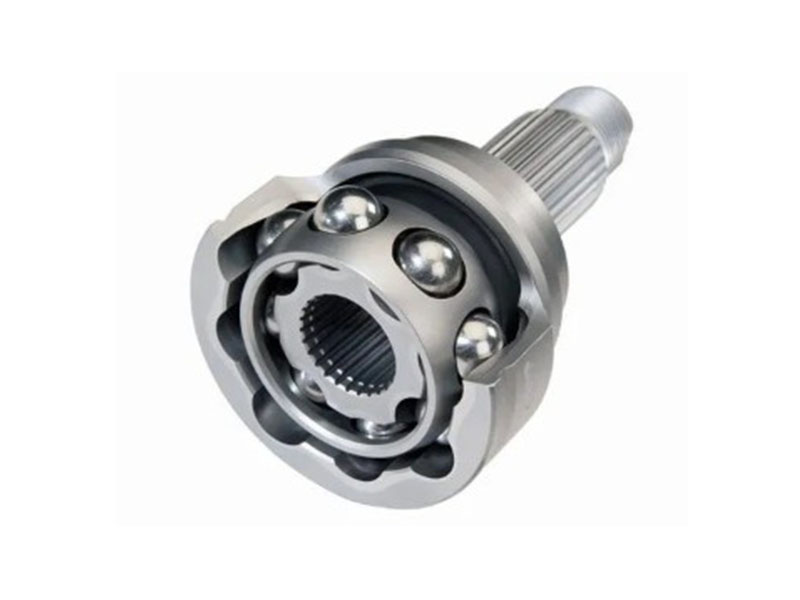
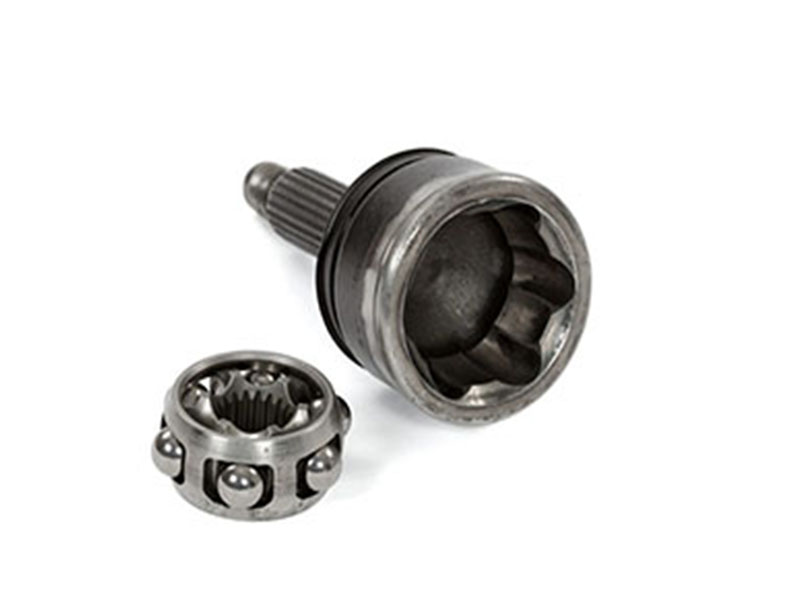
The most common CV joint on the wheel side is the Rzeppa joint (invented by Alfred Rzeppa in the 1920s). It consists of four main parts:
- Outer race (housing) – contains curved ball grooves.
- Inner race (star) – fits inside the outer race and also has grooves.
- Six steel balls – transmit torque from the inner to the outer race.
- Cage – keeps the balls in a single plane.
The critical role of the cage
The cage is not merely a spacer. In a Rzeppa joint, the cage holds the six steel balls precisely in one common plane – the equatorial plane of the joint. This plane is always perpendicular to the joint’s axis. When the drive shaft bends, the cage forces the balls to remain in that exact plane, which automatically positions them on the bisector of the angle between the inner and outer races. Without the cage, the balls would shift axially, the geometric relationship would be lost, and constant velocity would be impossible. Thus, the cage is the structural element that enforces the “equal‑angle” condition.
Step‑by‑step operation:
- Power input – The drive shaft rotates the inner race.
- Torque transmission – The inner race pushes the six steel balls along their grooves. The balls then press against the outer race.
- Angled operation – When the shaft bends (e.g., during a turn), the cage keeps the balls in the bisector plane. This geometric constraint ensures that the outer race rotates at the same instantaneous speed as the inner race – no pulsation, no vibration.
In short, how a CV joint works can be summarised as: the ball grooves are machined so that the velocity vectors of the input and output shafts always match, and the cage ensures that the balls always lie on the angle bisector.
Two CV Joints per Half‑Shaft – Different Roles
A typical drive half‑shaft uses two different CV joint designs – one at the wheel end (outer) and one at the differential end (inner). They have distinct functions.
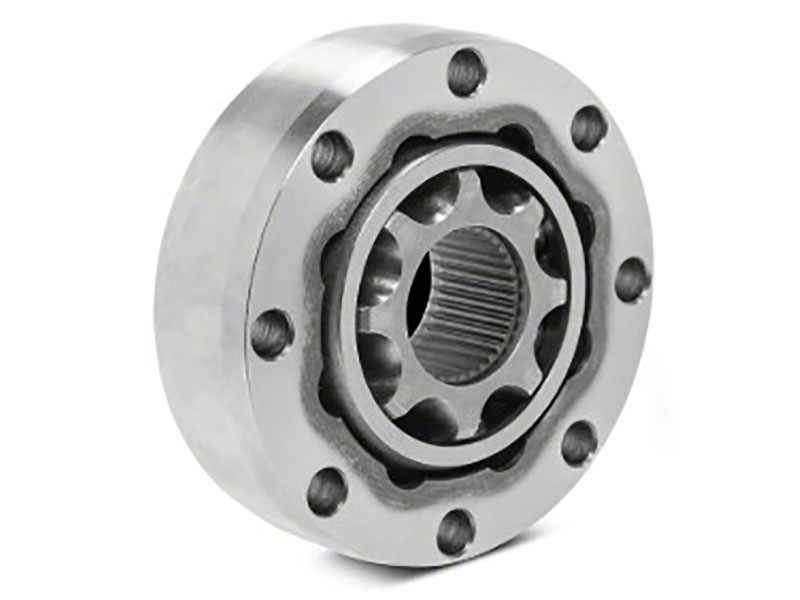
Outer CV joint (Rzeppa / ball type)
- Location – Near the wheel hub.
- Key feature – Very large articulation angle (typically 47‑50°). This allows the wheel to steer fully left or right.
- Limitation – Almost no axial plunge (telescoping) movement.
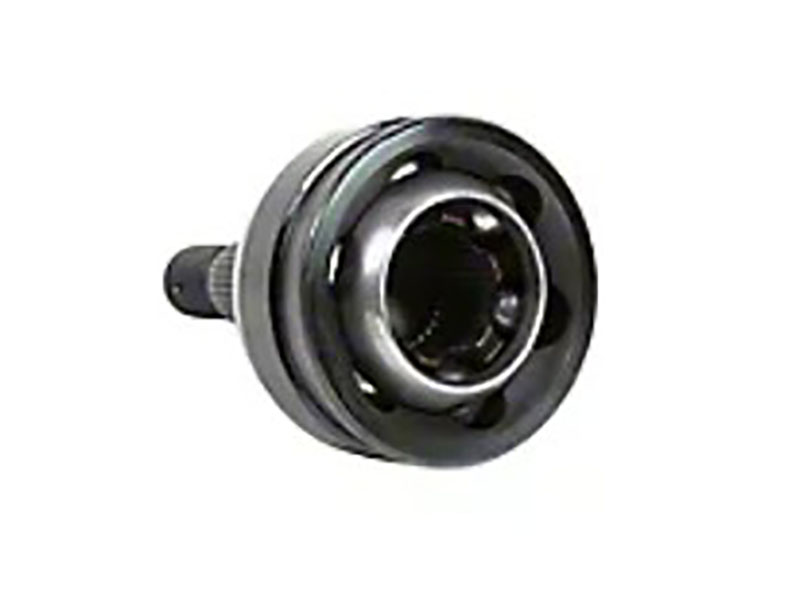
Inner CV joint (Tripod / three‑roller type)
- Location – Connected to the transaxle differential.
- Key feature – Axial plunge capability (up to ±20‑30 mm). This accommodates length changes as the suspension moves up and down.
- Articulation – Smaller angle (around 22‑31°).
When you ask how a CV joint works as a system, remember that the outer joint handles steering angles while the inner joint handles suspension travel. Together they make independent suspension feasible.
Failure Modes – How CV Joints Wear Out
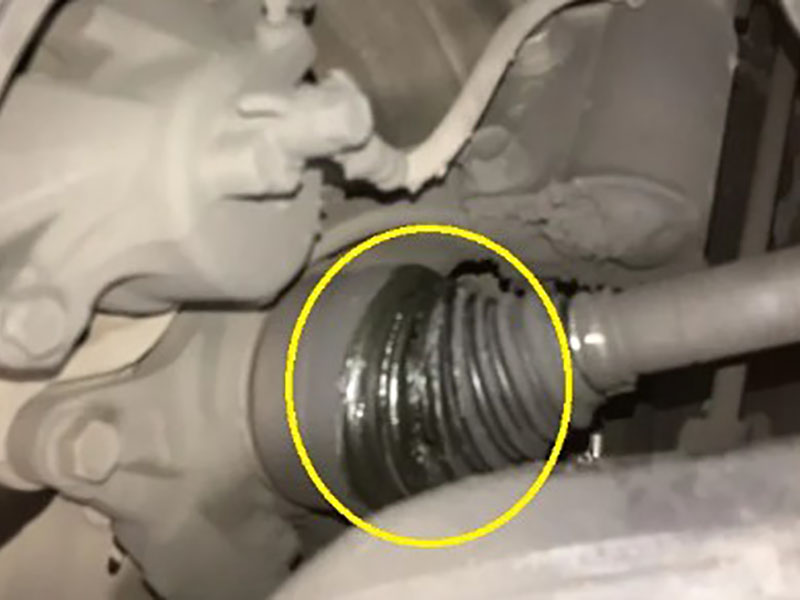
A CV joint is a precision component that relies on clean grease and intact seals. Its most vulnerable part is the rubber boot (gaiter).
The boot is critical
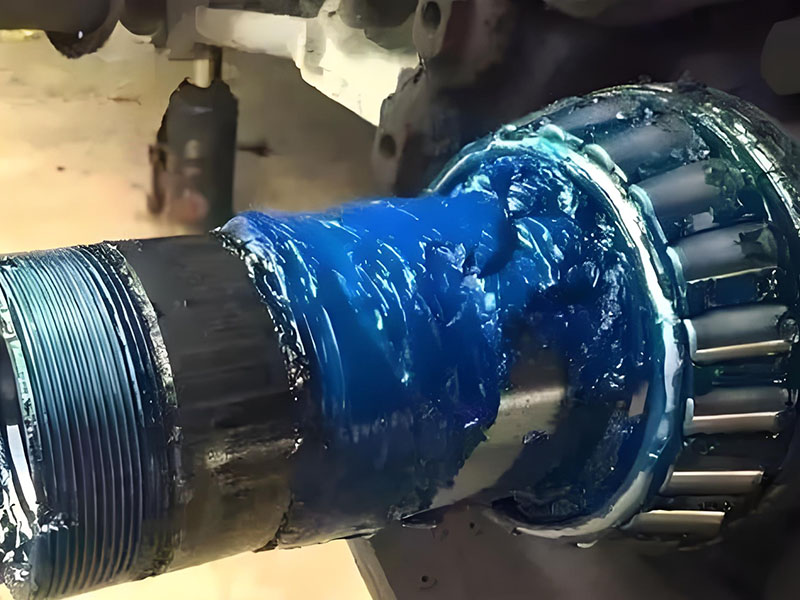
The joint is packed with a special molybdenum‑disulfide grease and sealed by a rubber boot. Once the boot tears, road grit and water enter. Within a few hundred kilometres, the polished ball grooves are eroded, leading to rapid wear.
Common failure symptoms
| Failed part | Symptom |
|---|---|
| Outer CV joint | Rhythmic clicking or knocking during low‑speed turns (especially when reversing on full lock) |
| Inner CV joint | Clunking or shuddering during hard acceleration or deceleration (usually straight‑line) |
| Torn boot | Fresh black grease splattered on the inside of the wheel or on suspension components |
If you hear such noises, the joint has already lost its precision. Continuing to drive risks a complete half‑shaft separation, which can leave the vehicle immobile and possibly damage the differential.
Conclusion
Understanding how a CV joint works helps you appreciate a simple but brilliant piece of engineering: a set of steel balls rolling in specially curved grooves, held in the bisector plane by a precision cage. This design delivers constant rotational speed, enabling smooth power delivery through steering and suspension motions.
Regular visual inspection of the rubber boots is the most effective way to extend CV joint life. Once a boot is torn and noise appears, replacement of the entire half‑shaft (or at least the joint) is the only reliable repair.
Frequently Asked Questions
Q: What is the difference between a CV joint and a universal (U‑) joint?
A: A CV joint maintains perfectly constant output speed, even at large angles. It is sealed and requires no regular maintenance. It is used on front‑wheel‑drive cars and independent suspensions. A conventional U‑joint (cross‑type) produces a speed fluctuation twice per revolution when operating at an angle. It can transmit very high torque and is commonly found on truck drive shafts and rear‑drive vehicles.
Q: Can I drive with a clicking CV joint?
A: No. A clicking sound indicates that the steel balls or races are already damaged. Driving further may cause the joint to fail completely – the half‑shaft could break or disengage, leaving you stranded and possibly damaging the transmission or differential.
Q: If the boot is torn but no noise yet, must I replace the whole axle?
A: Not necessarily. If you catch it early (no clicking, clean grease still present), you can install a new boot and repack the joint with fresh grease. However, once dirt has entered and noise has started, a boot‑only repair will fail quickly – the entire joint or half‑shaft must be replaced.
Q: How long should a CV joint last?
A: With an intact boot, a CV joint can easily last 100,000–150,000 miles (160,000–240,000 km). In many cases it outlives the vehicle. The boot’s condition is the single most important factor.
Q: Should I replace both half‑shafts if one fails?
A: Many professional mechanics recommend replacing both sides when one CV joint has failed. The other side has endured the same mileage and environmental conditions – its boot and joint are likely near the end of their life as well. Replacing both at once saves labour costs later.
Q: Does lifting a vehicle affect CV joints?
A: Yes. Installing a suspension lift increases the static angle of the drive shafts. The outer CV joints then operate near their maximum articulation angle more often, which accelerates wear. If you lift an off‑road vehicle, consider using high‑angle CV joints or reducing the lift height to avoid frequent joint failure.