Quick Answer: A spherical roller bearing size chart lists the bore diameter (d), outside diameter (D), bearing width (B), and chamfer dimension (rmin) for each designation. Use the part number to find the row, then confirm the size series, bore code, and any suffix such as K for a 1:12 tapered bore. The same bore can have different outside diameters and widths, so always read d, D, and B together.
Size charts are used at the counter and in the workshop for one practical reason: a bearing number alone does not tell you whether the part will fit the shaft and housing. The useful check is a row-by-row reading of bore, outside diameter, width, and chamfer, followed by a check of the suffix and the performance columns. A chart that shows only the bore is not enough for ordering.
What the Size Chart Covers: Dimensions and Standards
A spherical roller bearing size chart is built around four boundary fields. Read them as a set, not as separate lookups.
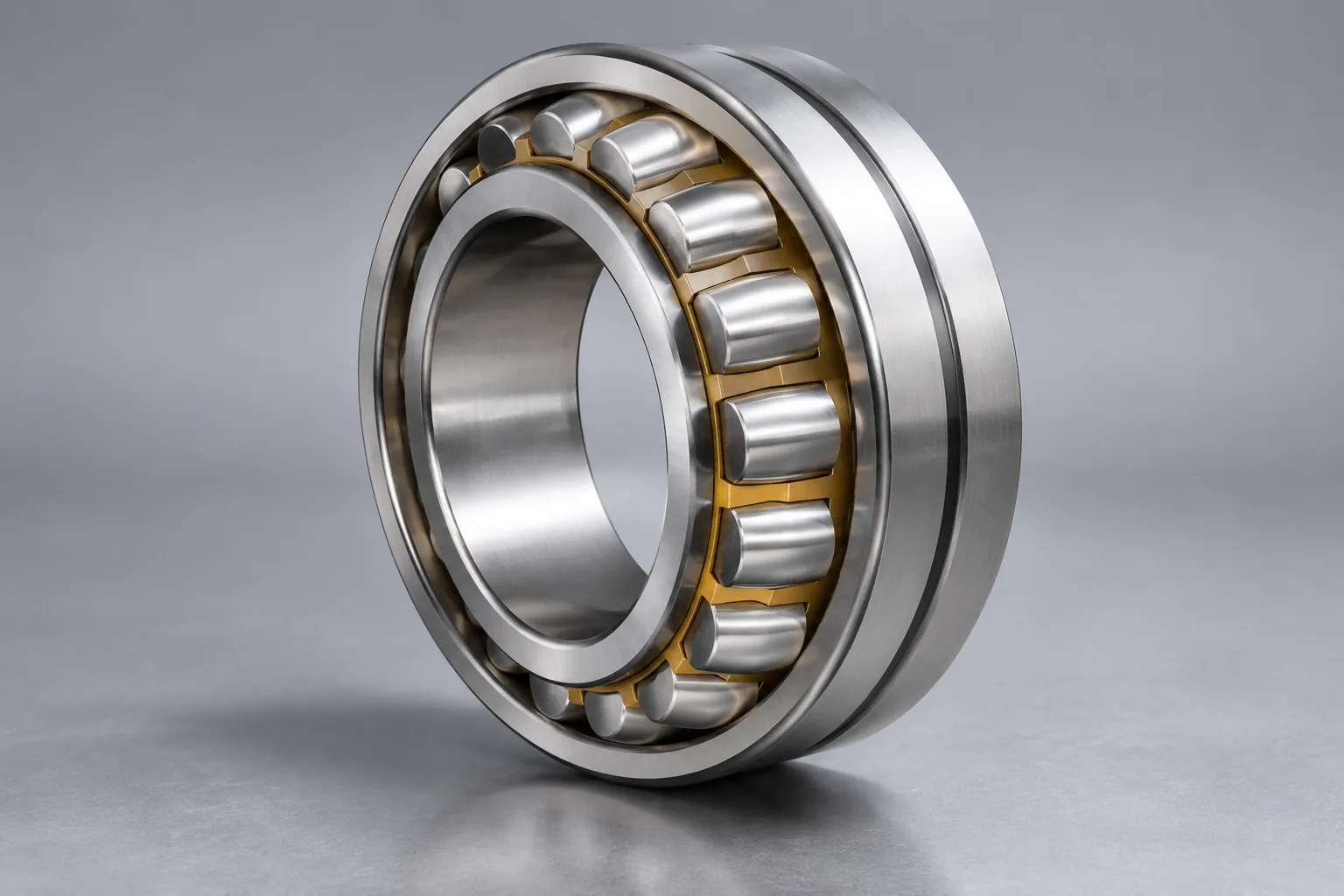
- Bore diameter d: the shaft-side diameter, usually the first size the buyer knows.
- Outside diameter D: the housing-side diameter, which sets the available radial space.
- Bearing width B: the axial envelope, which must match the housing and shaft shoulder arrangement.
- Chamfer dimension rmin: the corner radius needed for fillet clearance at the shaft and housing shoulders.
ISO 15:2017, Rolling bearings – Radial bearings – Boundary dimensions, general plan, sets preferred boundary dimensions for radial bearings and covers diameter series 7, 8, 9, 0, 1, 2, 3, and 4. It was published in July 2017 and confirmed in 2022. ISO 492:2023 covers dimensional and geometric tolerances. Its sixth edition was published in August 2023, and it refers nominal boundary dimensions to ISO 15 and chamfer limits to ISO 582.
Radial clearance can be checked against ISO 5753-1. JIS B 1512 is based on ISO 15, which helps when comparing Japanese and ISO catalog pages. SKF states that its spherical roller bearings normally follow ISO 15 boundary dimensions. The exception called out in its catalog is the width of sealed bearings with a BS2- prefix. Normal tolerance applies, dimensions and geometric tolerances follow ISO 492, and radial clearance follows ISO 5753-1.
These standards describe the dimension and tolerance system. They do not set one maker’s suffix, internal design, or load rating. For a specific part, the current product table remains the final check.
How to Read a Spherical Roller Bearing Size Chart
Start with the designation and locate the exact row. Then read the row from left to right: series, bore code, outside diameter, width, chamfer, and suffix. SKF’s basic designation rules provide a useful example for reading the number itself.
- The first digit 2 identifies a spherical roller bearing or a spherical roller thrust bearing.
- The next two digits give the ISO dimension series. The first digit relates to the width or height series, and the second relates to the diameter series.
- The last two digits are usually the bore code.
Bore codes are read as follows: 00 = 10 mm, 01 = 12 mm, 02 = 15 mm, and 03 = 17 mm. Codes from 04 upward usually multiply by 5 mm: 05 = 25 mm, 08 = 40 mm, and 20 = 100 mm.
A slash can override the usual bore code. For example, 22205/20 E has a 20 mm bore, while the regular 22205 E has a 25 mm bore. Both have a 52 mm outside diameter and an 18 mm width. The suffix K identifies a 1:12 tapered bore, so 22205 E is the cylindrical-bore version and 22205 EK is the tapered-bore version. K does not change the size series.
These rules are an SKF example. Other manufacturers may use different suffix systems, so read the catalog explanation for the brand and series in hand.
Spherical Roller Bearing Size Chart: Common Metric Sizes
The tables below list basic designations and boundary dimensions in mm. They are lookup aids, not complete product tables. A sealed, tapered, or otherwise suffixed version may have a different width or bore type, so confirm the exact designation.
Small and Medium Bore Examples: 25-45 mm
| Bearing designation | Bore diameter d (mm) | Outside diameter D (mm) | Bearing width B (mm) |
|---|---|---|---|
| 22205 | 25 | 52 | 18 |
| 21305 | 25 | 62 | 17 |
| 22206 | 30 | 62 | 20 |
| 21306 | 30 | 72 | 19 |
| 22207 | 35 | 72 | 23 |
| 21307 | 35 | 80 | 21 |
| 22208 | 40 | 80 | 23 |
| 21308 | 40 | 90 | 23 |
| 22308 | 40 | 90 | 33 |
| 22209 | 45 | 85 | 23 |
| 21309 | 45 | 100 | 25 |
| 22309 | 45 | 100 | 36 |
These are basic designations. A suffix version needs its own product row because seals, cages, clearance, and bore type can change the usable envelope.
Large Bore Examples: 80-360 mm
| Bearing designation | Bore diameter d (mm) | Outside diameter D (mm) | Bearing width B (mm) |
|---|---|---|---|
| 22216-E1-XL | 80 | 140 | 33 |
| 22218EA | 90 | 160 | 40 |
| 23160 | 300 | 500 | 160 |
| 23064 | 320 | 480 | 121 |
| 23072 | 360 | 540 | 134 |
Large bearings often carry different cages, clearance classes, seals, or lubrication variants. The size chart resolves boundary dimensions only. Check the product row for the suffix and the mounting dimensions.
Why the Same Bore Diameter Can Have Different Outside Diameters and Widths
The bore code is not a complete size code. The ISO dimension series changes the outer envelope and width to provide different load capacity and section height. At a 25 mm bore, 22205 is 25 x 52 x 18 mm, while 21305 is 25 x 62 x 17 mm. The bore code is the same, but the outside diameter and width are not.
At a 40 mm bore, 22208 is 40 x 80 x 23 mm, 21308 is 40 x 90 x 23 mm, and 22308 is 40 x 90 x 33 mm. The 21308 and 22308 share a 90 mm outside diameter, but the 22308 is 10 mm wider. This is why a size chart must list d, D, and B together. Selecting by bore alone can produce a bearing that does not fit the housing or the available axial space.
Sealed and Tapered-Bore Variants in Size Charts
Sealed bearings are not automatically dimensionally identical to open bearings. SKF 22205 E is an open bearing at 25 x 52 x 18 mm. The corresponding sealed version BS2-2205-2RS/VT143 is 25 x 52 x 23 mm, which is 5 mm wider.
The same issue appears in other sizes. NTN 22218EA is 90 x 160 x 40 mm. The sealed WA22218EALLSD1 is 90 x 160 x 48 mm, which is 8 mm wider. SKF notes that most sealed spherical roller bearings share boundary dimensions with open versions, but some sealed 222 E and 223 E products are wider. A BS2- prefix is therefore a prompt to check the product row rather than assume the open-bearing width.
A tapered bore is marked by the suffix K. The 22205 E has a cylindrical bore, while the 22205 EK has a 1:12 tapered bore. A tapered bore is mounted with an adapter or withdrawal sleeve, and the sleeve and installation dimensions must come from the product table for the exact bearing and sleeve combination.
Performance and Mounting Data That Should Accompany the Size Chart
A size chart is more useful when it carries the performance and mounting fields that affect selection. Look for the basic dynamic load rating C or Cr, the basic static load rating C0 or C0r, the fatigue load limit Pu or Cur, reference speed, limiting speed, mass, and the mounting dimensions da min, Da max, and ra max.
| Designation | d x D x B (mm) | C or Cr (kN) | C0 or C0r (kN) | Pu or Cur (kN) | Reference speed | Limiting speed | Mass | Mounting data |
|---|---|---|---|---|---|---|---|---|
| 22205 E | 25 x 52 x 18 | 49.9 | 44 | 4.75 | 13,000 r/min | 17,000 r/min | about 0.26 kg | – |
| 22216-E1-XL | 80 x 140 x 33 | 250 | 270 | 34.5 | 3,550 r/min | 6,200 r/min | about 2.072 kg | da min 91 mm; Da max 129 mm; ra max 2 mm |
| 22218EA | 90 x 160 x 40 | 385 | 398 | – | – | 5,500 r/min | about 3.28 kg | – |
These values are tied to the exact designations shown. Load ratings, speed limits, mass, and mounting dimensions can change with the manufacturer, cage, clearance, seal, and lubrication design. Do not copy a performance value from one maker’s basic designation to another maker’s similarly numbered bearing.
Size Series and Designation Ranges
Series names explain why a bore can sit in different outer envelopes. FAG/Schaeffler’s E1 range is one documented example. It covers eight series: 230, 240, 231, 241, 222, 232, 213, and 223. The range starts at a 20 mm bore and reaches a 1,220 mm outside diameter. The 230 series has a narrower cross-section. The 223 series is wider and carries higher capacity.
These descriptions help with reading a chart and shortlisting a series. They do not replace the load rating for the exact part. Series naming and suffix systems vary by manufacturer, so the chart and the product table must be read together.
How to Select a Size from the Chart
Use the chart in a fixed order so that a dimensional match is not mistaken for a complete selection.
- Fix the shaft diameter. This sets the required bore d.
- Check the housing. This sets the maximum outside diameter D and the available width B.
- Filter by duty. Load, speed, sealing, and cylindrical or tapered bore decide the series and suffix.
- Confirm the row. Read d, D, B, rmin, and the suffix together.
- Check the performance and mounting columns. Verify C, C0, speed limits, mass, da min, Da max, and ra max where published.
- Confirm the current product table before purchase. A size match does not prove interchangeability.
Final selection also needs the load spectrum, life target, lubrication, and installation conditions. Those calculations sit outside a size chart. The same bore in a different series, seal type, or tapered-bore version may not be interchangeable.
Standards and Manufacturer Reference Sources
A chart is only as good as its traceability. The following reference points are useful when comparing catalog pages.
- SKF Group is headquartered in Gothenburg, Sweden. Its spherical roller bearing catalog gives d, D, B, load ratings, speeds, mass, and cylindrical or tapered bore versions.
- Schaeffler AG / FAG is based at Industriestraße 1-3, 91074 Herzogenaurach, Germany. Its product pages list principal dimensions, mounting dimensions, loads, speeds, and mass for specific designations.
- NTN Corporation is based at Daibiru-Honkan Building, 3-6-32 Nakanoshima, Kita-ku, Osaka 530-0005, Japan. Its spherical roller bearing catalog is numbered 3033/E.
- The Timken Company is headquartered in North Canton, Ohio, United States. Its spherical roller bearing catalog lists metric and inch dimensions, loads, mounting dimensions, speeds, and weight.
Use the latest product table for the exact suffix. A standard defines boundary dimensions and tolerances. It does not define a maker’s suffix, internal design, or performance values.
Conclusion
A spherical roller bearing size chart is a boundary-dimension tool, not a complete selection system. Read the designation, then verify d, D, B, and rmin, and treat any K, sealed, or other suffix as a separate product row. The same bore can have several outside diameters and widths, so a quick bore-code check is not enough. For ordering, confirm the current manufacturer product table for the exact suffix, load rating, speed limit, and mounting dimensions.
FAQs
Q1: What do d, D, and B mean on a spherical roller bearing size chart?
A: d is the bore diameter, D is the outside diameter, and B is the bearing width. These three boundary dimensions decide whether the bearing fits the shaft and housing. The chamfer dimension rmin is also needed for corner clearance.
Q2: Why can two bearings with the same bore have different outside diameters?
A: The bore code fixes only the shaft fit. The ISO dimension series changes the outer envelope and width to provide different load capacity and section height. For example, 22208 is 40 x 80 x 23 mm, 21308 is 40 x 90 x 23 mm, and 22308 is 40 x 90 x 33 mm.
Q3: Does a K suffix change the bearing’s outside dimensions?
A: K identifies a 1:12 tapered bore rather than a different outside diameter or width. For the SKF example, 22205 E is cylindrical bore and 22205 EK is tapered bore. Still check the exact product row, because other suffixes can change seals or width.
Q4: Can a size chart confirm that two bearings are interchangeable?
A: No. Matching d, D, and B is only a boundary-dimension check. Interchangeability also depends on load rating, internal clearance, cage, seals, lubrication, tolerance class, and mounting design. Confirm the exact designation and the maker’s current product data before replacing a bearing.