Quick Answer: L10 bearing life is the basic rating life defined in ISO 281: the rolling-contact fatigue life that 90% of a sufficiently large group of apparently identical bearings reach or exceed under the same specified conditions. It corresponds to a 10% fatigue failure probability. L10 is calculated from the basic dynamic load rating C, the equivalent dynamic load P, and the life exponent p, and is expressed in million revolutions or, at constant speed, in operating hours.
L10 bearing life answers a narrow but important question: how long a bearing population can be expected to last before rolling-contact fatigue, at a stated reliability. The rating is widely used for bearing selection, catalogue comparison, and reliability targets, yet it is often read as if it were a guaranteed service life for one bearing. This article separates the definition from the formula, the standard from the application, and the basic rating from the modified rating.
What L10 Bearing Life Means
L10 bearing life is the basic rating life at 90% reliability: in a sufficiently large group of apparently identical bearings running under the same specified conditions, 90% should reach or exceed this life before rolling-contact fatigue. Put another way, L10 corresponds to a 10% fatigue failure probability. It is a population statistic, not a scheduled failure date for one bearing.
The subscript carries the reliability meaning. L10, L5, and L1 correspond to 10%, 5%, and 1% failure probability, or 90%, 95%, and 99% survival. L10 is a key parameter in Weibull-based bearing life statistics because it anchors the lower tail of the life distribution.
The core standard is ISO 281:2007, Rolling bearings – Dynamic load ratings and rating life. The second edition was published in February 2007, runs to 51 pages, and sits under ISO/TC 4/SC 8. It was confirmed in 2021, and a revision, ISO/DIS 281, remains in development. ISO 281 defines basic rating life for good-quality material, sound manufacturing, and conventional operating conditions, and its rating life addresses rolling-contact fatigue. It does not cover wear, corrosion, or electrical erosion.
The Basic L10 Formula and Units
For dynamic fatigue loading, the basic rating life in million revolutions is:
L10 = (C / P)^p
- L10 – basic rating life in million revolutions (10^6 revolutions).
- C – basic dynamic load rating. This is the constant load that gives a basic rating life of 1 million revolutions.
- P – equivalent dynamic bearing load, which combines the actual radial and axial loads under the application’s load and rotation conditions.
- p – life exponent: 3 for ball bearings and 10/3 for roller bearings.
At constant speed, convert million revolutions to operating hours with:
L10h = (10^6 / 60n) x (C / P)^p
Here n is rotational speed in r/min. The equation assumes a constant load and constant speed; a varying duty cycle requires an equivalent load that represents the complete load spectrum.
The exponent makes L10 highly load-sensitive. If the equivalent dynamic load doubles and C stays unchanged, a ball bearing’s L10 falls to 1/8 of its original value, while a roller bearing’s L10 falls to about 9.92% of the original value. This is why a small load error can change the calculated life far more than a small speed error.
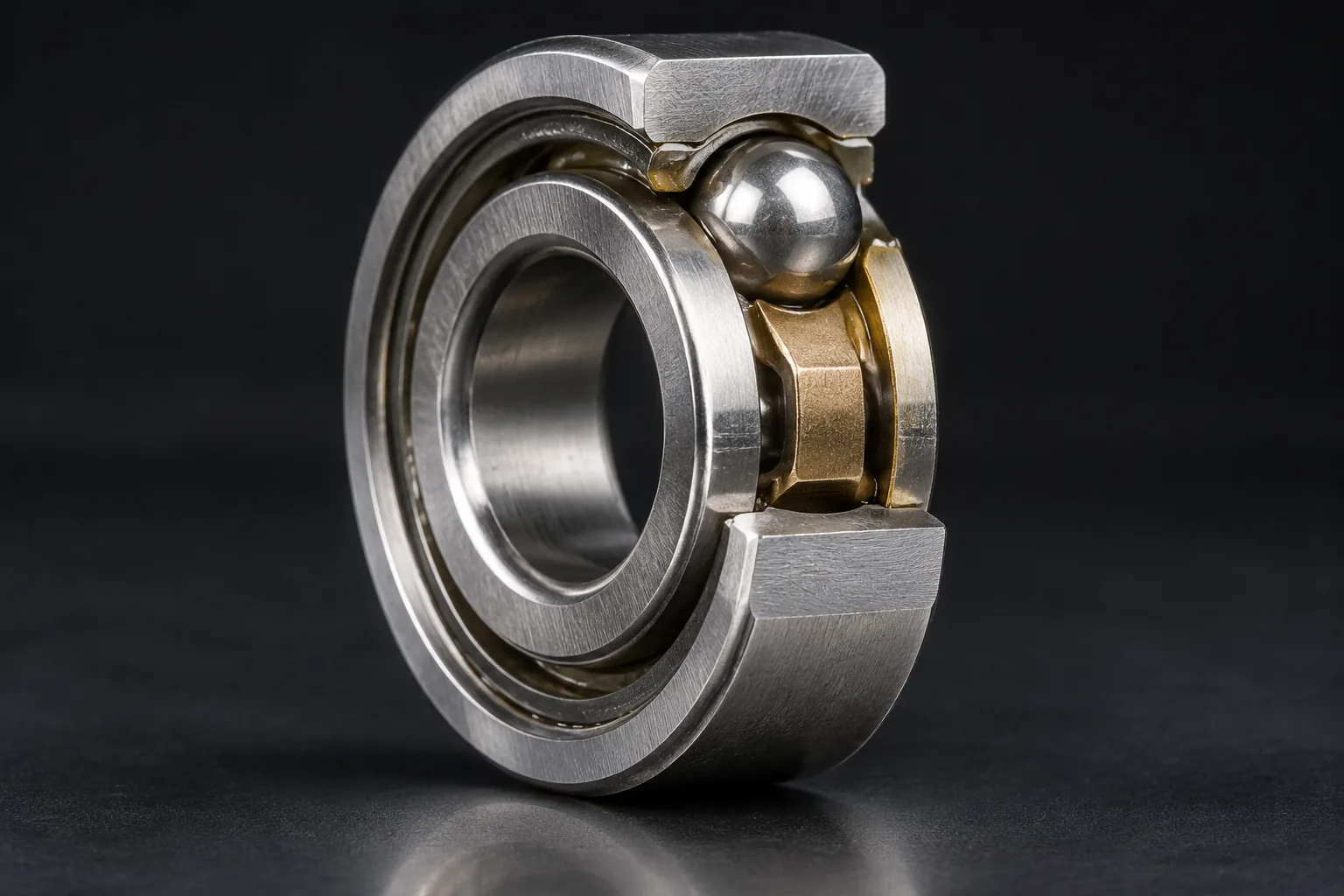
Worked Example: L10h for a 6205 Deep Groove Ball Bearing
A published catalogue example for a 6205 deep groove ball bearing uses a radial load of 100 lbf, a basic dynamic load rating C = 3,330 lbf, a speed of 3,600 r/min, and p = 3.
- Form the load ratio: 3,330 / 100 = 33.3.
- Raise it to the third power: 33.3^3 = about 36,926 million revolutions.
- Apply the speed conversion: (10^6 / (60 x 3,600)) x 36,926 = about 170,954 hours.
The result is the basic L10h for that example. It is an illustration of the calculation, not a promise for every 6205 bearing in service. Lubrication, contamination, mounting, and environment can move actual life well away from the calculated rating.
L10 Rating Life vs Actual Bearing Life
L10 is a statistical rating. Even bearings of the same type and nominal size can show a spread of fatigue lives because of material, manufacturing, and operating variation. That is why L10 should not be used to predict the failure date of a single bearing.
Median life L50 is about 3.5 times L10 in published bearing-life statistics. L50 is the life that about 50% of a bearing group reaches or exceeds. The gap between L10 and L50 shows that L10 is a conservative reliability anchor, not an average service life.
Actual service life also depends on factors outside the basic C/P calculation:
- Load magnitude and load distribution
- Speed and operating temperature
- Lubricant type, viscosity, quantity, and condition
- Contamination and moisture ingress
- Fits, internal clearance, and mounting practice
- Maintenance and the surrounding environment
System reliability adds another limit. A multi-bearing or multi-row system has lower statistical reliability than any one bearing alone when the same reliability target is applied to the whole system. The system life should be evaluated as a series reliability problem, not by reading one bearing’s L10 as the system life.
Modified Rating Life: Reliability, Lubrication, and Contamination
ISO 281 also provides a modified rating life method for conditions that differ from the basic 90% reliability assumption. The general structure is:
Lnm = a1 x aISO x L10
Some bearing catalogues use an equivalent form, Lnm = a1 x aSKF x L10, where the life modification factor is derived from the manufacturer’s own lubrication and contamination model. In both forms, a1 is the reliability life adjustment factor, and the second factor adjusts for lubrication condition, contamination, and load relative to the fatigue load limit.
The reliability factor changes quickly as the target moves away from 90%:
| Reliability | Failure probability | a1 | Life notation |
|---|---|---|---|
| 90% | 10% | 1.00 | L10m |
| 95% | 5% | 0.64 | L5m |
| 99% | 1% | 0.25 | L1m |
aISO considers lubrication condition, contamination, and the raceway material’s fatigue load limit. The alternative aSKF factor considers viscosity ratio, contamination level, and load relative to the fatigue load limit. Modified rating life is still a fatigue-life calculation. It does not become a wear-life, corrosion-life, or electrical-erosion calculation.
Advanced Calculation: ISO 16281:2025
ISO 16281:2025 covers methods for calculating the modified reference rating life for universally loaded rolling bearings. The current edition was published in January 2025, runs to 36 pages, and a corrected English and French version followed in August 2025.
The standard goes beyond a single bearing load ratio. It considers:
- Lubrication condition and contamination
- Material fatigue load limit
- Misalignment or tilt
- Operating clearance
- Internal load distribution among rolling elements
Its scope includes single-row and multi-row ball bearings and roller bearings under radial and axial loads. For roller bearings, the calculation can also consider edge stress and misalignment. The standard still addresses fatigue life only; wear, micropitting, and other non-fatigue mechanisms require separate assessment.
When L10 Is Not Enough: Static Load and Low-Speed Applications
ISO 76:2006 covers rolling bearing static load ratings and static equivalent load. That is a different check from the dynamic fatigue rating behind L10. For very low speed, intermittent motion, or static heavy-load applications, a dynamic L10 calculation alone can miss the controlling risk: permanent deformation at the contact.
Use a static safety check in addition to L10 when the bearing stands still under load, oscillates through a small angle, or runs too slowly for rolling-contact fatigue to govern. L10 remains useful for the dynamic part of the duty cycle, but it does not address static permanent deformation or other non-fatigue failure modes.
Comparing Manufacturer L10 Data: C1 vs C90
Catalogue load ratings are not always published on the same life basis. The common C1 rating is tied to 1 million revolutions. Some tapered roller bearing catalogues use a C90 rating tied to 90 million revolutions. The numbers look similar but describe different load levels.
For a C90 rating, the life equation is:
L10 = (C90 / Pr)^(10/3) x 90 x 10^6
Here Pr is the radial equivalent dynamic load, and the result is in revolutions. Before comparing two catalogue values, confirm whether the rating is C1 at 1 million revolutions or C90 at 90 million revolutions. A direct comparison of C values without that conversion can make one bearing appear stronger or weaker than it really is.
Practical Checklist for Using L10 Bearing Life in Selection
- Define the load spectrum and calculate the equivalent dynamic load P for the full duty cycle.
- Confirm operating speed and the required reliability target.
- Select a bearing with an appropriate basic dynamic load rating C, then calculate basic L10 or L10h.
- Apply modified rating life when lubrication, contamination, or a reliability target above 90% requires it.
- Check static safety for low-speed, intermittent, or static heavy-load applications.
- Account for system reliability when multiple bearings share a load path.
The result is a design-stage comparison, not a substitute for application-specific testing or field experience. A calculated L10 that meets a target still needs a lubrication review, a mounting review, and a check of the actual operating conditions.
Conclusion
L10 bearing life is a 90% reliability fatigue-life rating, not a guarantee for an individual bearing. The basic calculation, L10 = (C/P)^p, links the basic dynamic load rating, the equivalent dynamic load, and the life exponent; the L10h form converts million revolutions to hours at constant speed. Because the exponent is 3 for ball bearings and 10/3 for roller bearings, load changes have a strong effect on the result.
Use modified rating life when reliability, lubrication, or contamination differs from the basic assumptions. Add a static safety check for low-speed, intermittent, or static heavy-load duties. Before comparing catalogue data, confirm whether the rating is on a C1 or C90 basis. That sequence keeps an L10 bearing life calculation useful for selection without turning a statistical rating into a false promise.
FAQs
Q1: What does L10 mean in bearing life?
A: L10 is the basic rating life at 90% reliability. In a sufficiently large group of apparently identical bearings under the same specified conditions, 90% should reach or exceed L10 before rolling-contact fatigue, which is equivalent to a 10% fatigue failure probability.
Q2: Is L10 measured in hours or revolutions?
A: L10 is normally calculated in million revolutions. At constant speed, it can be converted to L10h in operating hours with L10h = (10^6 / 60n) x (C/P)^p, where n is speed in r/min.
Q3: Why does doubling the load reduce L10 so much?
A: The life exponent makes the rating life inversely proportional to load raised to p. Doubling P reduces a ball bearing’s L10 to 1/8 of its original value (p = 3) and a roller bearing’s L10 to about 9.92% (p = 10/3), if C and all other conditions stay unchanged.
Q4: Does better lubrication change L10?
A: Basic L10 assumes conventional conditions. Modified rating life adds a life modification factor for lubrication condition, contamination, and load relative to the fatigue load limit, so better lubrication and cleaner operation can raise the modified life above the basic L10 value.
Q5: Can I compare C values from different catalogues directly?
A: Not unless they use the same life basis. A C1 rating is tied to 1 million revolutions, while a C90 rating is tied to 90 million revolutions. Convert the rating to a common basis before comparing bearing capacity.
Q6: When do I need a static load check instead of L10?
A: Use a static check under ISO 76:2006 for very low speed, intermittent motion, or static heavy-load conditions. L10 addresses dynamic rolling-contact fatigue and does not cover permanent deformation or other non-fatigue failure modes.
Q7: Does L10 predict when one bearing will fail?
A: No. L10 is a population statistic with a 10% fatigue failure probability. Individual bearings of the same type can fail earlier or later because of material, manufacturing, lubrication, contamination, mounting, and operating differences. Use condition monitoring and maintenance records for an individual machine.