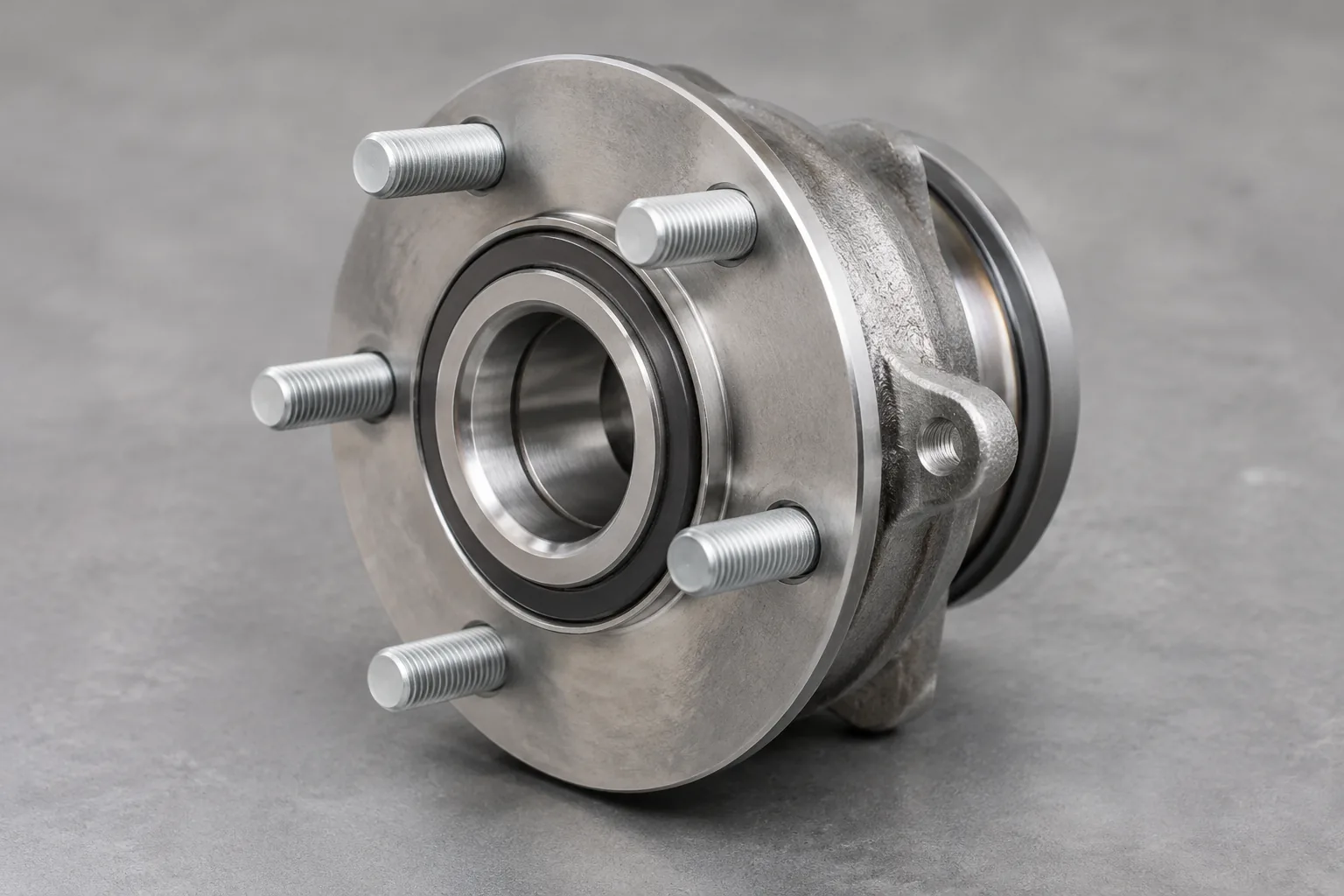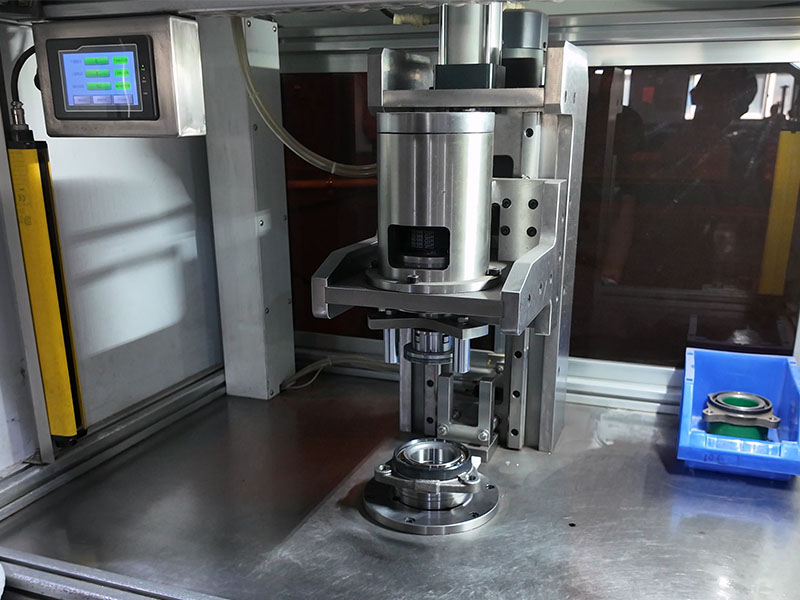
Quick Answer: Si3N4 ceramic bearings in EV drive systems are usually hybrid bearings: steel rings with silicon nitride rolling elements. The ceramic balls interrupt parasitic current through the bearing, while their low density and high hardness support high-speed motor and eAxle operation. They are not a complete current-management system, so grounding, lubrication, load rating and applicable standards still need engineering review. They suit traction motors and eAxle shaft systems where electrical erosion is a design risk.
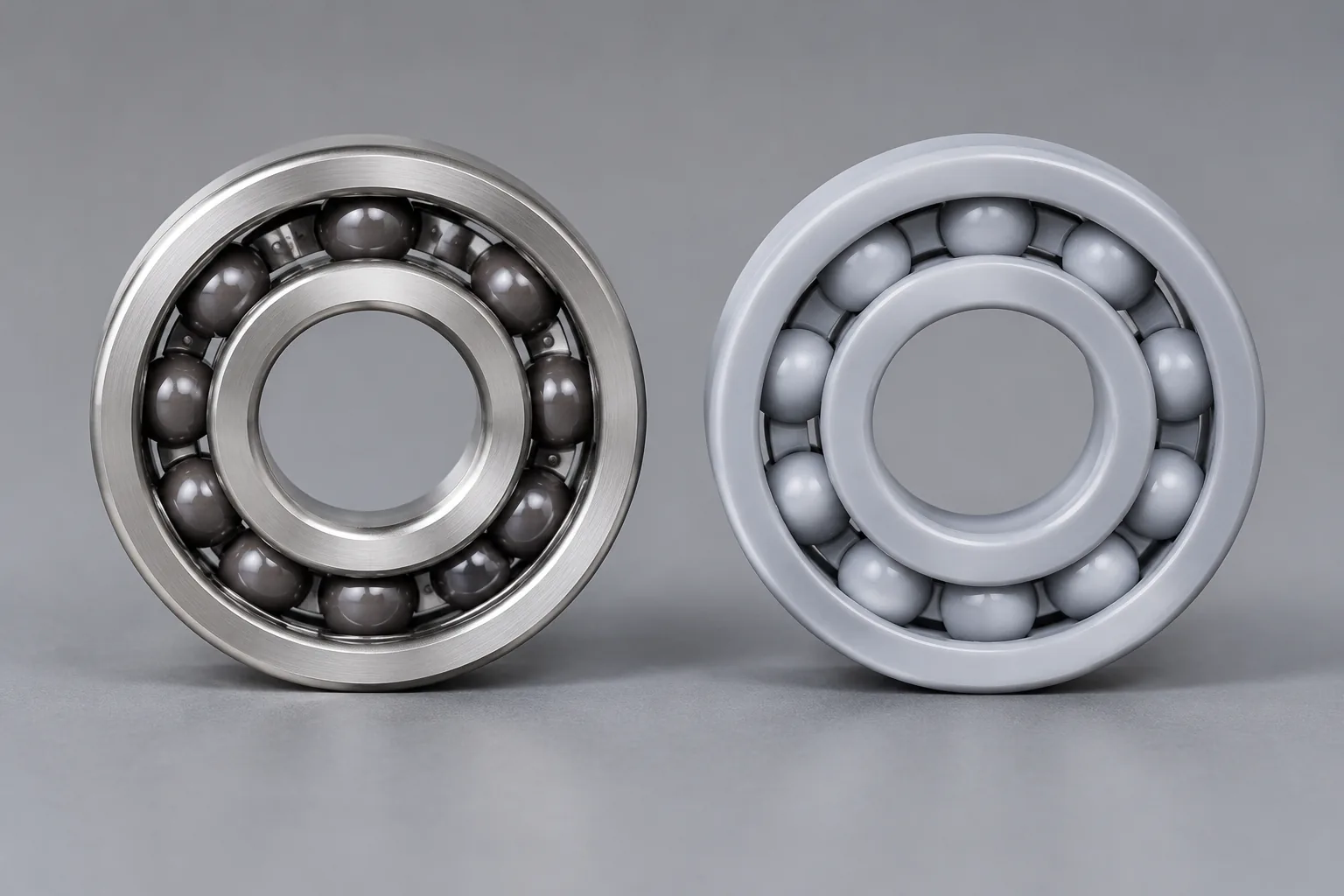
Electric vehicle drivetrains combine high shaft speeds, high voltage and fast power-device switching. That combination turns bearing current damage into a practical design issue. Si3N4 ceramic bearings are one countermeasure, but they work best when the whole current path is understood.
What Si3N4 Ceramic Bearings Actually Are
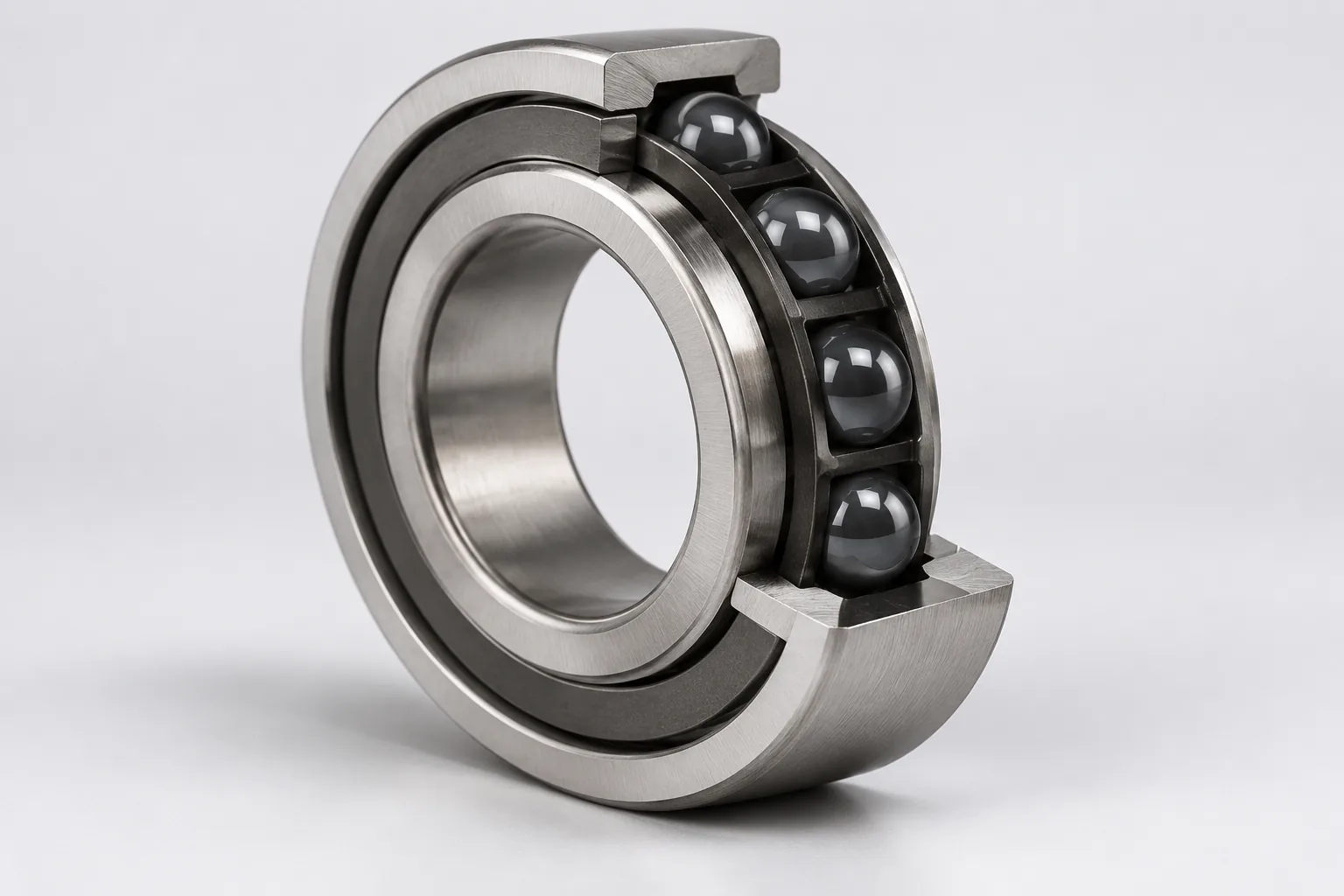
In electric drive systems, Si3N4 ceramic bearings are usually hybrid bearings: bearing-steel inner and outer rings with silicon nitride rolling elements. They are not full-ceramic bearings. The hybrid arrangement keeps the load-carrying rings in steel while using ceramic rolling elements to change the electrical and high-speed behavior of the bearing.
The ISO 20056 series addresses this hybrid bearing category. ISO 20056-1:2017 covers the basic dynamic load rating method, and ISO 20056-2:2017 covers the basic static load rating method for hybrid bearings with Si3N4 rolling elements. That matters because a hybrid bearing should not be rated as if it were an all-steel bearing with the same dimensions.
Hybrid vs. Full-Ceramic vs. Coated Bearings
- Hybrid bearings: steel rings and Si3N4 rolling elements. They combine load capacity with electrical insulation and are the usual choice for EV traction motors and eAxle shafts.
- Full-ceramic bearings: ceramic rings as well as ceramic rolling elements. They are a different category with different cost and toughness trade-offs, so they are not the default drop-in option.
- Coated or resin-insulated bearings: a ceramic coating or insulating layer interrupts the current path. Schaeffler lists hybrid bearings with ceramic balls and ceramic-coated bearings among insulation options. JTEKT notes that the industry also develops conductive, coated and resin insulation routes, each with different cost and performance trade-offs.
Why EV Drivetrains Create Bearing Electrical Erosion
Fast switching in the inverter creates common-mode voltage and high-frequency edges. NSK describes three parasitic currents in the motor: rotor ground current, circulating bearing current and EDM discharge current. When these currents discharge through a bearing, an arc can melt raceway or rolling-element material. The result can be pits, fluting, rising noise and vibration, and premature failure.
The risk is not fixed by voltage alone. Current magnitude, discharge duration, load, speed and lubrication all affect damage severity. Higher-voltage architectures make the issue more prominent: Schaeffler notes that electrical systems up to 800 V and SiC power semiconductors in the drive inverter create specific current-control requirements for motor bearings.
How Si3N4 Balls Interrupt the Current Path
Si3N4 rolling elements interrupt the conductive path between the shaft and the housing. In a hybrid bearing, the steel rings still carry load, but the ceramic balls or rollers make the bearing an insulating component in the current circuit. Under DC conditions, the ceramic rolling elements break the conductive path through the rolling contact.
The insulation is material-based. Bearing-grade Si3N4 has high electrical resistivity, about 10^14 Ω·cm, and a relative dielectric constant of about 4.2-6.1. These properties reduce the risk of current passing through the bearing, but they do not manage the whole system.
A hybrid bearing is one part of a current-control strategy, not a complete solution. In an eAxle, one end of the motor may use a conductive brush ring to provide a controlled ground path, while the other end uses a hybrid ceramic bearing for insulation. That arrangement controls where current flows instead of relying on one component.
Bearing-Grade Si3N4: Key Material Data
Bearing-grade Si3N4 differs from bearing steel in density, hardness and thermal expansion. Typical published values are summarized below.
| Property | Bearing-grade Si3N4 | Bearing steel |
|---|---|---|
| Density | About 3.2 g/cm3 | About 7.9 g/cm3 |
| Hardness | About 1,600 HV10 | About 700 HV10 |
| Linear thermal expansion | About 3 x 10^-6/K | About 12 x 10^-6/K |
Lower density reduces centrifugal load and friction at high speed. Higher hardness supports wear resistance, and lower thermal expansion helps keep clearance more stable as the bearing warms. These are typical values, not a purchase certificate; final acceptance should use the supplier’s material certificate for the actual batch.
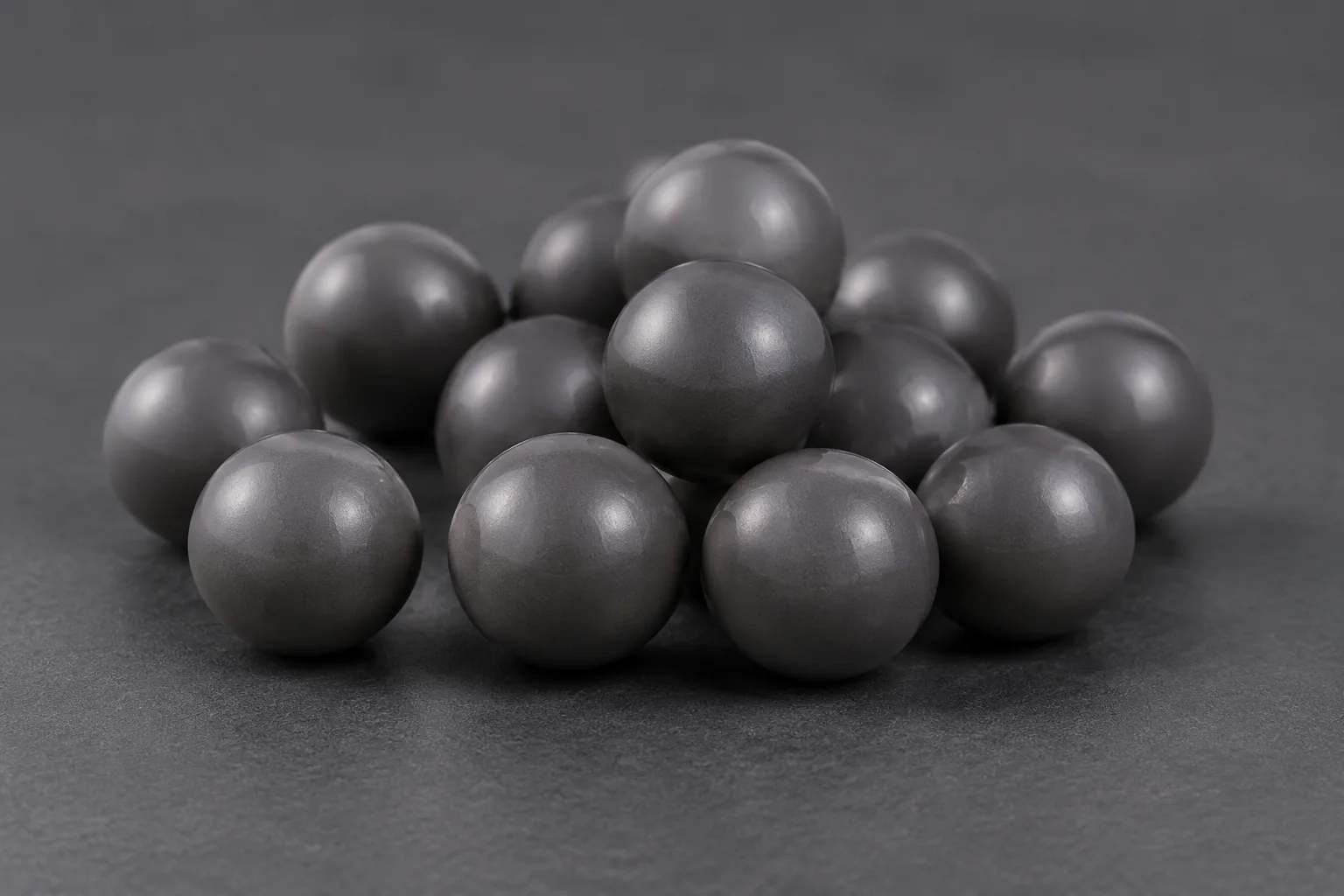
CoorsTek publishes comparison data for its Cerbec Si3N4 balls: about 58% lighter, 121% harder, 68% stiffer and 76% lower thermal expansion than steel alloy. Those figures are manufacturer product-comparison data, not an independent test result, so treat them as a starting point for engineering discussion rather than a universal specification.
Where They Sit in an EV: Motor and eAxle Shaft Systems
In an EV, these bearings sit in the traction motor and eAxle drive-unit shaft systems. They support the high-speed shaft and transmit motor drive force. The bearing position matters because the current path, lubrication access, cooling and fit all change between the motor shaft and the gearbox side.
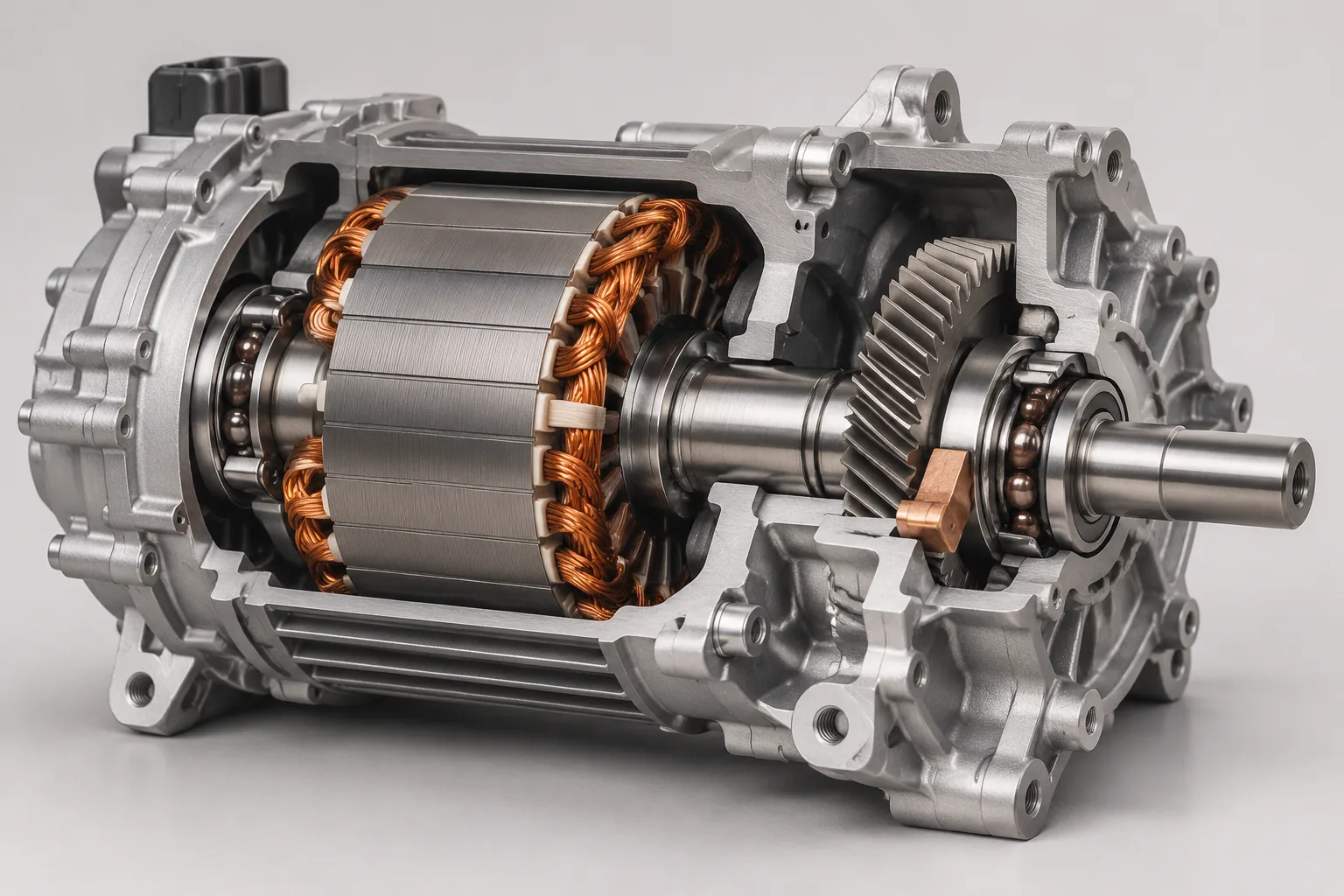
A common system layout uses a hybrid ceramic bearing for insulation at one end and a controlled grounding path at the other. The bearing and the grounding device should be selected together. Sizing a hybrid bearing without reviewing the ground path can leave the system with an uncontrolled discharge path elsewhere.
Size examples show the practical range. CoorsTek lists a 5/16 inch ball, about 7.94 mm, for EV motor shaft bearings, and its Cerbec ball range covers 0.5-50 mm. That is a product example, not a universal size for every motor or eAxle.
Drop-In Interchangeability and Design Impact
A hybrid bearing with Si3N4 balls can keep the same envelope dimensions as the corresponding all-steel bearing. In many designs, that means no change to the mounting space. Dimensional interchangeability is not the same as rating interchangeability. Load ratings for hybrid bearings should be recalculated using ISO 20056-1:2017 for basic dynamic load rating and ISO 20056-2:2017 for basic static load rating, rather than carrying over all-steel values.
Before a drop-in change is approved, confirm the same dimension series and tolerance class, then check lubrication, internal clearance, cage design, fits, speed limits and thermal behavior. A bearing that fits the housing may still behave differently under high-speed eAxle duty.
Standards and Quality Requirements to Specify
Specifications should separate material requirements, finished-ball requirements, strength testing, load rating and automotive quality systems.
- ISO 26602:2017 covers pre-machined silicon nitride material for rolling bearing balls and rollers. It classifies material by physical properties, mechanical properties and microstructure, and the 2017 version was confirmed as still valid in 2023.
- ISO 3290-2:2014 covers finished silicon nitride balls for rolling bearings. ISO confirmed this version as still valid on 2025-06-09.
- ISO 19843:2018 covers the notch-ball strength test for ceramic bearing balls, with priority for Si3N4 and an applicable ball diameter range of 3-50 mm. It was confirmed as still valid in 2024.
- ISO 20056-1:2017 and ISO 20056-2:2017 provide the basic dynamic and static load rating methods for hybrid bearings with Si3N4 rolling elements.
- ASTM F2094/F2094M-18a covers Si3N4 bearing balls in Class I, II and III, including basic quality, physical and mechanical property and test requirements.
- Automotive quality system: IATF 16949:2016 is the relevant automotive quality management standard. As a public example, CoorsTek’s advanced ceramics plant in Rayong, Thailand, was certified to IATF 16949:2016 with a certificate issued on 2024-03-28 and valid to 2027-03-27.
Supply Chain and Capacity Picture
Capacity for bearing-grade Si3N4 is concentrated among a small group of specialist suppliers. Several public announcements show how supply is being expanded.
- Niterra Materials, formerly Toshiba Materials: Niterra completed the full share acquisition and renamed the business on 2025-06-02. Its headquarters are in Higashi-ku, Nagoya, Japan.
- Yokohama expansion: the former Toshiba Materials announced in July 2022 an investment of more than 5 billion yen in Si3N4 ball production at its Yokohama site. Production was planned for November 2023, with capacity after ramp-up 50% above FY2021. The company said at the time that it accounted for about 50% of the global Si3N4 ball market.
- Oita second site: on 2023-07-25 the company announced a second Si3N4 ball plant in Oita, Japan, with an investment of more than 7 billion yen and production planned to start in January 2026. With Yokohama, total capacity after ramp-up was expected to reach 2.5 times the FY2022 level.
- CoorsTek Cerbec: the Cerbec brand was introduced in 1985. The company says it has produced and sold billions of Si3N4 balls, and its ceramic ball operations include East Granby, Connecticut, in the United States.
- SKF and Sinoma Nitride: the companies signed a joint-venture agreement on 2023-06-29 to produce nitride rolling elements. SKF holds 30%, and the announcement named electric vehicles as a target industry. The announcement was issued in Gothenburg, Sweden.
Cost and System-Level Trade-offs
Cost remains a major limit. JTEKT noted in a 2020-06-23 development announcement that ceramic ball bearings offer good insulation but carry a high price. The industry therefore also develops conductive, coated and resin-insulated alternatives, each with different cost and performance trade-offs.
System-level design often combines insulation and grounding: a conductive brush ring for grounding at one end and a hybrid ceramic bearing for insulation at the other. The quotation should therefore cover both ends of the current path, not just the bearing.
For a project decision, compare total lifecycle cost rather than unit price alone. Include bearing price, grounding hardware, validation testing, downtime risk, noise and vibration, warranty exposure and service access. The price premium for Si3N4 bearings is application-specific, so quoted prices should be based on the exact ball grade, size, volume and qualification level.
Specification Checklist for EV Bearing Projects
Use this checklist for an EV motor or eAxle bearing project, especially on 800 V and SiC platforms.
- Define the insulation target and map the system current path. Decide whether the design needs a grounding brush ring, a coated bearing, a hybrid bearing or a combination.
- Calculate hybrid bearing load ratings with ISO 20056-1:2017 and ISO 20056-2:2017. Do not reuse all-steel bearing ratings without verification.
- Specify the ball material and finished-ball standards: ISO 26602:2017, ISO 3290-2:2014 and ASTM F2094/F2094M-18a as applicable, with ISO 19843:2018 for notch-ball strength testing.
- Confirm the supplier’s automotive quality system, such as IATF 16949:2016, and require batch traceability for the ceramic balls.
- Validate lubrication, clearance, cage, fits and high-speed operation for the actual duty cycle. Recommended values depend on the motor, cooling, load spectrum and operating temperature.
Conclusion
Si3N4 ceramic bearings in the electric vehicle industry are best understood as a hybrid solution: steel rings with silicon nitride rolling elements that interrupt bearing current while carrying motor and eAxle loads. They help with electrical erosion and high-speed operation, but they do not replace a system-level current path review. The safe next step is to define the grounding and insulation strategy, recalculate load ratings with ISO 20056-1 and ISO 20056-2, specify the applicable ball standards, and validate the complete bearing system under the real duty cycle.
FAQs
Q1: Are Si3N4 ceramic bearings a full-ceramic bearing?
A: No. In EV drive systems they are usually hybrid bearings with steel rings and Si3N4 rolling elements. Full-ceramic bearings use ceramic rings as well as ceramic rolling elements and have different cost and toughness trade-offs. Check the drawing and the standard designation before assuming a full-ceramic construction.
Q2: Can hybrid ceramic bearings directly replace all-steel bearings?
A: Often the envelope dimensions can match, but direct replacement still requires verification. Recalculate the load rating with ISO 20056-1:2017 and ISO 20056-2:2017, then check clearance, cage, lubrication, fits, speed and thermal conditions. Do not assume interchangeability from dimensions alone.
Q3: If hybrid ceramic bearings are installed, is a grounding ring still needed?
A: Not always, but many eAxle designs combine insulation at one end with a grounding path at the other. The need depends on the current path, inverter, cable shielding, motor design and test measurements. A hybrid bearing is not a complete current-management system on its own.
Q4: Why are Si3N4 bearings suitable for high-speed motors?
A: Si3N4 has lower density than bearing steel, which reduces centrifugal load and friction at high speed. Its high hardness and low thermal expansion also support dimensional stability. Speed capability still depends on cage design, lubrication, preload, fits and thermal management.
Q5: What standards should EV Si3N4 balls meet?
A: Specify ISO 26602:2017 for pre-machined silicon nitride material, ISO 3290-2:2014 for finished balls, ISO 19843:2018 for notch-ball strength testing and ASTM F2094/F2094M-18a for Class I, II and III requirements. Use ISO 20056-1 and ISO 20056-2 for hybrid bearing load ratings.
Q6: How much more do Si3N4 bearings cost than all-steel bearings?
A: The premium is not fixed. It depends on ball size, material grade, order volume, qualification testing and supply chain. Ceramic ball bearings are generally recognized as a higher-cost option, so compare quoted prices for the exact specification and include downtime, noise and vibration, warranty and grounding hardware in the total lifecycle cost.