Quick Answer: Ceramic bearings for electric motors use silicon-nitride rolling elements to interrupt the current path through the bearing and reduce electrical erosion in PWM and VFD drives. They present high impedance to AC and high-frequency current and often have lower capacitance than coated bearings. They do not remove inverter, cable, or grounding causes, so current-path checks, proper grounding, shielding, and correct fit, grease, and seals remain essential.
Electrical erosion is a current-path failure, not a lubrication problem that grease alone can solve. In inverter-fed motors, fast switching creates common-mode voltage and high dv/dt pulses that can drive current through the bearing. The practical question for ceramic bearings in electric motors is how to confirm the damage, choose the right bearing design, and keep the rest of the current path under control.
Electrical Erosion in Motor Bearings: Definition and Failure Modes
Electrical erosion takes place when current travels between the bearing rings through the rolling elements. The current can cross the lubricant film, produce arcing at the contact, and damage the raceway or rolling elements.
Published bearing guidance separates the damage into two sub-failure modes:
- Excessive voltage or high current density: higher energy discharges can create coarse pitting, local melting, and rapid surface damage.
- Current leakage or low current intensity: continuous low-level current can produce thousands of small craters and a dull or grey contact surface.
Bearing current has three main sources: electrostatic charging, magnetic-flux asymmetry, and high-frequency current driven by common-mode voltage and fast voltage changes. The third source is closely linked to fast-switching PWM and VFD output. Long cables, poor grounding, and high dv/dt increase the risk. Electrostatic charging and magnetic asymmetry can also occur in machines that do not use a VFD, so inverter operation is not the only possible cause.
Visual Symptoms and Damage Patterns to Inspect For
Electrical damage can leave a recognizable pattern. Inspect for micro-cratering, pitting, rolling elements with a grey appearance, blackened grease, and washboard or fluting marks on the raceway. The fluting pattern is often the most visible sign, but it is not proof on its own.
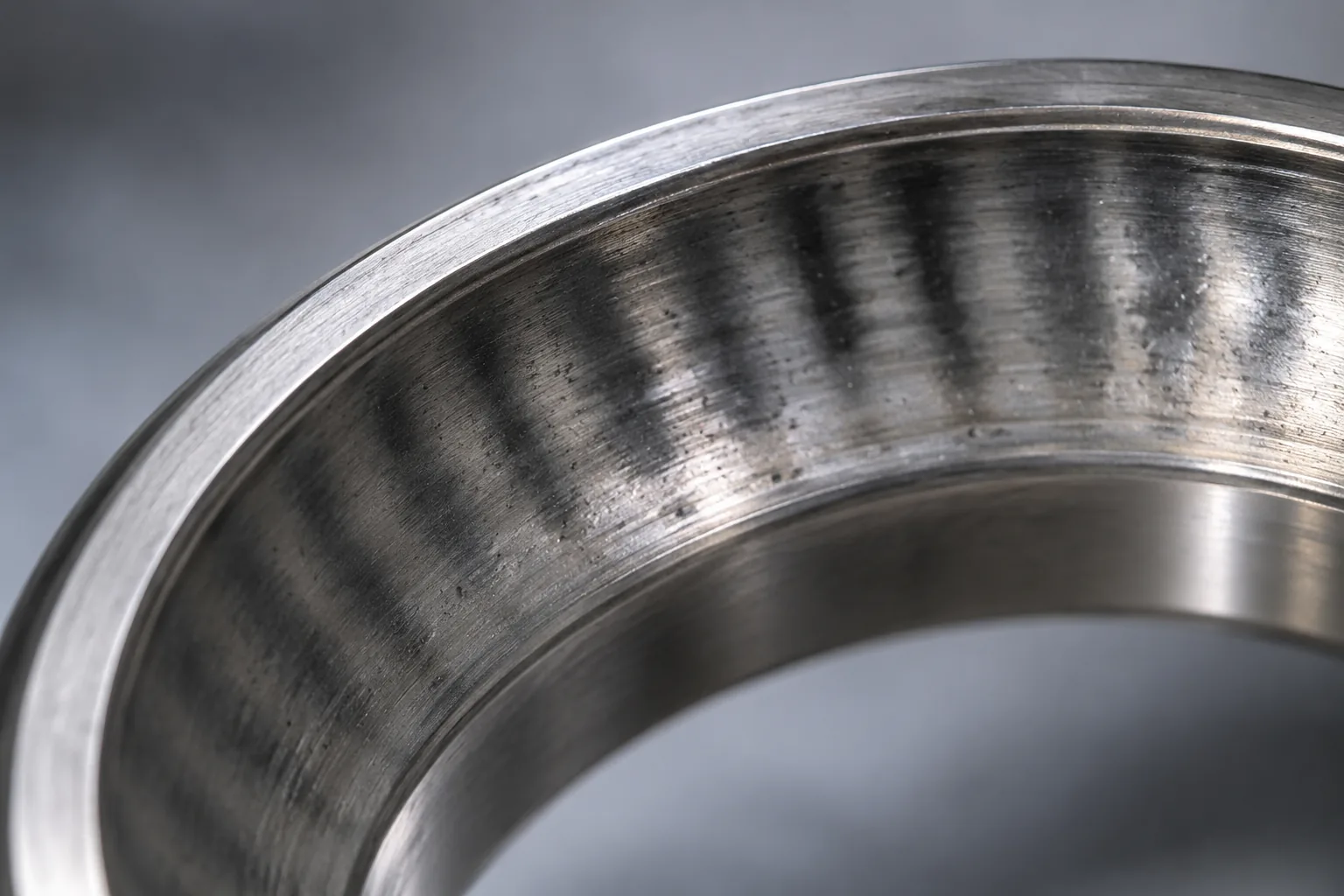
The mechanism is local. Voltage breaks down the thin lubricant film, current arcs between the rolling element and the raceway, and the steel surface melts and re-solidifies. Under magnification, a visible groove can resolve into crater-like depressions. The damage also degrades the lubricant. Secondary effects include noise, temperature rise, vibration increase, and shorter bearing life.
Inspect bearings from motors with unexplained noise, vibration, temperature rise, or repeated failures. Blackened grease, noise, and vibration can also come from contamination, misalignment, or lubrication starvation, so confirm the electrical cause before concluding that erosion is present.
How to Confirm Electrical Erosion
Use ISO 15243:2017 to classify in-service bearing damage by terms, characteristics, and causes. The standard was published in March 2017, and ISO confirmed it remained valid in 2022. Classification should be based on the actual appearance of the raceway and rolling elements, not on noise alone.
For small discharge pits, use about 500x to 1,000x magnification. A non-contact electrical discharge detector pen can help confirm discharge current where such a tool is available. Also check grounding, cable shielding and symmetry, drive output characteristics, and shaft-voltage or shaft-current evidence.
Use laboratory inspection or trained field inspection for a reliable conclusion. Not all electrical damage is visible. Lubricant analysis and electrical measurements can support the diagnosis when the surfaces look inconclusive.
How Hybrid Ceramic Bearings Interrupt Bearing Current
A hybrid bearing normally uses steel inner and outer rings with silicon-nitride (Si3N4) rolling elements. The ceramic rolling elements break the direct DC conductive path through the bearing and present high impedance to AC and high-frequency current.
The material difference is large. Published data give Si3N4 a resistivity of about 10^12 ohm*m, compared with about 0.4 x 10^-6 ohm*m for bearing steel. Si3N4 dielectric strength is about 15 kV/mm, and its relative permittivity is about 8 at 1 MHz. These properties explain why a ceramic rolling element can interrupt a path that steel completes.
Hybrid bearings also tend to have lower capacitance than many insulated-coated bearing designs. Published comparisons show hybrid-bearing capacitance can be as low as about 1/100 of an insulated-coated bearing, which makes hybrid designs attractive for high-frequency inverter-induced currents.
The bearing is not a complete filter. It interrupts the current path through the bearing, but it does not remove inverter, cable, grounding, or magnetic-asymmetry causes. System checks remain necessary.
Si3N4 Rolling-Element Properties That Affect Motor Bearing Performance
The electrical benefit is only one part of the case. Si3N4 also changes the mechanical behavior of the bearing.
- Lower density: 3.2 g/cm3 for Si3N4 compared with 7.9 g/cm3 for bearing steel. Lower mass reduces centrifugal load and friction at high speed.
- Higher hardness: 1,600 HV10 compared with 700 HV10. This improves resistance to hard-particle wear and plastic deformation.
- Lower thermal expansion: 3 x 10^-6/K compared with 12 x 10^-6/K. This helps maintain more stable internal clearance when bearing parts see temperature differences.
- Elastic modulus: 310 GPa compared with 210 GPa for steel, which affects contact stress and stiffness.
In one published study, hybrid bearings ran at about 12% higher contact pressure than the all-steel bearings tested, yet their rolling-contact-fatigue resistance was comparable. The benefits are most relevant in high-speed, light-load, or poor-lubrication conditions.
Do not substitute a hybrid bearing by dimensions alone. Verify dynamic and static ratings using ISO 20056-1 and ISO 20056-2, and confirm the application duty with the bearing supplier.
Hybrid Ceramic Bearings vs Insulated Coated Bearings
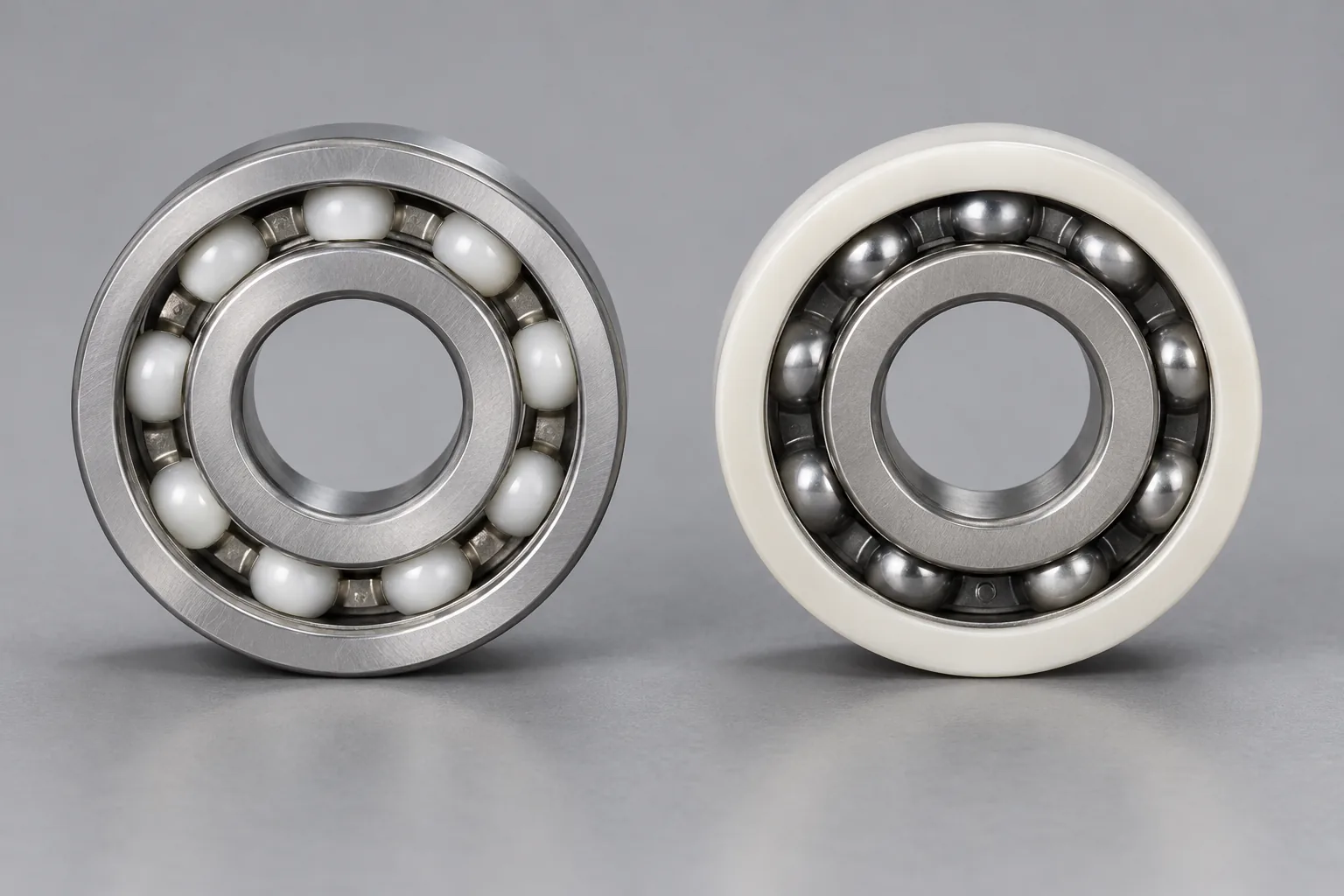
Both designs address bearing current, but they do it differently. A coated bearing uses a ceramic insulating layer on one or both rings and usually keeps steel rolling elements. A hybrid bearing uses ceramic rolling elements and usually keeps steel rings.
| Design | Current behavior | Typical fit |
|---|---|---|
| Insulated coated bearing | Ceramic layer blocks current across the coated ring; steel rolling elements remain. | Many low-frequency or medium-insulation needs; coating integrity and voltage rating must be checked. |
| Hybrid ceramic bearing | Ceramic rolling elements interrupt the path and raise impedance to AC and high-frequency current. | Fast-switching inverter drives and high-frequency common-mode currents; lower capacitance is an advantage. |
Coated-bearing examples show the range. One plasma-sprayed alumina outer-ring coating is about 100 micrometers thick, with special versions up to 300 micrometers. Published coated-bearing ratings include 100 micrometers and 500 V DC, 100 micrometers and 1,000 V DC, and 200 micrometers and 3,000 V DC. Another coated range is rated up to 3,000 V DC, with 7MC3-6314C3 as a product example.
Select by current type, frequency, voltage, environment, and whether one or both bearings need insulation. Coating damage and very-high-frequency currents may favor a hybrid ceramic bearing. Verify the choice with application data rather than assuming one design covers every current profile.
Typical Hybrid Bearing Formats for Electric Motors
Common formats are 60, 62, and 63 series deep groove ball bearings, including sealed variants. In SKF part numbering, the HC5 code indicates a ceramic-ball configuration. Published examples include 6205-2RZTN9/HC5C3WT, 6004-2RSLTN9/HC5C3WT, and 6208-2RZTN9/HC5C3WT.
These bearings are used in approximately 0.15-15 kW standard-size motors, and public stock covers a bore range of about 5-70 mm. Small standard motors often use one hybrid bearing at the non-drive end. Some current paths require both bearings to be insulated, so single-bearing isolation is not a universal rule. Confirm the current path by measurement and follow motor OEM guidance.
Lubrication and Sealing in Electrically Loaded Bearings
Electrical erosion degrades the lubricant as well as the metal surfaces. Blackened grease is a warning sign, and lubricant condition should be part of failure diagnosis. Sealed hybrid variants help retain grease and exclude contamination, which is useful in motor end-shield environments.
One sealed hybrid specification uses a synthetic-ester base oil with a polyurea thickener and a working range of about +70 to +120°C. Sealed examples use 2RZ or 2RS variants. Apply the grease only where the operating temperature falls within its range. High-temperature, high-speed, or chemically exposed applications may need a different grease, so confirm the lubricant with the supplier.
Selection Checklist for Ceramic Bearings in VFD Motors
Start with the current path. Published EV guidance separates rotor-ground bearing current, circulating bearing current, and EDM current. The same logic applies to industrial VFD motors: identify the path before choosing the remedy.
- Measure shaft voltage or shaft current where possible.
- Review drive dv/dt, cable length, shielding, and grounding.
- Decide whether one bearing or both bearings require isolation.
- Check speed, load, fit, lubrication, seals, and dimensional interchangeability.
- Verify ratings and test documentation, and consult the motor OEM for final approval.
Use this checklist for new motor designs and for recurring electrical-erosion failures. If the failure is mechanical misalignment, contamination, or lubrication starvation, a ceramic bearing alone may not solve it.
System-Level Mitigation to Use With Ceramic Bearings
Check proper grounding first and use symmetrical and shielded cabling where recommended. These measures reduce the source voltage and the current that reaches the bearing. A hybrid bearing is an isolation component within a system-level current-control strategy, not a substitute for good drive practice. Use this approach where parasitic current paths cannot be fully removed by bearing selection alone.
For EV eAxle-type systems, a published system example announced on 2024-04-04 combines a shaft grounding brush ring at one end with a hybrid ceramic bearing at the other. The combination controls the parasitic current path rather than relying on one component alone.
Safety grounding requirements and motor topology may limit full isolation. Any design that changes the grounding path requires engineering review.
Standards and Verification for Ceramic Bearing Quality
Specify the material and the test method, not only the bearing dimensions. Relevant standards include:
- ISO 26602:2017: silicon-nitride materials for rolling bearing balls and rollers.
- ASTM F2094/F2094M-18a: silicon nitride bearing balls.
- ISO 20056-1 and ISO 20056-2: dynamic and static load ratings for hybrid bearings with ceramic rolling elements.
- ISO 19843:2018: notched-ball strength test for finished ceramic balls, covering 3-50 mm.
- ISO 3643:2024: surface defects of finished Si3N4 balls and rollers, published in September 2024.
Use ISO 15243 for failure classification and supplier test reports for acceptance. Request certificates and test reports from the bearing supplier. Standards alone do not guarantee application suitability; validate the bearing against motor duty and current severity.
Key Takeaways
- Electrical erosion is a current-path problem; hybrid ceramic bearings interrupt the bearing current path.
- Si3N4 rolling elements provide electrical isolation plus high-speed and wear-related mechanical benefits.
- Selection depends on current type, drive frequency, motor size, lubrication, and whether one or both bearings need protection.
- System grounding and cabling remain part of the fix; ceramic bearings are not a standalone cure.
Conclusion
Specify hybrid ceramic bearings for electric motors when the bearing current path is confirmed and the application needs high impedance to AC or high-frequency current. Confirm the motor current path, bearing dimensions, grease, seals, and required standards before ordering. If you are reviewing a failure, provide motor data, drive details, and clear photos of the raceway and rolling elements so the bearing selection can be checked against the actual damage pattern.
FAQs
Q1: Can ceramic bearings solve electrical erosion in electric motors?
A: They can interrupt the bearing current path and greatly reduce electrical erosion, but they do not remove inverter, cable, grounding, or magnetic-asymmetry causes. Use them with system checks and correct installation.
Q2: Are hybrid ceramic bearings the same as full ceramic bearings?
A: No. Hybrid bearings usually have steel inner and outer rings with silicon-nitride rolling elements; full ceramic bearings use ceramic rings as well. Hybrid designs are the common choice for motor shaft isolation because they retain standard steel-ring mounting behavior.
Q3: Should I use one hybrid bearing or insulate both motor bearings?
A: It depends on the current path. Small standard motors often use one hybrid bearing at the non-drive end, but circulating currents or certain grounding arrangements can require both bearings to be insulated. Confirm by measurement and motor OEM guidance.
Q4: Will hybrid ceramic bearings fit standard motor housings?
A: They can, when the bearing envelope and bore match the original. Part numbers such as 6205-2RZTN9/HC5C3WT and 6208-2RZTN9/HC5C3WT show standard deep groove formats with ceramic balls. Verify dimensions, fit, seals, and load ratings; do not substitute by bore size alone.
Q5: Are hybrid bearings suitable for PWM/VFD-driven motors?
A: Yes, they are particularly relevant where fast switching produces common-mode voltage and high-frequency current. Their low capacitance and high impedance help, but cable length, shielding, grounding, and dv/dt still need review.
Q6: What grease is used in sealed hybrid motor bearings?
A: Sealed hybrid variants may use a synthetic-ester base oil with a polyurea thickener, with a working range around +70 to +120°C in one published specification. Confirm the grease meets the actual speed, temperature, and duty cycle.
Q7: How can I confirm that a failed bearing suffered electrical erosion?
A: Look for micro-craters, pitting, grey rolling elements, blackened grease, and fluting, then inspect at about 500x to 1,000x magnification. Use ISO 15243:2017 terminology, check shaft voltage and grounding, and rule out mechanical or lubrication causes.
Q8: When should I choose an insulated coated bearing instead of a hybrid ceramic bearing?
A: Coated bearings can suit lower-frequency or medium-insulation needs and often keep steel rolling elements. Hybrid bearings are favored for fast-switching, high-frequency currents because their capacitance can be much lower. Check coating integrity, voltage rating, frequency, and environment.