Quick Answer: Ball linear bearings use spherical rolling elements and generally favor low friction, smooth high-speed motion, and tolerance of minor mounting error. Roller linear bearings use cylindrical rollers and generally favor higher load capacity, stiffness, and resistance to deflection. Neither type is universally better. Select by load, stiffness, speed, acceleration, mounting accuracy, duty cycle, and life target, then compare exact sizes on the same load-rating basis.
The phrase linear bearing covers more than one architecture. A like-for-like choice between ball and roller designs starts with the same construction class, the same size envelope, and the same rating basis. This guide compares recirculating profiled rail guides, explains where each rolling element fits, and shows how to avoid misleading catalog comparisons.
Scope: What Linear Bearing Means in This Comparison
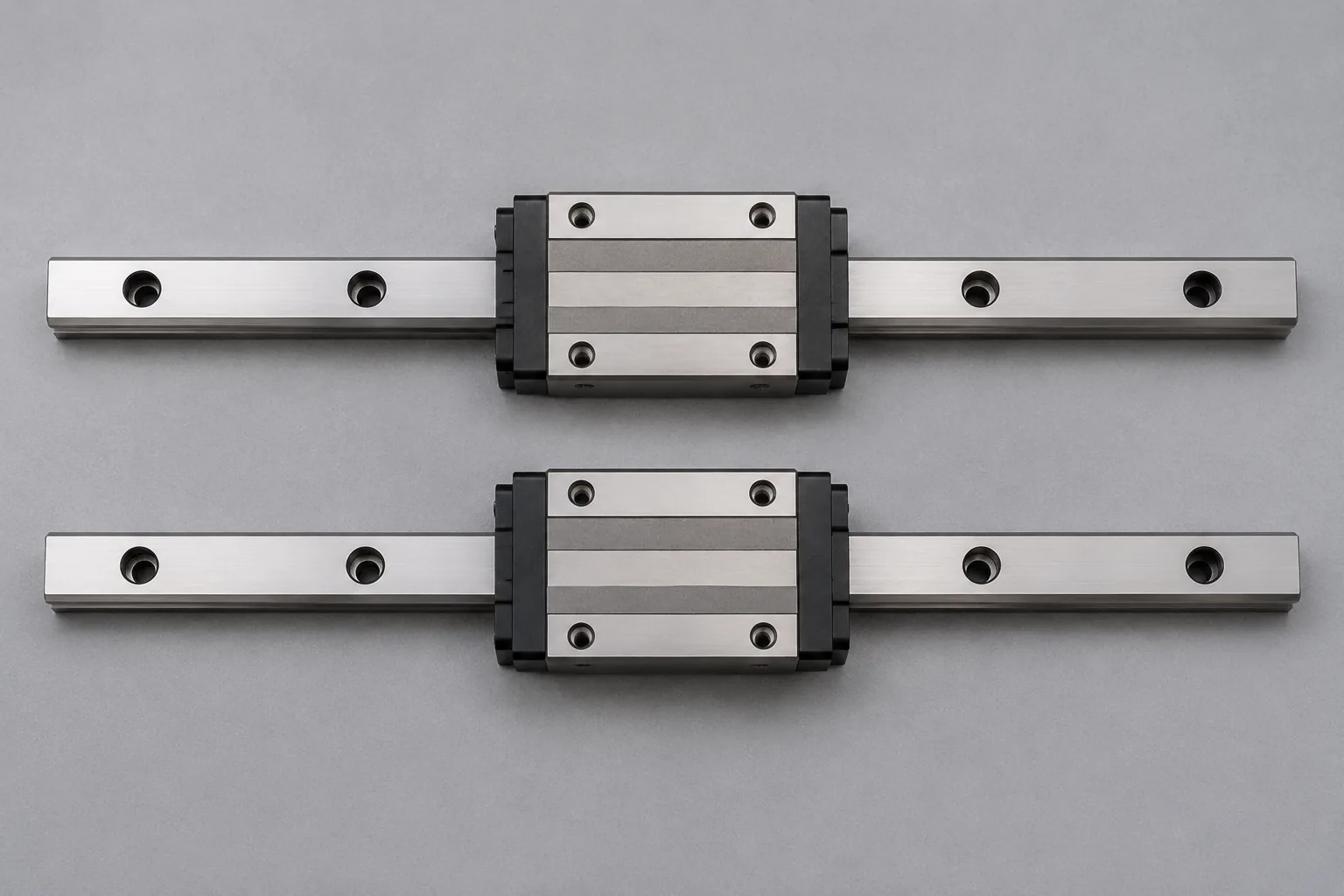
Linear bearing can mean a round-shaft sleeve-type ball bearing or a profiled rail guide with a carriage, rail, and recirculating rolling elements. Those are different architectures. ISO 10285:2007 addresses sleeve-type linear ball bearings, including boundary dimensions, tolerances, and terminology. ISO 12090-2:2011 addresses rolling linear guides with recirculating rolling elements for series 4 and series 5, including boundary dimensions and tolerances. These standards define boundary dimensions and tolerances; ISO 14728 provides the calculation methods. They do not by themselves rank ball against roller performance.
For a clean comparison, compare recirculating profiled rail guides with recirculating profiled rail guides. Do not compare a round-shaft ball bushing with a roller profiled rail guide; that mixes architectures and distorts the conclusion. If the machine is constrained to round-shaft construction, compare round-shaft ball bearings only with suitable round-shaft alternatives.
Ball vs Roller Linear Guides: Core Design Difference
Ball guides use spherical rolling elements. Roller guides use cylindrical rollers. The roller line contact spreads load over a larger contact area, which generally supports higher load capacity and stiffness. The ball point contact generally gives lower friction and smoother dynamic behavior. The practical question is application fit, not a universal winner. Any general statement still has to be checked against the specific manufacturer series, size, preload, and load direction.
Ball Linear Guides: Strengths and Limits
Ball linear guides suit low-friction, smooth-running, high-speed or high-acceleration motion, especially light-to-medium loads. They are generally better able to compensate for slight mounting geometry errors. Their limit is that at comparable size and duty, they typically provide lower load capacity and stiffness than roller guides.
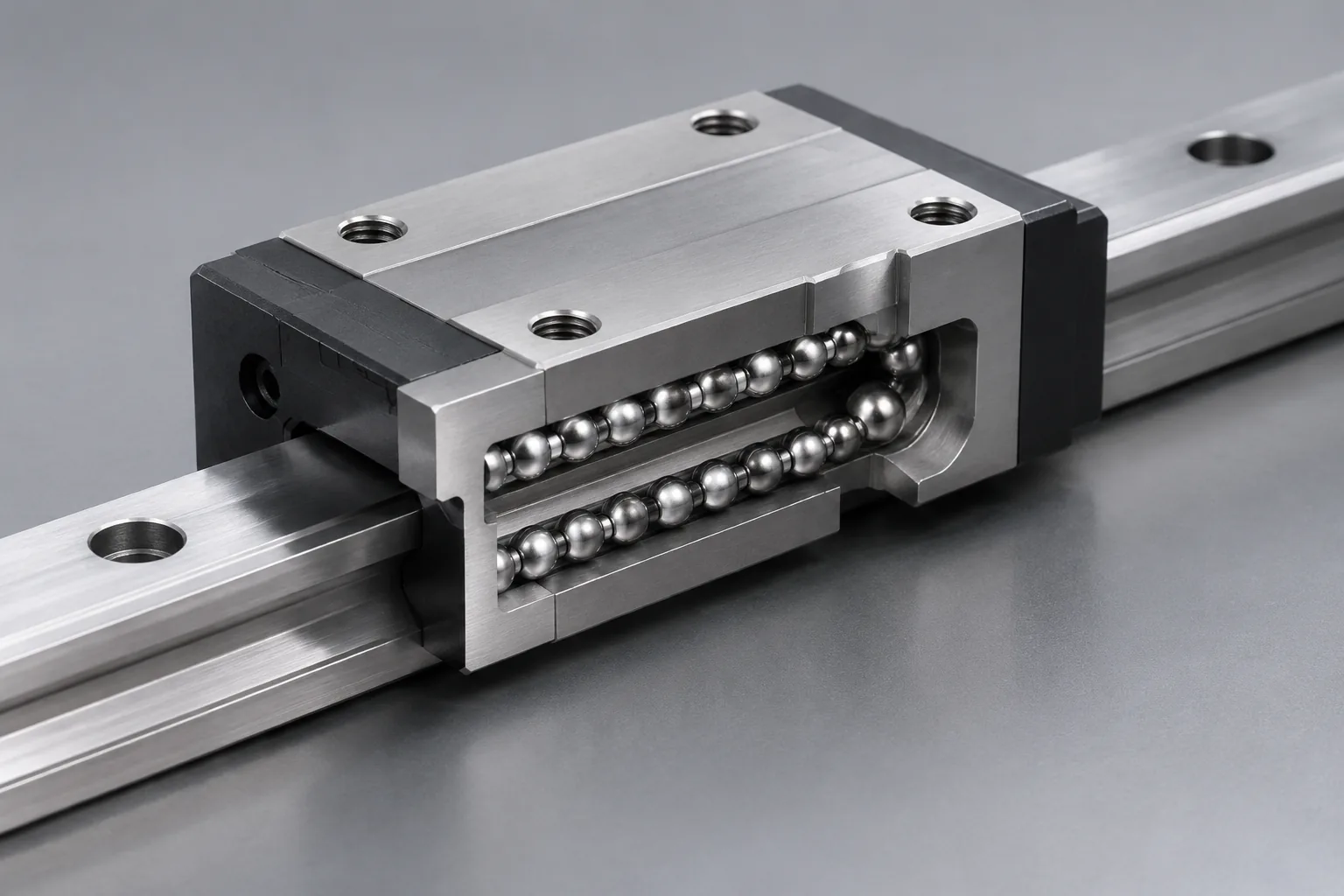
Published product-line data shows the spread: high-precision ball rail systems from one manufacturer cover sizes 15-65, product-line dynamic load ratings 3.9-223 kN, maximum speed 10 m/s, maximum acceleration 500 m/s², and maximum single rail length 6,000 mm. Published four-row recirculating ball guides can reach 360 m/min (6 m/s) and 150 m/s² under specific application conditions. Those figures are full product-line or test-condition values, not guarantees for every size or application.
Roller Linear Guides: Strengths and Limits
Roller linear guides suit high-load, high-stiffness, deflection-sensitive, or heavy-duty linear motion where smooth high-speed operation is secondary. Rollers provide line contact, which supports higher rigidity and load capacity than balls in comparable guide systems. The trade-off is generally higher friction and lower maximum dynamic performance.
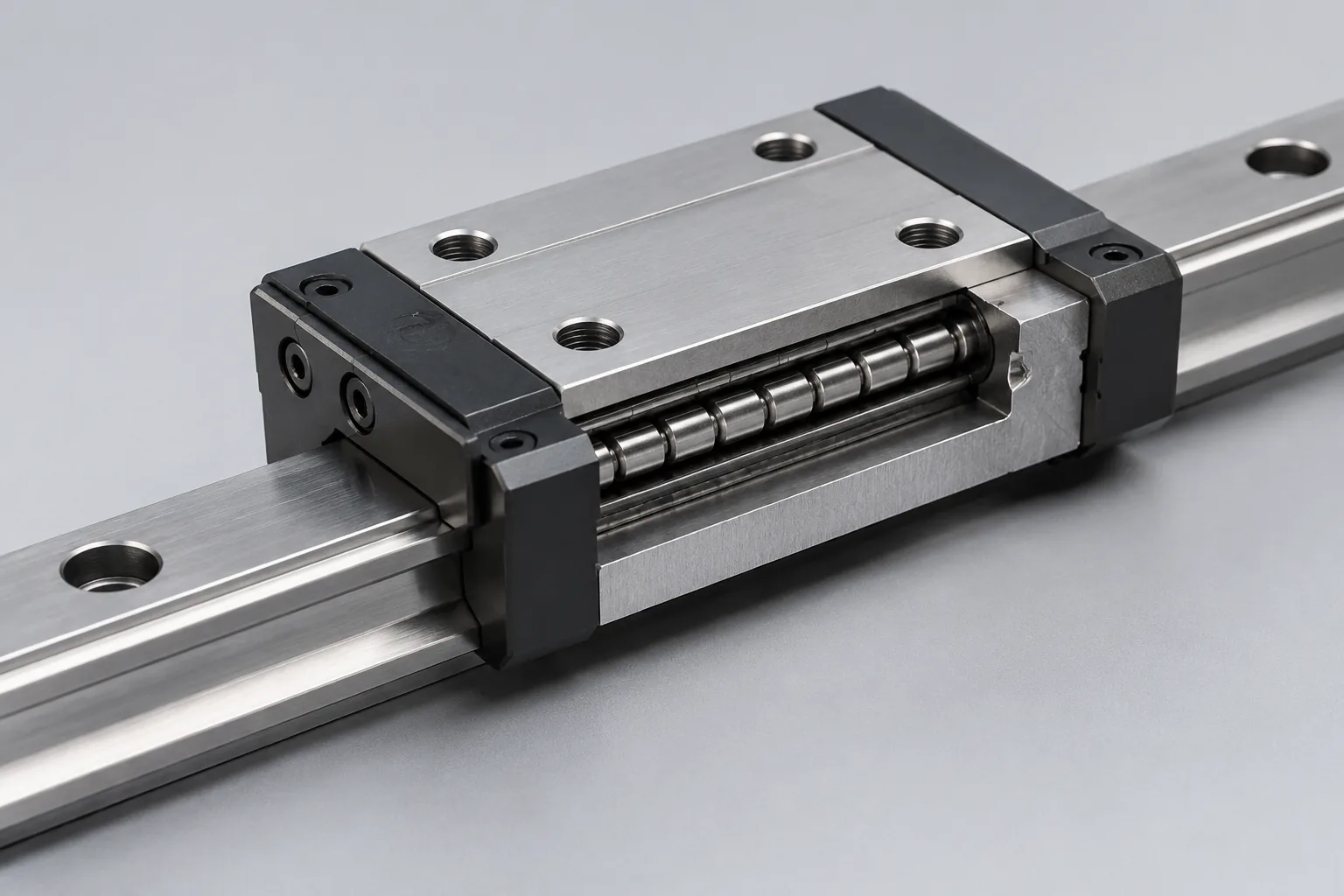
High-precision roller rail systems from one manufacturer cover sizes 25-125, product-line dynamic load ratings 30-1,020 kN, maximum speed 4 m/s, maximum acceleration 150 m/s², and maximum single rail length 6,000 mm. RUE-E / RUE-E-KT-L recirculating roller guides are published at maximum 4 m/s and maximum acceleration 100 m/s²; they are positioned for high-load, high-stiffness heavy-duty motion. The ball and roller ranges cited above do not cover identical size intervals, so their endpoint values cannot be divided to calculate a universal ball-to-roller ratio.
Load Capacity and Stiffness: Reading Vendor Claims Correctly
Roller guides are generally selected when load capacity, stiffness, and resistance to deflection dominate. Vendor comparisons often show roller guides at roughly 2-3 times the load capacity and stiffness of comparable ball guides, but this is series- and size-specific. One manufacturer states that its RUE roller guide basic static and dynamic load ratings are close to twice those of comparable ball guides, with significantly higher stiffness. Published application guidance summarizes same-size roller guides as approximately 2-3 times the load capacity and stiffness of ball guides.
For a concrete example, the RUE25-E / RWU25-E data list dynamic load rating C = 28,000 N and static load rating C0 = 65,000 N; the long carriage RUE25-E-L lists C = 33,500 N and C0 = 82,000 N. Treat the 2x and 2-3x claims as manufacturer and series comparisons, not universal conversion factors. Use per-size datasheets when selecting a guide. Compare at the same size, carriage length, preload, load direction, and rating basis.
Why Catalog Load Ranges Are Not a Direct Multiplier
Product-line load ranges can mislead because ball and roller series may not share the same size coverage, carriage lengths, or rating bases. SRG roller guide series catalog dynamic load ratings span 11.3-601 kN. SHS ball guide series catalog dynamic load ratings span 14.2-253 kN, but the two series are not a one-to-one model match. Do not calculate a ball-to-roller performance ratio by dividing the top of one catalog range by the top of another. Compare exact candidate part numbers instead of family-level maximums. Catalog ranges can show general positioning, but they are not a precise selection decision.
Speed, Acceleration, and Smoothness
Ball guides are generally preferred for low-friction, smooth, high-speed, and high-acceleration motion. Roller guides can run at high speed in specific designs, but their typical strength is load and stiffness rather than maximum dynamic performance. Published ball rail systems from one manufacturer are rated up to 10 m/s and 500 m/s² across the product line. That manufacturer’s roller rail systems are published up to 4 m/s and 150 m/s² across the product line.
SRG45LC roller guide durability testing used 180 m/min (3 m/s), 1.5 G acceleration, and a 2,300 mm stroke with only the initial fill of AFB-LF grease. That result is a specific test condition, not a general maintenance-free guarantee. Do not use catalog maximum speed as the application operating speed without engineering review. Actual permissible speed depends on lubrication, load, stroke, mounting accuracy, and controller dynamics.
Mounting Tolerance and Misalignment
Ball guides are generally the safer starting point when the frame or mounting surface may introduce slight geometric error. Roller guides should be applied with careful attention to rail parallelism, mounting accuracy, and structural stiffness. A roller guide’s higher stiffness does not remove the need for accurate mounting. In fact, a stiff guide can transfer more load into a misaligned structure. Final mounting tolerances must come from the selected manufacturer installation manual.
Rating Life and the 50 km vs 100 km Trap
L10 is the distance that 90% of a group of identical guides is expected to reach or exceed before first rolling-fatigue flaking under the same conditions. Ball and roller catalog life formulas may use different reference travel distances. In the catalog data used for this comparison, ball LM guide rating life is L10 = (C / Pc)^3 × 50 km. Roller LM guide rating life is L10 = (C / Pc)^(10/3) × 100 km. The corresponding ISO-based conversion in that catalog data is ball guide C100 = C50 / 1.26 and roller guide C100 = C50 / 1.23. ISO 14728-1:2017 specifies calculation methods for basic dynamic load ratings and rating life of linear motion rolling bearings. These are catalog methods; use the selected manufacturer C, Pc, and rating basis.
How to Compare Ball and Roller Load Ratings Fairly
Identify whether the catalog C value is based on 50 km or 100 km reference travel. Convert both candidates to the same reference travel before comparing. Confirm dynamic versus static rating, load direction, moment loading, preload, and carriage length. Use ISO 14728-1 and ISO 14728-2 as the calculation framework where applicable. ISO 14728-2:2017 covers static load rating calculation for linear motion ball or roller bearings, including recirculating ball and roller structures. A higher catalog C value is not automatically better if the rating basis differs.
Application Fit: When to Choose Ball vs Roller
Use application requirements to decide rather than brand-level generalities. Match the guide type to load, stiffness, speed, acceleration, mounting quality, duty cycle, and life target.
Choose Ball Linear Guides When…
- Loads are light to medium and smooth motion is important.
- The application needs low friction, high speed, or high acceleration.
- The mounting structure may have slight geometric error that the guide must tolerate.
- The design prioritizes quiet, smooth operation over maximum stiffness.
Verify that the selected ball guide still meets the required load, moment, and life target.
Choose Roller Linear Guides When…
- Loads are high or the structure must resist deflection.
- High stiffness is more important than maximum speed or acceleration.
- The application is heavy-duty and the mounting can be made sufficiently rigid and accurate.
- Moment loads or overhung loads make additional stiffness valuable.
Confirm that the roller guide lower speed and acceleration limits are acceptable for the duty cycle.
Selection Checklist for Ball vs Roller Linear Bearings
- Define load magnitude, direction, moments, and shock loads.
- Define required stiffness and allowable deflection.
- Define speed, acceleration, stroke, duty cycle, and target life.
- Check mounting accuracy and structural rigidity.
- Confirm lubrication, contamination, and maintenance constraints.
- Compare exact part numbers at the same rating basis.
- Verify envelope, rail length, carriage size, and interface dimensions.
Use manufacturer selection software or engineering support for final sizing.
Common Mistakes to Avoid
- Comparing a round-shaft ball bushing with a roller profiled rail guide.
- Dividing catalog family maximums to estimate a ball-to-roller ratio.
- Ignoring the 50 km versus 100 km rating basis.
- Treating catalog maximum speed as the normal operating speed.
- Quoting a vendor 2x or 2-3x comparison as a universal rule.
- Assuming a durability test with initial grease means the application is maintenance-free.
The cited product-line data show different size ranges and test conditions for ball and roller families, which prevents simple range-to-range multipliers. Manufacturer-specific comparisons remain useful when the exact series, size, and test conditions are disclosed.
Conclusion
In a ball vs roller linear bearing decision, ball guides are usually the better fit for low friction, speed, smoothness, and tolerance of minor misalignment. Roller guides are usually the better fit for high load, high stiffness, and deflection resistance. Neither type is universally superior. The safe next step is to compare exact part numbers on the same rating basis, with the same size, carriage length, preload, load direction, and reference travel, before ordering.
FAQs
Q1: Are roller linear bearings always stronger than ball linear bearings?
A: No. Roller guides generally offer higher load capacity and stiffness in comparable sizes, but the advantage depends on series, size, carriage length, preload, load direction, and rating basis. A specific ball guide can still be the correct choice when speed, friction, or mounting tolerance matters more.
Q2: Which is better for high-speed automation: ball or roller linear guides?
A: Ball guides are usually the better starting point for high-speed, high-acceleration automation because they generally run with lower friction and smoother dynamic behavior. Roller guides can run fast in specific designs, but their published maximum speed and acceleration are often lower. Confirm the actual duty cycle, lubrication, stroke, and controller dynamics with the selected manufacturer.
Q3: Can I compare ball and roller load ratings directly?
A: Only after both ratings use the same reference travel and the same rating definition. Ball and roller catalogs may use 50 km or 100 km bases, and dynamic versus static ratings are not interchangeable. Convert to a common basis, then compare the exact size, carriage length, preload, and load direction.
Q4: Do roller linear guides require more precise mounting?
A: They generally demand careful rail parallelism, mounting accuracy, and structural stiffness because their higher rigidity can transfer more load into misalignment. Ball guides are often more tolerant of slight geometric error. Always use the selected manufacturer installation tolerances.
Q5: Which lasts longer: ball or roller linear guides?
A: There is no universal answer. Rating life depends on load, equivalent load, speed, lubrication, contamination, mounting, and the catalog rating basis. A roller guide may have a higher load rating, but its L10 calculation and reference travel must be checked on the same basis as the ball guide. Compare calculated life for the exact application.
Q6: Are roller linear guides slower than ball guides?
A: As a general trend, yes: published roller rail systems often have lower maximum speed and acceleration than ball rail systems. Some roller designs run at high speed in specific tests, but that does not make every roller guide a high-speed solution. Check the series data and application conditions.
Q7: When should I choose ball linear guides over roller guides?
A: Choose ball guides when light-to-medium loads, low friction, smooth high-speed motion, or tolerance of minor mounting error are the dominant requirements. Confirm that the selected ball guide still meets the required load, moment, and life target. If high stiffness or deflection resistance dominates, evaluate roller guides instead.