Quick Answer: Choose self-aligning ball bearings for high-speed, low-friction duty with light-to-moderate radial loads and small-to-medium shafts. Choose spherical roller bearings for heavy radial loads, axial loads in both directions, shock resistance, high rigidity, and medium-to-large machinery. Ball bearings have limited axial capacity, while spherical roller bearings usually need adequate minimum load at high speed. Select by published ratings and calculated duty, not by bore or outside diameter alone.
Self-aligning ball bearings and spherical roller bearings solve the same alignment problem with different rolling elements and different limits. This comparison of self-aligning ball bearings vs spherical roller bearings separates structure, load ratings, speed, misalignment, mounting, and application fit so the choice is based on duty rather than envelope size.
What Is a Self-Aligning Ball Bearing?
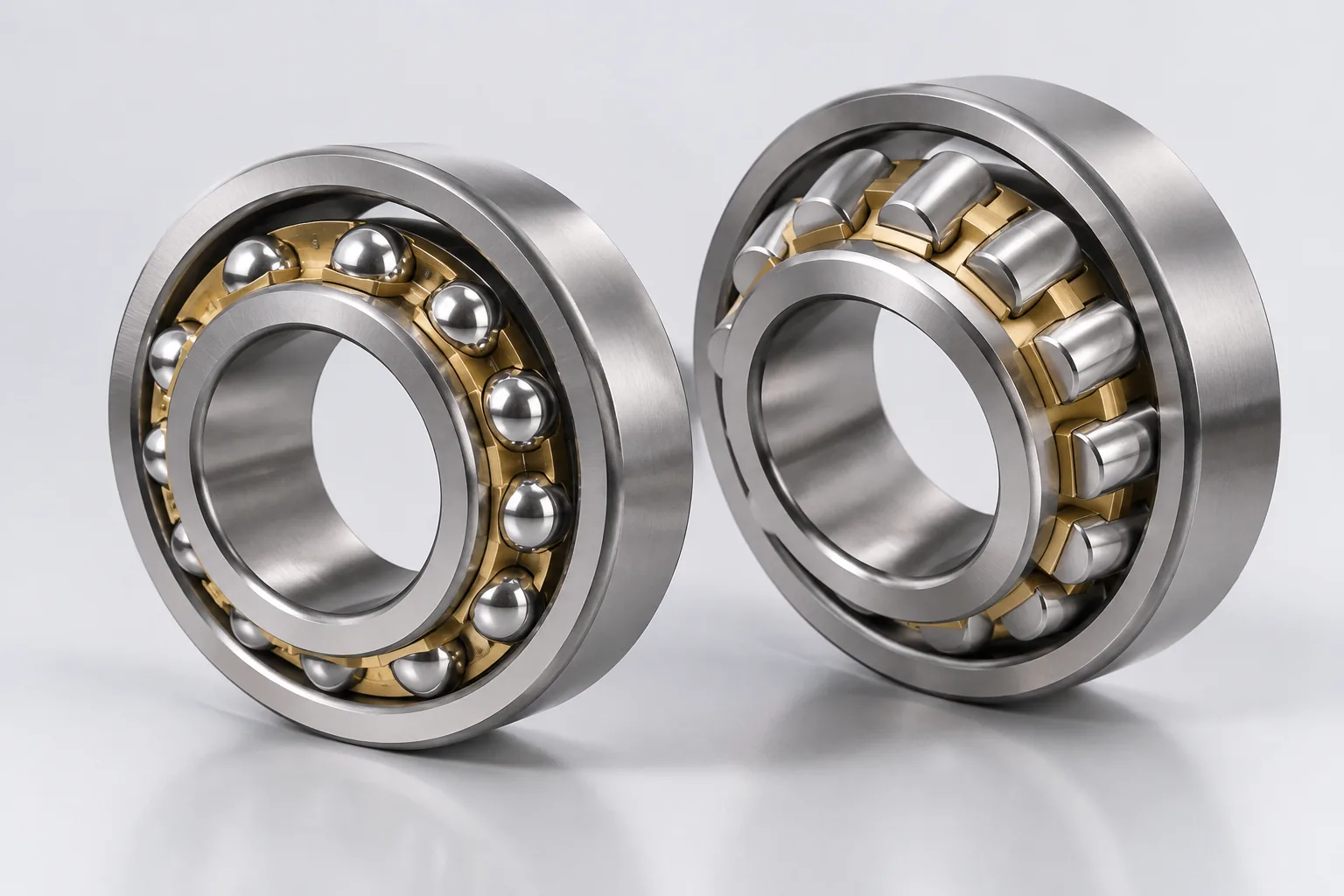
A self-aligning ball bearing has two rows of balls, a common spherical outer-ring raceway, and two continuous inner-ring raceways. The inner ring, ball set, and cage can oscillate relative to the outer ring, so the bearing compensates angular misalignment between shaft and housing and accommodates some shaft deflection. Point contact between balls and raceways keeps friction and heat generation low. Its main strengths are low friction, high-speed operation, and light-load performance. The small contact angle limits axial load capacity, so it is not a heavy axial-load bearing.
What Is a Spherical Roller Bearing?
A spherical roller bearing has two rows of symmetrical barrel-shaped rollers, a common spherical outer-ring raceway, and two inner-ring raceways inclined relative to the bearing axis. The center of the spherical outer raceway lies on the bearing axis, which gives the bearing its self-aligning ability. Line contact between rollers and raceways spreads load over a larger area and supports high radial loads. The design is suitable for heavy radial loads and axial loads in both directions. It also offers shock resistance, rigidity, and heavy-duty service capability.
Shared Self-Aligning Principle – and What It Does Not Mean
Both self-aligning ball bearings and spherical roller bearings are self-aligning bearings, not merely adjustable bearings that are aligned only at installation. They compensate angular misalignment between shaft and housing and can accommodate shaft deflection during operation. Permissible misalignment is not one fixed number. It depends on bearing series, size, load, seals, cage, lubrication, and surrounding components. Do not assume that one bearing type always has a larger permissible misalignment angle than the other. Confirm the limit for the exact variant and application geometry.
Design and Contact Differences at a Glance
| Comparison point | Self-aligning ball bearing | Spherical roller bearing |
|---|---|---|
| Rolling elements | Two rows of balls | Two rows of symmetrical barrel-shaped rollers |
| Main contact type | Point contact | Line contact |
| Primary strength | Low friction, high-speed and light-load operation | High radial load capacity, shock resistance, and greater rigidity |
| Radial loads | Light to moderate | Heavy to very heavy |
| Axial loads | Limited because of the small contact angle | Can carry axial load in both directions in addition to heavy radial load |
| Speed capability | Generally higher | Generally lower for the same envelope size |
| Minimum-load sensitivity | Performs well under light loads | Requires adequate minimum load, especially at high speed |
| Misalignment | Particularly high angular accommodation in open designs | Strong self-aligning capability under heavy load; permissible angle varies by series and size |
| Typical machine scale | Small and medium shafts | Medium and large industrial machinery |
| Typical selection rule | Choose for speed, low friction, and light or moderate load | Choose for load capacity, stiffness, shock, and harsh service |
Load Capacity: Self-Aligning Ball vs Spherical Roller
Self-aligning ball bearings carry light-to-moderate radial loads and limited axial loads. Spherical roller bearings carry heavy-to-very-heavy radial loads and axial loads in both directions. Spherical roller bearings are generally preferred for shock loads and high-stiffness applications. The same bore, outside diameter, and width can hide large differences in dynamic and static ratings.
| Specification | 2206 ETN9 self-aligning ball bearing | 22206 E spherical roller bearing |
|---|---|---|
| Bore x OD x width | 30 x 62 x 20 mm | 30 x 62 x 20 mm |
| Basic dynamic load rating, C | 23.8 kN | 66.1 kN |
| Basic static load rating, C₀ | 6.7 kN | 60.0 kN |
| Fatigue load limit, Pᵤ | 0.35 kN | 6.4 kN |
| Reference speed | 22,000 r/min | 10,000 r/min |
| Limiting speed | 15,000 r/min | 14,000 r/min |
| Mass | Approx. 0.26 kg | Approx. 0.29 kg |
| Bore options | Cylindrical or tapered | Cylindrical or tapered |
In this same 30 x 62 x 20 mm envelope, the 22206 E basic dynamic rating is about 2.78 times that of the 2206 ETN9. Its basic static rating is about 8.96 times that of the ball bearing. The 2206 ETN9 reference speed is about 2.2 times that of the 22206 E. These ratios are example-specific. Ratings and speeds depend on series, size, internal design, cage, lubrication, and operating conditions. Do not generalize them to every size or series.
Speed, Friction, and Minimum Load
Self-aligning ball bearings generally offer higher speed capability and lower friction than spherical roller bearings in the same envelope. Spherical roller bearings generally have lower speed capability for the same envelope size because line contact and higher load capacity change the internal dynamics. Seals reduce limiting speed, so compare open and sealed versions before selecting. For example, the open 2206 ETN9 has a limiting speed of 15,000 r/min, while the double-row contact-sealed 2206 E-2RS1TN9 has a limiting speed of 7,500 r/min. The 2206 ETN9 reference speed is 22,000 r/min; the 22206 E reference speed is 10,000 r/min.
Spherical roller bearings require adequate minimum load, especially at high speed, to avoid harmful sliding between rollers and raceways. Preliminary application guidance gives about 2% of the basic dynamic load rating as a minimum-load starting point, but final selection should use the specific product formula or manufacturer calculation tool. A higher speed rating does not justify using a ball bearing where heavy load or shock resistance governs. Speed ratings also depend on lubrication, load, cage, sealing, cooling, and mounting conditions.
Misalignment Capability: Do Not Use a Single Angle
Published guidance is not uniform. Self-aligning ball bearings can compensate significant angular misalignment in open designs; one common value is up to about 3° without affecting bearing performance. Another source gives about 0.07-0.12 rad, equal to about 4-7°, under normal load, subject to surrounding structure limits. Open spherical roller bearings also self-align under heavy load, but the angle varies by series and size: about 2° for 213 series, about 3° for 223 series, and up to about 3.5° for some larger 232 and 241 series. Sealed spherical roller bearings typically compensate only about 0.5° of shaft-to-housing misalignment.
Actual permissible misalignment depends on series, size, load, seals, and adjacent components. Check the selected data and application geometry. Do not use blanket statements that one type always allows more misalignment.
Axial Load and Load-Direction Limits
Self-aligning ball bearings have limited axial load capacity because of their small contact angle. Spherical roller bearings can carry axial loads in both directions in addition to heavy radial loads. Axial load direction and magnitude should be part of the bearing selection calculation, not assumed from bore size. For combined heavy radial and axial loads, spherical roller bearings are generally the more suitable self-aligning option. Axial capacity depends on bearing series, size, load ratio, lubrication, and speed.
Seals, Cages, and Bore/Mounting Options
Both bearing types are available with cylindrical bore and tapered bore. Tapered-bore bearings can be mounted directly on tapered journals or on cylindrical shafts using adapter sleeves or withdrawal sleeves. Self-aligning ball bearings are available in open and double-row sealed designs; sealed versions are often factory pre-greased. Their cages may be stamped steel, polyamide, or machined brass depending on series and application. Spherical roller bearings use window-type or pin-type cages and are available in open and sealed designs. Sealing reduces limiting speed and must be included in the speed margin. For example, the open 2206 ETN9 has a limiting speed of 15,000 r/min, while the sealed 2206 E-2RS1TN9 version is rated at 7,500 r/min. Cage and seal availability varies by manufacturer, series, and size. Follow the selected bearing’s mounting instructions.
Typical Applications
Application examples show how the technical differences translate into selection guidance. Use them as starting points, then verify load spectrum, speed, misalignment, lubrication, and minimum-load requirement.
Self-Aligning Ball Bearing Applications
- Textile yarn spindles.
- Fans and blowers.
- Agricultural attachments.
- Conveyor take-up pulleys.
- Food-industry separators.
- Pulp and paper processing equipment.
- Transmission shafts where shaft-to-housing alignment is difficult or shaft bending may occur.
These duties usually favor high speed, low friction, and light-to-moderate load, but each application still needs calculation.
Spherical Roller Bearing Applications
- Heavy-duty conveyors.
- Crushers.
- Vibrating screens.
- Rolling mills.
- Paper machinery.
- Mining equipment.
- Large industrial fans.
- Other heavy industrial duties requiring radial capacity, bidirectional axial capacity, shock resistance, and self-alignment.
Specific bearing selection must be verified against load, vibration, lubrication, speed, and minimum-load requirements.
Selection Checklist
- Define radial load, axial load magnitude and direction, shock load, and load spectrum.
- Check speed against reference speed and limiting speed, including sealed versus open design.
- Estimate misalignment from shaft deflection, housing stiffness, mounting tolerance, and thermal growth.
- Check minimum load for spherical roller bearings, especially at high speed.
- Confirm required stiffness, shock resistance, friction, and heat generation.
- Select lubrication, sealing, cage, clearance, and bore type.
- Confirm envelope dimensions, mounting method, and available adapter or withdrawal sleeves.
- Calculate rating life using ISO 281 and static safety using ISO 76.
- Verify availability and current published ratings before finalizing.
Standards and Rating Basis
ISO standards provide the common basis for dimensions, tolerances, ratings, life, and symbols. They do not make two bearing types interchangeable; the standard dimension plan only fixes preferred boundaries.
- ISO 15:2017 sets preferred boundary dimensions for radial bearings in diameter series 7, 8, 9, 0, 1, 2, 3, and 4. It was published in July 2017 and confirmed in 2022.
- ISO 492:2023 sets dimensional and geometric tolerances for radial rolling bearings; nominal boundary dimensions refer to standards such as ISO 15.
- ISO 281:2007 covers basic dynamic load ratings and rating life. Basic rating life corresponds to 90% reliability. It was confirmed in 2021 and is under revision.
- ISO 76:2006 covers basic static load ratings and static equivalent loads, with static safety factor guidance for heavy-duty applications.
- ISO 15241:2012/Amd 1:2020 unifies symbols for dimensions, tolerances, load ratings, and life. ISO 15241:2012 was confirmed in 2025.
Common Misapplications and Exceptions
- Using a self-aligning ball bearing for heavy shock or high axial load duties.
- Using a spherical roller bearing in a light-load, high-speed duty without checking minimum load.
- Assuming same bore and outside diameter means interchangeable load capacity.
- Assuming one bearing type always allows more misalignment.
- Ignoring the speed reduction caused by seals.
- Ignoring cage, clearance, lubrication, and mounting effects.
- Selecting by published size data alone without ISO 281 life and ISO 76 static safety checks.
Actual permissible misalignment, speed, and load capacity must be confirmed for the exact series, size, and variant. Same envelope dimensions do not make self-aligning ball bearings and spherical roller bearings interchangeable.
Conclusion
The choice between self-aligning ball bearings and spherical roller bearings is a trade-off between speed and friction on one side and load capacity and rigidity on the other. Choose self-aligning ball bearings for high-speed, low-friction, light-to-moderate radial duty where axial load is limited and alignment is difficult to control. Choose spherical roller bearings for heavy radial loads, axial loads in both directions, shock, vibration, and high-stiffness industrial duty, and check minimum load at high speed. Use published ratings, ISO 281 life calculations, ISO 76 static safety checks, and the exact mounting and sealing configuration before finalizing. The safe next step is to calculate the duty and confirm the selected variant’s ratings, misalignment limit, and speed margin.
FAQs
Q1: Are spherical roller bearings self-aligning?
A: Yes. The double-row barrel rollers run in a common spherical outer-ring raceway whose center lies on the bearing axis. This lets the inner ring and roller set tilt to accommodate shaft deflection or housing misalignment. Self-aligning ability does not remove the need to check alignment: permissible angle depends on series, size, load, seals, cage, lubrication, and surrounding components.
Q2: Can self-aligning ball bearings carry axial loads?
A: They can carry only limited axial loads because their contact angle is small. They are not the first choice for combined heavy radial and axial loads. If axial load is significant in either direction, a spherical roller bearing is generally more suitable, but the axial capacity still must be checked for the exact series, size, load ratio, lubrication, and speed.
Q3: Which bearing has higher load capacity?
A: Spherical roller bearings generally have much higher radial load capacity in the same envelope because line contact spreads load over a larger area. In one same-envelope example, a 22206 E has a basic dynamic rating of 66.1 kN and a basic static rating of 60.0 kN, compared with 23.8 kN and 6.7 kN for a 2206 ETN9. These values are example-specific and must not be generalized.
Q4: Which bearing is better for high speed?
A: Self-aligning ball bearings are generally better for high speed and low friction. In the same-envelope example, the 2206 ETN9 has a reference speed of 22,000 r/min and a limiting speed of 15,000 r/min; the 22206 E has a reference speed of 10,000 r/min and a limiting speed of 14,000 r/min. Lubrication, load, cage, seals, cooling, and mounting conditions can change the usable speed.
Q5: Are self-aligning ball bearings and spherical roller bearings interchangeable by dimensions?
A: No. A matching bore, outside diameter, and width only means the bearings share an envelope. It does not establish equal dynamic or static rating, speed capability, axial capacity, misalignment limit, stiffness, cage, clearance, lubrication, or mounting requirements. Treat same-envelope types as different designs and verify every selection parameter.
Q6: Which bearing allows more misalignment?
A: There is no single answer. Open self-aligning ball bearings are often listed at up to about 3°, with some guidance giving about 4-7° under normal load, subject to structure limits. Open spherical roller bearings are often listed at about 2° for 213 series, about 3° for 223 series, and up to about 3.5° for some larger 232 and 241 series. Sealed spherical roller bearings typically allow only about 0.5°.
Q7: Do spherical roller bearings require a minimum load?
A: Yes, especially at high speed. Without enough load, rollers can slide instead of rolling, which can damage the raceways. Preliminary guidance uses about 2% of the basic dynamic load rating as a starting point, but final selection should use the specific product formula or manufacturer calculation tool. Check minimum load together with speed, lubrication, and vibration.
Q8: Why are sealed bearings slower than open bearings?
A: Seals add friction, retain heat, and can restrict lubricant flow, so they usually reduce the limiting speed. In the 2206 example, the open version is rated at 15,000 r/min and the double-row contact-sealed 2206 E-2RS1TN9 is rated at 7,500 r/min. The actual limit still depends on lubrication, load, cage, cooling, and mounting conditions.