Quick Answer: An idler pulley is a non-driven pulley that guides, redirects, supports, or tensions a belt. A drive pulley is connected to a power source or driven shaft and transmits torque to or from the belt. Both carry belt tension, but only the drive pulley adds a torque path through its hub or shaft connection. Classify each pulley by its role in the power flow, then verify bearing loads, alignment, and belt type against the machine data.
Idler pulley vs drive pulley comparisons often start with appearance, but appearance is a weak guide. A flat, grooved, flanged, or crowned pulley can serve either role depending on the machine layout. The reliable question is where torque enters or leaves the belt and which pulley only routes, supports, or tensions it. Confirm that role on the machine schematic before using bearing size, pulley diameter, or mounting position as a substitute for the power-flow path.
Definitions and Terminology
In belt-drive terminology, an idler pulley and a drive pulley are both pulleys, but the words describe different roles in the power flow. The terms are often confused in maintenance and procurement because a replacement pulley may look similar to the original even when its function is different. Confirm function from the machine schematic, not only from the part appearance.
What Is an Idler Pulley?
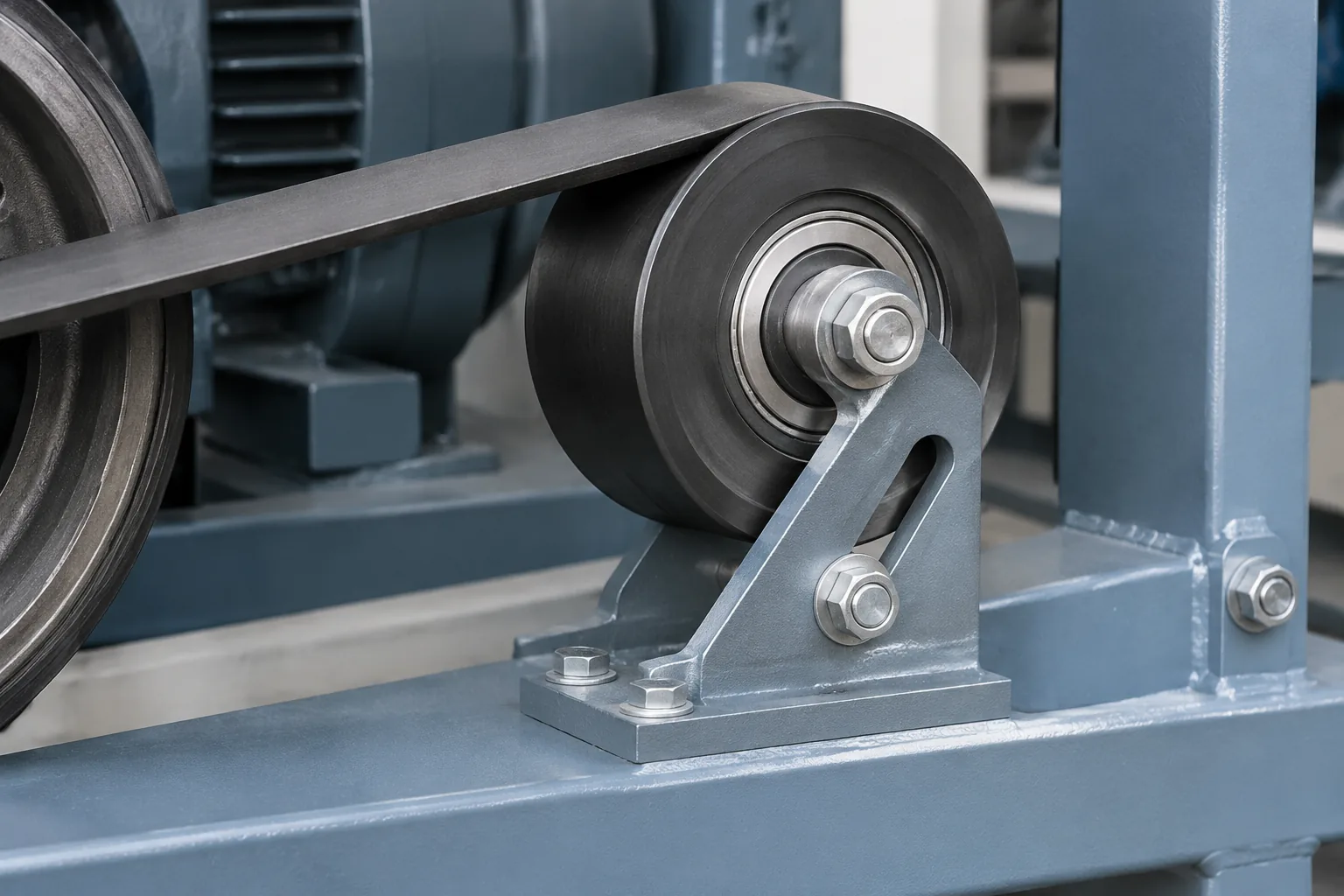
An idler pulley is typically free-running on a bearing or shaft and is not connected to a prime mover. It may guide, redirect, support, or tension the belt depending on the design. Idler faces may be flat, grooved, flanged, or crowned depending on belt type and routing; confirm the required form with the application.
- Only adjustable idlers tension the belt. Fixed guide idlers generally do not set belt tension.
- Snub, guide, tensioner, and take-up pulleys may all be described as idlers in maintenance vocabulary.
What Is a Drive Pulley?
A drive pulley is typically connected to a motor, engine, gearbox, or driven shaft. It transmits torque to or from the belt and helps define the speed relationship in the drive. It requires a torque-transmitting hub or shaft connection and careful alignment.
A pulley may be a driving or driven pulley depending on system convention. In conveyor contexts, drive pulley usually means the powered pulley; confirm the machine schematic before ordering.
Core Comparison at a Glance
The comparison below uses qualitative categories because load, speed, and life values depend on the application.
| Comparison point | Idler pulley | Drive pulley |
|---|---|---|
| Power source | Typically free-running and not connected to a prime mover. | Typically connected to a motor, engine, gearbox, or driven shaft. |
| Main function | Guides, redirects, supports, or tensions the belt. | Transmits torque to or from the belt. |
| Load path | Sees belt tension as a radial and moment load on its bearing and mounting. | Sees belt tension and also transfers torque through its hub or shaft connection. |
| Design features | Often uses bearing inserts, stub shafts, brackets, or adjustment features. | Often uses keyed, splined, taper-bush, or clamped connections. |
| Bearing choice | Must be checked against radial and axial loads, speed, misalignment, duty cycle, and environment. | Must be checked against the same factors plus the torque path and hub or shaft stresses. |
| Typical failure focus | Bearing noise, seizure, pulley wobble, or tracking drift. | Slip, wear, hub or keyway damage, loose fastening, or belt wear patterns. |
The table is a classification aid, not a replacement rule. Bearing choice is not automatically interchangeable between the two roles; verify the actual loads and mounting conditions.
Function and Power Flow: Which Pulley Does What?
Power flow is the clearest way to distinguish the two pulley roles. Compare where torque enters the system, how the belt is routed, which pulley adjusts tension, and which pulley sets the speed relationship. Do not judge by size, shape, or location alone.
Idler Pulley Functions in a Belt System
- Routes the belt around obstructions or along a required path.
- Can increase wrap angle on another pulley when designed for that purpose.
- Maintains belt tension when configured as a tensioner or take-up pulley.
- May support the belt over long spans or reduce unwanted belt movement depending on layout.
Adding or moving an idler changes belt wrap, load, and tracking. Verify the design effect before modifying a layout. Unnecessary idlers add drag, noise, and additional failure points.
Drive Pulley Functions
A drive pulley transfers torque between the shaft and the belt. It also helps set the belt speed relationship with the driven pulley. The design must account for starting torque, reversing duty, shock loads, and belt tension.
Bearing loads and hub stresses depend on wrap angle, belt pull, and torque path. Use a free-body diagram for critical drives. A drive pulley is not automatically the largest pulley in the system; confirm the layout.
Combined Layouts and Terminology Exceptions
Most belt systems use both drive and idler pulleys. Identify the power source, torque path, and belt routing before classifying each pulley. Document the pulley position and function in maintenance records to avoid replacement errors.
Some pulleys combine functions, such as an adjustable drive pulley or a tensioner with a guide role. Classify by primary function and verify with OEM data.
Loads, Speed, and Bearing Implications
An idler and a drive pulley may need different bearing reviews even when their dimensions look similar. The review should cover belt tension, wrap angle, overhung load, speed, misalignment, lubrication, and environment. Bearing selection must follow the actual load path.
Load Path on Idler Pulleys
Belt tension produces a resultant radial load on the pulley shaft and bearing. Load direction and magnitude depend on belt pull and wrap angle. Cantilevered or overhung idlers can add moment load; verify mounting stiffness.
A tensioner adjustment force may add load beyond the belt pull. A low-wrap guide idler may be lightly loaded but can still fail from misalignment, contamination, or lubrication loss.
Load Path on Drive Pulleys
Belt tension loads the shaft and bearings. Torque is transmitted through the hub, keyway, spline, taper bush, or clamp connection. Starting, reversing, and shock torque can affect hub and shaft connection integrity, not only bearing life.
Bearing load depends on belt pull and wrap angle; use a free-body diagram for critical drives. A drive pulley bearing is not necessarily larger simply because it is a drive pulley; confirm the actual loads.
Bearing Selection Criteria for Both Pulley Types
Review radial load, axial load, speed, misalignment tolerance, lubrication, sealing, temperature, contamination, duty cycle, mounting, and target life. Confirm housing and shaft fits, clearance, and lubrication method. Use catalog data and machine OEM requirements rather than the pulley name alone.
Critical or high-load drives should be verified by engineering calculation. Do not select a bearing only because it fits the shaft diameter.
Design and Construction Differences
Hub connection, shaft mounting, belt face geometry, tracking features, material, and surface treatment all follow function and belt type. These features are not determined by the idler or drive label alone.
Hub, Shaft, and Fastening Differences
Drive pulleys commonly use keyed, splined, taper-bush, or clamped connections to transmit torque. Idler pulleys commonly use bearing inserts, stub shafts, through shafts, or bracket-mounted designs.
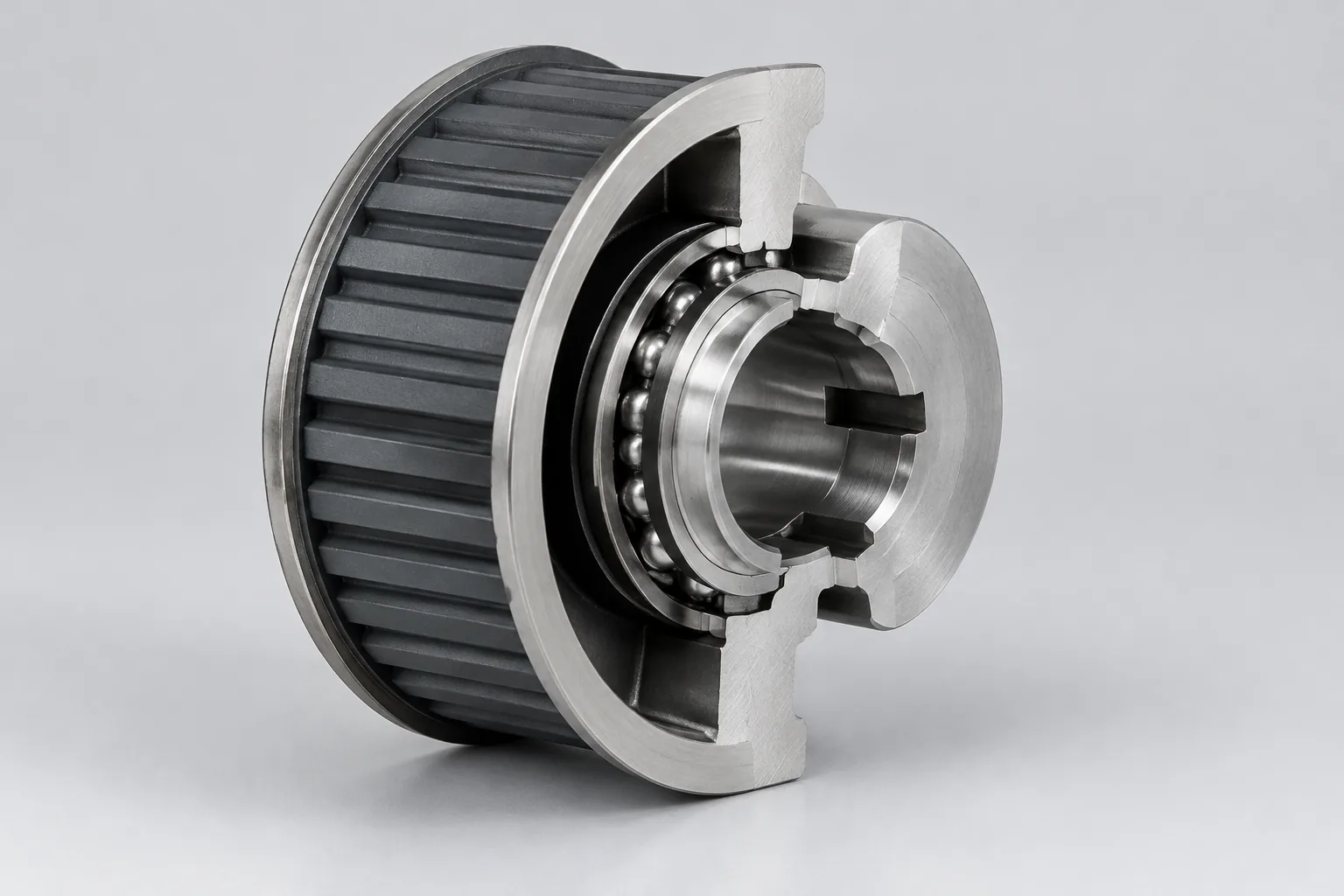
Replacement must match shaft fit, fastening method, and torque path. A pulley that fits the shaft diameter but cannot transmit or react the required torque is not a valid substitute.
Belt Face, Tracking, and Environment
The drive pulley profile must match the belt type, such as flat, V, timing, or ribbed belt. An idler face may be flat, crowned, or flanged depending on belt tracking requirements. Material and coating depend on load, corrosion, abrasion, temperature, and belt compatibility.
A feature used on one belt type may be unsuitable for another. Confirm crown, flange, surface finish, and material requirements with the belt or machine data before ordering.
Selection Guide: Idler or Drive Pulley?
Choose a drive pulley when the component must input or output torque or define the belt speed relationship. Choose an idler pulley when the component only routes, tensions, or supports the belt and does not transmit torque.
Use this checklist before ordering:
- Belt type and size.
- Pulley dimensions and profile.
- Shaft and hub connection.
- Radial and axial load.
- Speed and duty cycle.
- Environment, including contamination and temperature.
- Adjustment range if the pulley tensions the belt.
- Maintenance access and guard clearance.
Do not replace an idler with a drive pulley, or the reverse, without engineering review. Review load path, bearing, tracking, guards, and fasteners. If tensioning is required, confirm whether the design uses a tensioner idler or an adjustable driven or drive arrangement. Some pulleys combine functions; classify by primary power-flow role and verify with the machine schematic.
Common Failure Modes and Diagnosis by Pulley Type
Failure symptoms differ by role, but one type is not inherently more reliable than the other. Connect every symptom to bearing condition, belt tension, alignment, hub condition, and environment before replacing parts. Root-cause checks come before replacement.
Idler Pulley Symptoms
- Bearing noise, grinding, roughness, play, or seizure.
- Pulley wobble, belt tracking drift, belt edge wear, or loss of tension.
- A seized idler causing belt wear, slip, or overheating.
Drive Pulley Symptoms
- Belt slip, whine, or reduced drive performance.
- Pulley wear, keyway or hub damage, a loose taper bush, or abnormal vibration.
- A belt wear pattern indicating misalignment, insufficient tension, or pulley profile wear.
Bearing Inspection and Misdiagnosis Risks
Inspect bearing play, roughness, temperature, lubrication leakage, contamination, alignment, and belt tension. Belt noise can come from alignment or tension, not only the bearing. Drive slip can come from belt contamination or tension, not only pulley wear. Replace the bearing only after identifying the root cause.
Maintenance and Replacement Checklist
- Record pulley position, function, dimensions, belt type, and bearing marking before removal.
- Inspect belt tension and alignment, pulley wear, bearing play, fasteners, and guards.
- Use the correct replacement bearing and housing; confirm load, speed, and environment.
- After replacement, check alignment, tension, guard fit, noise, vibration, and run-in behavior.
Follow machine OEM instructions before generic maintenance guidance. Damaged shaft, hub, keyway, or pulley face may require pulley replacement rather than bearing replacement alone.
Conclusion
The idler pulley vs drive pulley distinction is ultimately a power-flow distinction, not a shape or size rule. A drive pulley inputs or outputs torque and therefore places demands on the hub, shaft connection, and bearing load path; an idler pulley routes, supports, or tensions the belt and usually runs free on its bearing. Both see belt tension, and both can fail from misalignment, contamination, or incorrect tension. Before replacement, confirm the pulley’s role on the machine schematic, verify the belt type and load path, and match the bearing and housing to the application. Do not substitute one role for the other without engineering review.
FAQs
Q1: What is the main difference between an idler pulley and a drive pulley?
A: An idler pulley is non-driven and routes, supports, or tensions the belt, while a drive pulley is connected to a power source or driven shaft and transmits torque. Both can carry belt tension, but only the drive pulley adds a torque path through its hub or shaft connection.
Q2: Can an idler pulley be used as a drive pulley?
A: Not as a direct substitute. An idler typically lacks the torque-transmitting hub, shaft connection, and bearing review required for a drive role. Converting the role requires engineering review of load path, fasteners, guards, tracking, and bearing capacity.
Q3: Which pulley usually carries more load?
A: Neither role automatically carries more load. Belt tension, wrap angle, overhung load, speed, and torque path determine the bearing and shaft loads. A drive pulley adds torque transmission, but a heavily wrapped or cantilevered idler can still be highly loaded.
Q4: Do idler and drive pulleys use the same type of bearing?
A: Not necessarily. Similar shaft dimensions do not prove the same bearing is suitable. Verify radial and axial loads, speed, misalignment, lubrication, sealing, duty cycle, and housing fit for each position.
Q5: How can I tell if an idler pulley bearing is failing?
A: Look for bearing noise, grinding, roughness, play, seizure, pulley wobble, belt tracking drift, or belt edge wear. Confirm alignment, tension, and contamination before replacing the bearing, because belt noise can come from the system rather than the bearing alone.
Q6: What causes drive pulley slip or noise?
A: Drive pulley slip or noise can come from insufficient belt tension, contamination, misalignment, pulley profile wear, a loose taper bush, or hub and keyway damage. Check the belt and the full torque path before assuming the pulley itself is worn out.
Q7: Does an idler pulley increase belt tension?
A: Only an adjustable idler, such as a tensioner or take-up pulley, is intended to change belt tension. A fixed guide or snub idler generally does not set tension, although adding or moving any idler can change wrap angle, load, and tracking.
Q8: When should I replace the pulley instead of only the bearing?
A: Replace the pulley when the belt face, flange, hub, keyway, shaft fit, or fastening features are damaged or worn beyond the machine maker’s limits. If the housing and pulley body remain serviceable, bearing replacement may be possible after root-cause checks.