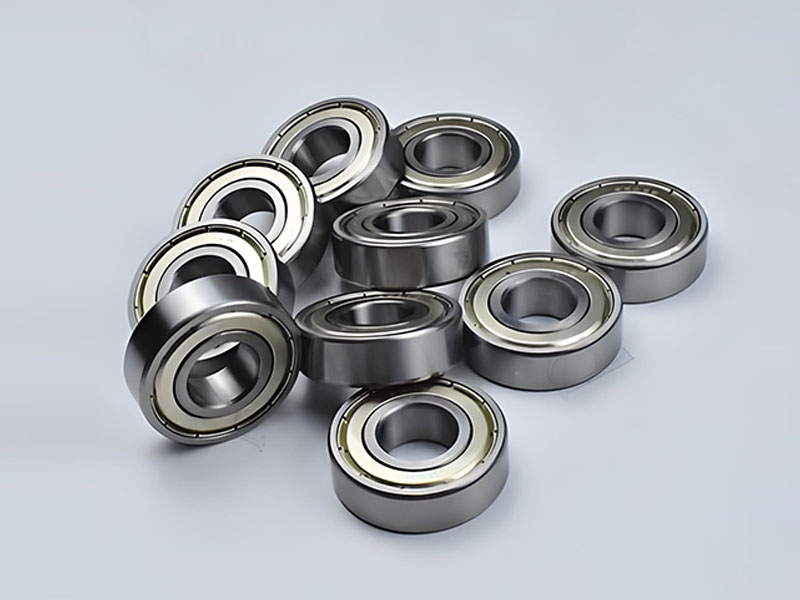
Quick Answer: Troubleshooting center support bearings starts with the part’s job: a center support bearing, also called a driveshaft support bearing, center bearing, carrier bearing, propshaft support bearing, or hanger bearing, carries the joint between driveshaft sections and holds the shaft in line. When it fails, look for takeoff shudder, speed-related noise, or vibration under load. A road test alone cannot confirm the part: inspect the rubber cushion, bracket fasteners, bearing rotation, universal joints, and slip spline first.
Troubleshooting center support bearings means treating the same shudder or howl as a shared symptom: it can come from a worn universal joint, an unbalanced shaft, a loose bracket, or a tire. This guide works from symptom to confirmed cause instead of from symptom to part number. Reading symptoms is a diagnosis aid, not proof that the center support bearing has failed.
What a Center Support Bearing Does in a Driveshaft
A center support bearing is also known as a driveshaft support bearing, center bearing, carrier bearing, propshaft support bearing, or hanger bearing. On a two-piece or multi-piece driveshaft, it mounts to the frame, a crossmember, or the vehicle underbody. It supports the shaft at the joint between sections and keeps the shaft line aligned.
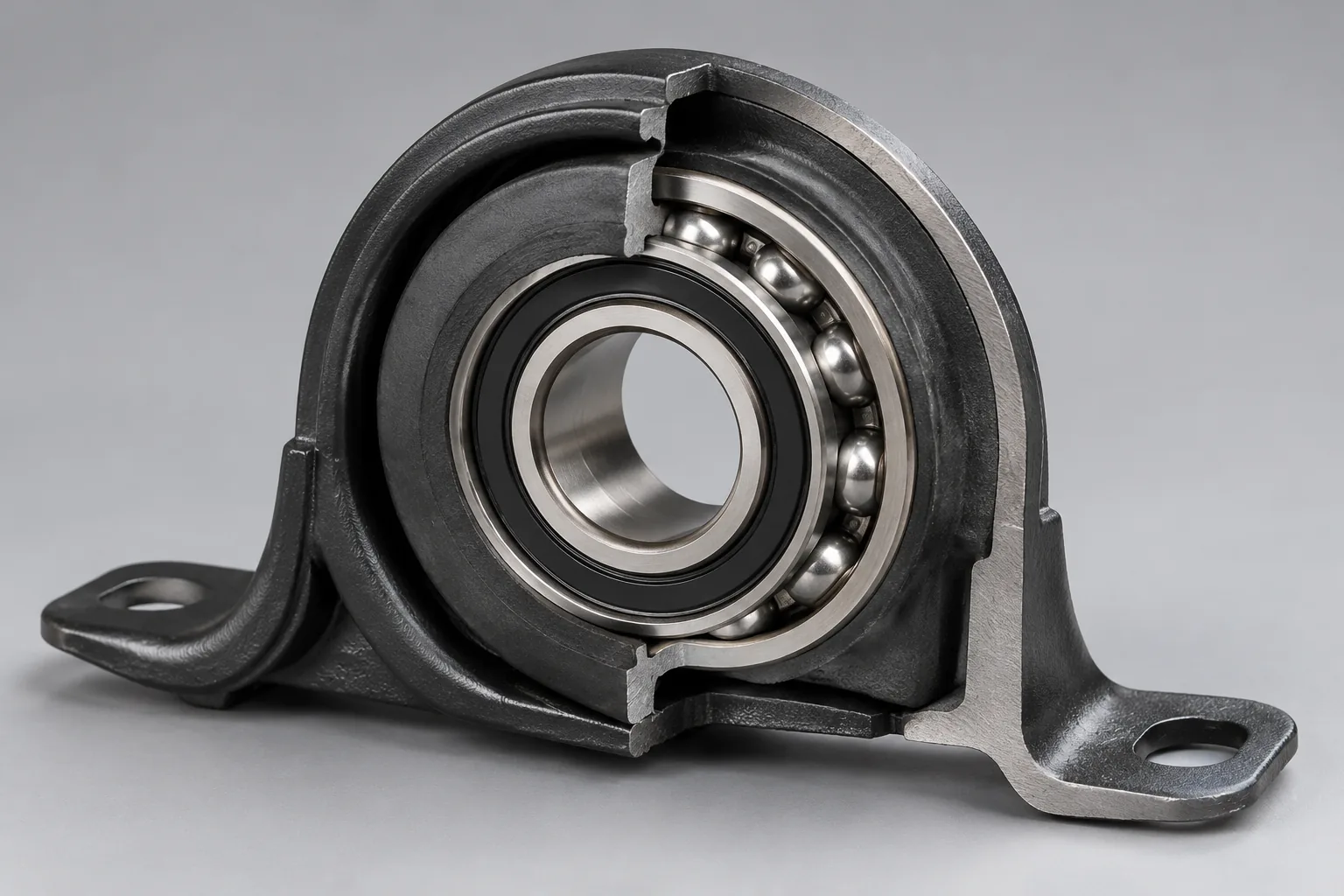
A typical assembly contains a sealed ball bearing, a rubber cushion or isolator, and a steel or aluminum bracket. The rubber element isolates shock, noise, and driveline vibration. These bearings are normally supplied pre-lubricated and use metal-reinforced seals to keep contaminants out.
On a long shaft, the center support also limits shaft whip at high speed or heavy load. Long-shaft design has to stay clear of the driveshaft’s critical and half-critical speeds. Rigid and self-aligning designs are not interchangeable in behavior. A self-aligning bearing tolerates a defined misalignment range, but that range is a design property of that specific part and not a general installation allowance. Some self-aligning units are rated for +/-10 degrees of design alignment and use a maintenance-free factory-sealed bearing, a double-lip seal, and a vibration-isolating elastomer. A self-aligning bearing does not correct a bent shaft, a worn universal joint, or a mispositioned bracket.
Symptoms That Point to a Center Support Bearing
Symptoms indicate the need for diagnosis. They do not prove that a single part has failed.
- Takeoff shudder or jolt: a clear shudder or impact when the vehicle accelerates from rest is a common sign of a failed center support bearing or a collapsed rubber cushion.
- Speed-related noise: a failing bearing can howl, grind, knock, or squeal during acceleration, deceleration, or steady-speed driving. The sound usually comes from under the middle of the vehicle.
- Whining: a dry or worn bearing can whine, but driveline whine can equally come from a dry or worn universal joint. Sound alone does not identify the part.
- Vibration under acceleration: a loose support or damaged rubber cushion lets the shaft move out of position. The vibration reaches the cabin through the floor, seats, or chassis.
- Increased drag or reduced power delivery: a support bearing near the end of its life or already damaged can create a sense of drag while driving.
A rattle in motion is not automatically internal bearing damage. A published technical service bulletin, 03-001-24 (published 2024-01-09), traced a driving rattle on some 2023-2024 Jeep Grand Cherokee and Grand Cherokee L vehicles built from 2023-01-01 through 2023-09-28 to center support bearing fasteners that were loose or missing. On a vehicle covered by that bulletin, tightening or reinstating the fasteners may be the correct repair rather than replacing the bearing.
Step-by-Step Troubleshooting Sequence
Troubleshooting center support bearings follows this sequence. Work through the checks in order. Each step narrows the suspect list before any part is replaced.
- Confirm the trigger conditions. Record separately whether the noise or vibration appears on takeoff, under load acceleration, on throttle lift or deceleration, at steady speed, or only in a particular road-speed band. Center support bearing noise can occur in all three driving states, so the pattern narrows the suspect list rather than confirming the part.
- Inspect the rubber isolator. Look for cracking, tearing, hardening, deformation, or separation from the bearing shell or bracket. A failed rubber element reduces both shaft support and vibration isolation.
- Inspect the bracket and fasteners. Check for cracks, distortion, loose mounting bolts, or missing bolts. Take the tightening torque from the vehicle service manual or the manufacturer bulletin, never from a generic torque table.
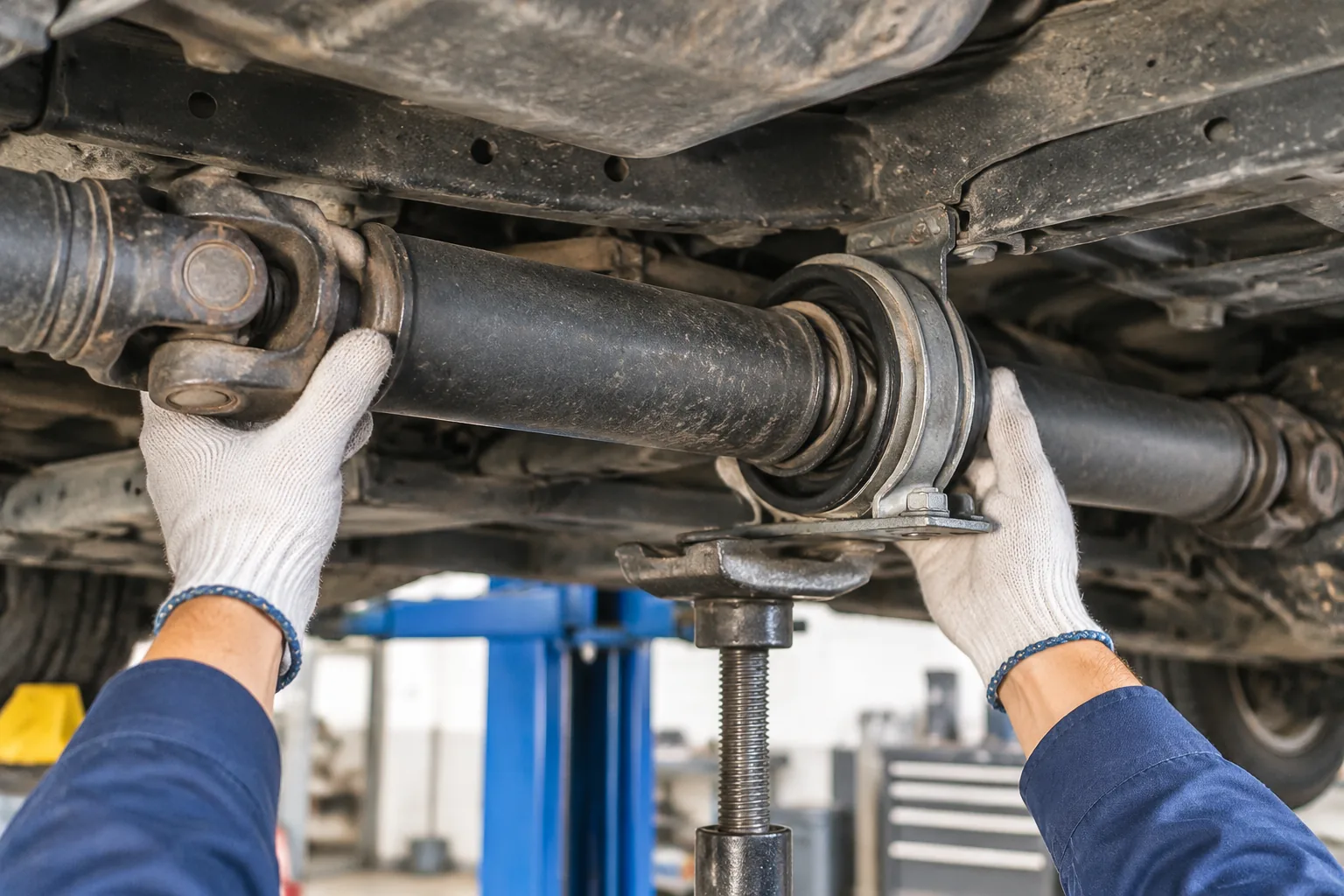
- Check bearing rotation. With the shaft released or removed, turn the bearing by hand and feel for roughness, binding, grit, or abnormal play. Look for seal damage, corrosion, or grease leakage.
- Check driveshaft position. Confirm the shaft is not visibly sagging or sitting off-center in the rubber cushion. Inspect the tube for dents, bends, missing balance weights, and impact marks.
- Check universal joints and the slip spline in the same pass. Worn universal joints, slip joints, and worn transmission tailshaft or differential pinion bushings produce similar squeaks, grinds, and clunks. Driveline noise diagnosis requires excluding them.
- Rule out other sources. Tire imbalance, wheel bearings, springs, transmission, and differential faults can generate comparable noise or vibration. Do not replace the center support bearing after a single road test.
Steps 4 and 5 require the driveshaft to be released or removed, which needs suitable lifting equipment and support stands. If the rubber cushion is fully torn, the shaft is visibly sagging, the bracket is loose, the shaft contacts the body, or vibration is severe, stop road testing and inspect before driving further.
Common Root Causes of Center Support Bearing Failure
A new bearing will fail again if the original cause remains. Match each cause to the inspection findings.
- Lubrication or seal failure: missing lubricant, degraded grease, or water and solid particles entering the raceway raises noise, friction, and surface fatigue.
- Misalignment: an incorrect support face, bracket position, or shaft angle raises bearing and seal load, friction, and temperature and shortens life. Correct support seating with proper measuring equipment and shims.
- Driveshaft imbalance: imbalance increases bearing heat and load. Check for contamination attached to the shaft and rebalance rotating components where needed.
- Out-of-phase assembly: a multi-piece driveshaft reassembled out of its original phase can vibrate and damage the shaft and its connected parts.
- Installation damage: impact during fitting, a wrong press force path, too tight or too loose a fit, cocked installation, and incorrect clamping are recognized installation-related causes of bearing damage.
- Under-tightened bracket: the bulletin case shows that a center support bearing not correctly secured to the body can rattle in motion.
The same bulletin, 03-001-24, identifies incorrect fastening of the center support bearing as the cause of a rattle on the covered 2023-2024 Jeep Grand Cherokee and Grand Cherokee L build range. Roughness found only at the bearing is not evidence of a single cause. Lubrication, contamination, alignment, imbalance, and installation have to be separated.
Reading Inspection Findings Against Failure Modes
Use ISO 15243:2017 as the language for describing what the removed bearing shows. The standard classifies six running-damage categories:
- rolling contact fatigue
- wear
- corrosion
- electrical erosion
- plastic deformation
- cracking and fracture
The standard classifies damage and failure modes after inspection. It does not replace the vehicle repair procedure or set acceptance limits. In plain terms, grit and dull raceways point toward wear and contamination. Rust and seal damage point toward corrosion. A brinelled or dented raceway points toward plastic deformation from impact or standing load.
Condition monitoring with vibration analysis, thermography, and lubricant analysis can identify a developing bearing fault before severe damage and collateral damage occur. The practical outcome is simple: the failure mode indicates what has to change in alignment, sealing, installation, or shaft condition before a new bearing is fitted. Naming a failure mode applies to the inspected part on the bench, not to a guess made from a road test.
Safety Limits During Diagnosis and Road Testing
A driveshaft is a high-speed rotating part. Under-vehicle inspection requires approved lifting equipment and correct support points, never a single jack.
- Stop road testing when the rubber support is completely torn, the shaft hangs visibly low, the bracket is detached, the shaft contacts the body, or vibration is severe.
- Keep hands, tools, and clothing clear of a shaft that can rotate. Never inspect a rotating shaft.
- Limit vehicle speed and load until a suspected driveline fault is confirmed.
All checks under the vehicle are conditional on the lifting and support method being adequate for the vehicle weight.
Replacement and Installation Details That Prevent Repeat Failure
Mark before dismantling. Clearly mark the flange, shaft sections, universal joint positions, spline position, and bearing position so the assembly goes back in the original location and phase. Reassembling a driveshaft out of phase can cause vibration and component failure and, in severe cases, separation of the shaft from the vehicle.
Follow the specific procedure when the shaft uses a bonded or marked joint. One service document, 10152054 (January 2020), covers center bearing replacement on the SPL 250/350 Lite. The procedure says to find the yellow alignment mark on the outside diameter of the spline sleeve before removal, and to copy that mark to the opposite side of the bearing when the work might wipe it away. That procedure specifies kit 350CB03X and DP420NS Black Epoxy Adhesive, number 7100148758, supplier number 10152047. That kit and adhesive are specific to that assembly and are not a general requirement.
Align before pressing. 10 Series service information calls for the new center bearing to line up with the machined face of the midship tube shaft. When alignment is right, the bearing slides on with only light effort.
A center bearing is normally a pre-lubricated sealed assembly. Do not drill it, open the seal, or add a different grease unless the vehicle or bearing manufacturer explicitly permits relubrication. A pre-lubricated sealed bearing that shows damage is replaced, not regreased.
Support location, shims, preload direction, and fastener torque differ by vehicle. Take them from the VIN-specific OEM service manual, technical bulletin, or installation instructions. A published safety recall, ACX-2305/DC-2301 (NHTSA 23V196, May 2023), specifies 90 lb-ft (about 122 N-m) for the four center support bracket fasteners on certain ACX vehicles with an aluminum crossmember. That figure applies only to the vehicles named in that document and is not a general center bearing torque.
If vibration persists after replacement, recheck shaft phase, balance, tube straightness, universal joint condition, slip spline, and operating angles. Do not fit another bearing before those checks are complete. A center bearing bonded to the shaft cannot be removed and refitted using a procedure written for a bolted or pressed bearing.
Every torque value, shim, and support position quoted here applies only to the vehicle or assembly named in the source document.
Conclusion
Troubleshooting center support bearings follows a decision path: symptom pattern first, then the rubber isolator, bracket fasteners, bearing rotation, shaft position, universal joints, and slip spline, and only then other noise sources. The process ends in a confirmed cause, not a part guess. Correct the found cause – misalignment, imbalance, phase, fastener condition, sealing, or installation damage – before a new bearing goes in. Keep torque and position values tied to the vehicle-specific manual, do not open a sealed bearing, and stop diagnosis when the shaft is unsafe to test. If vibration remains after replacement, recheck phase, balance, and operating angles before fitting another part.
FAQs
Q1: How do I tell a bad center support bearing from a bad universal joint?
A: The two produce overlapping howl, grind, and clunk, so separate them by inspection rather than sound. At the support, check bearing roughness, seal damage, and rubber cushion condition. At the joint, check for play, dry or seized crosses, and slip spline wear. Replace only the part that fails its own check.
Q2: Can I keep driving with a bad center support bearing?
A: Not safely if the rubber cushion is torn, the shaft sags, the bracket is loose, or vibration is heavy. Those conditions mean stop the road test and inspect before driving further. Continued driving can damage the shaft, joints, and body. Limit speed and load until the cause is confirmed.
Q3: Why did my new center support bearing fail again?
A: The original cause was probably left in place. Check misalignment, shaft imbalance, wrong phase, worn universal joints, incorrect fit or press load, and loose fasteners. Recheck shaft phase, balance, tube straightness, joint condition, slip spline, and operating angles before fitting another bearing.
Q4: Does a loose bracket really sound like a failed bearing?
A: Yes. A rattle can come from fasteners that are loose or missing, not from internal bearing damage. Technical service bulletin 03-001-24 covers some 2023-2024 Jeep Grand Cherokee and Grand Cherokee L vehicles built from 2023-01-01 through 2023-09-28 for this condition. Tighten or reinstate the fasteners to the vehicle specification before replacing the bearing.
Q5: Do center support bearings need greasing?
A: No for the normal sealed, pre-lubricated assembly. Do not drill the bearing, open the seal, or add a different grease unless the vehicle or bearing manufacturer explicitly permits relubrication. A sealed bearing that shows damage is replaced, not regreased.
Q6: Which torque should I use for the support bracket?
A: Use the VIN-specific OEM service manual value. Published figures from a recall or bulletin apply only to the vehicles named in that document. For example, recall ACX-2305/DC-2301 (NHTSA 23V196) lists 90 lb-ft (about 122 N-m) for certain ACX vehicles with an aluminum crossmember, not for every center support bearing.