Quick Answer: A failing center support bearing typically produces squealing, whining, or howling noises during acceleration, shuddering or vibration when taking off, clunking sounds when changing gears or throttle, and in severe cases, the driveshaft may bang against the vehicle floor. Prompt diagnosis prevents driveline damage.
A center support bearing (also referred to as a carrier bearing or support bearing) is a critical component in vehicles with split driveshafts – including rear‑wheel drive, four‑wheel drive, and all‑wheel drive trucks, SUVs, and passenger cars. When this bearing begins to fail, it produces noticeable noises, vibrations, or driveline movements. Recognizing these symptoms early can prevent more extensive – and expensive – damage to the transmission, differential, or driveshaft itself. But what exactly should a driver listen or feel for? And how does a worn center support bearing differ from a bad wheel bearing? This article provides a systematic overview of the most frequent failure signs, helping fleet managers, mechanics, and vehicle owners make informed maintenance decisions.
What Is a Center Support Bearing?
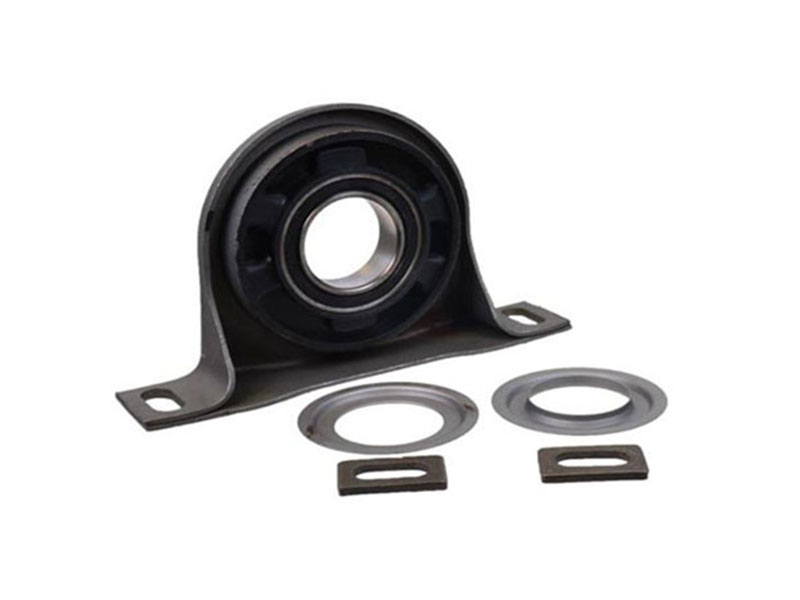
In vehicles with a long driveshaft, the shaft is typically split into two or more sections. The center support bearing is mounted between these sections, secured by a U‑shaped metal bracket and encased in a rubber isolation ring. Its primary functions are to keep the driveshaft centered, absorb torsional vibrations during acceleration, and reduce the transmission of noise and vibration into the chassis. Over time, the internal bearing can wear, or the rubber isolation can degrade, leading to a range of driveability symptoms.
Symptoms of a Failing Center Support Bearing
The following symptoms are the most frequently reported indicators of a worn or damaged center support bearing. In many cases, multiple symptoms appear simultaneously as wear progresses.
1. Unusual Noises During Acceleration – Squealing, Whining, or Howling
One of the earliest signs of a failing center support bearing is a high‑pitched squeal or a low‑frequency howl that occurs mainly when accelerating from a stop. The noise often diminishes once the vehicle reaches cruising speed. In some cases, a constant humming or droning sound appears at highway speeds, and it typically changes in pitch or loudness when the vehicle is under load (e.g., climbing a hill or towing). Unlike engine‑related noises, these sounds are tied directly to driveshaft rotation and will not change with gear shifts.
2. Shuddering or Vibration on Takeoff
When the center support bearing loses its ability to keep the driveshaft stable, the shaft may flex or wobble during initial acceleration. This results in a pronounced shudder or vibration felt through the floorpan, the accelerator pedal, or even the driver’s seat. The vibration is most noticeable when moving from a standstill and tends to smooth out at higher, steady speeds. Persistent shuddering not only degrades driving comfort but also places additional stress on U‑joints and transmission output bearings.
3. Clunking or Banging Noises – Especially When Changing Gears or Throttle
A clearly audible clunk, thud, or bang coming from underneath the vehicle – roughly near the center of the floor – is a classic sign of advanced center support bearing failure. The noise occurs when the worn bearing allows the two driveshaft sections to knock against each other or when the shaft moves enough to contact the chassis. Drivers often hear this clunk during gear changes (particularly shifting from reverse to drive), when suddenly pressing or releasing the accelerator, or when going over bumps. In severe cases, repeated metal‑to‑metal contact can damage the underside of the vehicle.
4. Driveshaft Contact With the Vehicle Floor
As the support bearing deteriorates further, the driveshaft may drop out of its intended alignment and physically strike the floorpan or the chassis crossmember. This produces a repetitive banging or scraping sound, typically noticeable during acceleration, deceleration, or when driving on uneven roads. In addition to noise, this condition can cause visible marks on the driveshaft and structural damage to the vehicle floor if left unaddressed.
5. Driveline Vibrations at Cruising Speeds
Not all vibrations are limited to takeoff. A failing center support bearing can also generate a constant, low‑frequency vibration at highway speeds – usually above 50 mph (80 km/h). The vibration may feel like a rumble that resonates through the entire cabin. Because wheel imbalance or worn tires can cause similar sensations, a professional inspection is recommended to isolate the source.
Why Prompt Diagnosis Matters
Ignoring a worn center support bearing does not stop at noise or vibration. Progressive failure can lead to:
- Accelerated wear of U‑joints and transmission tail shaft components due to abnormal driveshaft angles.
- Damage to the differential input flange or output shaft of the transmission from sustained vibration.
- Complete loss of driveshaft support, causing the shaft to whip and potentially detach – a serious safety hazard.
Once any of the above symptoms appear, the vehicle should be inspected by a qualified technician. Replacement of the center support bearing is often straightforward, but delaying may turn a low‑cost repair into a major drivetrain overhaul.
Conclusion
A failing center support bearing does not fail silently. From acceleration squeals and takeoff shudder to clunking during gear changes and floor‑contact banging, the symptoms provide clear early warnings. Recognizing these signs and scheduling an inspection without delay helps protect the entire drivetrain. For vehicle owners and maintenance professionals, understanding these failure modes supports more accurate diagnostics and cost‑effective repairs.
Frequently Asked Questions (FAQs)
Q1: Is a center support bearing the same as a carrier bearing?
A: Yes. The terms center support bearing, carrier bearing, support bearing, and centre bearing are used interchangeably by most manufacturers and parts suppliers. They all refer to the bearing assembly that supports the middle of a two‑piece driveshaft.
Q2: How can I tell the difference between a bad center support bearing and a bad wheel bearing?
A: A bad wheel bearing typically produces a rhythmic growling or grinding noise that changes pitch when the vehicle is turned left or right (loading and unloading the bearing). In contrast, a failing center support bearing generates noises or vibrations that correlate with acceleration, throttle changes, or gear shifts – not with steering angle.
Q3: How long does a center support bearing usually last?
A: Service life varies widely depending on vehicle usage, load conditions, and rubber isolation quality. Many original bearings last between 100,000 and 150,000 miles (160,000–240,000 km). Heavy towing, frequent driving on rough roads, or exposure to oil leaks can significantly shorten that lifespan.
Q4: Is it safe to drive with a failing center support bearing?
A: Short trips at low speed may be possible, but continued driving is not recommended. A severely worn bearing can allow the driveshaft to move beyond its design limits, leading to sudden driveline failure, loss of vehicle control, or damage to the transmission housing and floorpan.
Q5: Can a vehicle owner replace a center support bearing themselves?
A: Replacement requires removing the driveshaft, pressing the old bearing off, and installing the new one while maintaining exact phasing and torque specifications. Special tools are often needed. For most DIYers, professional service is advised. However, qualified technicians can perform the job efficiently, ensuring proper alignment and balance.
As a manufacturer of precision automotive bearings, DUHUI Bearing supplies center support bearings and related driveline components that comply with dimensional and performance standards. For technical documentation or product specifications, refer to our published catalogs.