Quick Answer: Measure needle bearing dimensions by first identifying the full bearing code, then recording the applicable bore, outside diameter, width, roller envelope, and chamfer. Use Fw for bearings without an inner ring and d for complete bearings. Once the envelope matches, compare load ratings, speed limits, clearance, seals, fits, and raceway requirements before choosing K, HK/BK, NK/NKI, drawn-cup, thrust, or combined designs.
Needle bearings are compact, but their measurement is not a single caliper reading. The bearing family changes which dimension is the effective bore, and a matching envelope does not prove that two bearings can replace each other. This guide separates identification, measurement, and selection so the final code is supported by the shaft, housing, load, speed, and mounting conditions.
Read the Bearing Marking and Identify the Type First
Clean grease, burrs, and rust from the end face before reading the full designation. Record every prefix and suffix, because the code identifies the bearing family, the presence of an inner ring, the sealing variant, the cage style, the clearance class, and the precision class. The code is more reliable than a single caliper reading.
The following model codes are common in needle bearing documentation:
| Code | Meaning |
|---|---|
| K | Needle roller and cage assembly |
| HK | Open drawn cup bearing |
| BK | Drawn cup bearing with one closed end |
| HN | Open drawn cup, full complement |
| NK / NKS | Machined rings, flanges, without inner ring |
| NKI / NKIS | Machined rings, flanges, with inner ring |
| RNA | Machined bearing without inner ring |
| NA | Machined bearing with inner ring |
| IR / LR | Separate inner ring |
| AXK | Needle roller thrust assembly |
| RS / 2RS | One or two contact seals |
| ZW | Double-row assembly |
| V | Full complement, without cage |
Dimension Symbols You Must Recognize
Use published bearing data symbols consistently. Do not replace a defined symbol with an undefined caliper reading, because the same reading can mean different things on a complete bearing, a drawn cup, a cage assembly, or a thrust assembly.
| Symbol | Meaning |
|---|---|
| d | Shaft diameter or inner-ring bore |
| D | Outer-ring outside diameter or housing bore |
| B/C | Bearing or outer-ring width |
| Fw | Roller inner envelope circle diameter |
| Ew | Roller outer envelope circle diameter |
| Bc | Cage assembly width |
| r or rs min | Minimum chamfer dimension |
| Average bearing diameter | (d + D) / 2 |
Use Fw for bearings without an inner ring. Use d for bearings with an inner ring. Confirm the width symbol used in the bearing data: B/C is bearing or outer-ring width, while Bc is cage assembly width.
Measure a Complete Needle Bearing with Inner Ring
For a complete bearing with an inner ring, measure the inner-ring bore d, the outside diameter D, and the total width B/C. Use a caliper or an outside micrometer, and repeat readings at approximately 90 degrees to detect obvious out-of-roundness.
Check the minimum chamfer r or rs min so shaft shoulder fillets do not prevent the bearing end face from seating. Compare the measured values with the published boundary dimensions and tolerances. ISO 1206:2023 covers boundary dimensions, normal tolerance, geometric features, and limit deviations for machined-ring needle roller bearings.
Do not use the roller envelope Fw as the inner-ring bore when an inner ring is present. The inner-ring bore and the roller envelope are different dimensions.
Measure a Needle Bearing Without Inner Ring
For a bearing without an inner ring, measure the outside diameter D and the width B/C. Use the published Fw value as the effective inner diameter below the rollers. Do not treat the gap between rollers as a normal bearing bore.
The shaft itself acts as the inner raceway, so match Fw to the actual shaft raceway diameter and tolerance. Confirm that the shaft hardness, finish, and roundness are suitable for raceway service. A shaft that serves as a raceway should be hardened and ground.
For machined bearings without an inner ring, common shaft tolerance recommendations for Fw of 65 mm or less are k5, h5, or g6. These can give reduced, normal, or increased operating clearance respectively, depending on the required fit. If the shaft cannot be hardened or ground economically, use a bearing with an inner ring or a separate IR/LR inner ring.
Measure Drawn Cup Needle Bearings After Installation
Use free-state D and C readings only for preliminary identification. A thin drawn cup may not be its final shape before mounting. Press the bearing into the specified ring gauge or a qualified housing bore, then check Fw with a plug gauge, functional gauge, or measuring mandrel.
A drawn cup obtains its final dimensions and geometric accuracy only after it is pressed into the housing bore. Do not reject a drawn cup solely because it is not perfectly round before mounting.
ISO 3245:2023 applies to drawn-cup needle roller bearings without an inner ring. It specifies boundary dimensions, preferred sizes, minimum chamfers, roller-set bore tolerance, outer-ring width tolerance, and closed-end thickness.
Measure Needle Roller and Cage Assemblies
For a needle roller and cage assembly, record Fw, Ew, and cage width Bc. Measure the shaft raceway and the housing raceway as well, because the assembly has no separate inner or outer ring.
Check raceway hardness, finish, and dimensional tolerances. Use this design when radial space is minimal and the shaft and housing can serve directly as raceways.
ISO 3030:2022 covers radial needle roller and cage assemblies. It includes boundary dimensions, cage width tolerances, functional gauge measurement of the roller-set bore, and reference tolerances for the shaft raceway, housing raceway, and raceway width.
Measure Thrust Needle Roller Assemblies
Measure the bore, outside diameter, and assembly thickness. Check the shaft washer and housing washer dimensions separately, because these components can carry their own tolerances and seating requirements.
Verify that the chosen assembly is for axial load, not radial load. AXK thrust assemblies are used where the primary load is axial. ISO 104:2015 specifies preferred boundary dimensions for single-direction and double-direction flat-back thrust bearings. Published thrust needle assembly ranges extend from 5 mm to 240 mm.
Confirm Metric and Inch Dimensions Before Ordering
Record the unit system explicitly on the measurement sheet. Do not assume that a near-identical metric size can replace an inch bearing, or the reverse. Check the available range and the model code for the correct series.
Published drawn-cup ranges run from 3 mm to 139.7 mm, equivalent to 1/8 in to 5-1/2 in. Metric and inch bearings with similar appearance and approximate dimensions are not interchangeable.
Choose K Needle Roller and Cage Assemblies for Minimum Radial Space
Use a K needle roller and cage assembly when only radial load is present and radial space is the limiting factor. The shaft and housing must be hardened, ground, and finished to raceway requirements. The assembly has no inner or outer ring, so the surrounding components act as raceways.
This choice relies on adequate raceway hardness and finish. Do not use it if the housing or shaft cannot meet raceway requirements. The applicable boundary standard is ISO 3030:2022.
Choose Drawn Cup Bearings When the Housing Cannot Be a Raceway
Use a drawn cup bearing when the housing cannot serve directly as the outer raceway and a thin outer ring is required. Choose HK for open ends and BK for one closed end. The closed end suits shaft-end positions and helps retain lubricant and exclude contaminants and moisture.
The housing bore must accept a pressed thin-walled outer ring. Do not judge free-state roundness as final; check the bearing after installation.
Choose No-Inner-Ring Machined Bearings When the Shaft Can Be a Raceway
Consider NK, NKS, or RNA when the shaft can be hardened and ground. Omitting the inner ring can allow a larger shaft diameter, improve shaft stiffness, and produce a more compact arrangement. Measure and control the shaft raceway diameter and tolerance.
This option depends on a shaft that can be hardened and ground to raceway quality. If that condition cannot be met, a bearing with an inner ring is the safer choice.
Choose Bearings with Inner Rings When the Shaft Cannot Be a Raceway
Use NKI or NA, or add a separate IR/LR inner ring to a drawn-cup bearing, when the shaft cannot or should not be hardened and ground. This arrangement is appropriate when the shaft cannot be economically prepared as a raceway.
When using a separate inner ring, measure its bore, raceway outside diameter, and width separately. For example, an IR 5X8X12 inner ring has a 5 mm bore, an 8 mm outside diameter, and a 12 mm width, and it is made of bearing steel.
Choose Machined Thick-Wall Bearings for Shock and Stiffness
Use machined thick-wall outer rings when higher structural stiffness and shock resistance are needed. Heavy-duty designs use machined and ground channel-shaped thick outer rings, and published bore sizes cover 5 mm to 335 mm.
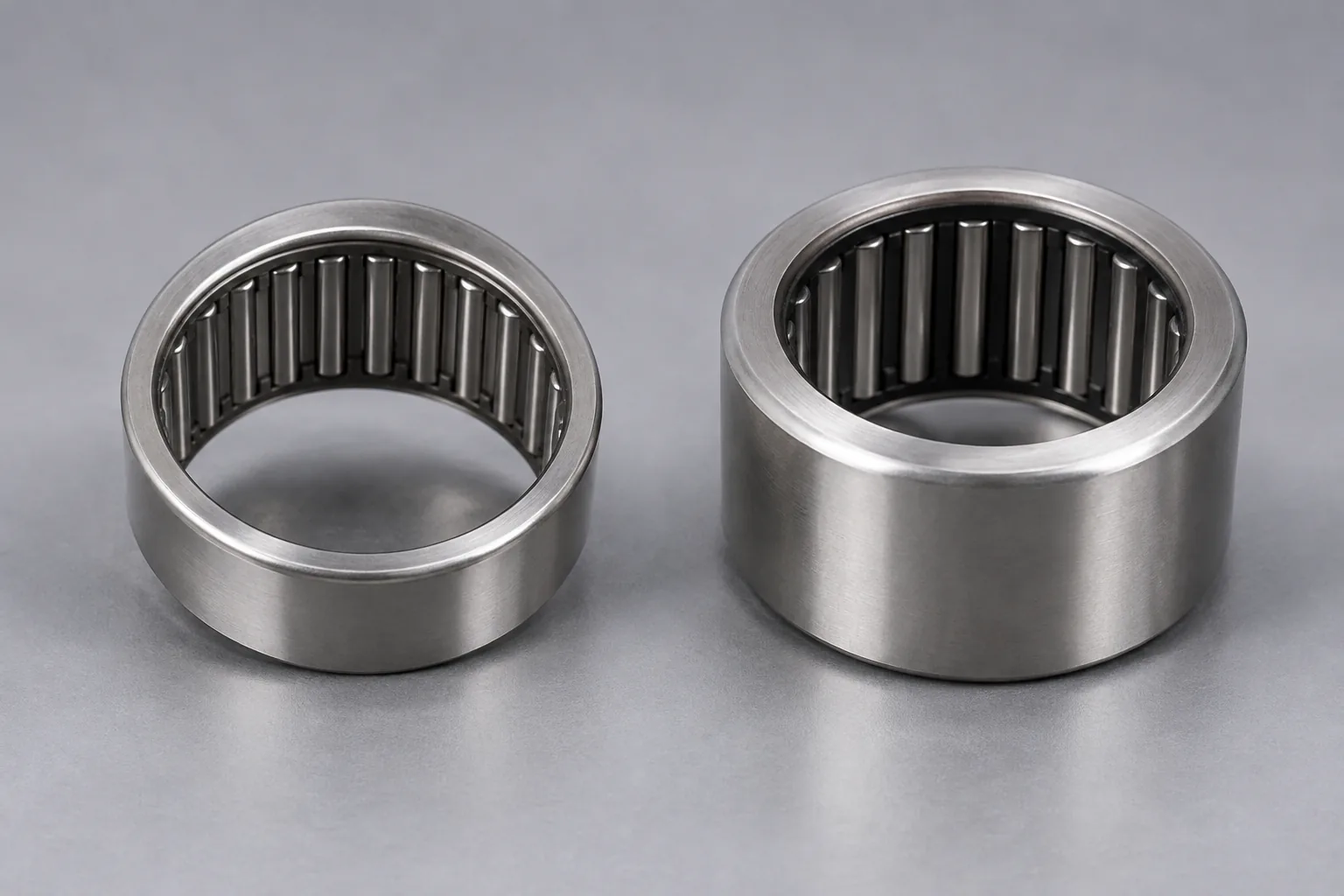
Confirm the bore range and load rating rather than relying on envelope dimensions alone. A thick outer ring changes the housing fit and the load path, so the surrounding structure must be checked as well.
Choose Full-Complement or Caged Designs by Load and Speed
Full-complement V designs generally provide higher radial load capacity. Caged designs are preferred for higher speed and better lubricant retention. Confirm speed limits and lubrication before selecting either design.
Use a full-complement design for high radial load and relatively low speed. Use a caged design when higher speed or a lubricant-retention need is present.
Choose Thrust or Combined-Load Bearings for Axial Loads
Use an AXK thrust needle assembly when the primary load is axial. Do not use radial HK, NK, or NA bearings as axial thrust bearings.
When radial and axial loads occur together, use a combined bearing family or a separate axial and radial arrangement. Combined families include NKIA/NKIB needle roller/angular contact ball bearings, NKX needle roller/thrust ball bearings, NKXR needle roller/cylindrical roller thrust bearings, and NX needle roller/full-complement thrust ball bearings.
Account for Misalignment, Sealing, Clearance, and Precision Suffixes
Normal machined-ring needle roller bearings accommodate only about 1 arc minute of misalignment. Misalignment increases noise and reduces service life. Do not treat these bearings as self-aligning bearings. If mounting skew cannot be controlled by machining or assembly, use a self-aligning needle bearing.
Use RS for one contact seal and 2RS for two contact seals. Use C3 for radial internal clearance greater than normal. Use P6 or P5 for higher dimensional and running accuracy. Confirm that the suffix matches the required sealing, clearance, and precision before ordering.
Verify Load Ratings, Speed Limits, Fits, and Life After the Dimensions Match
The same d x D x B/C does not mean the bearings are interchangeable. Compare dynamic load rating C, static load rating C0, speed limits, internal clearance, precision, seals, lubrication, and shaft and housing fits.
ISO 281:2007 defines basic dynamic load ratings and rating life. The basic rating life is based on 90% reliability and does not cover wear, corrosion, or electrical erosion.
Typical recommendations for drawn-cup bearings in steel or cast-iron housings are housing N6, shaft used directly as a raceway h5, and shaft seat for an inner ring k5. A light-alloy housing may use R6, and the drawn-cup housing bore geometric tolerance is commonly set to IT5/2. These are recommendations; verify them for the actual load, temperature, and housing stiffness.
Recommended Measurement and Selection Workflow
- Clean the bearing and read the full designation, including prefixes and suffixes.
- Identify the bearing family and whether an inner ring is present.
- Measure the applicable dimensions: d, D, B/C, Fw, Ew, Bc, or thrust assembly thickness.
- Confirm whether the dimensions are metric or inch.
- Check the measured envelope against the relevant ISO boundary standard.
- Verify shaft and housing raceway dimensions and tolerances.
- Compare C, C0, speed, clearance, precision, seals, and lubrication.
- Confirm the final model code before ordering.
Common Measurement Mistakes to Avoid
- Using caliper jaws between rollers as the bore of a bearing without an inner ring.
- Judging an unmounted drawn cup as out-of-round.
- Ignoring chamfer r or rs min and shaft shoulder fillets.
- Mixing metric and inch dimensions.
- Assuming that the same dimensions mean the same load rating or internal clearance.
- Skipping shaft and housing raceway checks.
Conclusion
Needle bearing dimensions are only the start of a reliable selection. Read the full code, measure the dimensions that belong to that design, and then confirm the shaft and housing raceways, units, load ratings, speed limits, clearance, seals, and fits. If the measured envelope matches but one of those conditions does not, the bearing is not a safe replacement.
FAQs
Q1: Can I measure a needle bearing with a caliper?
A: A caliper is useful for outside diameter, width, and initial checks, but it is not enough for every dimension. For a drawn cup, check Fw after mounting with a gauge or mandrel, and use a micrometer where higher precision is needed.
Q2: What does Fw mean on a needle bearing?
A: Fw is the roller inner envelope circle diameter. It is the effective inner diameter below the rollers in a bearing without an inner ring, not the bore of an inner ring. Match it to the shaft raceway diameter and tolerance.
Q3: Are two needle bearings with the same dimensions interchangeable?
A: Not necessarily. The same d x D x B/C can still differ in dynamic load rating C, static load rating C0, speed limit, internal clearance, precision, seals, lubrication, and shaft or housing fit. Compare the full specification before replacement.
Q4: How do I check a drawn cup bearing before installation?
A: Use free-state outside diameter and width readings for preliminary identification only. Final roller envelope Fw should be checked after pressing the bearing into the specified ring gauge or a qualified housing bore.
Q5: When should I choose a bearing with an inner ring?
A: Use NKI or NA, or add an IR/LR inner ring, when the shaft cannot or should not be hardened and ground to raceway quality. Measure the inner-ring bore, raceway outside diameter, and width separately.
Q6: Can a radial needle bearing carry axial load?
A: No. Radial HK, NK, and NA designs are for radial load. Use an AXK thrust assembly for primarily axial load, or a combined bearing family when radial and axial loads act together.
Q7: What do RS, 2RS, C3, P6, and P5 mean?
A: RS is one contact seal, 2RS is two contact seals, C3 is radial internal clearance greater than normal, and P6 or P5 indicates higher dimensional and running accuracy than normal.