Quick Answer: Diagnosing wheel noise starts by matching the sound and the conditions that trigger it to a likely source, then confirming that source with a road test, a lift test, side-to-side comparison, and a known-good wheel and tire swap. Bearing noise usually rises with vehicle speed, tire noise follows tread condition and road surface, brake noise changes with pedal application, and clicks on turns point to a CV joint or fastener. Sound direction alone is not reliable.
Diagnosing wheel noise is rarely a matter of guessing at the loudest corner. The same road speed can produce a bearing roar, a tire hum, a brake grind, or a driveline click, and the driver’s sense of direction can point to the wrong side. The four common sources are the wheel bearing, the tire, the brake, and the CV joint or fastener. Each one leaves a different pattern in the noise record.
Record the Noise Type and When It Appears
Diagnosis starts with a written record, not a parts decision. The record should capture:
- Noise type: hum, whir, roar, rumble, grind, squeal, click, or clunk.
- The speed at which the noise first appears and whether it grows with vehicle speed.
- Driving state: acceleration, steady speed, coasting with the throttle released, or braking.
- Steering state: left turn, right turn, full lock, or straight ahead.
- Direction of travel: forward and reverse.
- Road surface, measured tire pressures, tread wear pattern, and remaining tread depth.
- Vibration in the steering wheel, seat, or body.
- Vehicle VIN, model year, and any applicable OEM service bulletin number so the correct procedure can be followed.
A whirring, roaring, grinding, or rumbling noise that increases with vehicle speed is a primary trigger for a wheel bearing check. Hyundai TSB 19-DS-001H-1, February 2019, applies that trigger across the Hyundai models it covers. Record the speed, load state, steering state, direction of travel, and road surface before any component is condemned.
A click heard only while turning must not be assumed to be a wheel bearing. Toyota T-SB-0106-20 Rev1 and Honda Service Bulletin 10-042 treat turning clicks as driveshaft or CV joint territory first. A noise heard only with the brake pedal applied belongs to the brake section, not the bearing section.
Isolating the Source: Bearing, Tire, Brake, or Driveline
Each source has a signature behavior pattern. Use the same dimensions for every row so the comparison stays useful before the vehicle is lifted.
| Source | Speed dependence | Steering or load | Pedal | Other clues |
|---|---|---|---|---|
| Bearing | Rises with vehicle speed | Can change with cornering load | Does not depend on pedal | May persist on a coast-down; acoustic comparison helps locate the side |
| Tire | Most obvious at medium to high speed | Follows road surface more than steering | Does not depend on pedal | Check pressure, tread depth, and wear pattern |
| Brake | Can appear at any speed | May change with steering if a caliper or hardware drags | Appears or changes with pedal application | Continuous drag suggests a sticking caliper or debris contact |
| Driveline or fastener | Usually a low-speed click or clunk | Appears on turns or torque reversal | Not pedal-dependent | Check CV boots and nut torque |
Wheel Bearing Noise
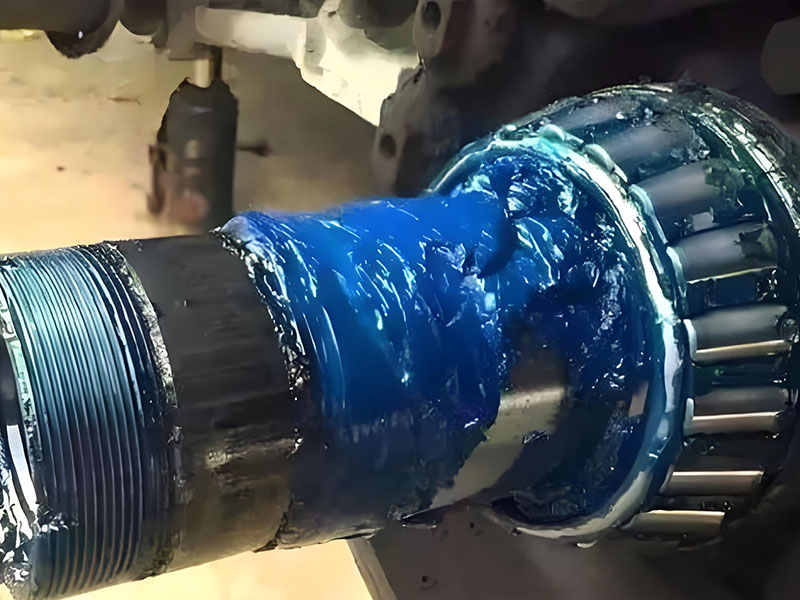
Bearing noise typically rises with vehicle speed and is described as whirring, roaring, grinding, or rumbling (service bulletin 19-DS-001H-1). Audi technical bulletin 40 20 12 2047920/5, dated 15 July 2020, lists the bearing decision points: whether frequency rises with vehicle speed, whether the noise becomes louder when steering, whether it is still present while coasting down, whether it is more obvious at the steering wheel, and whether vibration can be felt on the unloaded coil spring while the wheel is rotated.
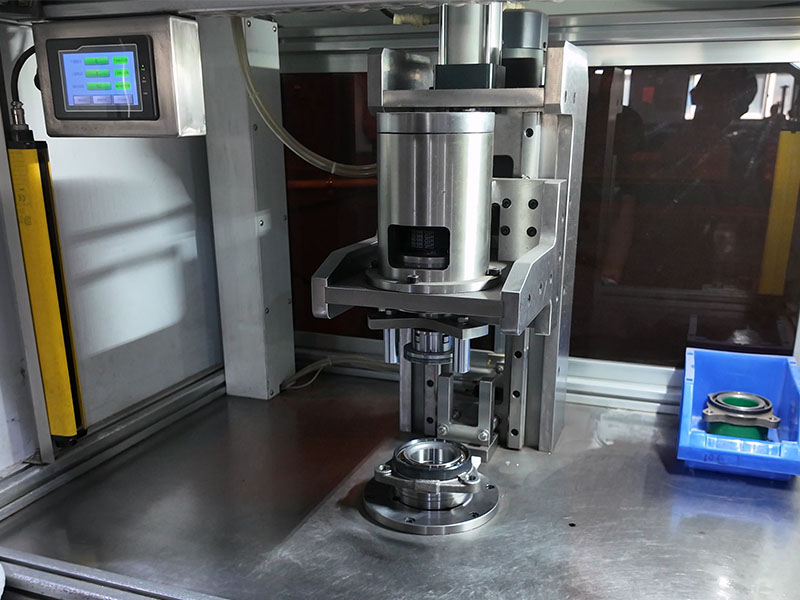
The side the driver reports is unreliable. The same Audi bulletin states that a noise that sounds like it comes from the left may be produced by the right bearing, so acoustic test equipment is required for exact location. The Hyundai procedure connects an electronic stethoscope to the suspected steering knuckle, then to the opposite knuckle and other suspected components, and compares sound intensity during a road test rather than relying on the driver’s sense of direction. The named tool is Chassis Ears, Hyundai special service tool J-39570, used for multi-channel comparison of wheel-end noise.
Mazda service alert SA-020/25, dated 15 April 2025 and issued from Irvine, California, warns that wheel bearing noise can be misdiagnosed as transmission, transfer case, or differential noise. Confirmation requires running the vehicle on a lift at the speed that produces the noise and comparing bearings with a chassis-ear stethoscope or standard stethoscope. Replace only the side confirmed abnormal. The Audi 40 20 12 bulletin requires replacing only the side confirmed abnormal, not automatically replacing front bearings in pairs.
Bearing confirmation requires a road test with side-to-side acoustic comparison; a driver’s directional impression alone is not confirmation. Bearing noise can be present on a coast-down and can be masked by tire noise, so a single test may not be conclusive.
Tire Noise and Irregular Wear
Tire manufacturer guidance states that the most common cause of an abnormally loud tire is irregular or uneven wear that has already formed. Cupping, also called scalloping, can be linked to bent or worn suspension components, incorrect wheel alignment, and an unbalanced tire and wheel assembly. Once formed, this wear is irreversible, and the tire continues to wear unevenly.
Visual wear mapping gives a first screen:
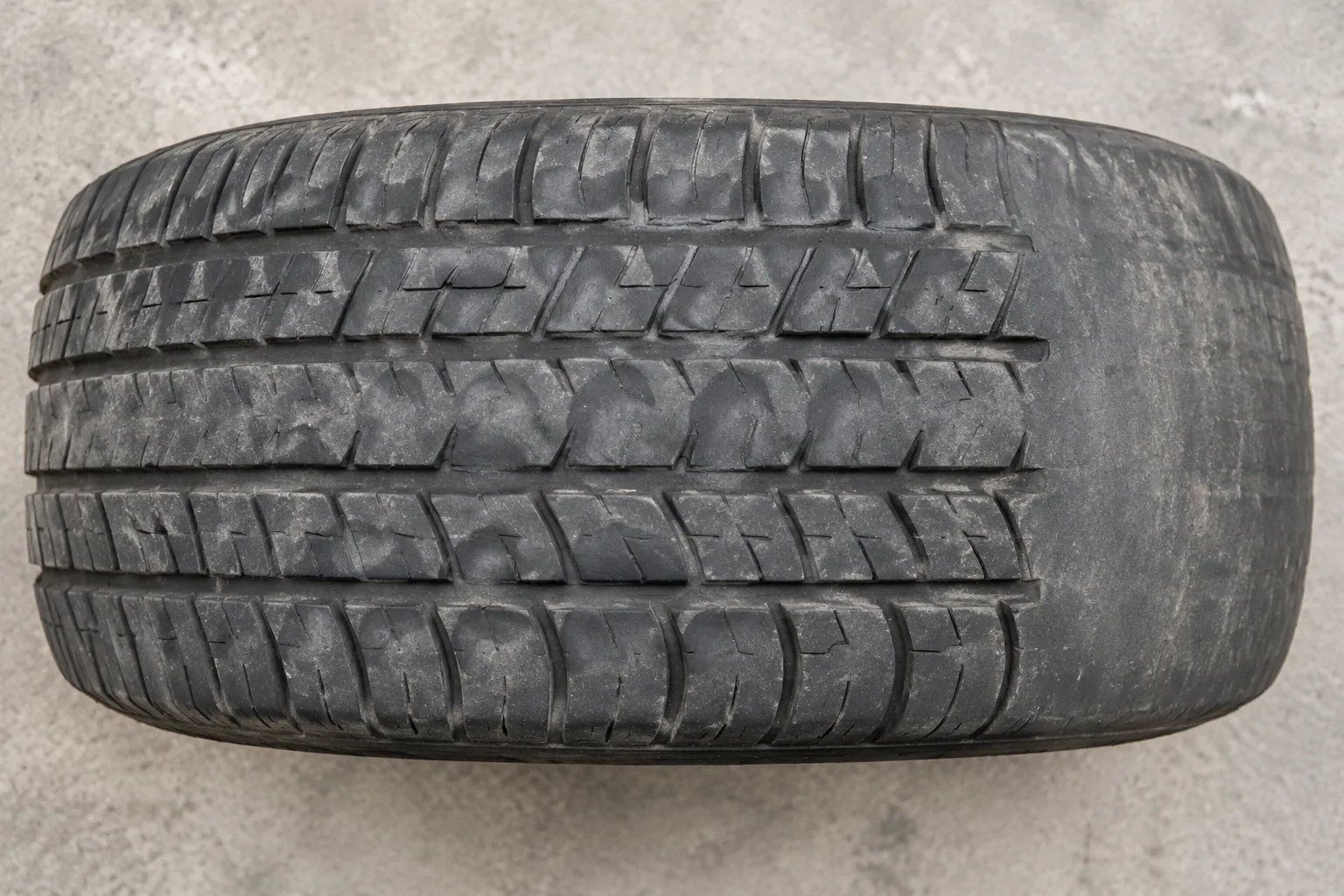
- Center wear: long-term overinflation.
- Both shoulder wear: long-term underinflation.
- One-sided wear: alignment problem.
- Cupping: imbalance or worn dampers.
- Feathering: toe problem.
Tire industry guidance notes that rolling noise is usually most noticeable at medium to high speed. Irregular wear and incorrect inflation pressure amplify it, and coarse road surfaces produce stronger rolling noise. From roughly 80-100 km/h, wind noise can progressively mask tire rolling noise.
The US NHTSA safety reference is 2/32 inch (about 1.6 mm) of remaining tread, at which point the tire should be replaced. Tread wear indicators flush with the tread also mark the replacement point. NHTSA also advises a professional tire inspection when noise comes with vibration, irregular wear, bulging, or failure to hold pressure.
An OEM differentiation step matters when the bearing comparison does not confirm the source. Mazda service alert SA-020/25 requires fitting the wheels and tires from a known-good vehicle and retesting. Tire noise assessment also requires measured inflation pressure, a tread-depth reading, and a wear-pattern inspection on all four positions. Cupping wear cannot be reversed once formed, so a noise caused by it will not disappear after balancing alone.
Brake Noise
Audi technical bulletin 46 21 24 2034181/18, dated 10 February 2021, lists brake noise types as squeal, squeak, grinding, groaning, thumping, and creaking. The same bulletin lists common causes: discs or pads at or near the wear limit, new discs and pads not correctly bedded in, non-OEM discs or pads fitted, and sand, road salt, or grit between disc and pad.
Whether the noise exists only while the brake pedal is applied is a key recorded condition that separates brake noise from bearing and tire noise. Record the pedal state as applied, released, light pressure, hard pressure, and whether the vehicle is moving or stationary.
Mitsubishi TSB-24-35-001, dated April 2024, documents front caliper noise during braking or steering caused by insufficient stiffness of the pad retainer, which moves with the pad and can interfere with the disc. Mazda SA-016/24, dated 6 June 2024, maps symptoms to checks:
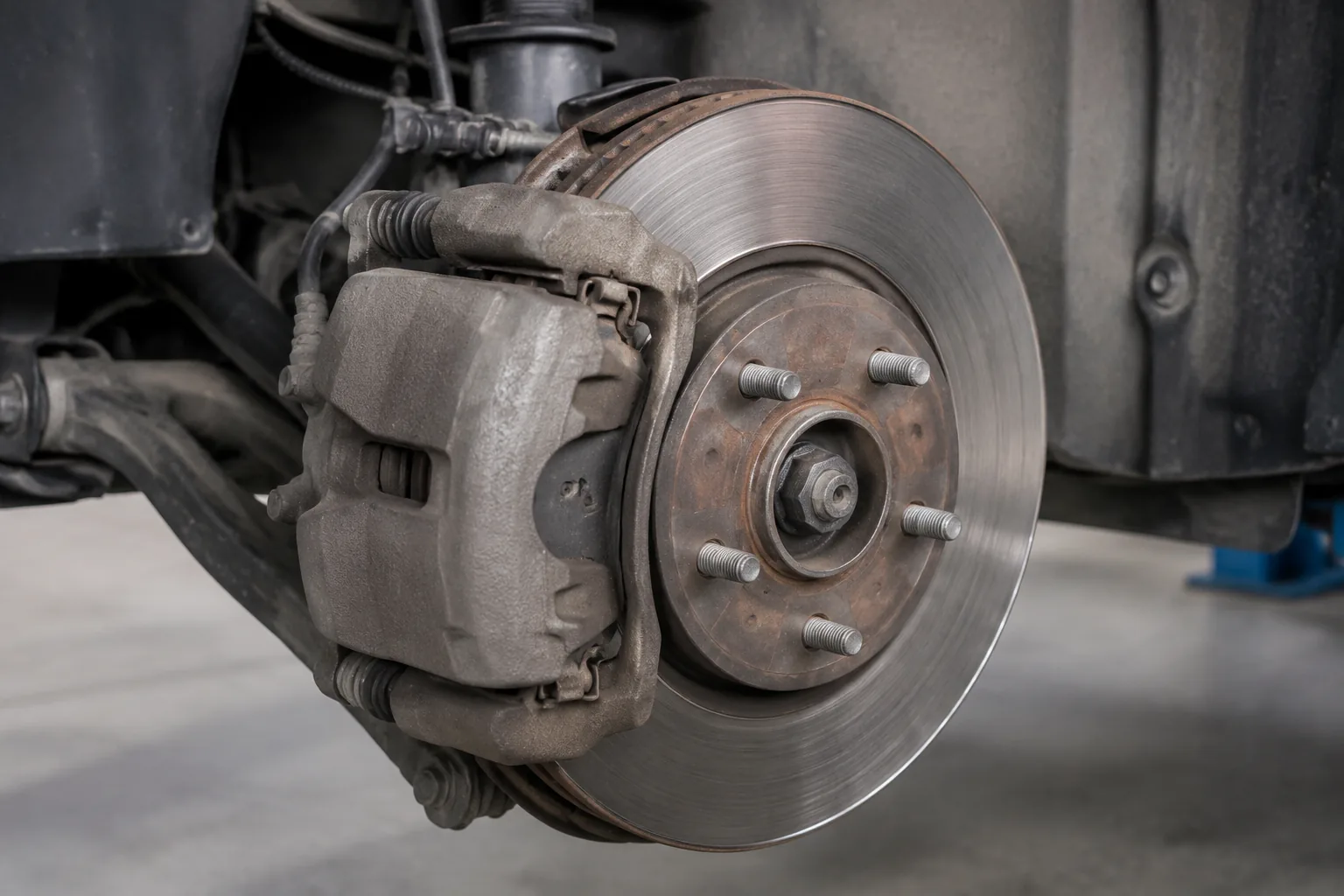
- Groan or squeal when braking: inspect the friction pads.
- Continuous dragging sound: check the caliper and guide pins for sticking.
- Click or knock: check pad shims, mounting hardware, and component clearance.
For readers who need formal test methods, SAE J2521_202210 is an inertia-dynamometer brake squeal noise test procedure for vehicles without regenerative braking, and SAE J2786_200910 is the standard nomenclature for automotive brake noise and vibration. A continuous grinding that remains with the pedal released points to a dragging caliper or a shield or debris contact, rather than a pad-friction characteristic.
Clicking, Clunking, and CV Joint or Fastener Causes
Toyota T-SB-0106-20 Rev1 for the 2015-2021 Corolla describes a click that appears when the steering wheel is at full lock, steering exceeds 90 degrees, and the vehicle accelerates. The procedure first confirms whether the sound comes from the left or right front driveshaft and inspects the boots for tearing and grease leakage.
Honda Service Bulletin 10-042 records clunking, popping, or clicking from the front while turning on the listed models, with a failed outer CV joint as the possible cause. The method is a road test to reproduce the noise and identify the faulty side.
GM Bulletin 18-NA-043 states that a front-wheel click at low-speed turns or during torque changes can also come from incorrect driveshaft nut torque or from interaction between the wheel mounting face and the brake disc mounting face. Its reproduction conditions are a high-friction surface that allows a full circle or figure-of-eight, the window open, steering at full lock, and idling at 2-5 mph (3-8 km/h), raised to 5-10 mph (8-16 km/h) if more load is needed, comparing forward, reverse, left, and right turns.
Loose wheel nuts can also produce a metallic click on turns. GM Bulletin 18-NA-043 requires checking with a calibrated torque wrench at the model-specific value and treats the cause as loose wheel nuts if the noise disappears after correct tightening. No universal wheel nut torque value applies to all vehicles; the model-specific specification must be used. Clicks on turns must be reproduced with a defined steering angle, speed, and direction before a CV joint or fastener conclusion is accepted. A click that disappears after correct wheel nut torque is applied is attributed to loose wheel nuts, not to a worn bearing.
Road-Test Steps for Diagnosing Wheel Noise
Use a repeatable sequence so each result can be compared with the original noise record.
- Reproduce the noise on a known road surface at the recorded speed in straight running, a left turn, a right turn, and a coast-down.
- Repeat the same run with the brake pedal lightly applied and then released to separate brake noise from rolling noise.
- Lift the vehicle and run it at the speed that produces the noise, then compare bearings with a chassis-ear stethoscope or standard stethoscope (Mazda service alert SA-020/25, tool J-39570 method).
- Compare the suspected corner with the opposite corner and with a known-good vehicle before any part is ordered.
- If the bearing comparison is inconclusive, fit known-good wheels and tires and retest (Mazda service alert SA-020/25).
- Inspect tread depth and wear pattern, measure inflation pressure, and check for bulges or pressure loss (NHTSA guidance).
- Inspect CV boots for tears and grease leakage, and check driveshaft nut and wheel nut torque with a calibrated wrench at the model-specific value (Toyota T-SB-0106-20 Rev1, GM 18-NA-043).
- Check the brakes for dragging, pad and disc wear, and hardware condition (Mazda SA-016/24, Audi 46 21 24).
Any lift test must follow the vehicle manufacturer’s lifting points and safety procedure; wheels must be supported and chocked as required. If the noise cannot be reproduced under any recorded condition, the diagnosis is incomplete and no part should be replaced on suspicion alone.
Record the result of each step in the same worksheet as the initial noise record so the conclusion is traceable.
Reference Standards for Tire and Brake Noise Measurement
These standards define controlled measurement methods, not workshop pass or fail limits for a worn bearing. That distinction matters when a service writer asks for a number that the standard does not provide.
- ISO 13325:2019, Tyres – Coast-by methods for measurement of tyre-to-road sound emission, measures tyre-to-road sound with the vehicle rolling freely and not driven. It applies to passenger cars and commercial vehicles as defined in ISO 3833; the second edition was published in July 2019.
- UN Regulation No. 117 (UN R117) covers type approval for tyre rolling sound, wet grip, and rolling resistance. Its rolling sound testing uses 70-90 km/h with an 80 km/h reference speed for C1 and C2 tyres, and 60-80 km/h with a 70 km/h reference speed for C3 tyres.
- SAE J2521_202210 is an inertia-dynamometer brake squeal noise test procedure for vehicles without regenerative braking, revised in October 2022. It covers microphones, noise detection thresholds, temperature, vehicle load, cooling airflow, and test-channel marking.
- SAE J2786_200910 is the standard nomenclature for automotive brake noise and vibration, covering disc and drum foundation brake systems. It defines phenomena from tactile vibration near 0 Hz to audible noise around 17 kHz; it was published in 2009 and stabilized in 2017.
Standards apply to type approval and controlled measurement, not to judging whether an individual bearing on a customer vehicle is serviceable.
Confirming the Fault Before Replacing Parts
Replace only the component confirmed abnormal. The Audi 40 20 12 bulletin explicitly rules out automatic pair replacement of front bearings.
Before installing a new bearing or hub, confirm the mating surfaces are clean and undamaged, and use the specified tools and the model-specific torque values for the axle nut and wheel nuts. No universal torque value exists (GM 18-NA-043).
Check the surrounding parts that can create the same noise after a bearing change: tire wear condition and balance, brake pad and disc condition and hardware, CV boot integrity, and driveshaft nut torque.
Record the final diagnosis, the tests performed, and the parts replaced so a returning noise can be compared with the original record. If the noise remains unchanged after replacing a bearing, the source was misidentified. Return to the recorded symptom pattern and repeat the side-to-side comparison. A noise that moves with a swapped wheel and tire assembly follows the tire, not the bearing.
Conclusion
Diagnosing wheel noise is a sequence, not a single guess. Record the noise type and the conditions that trigger it, match the pattern to bearing, tire, brake, or driveline, then confirm with side-to-side acoustic comparison and a known-good wheel and tire swap. Two cautions matter most: the side the driver reports may be wrong, and bearing noise can be mistaken for transmission, transfer case, or differential noise. Replace only the confirmed component, use model-specific torque values, and recheck if the noise persists.
FAQs
Q1: How can I tell whether the noise is a wheel bearing or a tire?
A: Compare the two. Bearing noise usually rises with vehicle speed and can change with cornering load, while tire noise follows tread condition and road surface and is most noticeable at medium to high speed. The decisive test is fitting known-good wheels and tires and retesting when bearing comparison is inconclusive, as required by Mazda service alert SA-020/25.
Q2: Does wheel bearing noise get louder when turning?
A: It often does, but the direction is unreliable. The Audi 40 20 12 bulletin lists increased noise when steering as a bearing indicator and also warns that noise sounding like it comes from the left may be produced by the right bearing. Confirm with an acoustic tool on both steering knuckles during a road test rather than trusting the perceived side.
Q3: Can a bad wheel bearing be mistaken for transmission or differential noise?
A: Yes. Mazda service alert SA-020/25 states that wheel bearing noise can be misdiagnosed as transmission, transfer case, or differential noise. Confirmation requires running the vehicle on a lift at the speed that produces the noise and comparing bearings with a chassis-ear stethoscope or standard stethoscope, and comparing with a known-good vehicle.
Q4: Should wheel bearings be replaced in pairs?
A: Not automatically. The Audi 40 20 12 bulletin requires replacing only the side confirmed abnormal, rather than automatically replacing both front bearings. Replace the opposite side only when it fails the same acoustic comparison.
Q5: Why does my car click when turning at low speed?
A: A low-speed turning click usually points to the driveline or fasteners before the bearing. Honda Service Bulletin 10-042 lists a failed outer CV joint as a possible cause, Toyota T-SB-0106-20 Rev1 targets the front driveshaft on full-lock acceleration, and GM 18-NA-043 adds incorrect driveshaft nut torque, wheel-to-disc mounting face interaction, and loose wheel nuts, checked with a calibrated torque wrench at the model-specific value.
Q6: When does tire noise mean the tire must be replaced?
A: When tread reaches 2/32 inch (about 1.6 mm), or when the tread wear indicators are flush with the tread, NHTSA advises replacement. NHTSA also advises professional inspection when noise comes with vibration, irregular wear, bulging, or failure to hold pressure.
Q7: How much tread depth or speed data do I need before diagnosing wheel noise?
A: Record the speed at which the noise first appears and whether it grows with speed, plus measured inflation pressure and tread depth at all four positions. Industry guidance notes wind noise can progressively mask tire rolling noise from roughly 80-100 km/h, so a high-speed-only complaint may not be a bearing at all.