Quick Answer: When, Why, and How to Replace a U-Joint
Replace a U‑joint when you hear clunking on shifting, feel vibration, or see rust‑colored dust around the joint. Driving with a bad joint risks driveshaft detachment and transmission damage – repairs can exceed $1,000. DIY replacement costs $20–100 for parts and takes 2–4 hours with basic tools. Professional service runs $270–400 per joint.
Universal joints (U-joints) are small but critical components in the drivetrain of rear‑wheel‑drive, four‑wheel‑drive, and many heavy‑duty vehicles. When they wear out, you may hear clunking noises, feel vibrations, or eventually lose power to the wheels. This guide answers three essential questions: when to replace U‑joints, why prompt replacement matters, and how to do the job correctly – whether you plan a DIY repair or hire a professional.
What Is a U‑Joint and What Does It Do?
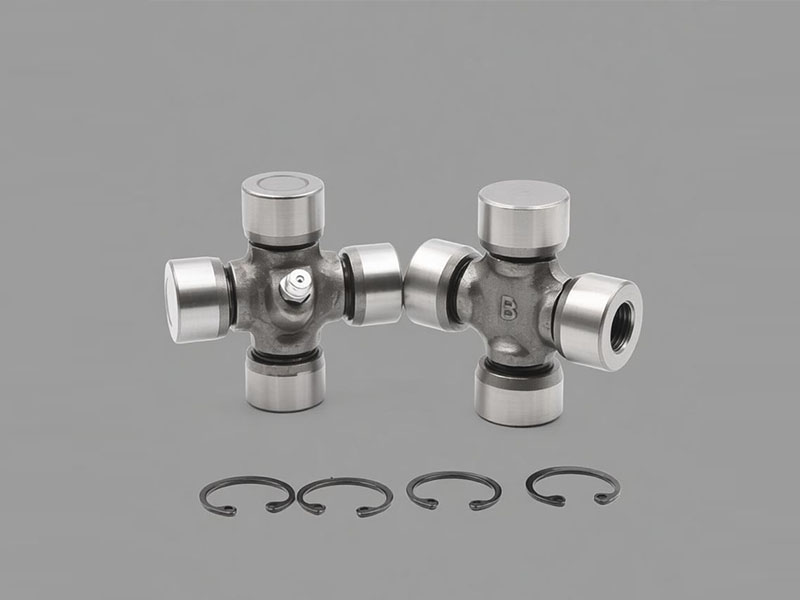
A universal joint is a mechanical coupling that connects the driveshaft to the transmission output shaft or the differential pinion. Its primary function is to transmit rotational power while allowing angular changes between the shafts – for example, when the rear axle moves up and down over bumps.
Most U‑joints consist of a cross‑shaped bearing (the “cross” or “spider”), four bearing cups with needle rollers, retaining clips (circlips), and grease seals. They are found on virtually all vehicles with a solid rear axle, including pickup trucks, SUVs, vans, and many passenger cars with rear‑ or four‑wheel drive.
Torque Multiplication at Steep Angles
When a U‑joint operates at an angle, the load transferred through the joint increases beyond the engine’s output torque. At 15 degrees, the torque increase is minimal. However, at 40 degrees, approximately 30% more torque is projected onto the U‑joint. This means that during rock crawling or heavy pulling, a U‑joint operating near its strength limit is significantly more likely to deform or break if the steering is turned sharply under load. Keeping wheels as straight as possible during high‑torque situations reduces this risk.
Common Signs That a U‑Joint Needs Replacement
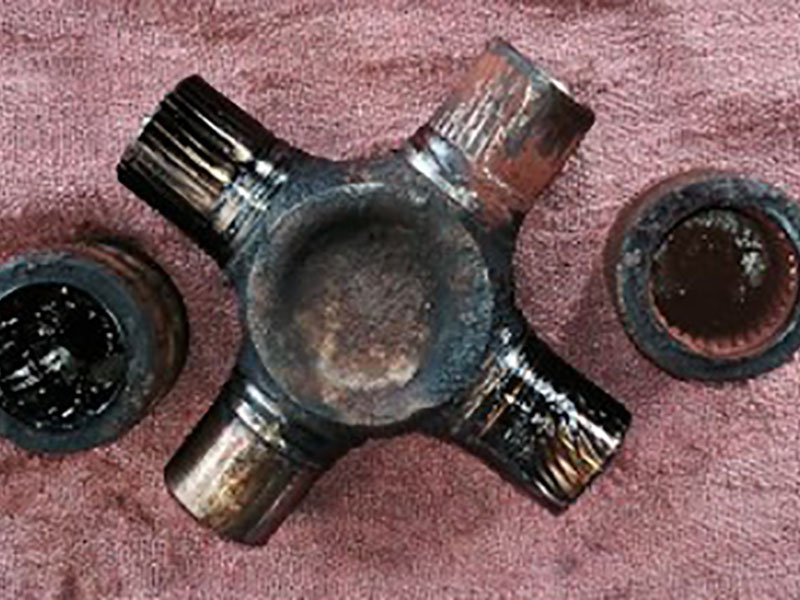
Recognizing early symptoms prevents costly drivetrain damage. The most frequent indicators of a failing U‑joint include:
- Clunking noise when shifting – A sharp “clunk” when moving from Park to Drive or Reverse often signals excessive wear or internal corrosion.
- Squeaking or chirping at low speeds – Dry needle bearings produce a high‑pitch sound, especially when pulling away from a stop.
- Vibration during acceleration or deceleration – A shudder or rumble that changes with vehicle speed indicates an unbalanced or worn U‑joint.
- Rust‑colored dust around the joint – This is powdered metal from failed bearings, often accompanied by leaked grease.
- Driveshaft play – Grabbing the driveshaft near the joint and trying to rotate it by hand should reveal almost no free movement. Any noticeable play means the joint is worn.
Once any of these signs appear, inspection and replacement should be scheduled promptly.
How Long Do U‑joints Typically Last?
Under normal on‑road driving, original‑equipment U‑joints often last between 80,000 and 100,000 miles (≈130,000 – 160,000 km). Some vehicles may exceed this range, especially if they are lightly used and regularly lubricated.
Several factors shorten U‑joint life:
- Heavy towing or frequent off‑road use – Increased torque and axle articulation accelerate wear.
- Lack of maintenance – Traditional U‑joints with grease fittings require lubrication approximately every 5,000 miles. Neglect leads to premature failure.
- Environmental corrosion – Road salt, mud, and moisture can enter the seals and corrode the needle bearings.
Routine inspection during oil changes or tire rotations helps catch wear before a breakdown occurs.
Why Immediate Replacement Is Critical
A worn U‑joint rarely fails quietly. Ignoring it can trigger a cascade of expensive and potentially dangerous failures.
Direct Risks
- Driveshaft detachment – If the cross breaks completely, the driveshaft can drop at one end, causing loss of power to the wheels and possible ground impact that may pole‑vault the vehicle.
- Sudden immobilization – The vehicle simply stops moving, requiring a tow and often leaving the driver stranded.
Secondary Damage to Other Components
- Output shaft seal or pinion seal leakage – Vibration from a bad U‑joint wears out these seals, leading to transmission or differential fluid loss.
- Transmission or transfer case damage – Fluid loss plus excessive vibration can destroy internal bearings and gears, resulting in a full rebuild or replacement.
- Driveshaft imbalance – A failing joint allows the driveshaft to wobble, which can bend the shaft or throw off its factory balance.
Economic Impact
Repair costs for a neglected U‑joint often include towing, rental car, and potential transmission work – easily exceeding the modest price of a timely U‑joint replacement.
Can You Drive with a Failing U‑joint?
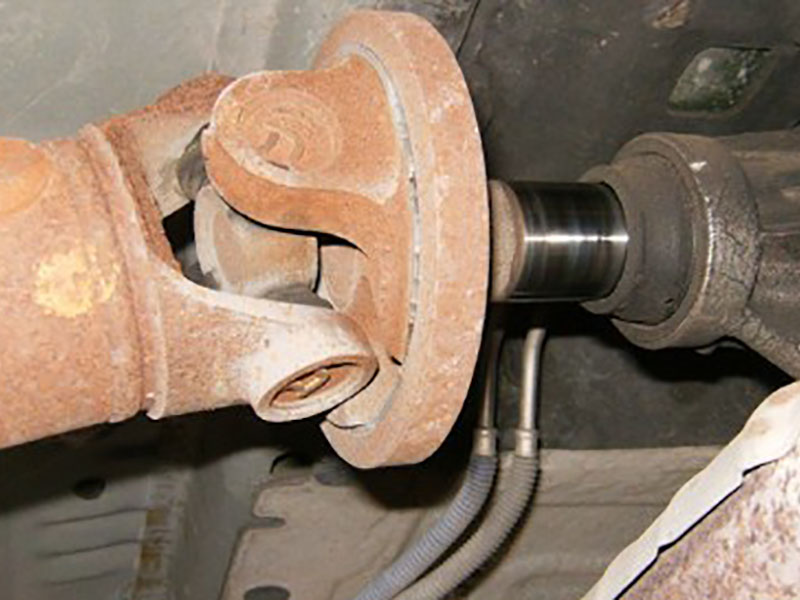
Technically, you may be able to drive a short distance – for example, to a nearby repair shop – but it is not safe for extended trips or highway speeds. As wear progresses, the joint generates increasingly violent vibrations that can suddenly lock up or separate. Many mechanics recommend having the vehicle towed if the symptoms are severe (loud clunking or significant driveshaft play). When in doubt, do not drive; arrange an inspection as soon as possible.
Should You Replace All U‑joints at the Same Time?
On a two‑piece driveshaft or a vehicle with multiple U‑joints (front and rear of the main shaft), it is wise to replace both joints on the same shaft simultaneously.
Why?
- When one joint wears out, the other has endured the same mileage and operating conditions. It is likely close to failure as well.
- Removing the driveshaft requires the same labor for one joint or two. Adding a second joint costs little extra time and parts.
- Replacing only one often leads to a second repair within months, doubling your labor expenses.
For fleet managers, this “paired replacement” approach reduces vehicle downtime and total maintenance costs.
How Much Does U‑joint Replacement Cost?
Costs vary by vehicle, location, and whether you use original equipment or aftermarket parts.
| Cost Component | Typical Range | Notes |
|---|---|---|
| Part cost (basic) | $20 – $30 | For light trucks / cars |
| Part cost (heavy‑duty / performance) | $80 – $100+ | For trucks, off‑road, high‑torque |
| Labor cost | $100 – $220 | Dependent on local shop rates |
| Total professional replacement (one joint) | $270 – $400 | Parts + labor |
| Additional costs (if applicable) | +$150 – $400 | Yoke replacement / carrier bearing / transmission seal |
Factors influencing total cost include vehicle model, local labor rates, material type (stainless steel, aluminum, titanium), OEM vs. aftermarket choice, and whether additional components like yokes or seals need replacement. Higher‑quality U‑joints – with precision‑ground crosses, better seals, and high‑grade needle bearings – cost slightly more upfront but reduce the risk of repeat failure. As a bearing manufacturer, DUHUI Bearing supplies durable, OE‑grade universal joint kits designed for consistent fit and long service life.
Use a reliable U‑joint lookup tool to confirm compatibility with your vehicle.
U‑Joint vs. CV Joint – Key Differences
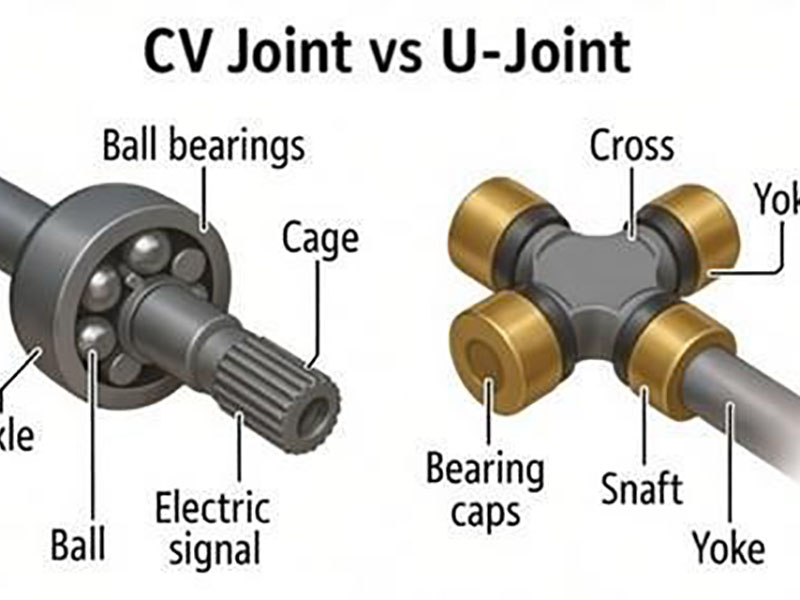
- Application – U‑joints are used on driveshafts (between transmission and axle) where angles are relatively small (typically ≤15°). CV joints are used on half‑shafts of front‑wheel‑drive and all‑wheel‑drive vehicles, where steering and suspension create large, constantly changing angles (up to 45° or more).
- Operation – A single U‑joint rotates at a slightly non‑constant speed when angled, while a CV joint maintains constant velocity for smooth power delivery.
- Maintenance – Traditional U‑joints require periodic greasing (unless sealed). Most CV joints are permanently sealed and non‑serviceable.
- Strength vs. smoothness – U‑joints are stronger and cheaper for high‑torque applications (trucks). CV joints are smoother and more compact.
- Special case: Double Cardan joint – Effectively two U‑joints paired together, often used on lifted off‑road vehicles to cancel vibration at steep driveshaft angles (25–30°).
Can You Replace a U‑joint Yourself?
With moderate mechanical skill and the right tools, a DIY U‑joint replacement is feasible. However, some vehicles use non‑serviceable (staked) U‑joints that require complete driveshaft replacement.
Required Tools
- Floor jack and jack stands (safety first)
- Wheel chocks
- Socket set and wrenches
- Circlip pliers (internal/external)
- Hammer and brass drift or punch
- Grease gun with NLGI #2 lithium grease
- Optional but helpful: U‑joint press tool (avoids hammer damage)
Basic Steps
- Secure the vehicle – Chock the wheels, lift the rear (or front) axle, and support securely on stands.
- Mark the driveshaft – Before unbolting, scribe alignment marks between the driveshaft and differential/transmission flange to maintain factory balance.
- Remove the driveshaft – Unbolt the U‑joint straps or bolts, then slide the shaft out.
- Remove the old U‑joint – Take out the circlips, then press or lightly hammer out the bearing cups. Clean the yoke bores thoroughly.
- Install the new U‑joint – Place the cross into the yoke, carefully start each bearing cup – ensuring no needle rollers tip over inside. Press or tap cups in evenly.
- Install circlips – Once the cups are fully seated, snap the circlips into their grooves.
- Reinstall the driveshaft – Align your marks, tighten bolts to the manufacturer’s torque specification.
- Grease the joint – If the new U‑joint has a grease fitting, add grease until fresh grease appears at all four seals.
Difficulty and Common Mistakes
- Difficulty level – Intermediate. A first‑time DIYer should expect 2–4 hours and work patiently.
- Needle roller displacement – The most frequent mistake. If a needle roller falls sideways inside the cup during assembly, the joint will bind and fail quickly. Always double‑check before pressing.
- Skipping alignment marks – This introduces a new vibration.
- Hammer damage – Hitting the driveshaft tube deforms it, ruining balance. Use a press or a drift on the strongest part of the yoke.
- No grease after installation – Running even a few miles without grease destroys new bearings.
If your vehicle has staked U‑joints (no circlips, cups held by deformed metal), you cannot service them yourself – a complete driveshaft assembly is required. When in doubt, consult a professional mechanic.
Troubleshooting Common Issues After U‑Joint Replacement
Even with careful work, issues may arise after replacement. The table below helps diagnose and resolve the most frequent problems.
| Symptom After Replacement | Possible Cause | Solution | Need to Re‑do the Job? |
|---|---|---|---|
| Vibration during acceleration | Yokes misaligned during reassembly | Reinstall driveshaft with original alignment marks | Yes |
| Vibration at highway speeds | Driveshaft phasing incorrect | Check yoke orientation and re‑phase | Yes |
| Clunking noise | Loose U‑joint bolts or insufficient torque | Retighten to manufacturer spec | Maybe |
| Squeaking or chirping | Insufficient grease (greaseable joint) | Apply grease with grease gun | No |
| Loss of power transfer | Joint binding or incorrect fitment | Verify part compatibility and replace if needed | Yes |
| Persistent vibration after reinstallation | Driveshaft balance affected | Professional balancing may be needed | Consult a shop |
Most post‑replacement vibrations trace back to misaligned alignment marks or incorrect phasing. Always double‑check these before assuming a defective part.
Conclusion
A failing universal joint is not a component to ignore. Recognizing the signs early, understanding why immediate replacement prevents severe damage, and knowing how to perform the job – or when to hire a professional – will keep your vehicle safe and reliable. Quality U‑joints from established manufacturers, like DUHUI Bearing, provide the precision and durability needed for long‑term drivetrain health. Whether you choose to DIY or visit a shop, timely replacement is always the better investment.
Frequently Asked Questions
Q1: How do I know for sure that my U‑joint is bad?
A: The most reliable method is to raise the vehicle, place it securely on stands, and try to rotate the driveshaft by hand near each joint. Any noticeable rotational play or clunking points to a worn joint. You may also see rust‑colored dust around the bearing cups.
Q2: How many miles do U‑joints typically last?
A: 80,000 to 100,000 miles under normal conditions. Heavy towing, off‑road use, or lack of lubrication significantly shortens that range.
Q3: Can I replace just one U‑joint on a two‑joint driveshaft?
A: Technically yes, but not recommended. The other joint has similar wear and will likely fail soon. Replacing both at the same time saves labor and future downtime.
Q4: Is a U‑joint replacement a DIY‑friendly job?
A: It is an intermediate task. You need basic mechanical skills, tools (circlip pliers, press or hammer with drift), and patience. The most critical step is avoiding needle roller misalignment. Some vehicles have non‑serviceable U‑joints that require a full driveshaft replacement.
Q5: How much does a professional U‑joint replacement cost?
A: Typically $270 to $400 per joint including parts and labor. Costs depend on vehicle model, local labor rates, and whether other components (yoke, carrier bearing) are replaced.
Q6: Do I need an alignment after changing a U‑joint?
A: No. A U‑joint replacement does not affect steering or suspension geometry. No wheel alignment is required.
Q7: What is the difference between a U‑joint and a CV joint?
A: U‑joints are used on driveshafts of rear‑wheel‑drive vehicles and can operate at moderate angles (≤15°). CV joints are used on front‑wheel‑drive axles, operate at high angles (up to 45°+), and maintain constant velocity. Double Cardan joints combine two U‑joints to reduce vibration on lifted trucks (25–30° angles).
Q8: Can I drive with a bad U‑joint to the repair shop?
A: Very short distances at low speed might be possible, but it is risky. Severe vibration or sudden joint separation can cause loss of vehicle control. Towing is the safer option.
Q9: How often should I grease my U‑joints?
A: If your U‑joints have grease fittings (zerks), lubricate them every 5,000 miles or during every oil change. Use a quality lithium‑based grease.
Q10: Are all U‑joints replaceable?
A: No. Some factory U‑joints are “staked” – the bearing cups are permanently deformed into the yoke. These cannot be serviced; you must replace the entire driveshaft assembly.