Quick Answer: A bad wheel bearing usually produces a hum, rumble, or growl that rises with road speed and may change when steering. Diagnosing it starts with a road test, then a lifted-vehicle check for wheel play at about 2:45 and 5:30, listening to each wheel, and comparing both sides. Confirm the source and measure axial play against the vehicle manufacturer’s specification before replacing any parts.
Wheel bearing noise is easy to misread. A tire with a flat spot, a warped rotor, a worn CV joint, or a damaged ABS sensor can create a similar complaint. The symptoms point to a diagnostic path, not to a part. The goal of diagnosing a bad wheel bearing is to prove where the noise or play originates, confirm the affected side, and avoid replacing a hub that is not at fault.
How to Diagnose a Bad Wheel Bearing Step by Step
The reliable sequence is road test, lifted inspection, side-to-side confirmation, axial play measurement, then elimination of other noise sources. Each step answers a different question. The road test shows when the noise appears. The lifted check shows play, roughness, or local vibration. The side comparison shows which corner is the likely source. Axial play measurement shows whether the hub is outside specification. None of these steps alone proves bearing failure.
Road Test First
Technical service tip TT 08-011, dated April 2008, recommends a road test first. Record whether the abnormal sound changes with vehicle speed and watch for an ABS warning light. A 2020 manufacturer service bulletin adds a useful set of questions:
- Does the tone or frequency rise with vehicle speed?
- Does the sound become louder during turns?
- Does it remain during deceleration?
- Is it amplified at the steering wheel?
- Can vibration be felt on an unloaded coil spring when the wheel is rotated?
Bearing noise can travel through the steering system into the cabin and can be hard to separate from tire rolling noise. A road test is therefore a clue-gathering step, not a final diagnosis.
Perform the road test on a safe route under local traffic law, with a driver or technician who can concentrate on the sound. Some bearing noise appears only with the vehicle under load, so a quiet road test does not fully exclude a bearing fault.
Lifted-Vehicle Checks
Diagnostic guide PRMM01702-EN recommends raising the vehicle so each wheel can spin freely, then checking every wheel for play, noise, and vibration. Rotate each wheel by hand and listen for abnormal sound. Look for grease leakage, damaged seals, and rough or uneven rotation.
With both hands, rock the wheel at about the 2:45 and 5:30 positions. If you feel looseness, the bearing may be worn or damaged. Another check is the spring feel method: while rotating the wheel, lightly touch the unloaded suspension coil spring. Vibration from a damaged bearing can travel through the steering knuckle into the spring. A normal new bearing should not create that noticeable vibration.
Use a stable lift or safety stands. Do not rely on a jack alone or put your hands into the wheel arch while the vehicle is supported only by a jack. Play and clunking can also come from suspension parts, so a loose wheel check is not a final conclusion. A quiet hand-spin does not rule out a bearing, because some noise appears only under vehicle load.
Side-to-Side Confirmation
The body and frame transmit bearing noise. The side that sounds bad from the driver’s seat is not always the side with the damaged bearing. Run the wheels at moderate speed on a lift and compare left and right with a mechanical stethoscope or another listening device.
Service bulletin 24-DS-003G describes a more controlled comparison. Electronic chassis listening devices, often called chassis ears, can be placed on the suspected knuckle, the opposite knuckle, and other suspected noise sources. A road test then compares left and right hub bearing noise. Replace the hub assembly on a side only after the noise has been traced to that knuckle area.
When running wheels on a lift, keep the vehicle stable, keep the wheels free of load, and follow the lift manufacturer’s operating procedure. A 2020 manufacturer service bulletin notes that a driver may perceive noise from the left side when the right bearing is the actual source. Do not choose the repair side from cabin impression alone.
Axial Play Measurement
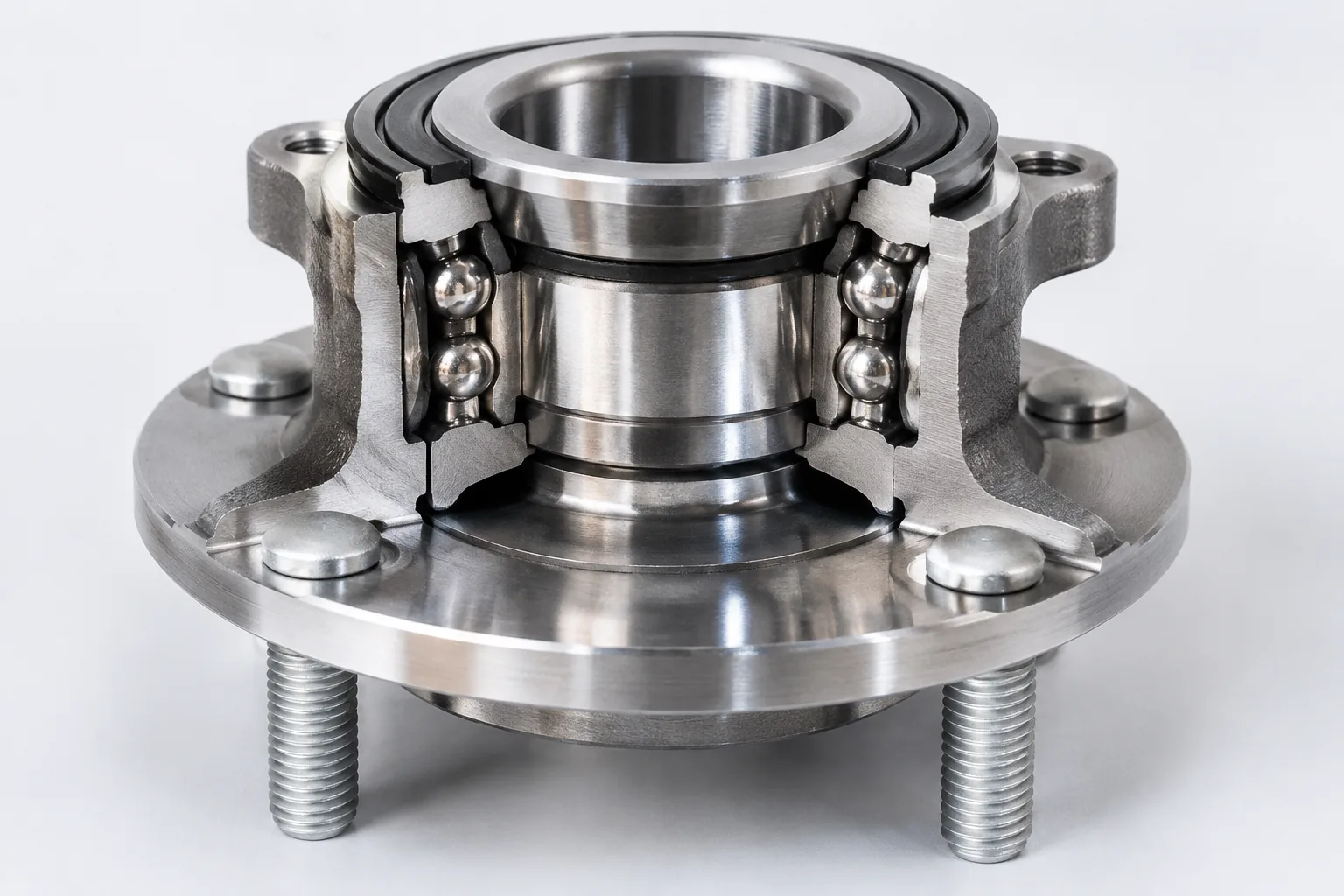
A hub bearing assembly can develop excessive axial play and a growling noise, which may affect vehicle handling or wheel alignment. The first step is to check axial play against the manufacturer’s specification and replace the hub assembly when it is outside that specification.
A dial indicator procedure defines wheel end axial play as the free movement of the tire and wheel assembly along the spindle axis. At the 3 and 9 o’clock positions, push and pull the wheel, rock it slightly so the bearing seats, then read the total displacement on the dial indicator.
One repair procedure for adjustable commercial wheel ends requires a dial indicator with resolution of at least 0.001 in (0.03 mm). The acceptable value for that application is 0.001-0.005 in (0.025-0.125 mm). Those figures are a specific wheel-end specification. Do not apply them to all passenger cars or sealed hub assemblies. Use the vehicle manufacturer’s specification for the vehicle being serviced.
Only judge axial play after comparing the reading with the correct vehicle or wheel-end specification. Without a manufacturer’s specification, do not invent a passenger-car bearing clearance limit.
What a Bad Wheel Bearing Sounds and Feels Like
A failing hub bearing can produce several distinct complaints. Typical symptoms include:
- A hum, rumble, or growl that gets louder as road speed rises and can change when you turn the steering wheel.
- A constant whine or grinding sound while the vehicle is moving.
- Steering looseness or a clunk when the vehicle passes over bumps.
- Steering wheel vibration that changes with speed or steering input.
- ABS faults that trace to the wheel speed sensor built into the hub bearing.
These are symptoms, not a diagnosis. Each one needs to be separated from other components. A car can produce more than one noise at the same time, so a single symptom does not justify replacing a bearing.
What Else Can Mimic a Bad Wheel Bearing
Before replacing a bearing, rule out tires, brakes, driveline, suspension, and ABS wiring. A wrong replacement does not remove the noise, and it can hide a safety item that still needs repair.
Tires and Wheels
An unbalanced wheel commonly causes steering wheel, seat, or floor vibration above 45 mph. Vibration that appears only in a high-speed range should prompt a tire and balance check before a bearing diagnosis.
Tire imbalance, flat spots, or belt separation can also produce abnormal vibration or thumping. A pull can come from low tire pressure, tire damage, a brake problem, or poor alignment. Inspect tire pressure, tread wear pattern, flat spots, and bulges, and confirm wheel balance.
Tire problems and bearing faults can exist together. After tire issues are excluded, continue with the bearing checks.
Brakes
When vibration appears only as the brake pedal is applied, a warped brake rotor is a more likely cause. Worn brake pads may produce a squeal or grinding sound during braking. Record whether the noise is tied to brake operation, and inspect rotors, pads, and calipers.
Brake noise and bearing noise can overlap. Do not identify a part from sound type alone.
Driveline, Spindle and Chassis
Inspect the spindle assembly, axle or CV joints, wheel flange, and frame for damage. These parts can produce noise or vibration that resembles a bad bearing. Use wheel alignment when needed to confirm a bent part.
Check tie rods, suspension ball joints, and bushings for play. Loose or clunking suspension can imitate a bearing complaint. An abnormal alignment reading does not prove bearing damage. It shows a geometry or component issue that needs further location.
ABS Sensors and Wiring
An ABS light alone does not prove bearing failure. Read fault codes, compare wheel speed sensor resistance with the vehicle manufacturer’s specification, and inspect the harness and connectors. An ABS light can also come from the sensor itself or from wiring.
If a wheel speed sensor fault is found, separate the sensor, the harness, and the sensor ring built into the bearing. Compare sensor resistance with the correct manufacturer’s specification. A failed ABS sensor inside a hub bearing can trigger ABS problems, but the ABS light is not evidence of bearing damage by itself.
Reading Bearing Condition: Heat, Grease and Wear Patterns
Abnormal wheel end heat, increased noise or vibration, grease leakage or discoloration, rough or uneven rotation, and damaged or contaminated seals are warning signs that bearing integrity may be compromised.
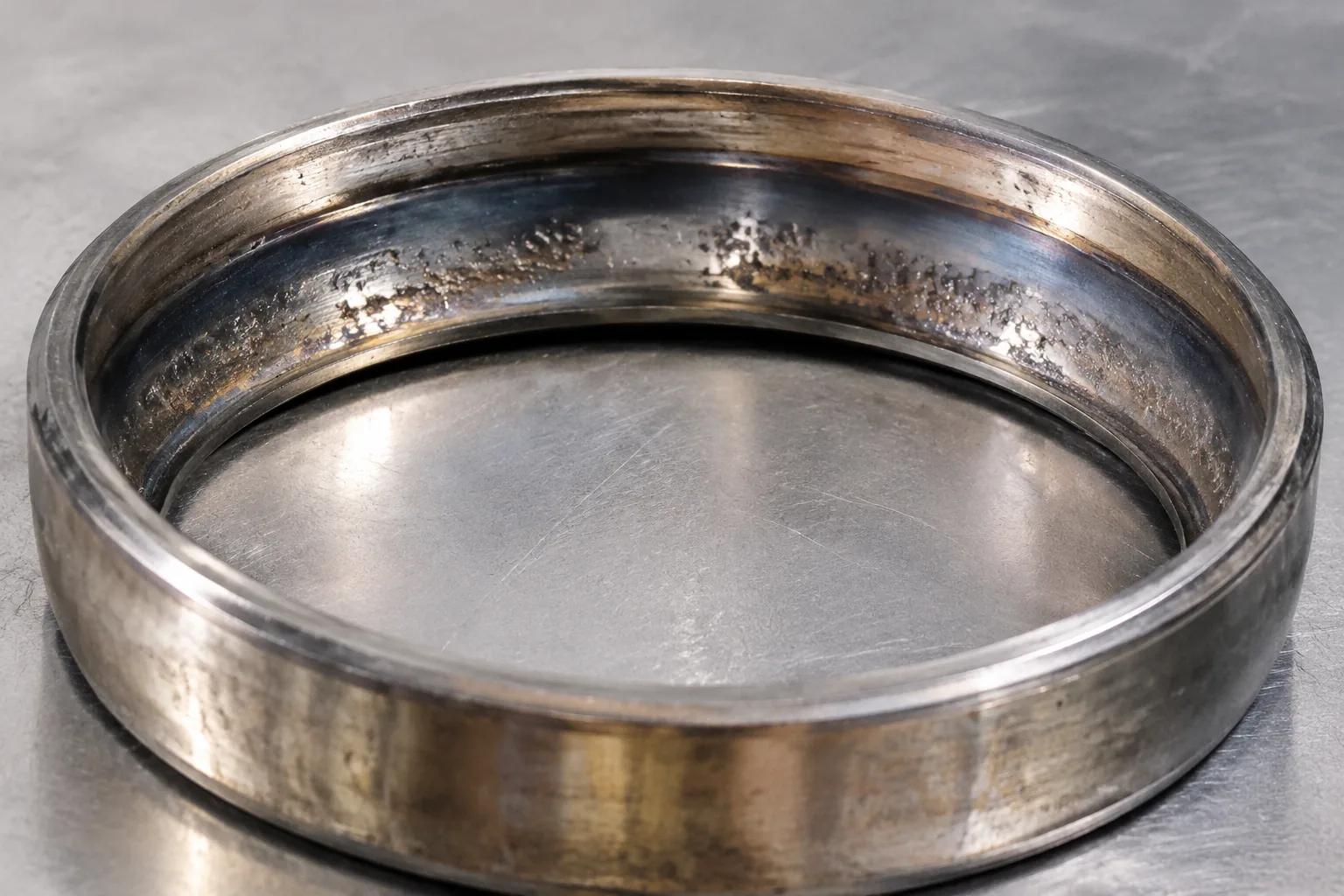
After disassembly, a bearing that overheated from poor lubrication may change from silver to dark blue. A black surface may indicate that the bearing seized and transferred metal. Technical file TP-2431, published in November 2024, requires replacement of bearings with this heat damage. The same file also lists uneven wear and spalling on the bearing cup or cone as damage that requires replacement.
A commercial wheel-end vibration monitor used on trucks and trailers detects bearing raceway spalling and reports damage with a red flashing light. This shows that raceway spalling has a vibration signature, but a hand-held listening check is not a substitute for bench monitoring.
Use these checks to confirm the condition of a bearing that has already been removed or located. They do not replace a road test and a side-to-side comparison. Judge color and wear in clean, well-lit conditions and include grease condition and seal inspection. Dark blue or black surfaces may have more than one cause. Replace a bearing with this heat damage or metal transfer instead of returning it to service.
When Replacement Is Needed and How to Verify the Repair
Replace only the bearing or hub assembly that has been confirmed by diagnosis. If the noise cannot be traced to the bearing, keep checking other components. A 2020 manufacturer service bulletin states that front wheel bearings do not need to be replaced in pairs. Locate and replace the bearing that is actually affected.
A hub assembly should be replaced when axial play is outside the manufacturer’s specification. Excessive axial play and growling can affect handling or wheel alignment.
Service bulletin 24-DS-003G requires a road test after repair to confirm that the original noise is gone. This closes the loop: locate before replacement, then verify after repair.
During installation, follow the vehicle manufacturer’s specified fasteners, torque values, and hub installation procedure. Do not use a generic torque value when no specification source is available. A severely worn hub bearing should be repaired promptly. Continued driving can affect handling and the operation of the brake system.
Before replacement, confirm that the noise comes from the relevant knuckle or hub area and that tire, brake, driveline, and ABS wiring issues have been excluded. If noise remains after replacement, recheck the diagnosis instead of replacing the other side without evidence. Replacement procedures differ by vehicle and wheel-end design; use the vehicle manufacturer’s service information for torque and sequence.
Conclusion
Diagnosing a bad wheel bearing is a sequence, not a guess. Record the noise during a road test, including its relationship to speed, steering, braking, and ABS warnings. Lift the vehicle and check wheel play, rotation noise, and spring vibration. Compare both sides with listening equipment, measure axial play, and exclude tires, brakes, driveline, and ABS wiring.
A common mistake is replacing the bearing on the side that sounds loud from the cabin. Body and frame conduction can put the source on the opposite side. Once the bearing is confirmed, replace the affected side using the vehicle manufacturer’s procedure and road test the vehicle afterward to verify that the noise is gone.
FAQs
Q1: How can I tell if the noise is a wheel bearing or a tire?
A: Wheel bearing noise usually rises with vehicle speed and may change when steering, while tire imbalance more often produces vibration above 45 mph. Check tire pressure, flat spots, bulges, belt separation, and wheel balance; if the sound changes clearly during steering, prioritize a side-to-side bearing check. Tire problems and bearing faults can exist together, so continue bearing inspection after tire issues are excluded.
Q2: Can I drive with a bad wheel bearing?
A: Do not treat a confirmed bad wheel bearing as a part for long-term continued driving. Excessive axial play and growling can affect handling or wheel alignment. If there is constant grinding, obvious wheel play, or abnormal steering, arrange repair promptly instead of continuing at high speed. The final decision depends on damage severity and the vehicle manufacturer’s guidance; there is no universal safe mileage limit.
Q3: Does a bad wheel bearing always make noise?
A: No. Some bearing noise appears only with the vehicle under load, so a quiet hand-spin check does not fully exclude a bearing fault. Use a road test, the spring feel method, side-to-side listening, and axial play measurement together rather than relying on one static check.
Q4: Will a bad wheel bearing trigger the ABS light?
A: It can. A failed wheel speed sensor built into the hub bearing assembly may cause ABS-related problems. However, an ABS light alone does not prove bearing failure; read fault codes, measure wheel speed sensor resistance against the vehicle manufacturer’s specification, and inspect the harness and connectors. A sensor or wiring fault can also turn on the ABS light.
Q5: Do wheel bearings need to be replaced in pairs?
A: No, not as a default. A 2020 manufacturer service bulletin states that front wheel bearings do not need pair replacement; locate and replace the bearing that is actually affected. Replace the opposite side only when diagnosis confirms damage there. Follow the vehicle manufacturer’s guidance for the specific model.
Q6: How is wheel bearing play measured?
A: Use a dial indicator to measure wheel end axial play. At the 3 and 9 o’clock positions, push and pull the wheel, rock it slightly so the bearing seats, then read the total displacement. One adjustable commercial wheel-end procedure requires a dial indicator with resolution of at least 0.001 in (0.03 mm) and gives an acceptable value of 0.001-0.005 in (0.025-0.125 mm). Those figures are specific to that wheel end, not a universal passenger-car or sealed-hub specification; use the vehicle manufacturer’s value.