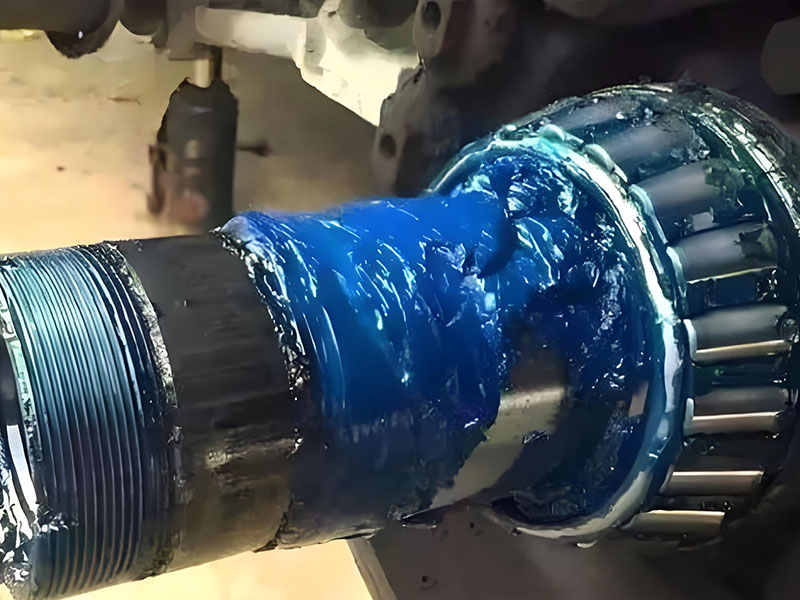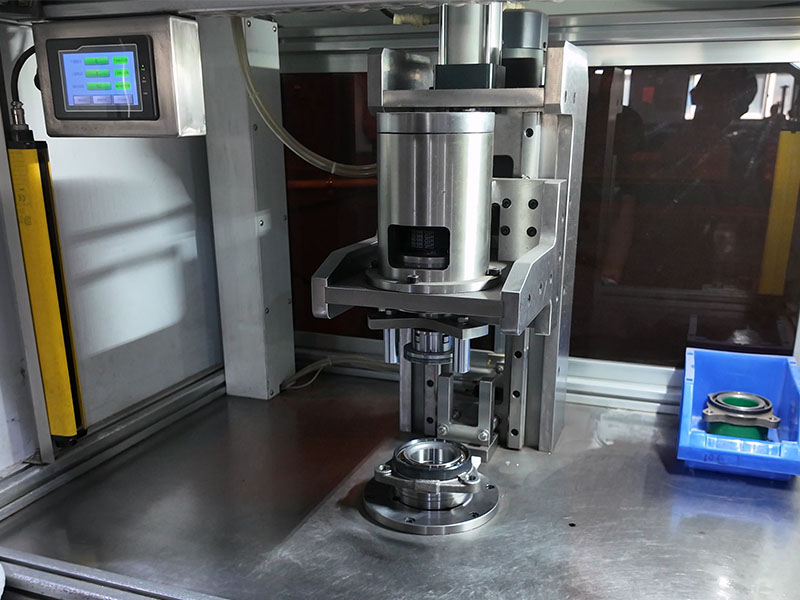
Quick Answer: The torque of a slewing bearing has no single universal rating. The value usually discussed is friction torque, the resistance that must be overcome to rotate the bearing under a given load, preload, seal, lubrication, and installation condition. Calculate or measure it for the exact bearing and duty cycle. Keep it separate from tilting moment capacity, gear torque, and bolt tightening torque.
A buyer or engineer asking about the torque of a slewing bearing usually needs one of several different values. The number may be a friction torque for drive sizing, a tilting moment capacity for load checks, a gear torque for a geared bearing, or a bolt tightening torque for installation. Mixing them leads to the wrong drive, the wrong bearing, or an unsafe installation assumption.
This article separates those values, shows the common calculation methods, and explains why a calculated result is an estimate rather than a guaranteed catalogue constant.
Short Answer: There Is No Single Universal Torque Rating
Slewing bearing torque usually means friction torque or rotational resistance torque: the torque required to turn the bearing under its actual operating conditions. It depends on axial load, radial load, tilting moment, raceway diameter, bearing type, preload, seals, lubrication, and installation condition.
It is not the same as tilting moment load capacity, and it is not the same as gear transmission torque. In practice, no universal rating exists; friction torque must be calculated for the exact bearing and application, then checked by measurement when the result is critical.
The Torque Terms Commonly Confused
Several bearing-related torque terms are often used in the same conversation. They describe different physical quantities, and each has a different role in selection.
Friction or Rotational Torque
Friction torque is the torque needed to overcome rolling resistance, raceway friction, cage or spacer friction, seal friction, and lubricant resistance. This is the main meaning of slewing bearing torque in drive calculations, because it is the resistance the drive must turn.
Tilting Moment Capacity
Tilting moment is a load term or a load capacity, not the torque required to rotate the bearing. A bearing may have a high tilting moment rating and still need a separately calculated friction torque for rotation. Do not substitute a tilting moment rating for friction torque when sizing a drive.
Gear Transmission Torque
For geared slewing bearings, gear torque refers to torque transmitted through the gear teeth. Gear torque is not the same as bearing friction torque. If the product is a complete slew drive, published output torque refers to the drive, not to the bearing alone.
For example, IMO GmbH & Co. KG, headquartered in Gremsdorf, Germany, publishes slew drive maximum output torque up to about 450 kN*m, maximum tilting moment load about 1,200 kN*m, and raceway diameter about 1,000 mm. These are complete slew drive capabilities, not inherent bearing friction torque.
Bolt Tightening Torque Is Also Different
Bolt tightening torque is the torque applied to fasteners during installation. It is unrelated to the bearing rotational resistance torque discussed in this article. It is mentioned here only to avoid terminology confusion, not as a bolt tightening procedure.
Basic Torque Definition and Units
Torque is a force acting at a distance from a rotation axis:
T = F x r
Here, T is torque in N*m, F is tangential force in N, and r is the perpendicular distance from the force to the rotation axis in m. Bearing friction torque formulas commonly use kN*m, kN, and m, so keep the units consistent through the calculation.
Calculating Slewing Bearing Friction Torque
The formulas below are published estimation methods. They are not guaranteed exact values. Unless stated otherwise, they estimate the friction torque related to external load; they do not automatically include every no-load resistance in a mounted assembly. Use the coefficient that matches the bearing design and confirm the result by test where possible.
Ball Slewing Bearing Formula from thyssenkrupp rothe erde
For a ball-type slewing bearing using the published rothe erde method:
M_r = (μ / 2) x [4.4 M_k + F_a D_L + 2.2 F_r D_L x 1.73]
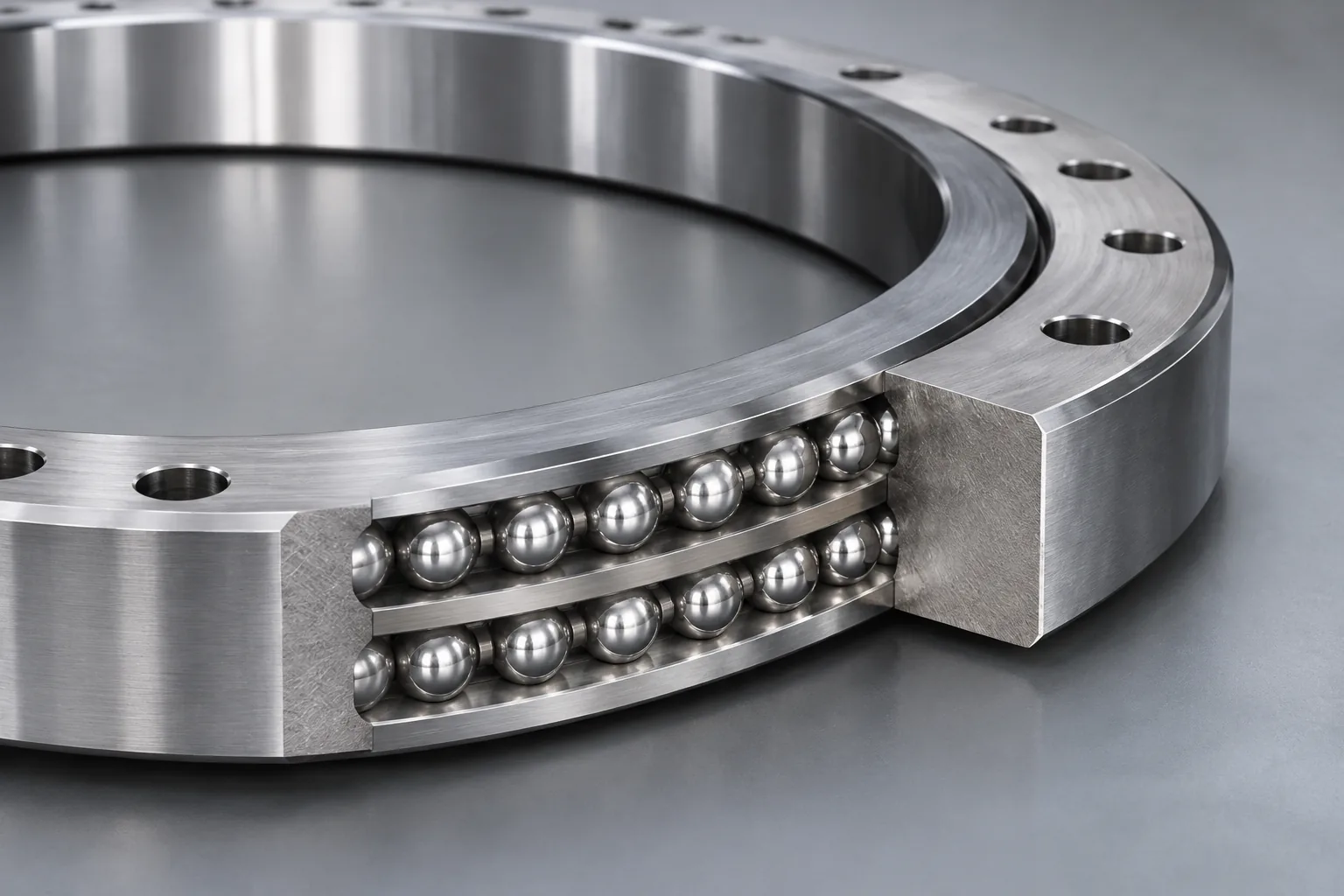
M_r is in kN*m; M_k is tilting moment in kN*m; F_a is axial load in kN; F_r is radial load in kN; D_L is raceway diameter in m; and μ is the friction coefficient.
Roller Slewing Bearing Formula from thyssenkrupp rothe erde
For a roller-type slewing bearing using the published rothe erde method:
M_r = (μ / 2) x [4.1 M_k + F_a D_L + 2.05 F_r D_L]
The units and variable definitions are the same as for the ball bearing formula. The coefficients differ from the ball version, so use the formula that matches the rolling element type.
Kaydon/SKF External-Load Torque Estimate
An alternative published estimate for external-load torque is:
M_w = μ(4.4 M_k + F_a D_p + 2.2 F_r D_p) / 2
The original Kaydon catalogue uses imperial units: M_w and M_k in ft*lbf; F_a and F_r in lbf; and D_p in ft. This formula estimates torque caused by external loads only. With zero external load, rotating component weight, seals, and lubricant can still create resistance.
The formula assumes the bearing is installed and maintained to the manufacturer’s Catalog 390 guidance. Manufacturing variation can significantly affect results, so keep additional torque margin for preliminary drive selection.
Worked Example: Ball Bearing Friction Torque
Assume a ball slewing bearing with μ = 0.006, M_k = 100 kN*m, F_a = 200 kN, F_r = 50 kN, and D_L = 1.0 m. Using the rothe erde ball formula:
M_r = (0.006 / 2) x [4.4(100) + 200(1) + 2.2(50)(1)(1.73)]
M_r ≈ 2.49 kN*m = 2,490 N*m
Applying an approximate +/-25% variation gives about 1.87 to 3.11 kN*m for bearing friction torque alone. This example is illustrative. It does not include wind load, acceleration torque, equipment tilt gravity torque, or other external resisting loads.
Friction Coefficients Published by Manufacturers
Published coefficients are reference values tied to specific bearing designs and manufacturers. They are not universal constants. Use them only with the matching formula, units, and manufacturer assumptions.
| Bearing design | Published friction coefficient |
|---|---|
| rothe erde KD 210, types 13 and 21 normal bearings | 0.008 |
| rothe erde KD 210, type 110 | 0.006 |
| rothe erde KD 320 | 0.004 |
| rothe erde KD 600 | 0.006 |
| rothe erde KD 700 | 0.003 |
| rothe erde KD 800 | 0.004 |
| rothe erde RD 900 | 0.003 |
| Kaydon RK, HS, HT, MT, KH, XT, and DT series | 0.006 |
| Kaydon XR and TR series | 0.004 |
Precision, no-clearance, and preloaded bearings require a separate manufacturer inquiry because their friction torque can differ from the standard values above.
What Changes the Actual Torque
Calculated and measured torque can differ because the total resistance has load-dependent and load-independent parts. Liebherr expresses total friction torque as:
M_Reib = M_E + M_RN
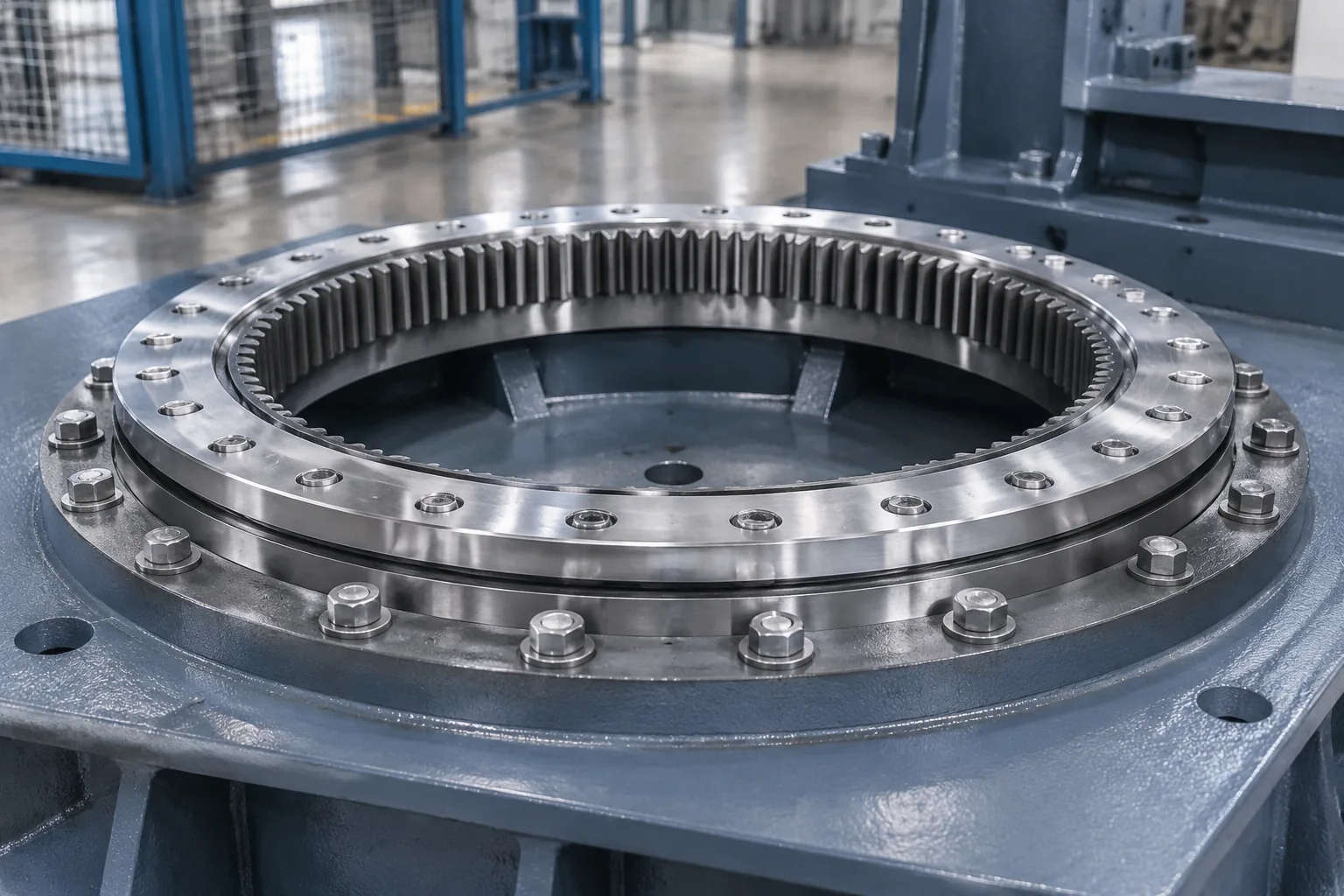
M_E is the base installed torque after the bearing is fastened in place. It comes mainly from lubricant, rolling elements, cage or spacer, and seals. M_RN is the load-related torque portion. Liebherr’s method also considers raceway diameter, bolting, adjacent structure, speed, axial load, radial load, and tilting moment.
Schaeffler describes rotational resistance torque as influenced by rolling resistance, internal clearance or preload, cage or spacer friction, seal friction, seal preload, lubrication, grease quantity, manufacturing tolerances, installed clearance changes, and adjacent structure deformation. Its technical guidance states that rotational resistance torque can only be approximately calculated.
When precise drive sizing or acceptance criteria are required, verify the actual torque by measurement rather than relying only on a formula.
From Bearing Friction Torque to Drive Power
Bearing torque and speed convert into required power with the published relation:
P = M_r n / (9.55 η)
Here, P is power in kW, M_r is bearing friction torque in kN*m, n is speed in rpm, and η is drive efficiency.
This relation is only a starting point. Complete drive selection also needs acceleration torque of rotating masses, wind load torque, gravity torque from equipment tilt, and other external resisting torques. A complete slew drive output torque is a drive capability, not the same thing as bearing friction torque.
Accuracy, Tolerances, and Verification
Calculated friction torque is an estimate. rothe erde notes that theoretical friction torque can vary by about +/-25%. rothe erde also states that its formula does not include resistance from seals and lubricants for an unmounted bearing without external load.
Kaydon advises additional torque margin for preliminary drive selection because manufacturing variation can significantly affect results. For precision, preloaded, or special-seal bearings, use proprietary torque data or testing when the value is critical.
Standards and Research Context
Standards and research help show why torque depends on application and bearing specifics. They do not provide a universal torque value for every slewing bearing.
ISO 16123:2025, Ships and marine technology – Marine cranes – Slewing bearings, was published in March 2025, has 17 pages, and was developed by ISO/TC 8/SC 4. It applies to marine crane slewing bearings with a minimum ambient temperature of -40°C and covers design, manufacture, inspection, testing, marking, installation, and maintenance. It is an application-specific marine crane standard and does not replace manufacturer friction torque data for a specific bearing model.
In Mechanism and Machine Theory, Vol. 192, 2024, article 105542, DOI 10.1016/j.mechmachtheory.2023.105542, the authors present an engineering approach to assess friction torque in generally loaded four-point contact slewing bearings. The work states that friction torque depends on external load, bearing macro-geometry, micro-geometry, and friction coefficient.
In Friction, 2024, Vol. 12, pp. 1838-1857, DOI 10.1007/s40544-024-0867-6, online May 28, 2024, a methodology addresses the friction torque of ball slewing bearings while considering preload scatter.
Practical Checklist for Specifying or Checking Torque
- Confirm whether the value needed is bearing friction torque, gear torque, tilting moment capacity, bolt tightening torque, or complete drive torque.
- Collect axial load, radial load, tilting moment, raceway diameter, bearing type, preload, seal type, lubrication, speed, and installation conditions.
- Select a published formula and the matching friction coefficient, then state units clearly.
- Add acceleration, wind, gravity, and other external torques for drive sizing.
- Apply a margin for calculation uncertainty and manufacturing variation.
- Ask the manufacturer for model-specific torque data or test verification when torque is critical.
Conclusion
The torque of a slewing bearing is a calculated or measured resistance, not a catalogue constant. Start by naming the torque you need: friction torque for rotation, tilting moment capacity for load, gear torque for the gear teeth, bolt tightening torque for fasteners, or complete drive torque for the drive package.
Then calculate with the matching formula and coefficient, add the external loads that apply, and keep a margin for variation. When the result affects drive sizing, safety, or acceptance, confirm it with the bearing manufacturer or a measurement.
FAQs
Q1: Does a slewing bearing have a fixed torque value?
A: No. A slewing bearing has no single fixed torque value. Its friction torque depends on load, preload, seals, lubrication, speed, and installation, so the value must be calculated or measured for the exact bearing and application.
Q2: Is slewing bearing torque the same as tilting moment?
A: No. Tilting moment is a load or load capacity that acts on the bearing. Friction torque is the rotational resistance the drive must overcome. Use each value for its own check and do not substitute one for the other.
Q3: How do I calculate the friction torque of a slewing bearing?
A: Use a published formula for the bearing type, with axial load, radial load, tilting moment, raceway diameter, and the matching friction coefficient. State units consistently. For critical drive sizing, confirm the result by test or with the bearing manufacturer.
Q4: Which friction coefficient should I use?
A: Use the coefficient published for the exact bearing design and formula. Published coefficients are design-specific reference values, not universal constants; they vary by bearing series and manufacturer. For precision, no-clearance, or preloaded bearings, ask the manufacturer for specific torque data.
Q5: Why does measured torque differ from calculated torque?
A: A calculation is an estimate. Seal and lubricant resistance, preload scatter, manufacturing tolerance, installation, adjacent structure deformation, and load distribution can all change the measured result. rothe erde notes about +/-25% variation for theoretical friction torque.
Q6: Does gear torque equal bearing friction torque?
A: No. Gear torque is transmitted through the gear teeth. Bearing friction torque is the resistance to rotation. For a complete slew drive, published output torque describes the drive, not the bearing alone.
Q7: Can I use bearing friction torque directly for motor selection?
A: No. Bearing friction torque is only one input. Motor and drive selection also need acceleration torque, wind load torque, gravity torque from equipment tilt, other external resisting torques, and drive efficiency.
Q8: How do preload and seals affect slewing bearing torque?
A: Preload raises rotational resistance, and seal friction plus seal preload adds further resistance. Lubrication type and grease quantity also change the result. Preloaded or special-seal bearings may need manufacturer-specific torque data.
Q9: Is slewing bearing torque the same as bolt tightening torque?
A: No. Bolt tightening torque is applied to fasteners during installation. It is not the rotational resistance of the bearing and should not be used as a substitute for bearing friction torque in drive calculations.
Q10: What standard applies to marine crane slewing bearings?
A: ISO 16123:2025 covers marine crane slewing bearings, including design, manufacture, inspection, testing, marking, installation, and maintenance. It was published in March 2025, has 17 pages, was developed by ISO/TC 8/SC 4, and applies to a minimum ambient temperature of -40°C. It does not replace manufacturer torque data for a specific bearing.