Quick Answer: A taper roller bearing size chart lists boundary dimensions in the order d × D × T: bore diameter, outside diameter, and overall assembled width. Read B as cone width and C as cup width; T is not B or C. Metric and inch charts use different conventions. Use chart values to shortlist, then verify the exact part number, tolerances, shoulders, load ratings, and suffix in the manufacturer’s product table.
A taper roller bearing size chart is a working reference for identifying boundary dimensions and comparing series before a purchase or replacement decision. The key is to read the chart in the order the data is published: bore diameter, outside diameter, and overall width, then use the remaining columns to check the component widths and mounting limits. Metric and inch charts do not follow identical conventions, so the table legend matters as much as the numbers.
What a Taper Roller Bearing Size Chart Includes
A size chart primarily lists boundary dimensions. It is not a complete performance sheet, and it does not by itself prove that two bearings can be interchanged. The common fields support bearing comparison and mounting checks:
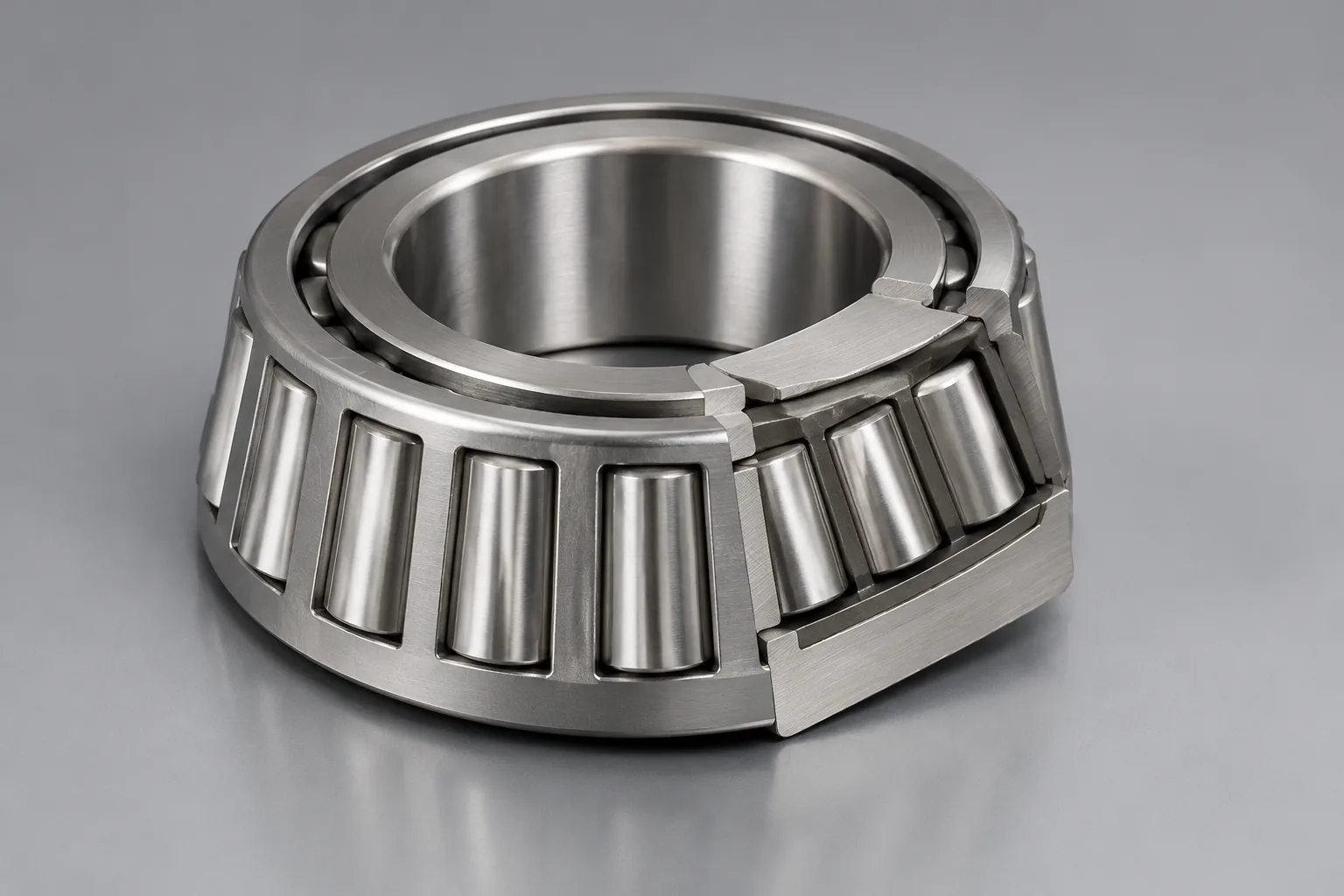
- Bore diameter d: the shaft or inner-ring bore.
- Outside diameter D: the outer-ring outside diameter and the main housing fit dimension.
- Overall bearing width T: the total width of the assembled bearing.
- Inner ring or cone width B: the width of the inner-ring assembly.
- Outer ring or cup width C: the width of the outer ring.
- Minimum chamfer dimension r, r1: the edge break limits used in mounting checks.
- Shaft shoulder da, db: recommended or limiting shaft shoulder diameters.
- Housing shoulder Da, Db: recommended or limiting housing shoulder diameters.
- Mass m: the bearing mass.
- Basic dynamic load rating C: the dynamic rating in the rating column.
- Basic static load rating C0: the static rating in the rating column.
Load ratings, speed limits, and mass are manufacturer-specific and may be listed separately from ISO boundary dimensions. In dimensional columns, C means cup width; in rating columns, C can mean basic dynamic load rating. Read the column heading and legend before comparing values. Inch catalogs may use different letters, so label the symbol system used on the page.
How to Read d, D, T, B and C
d is bore diameter, D is outside diameter, and T is the total assembled bearing width. B is the inner-ring or cone width, while C is the outer-ring or cup width. T is not equal to B or C, and the three values must not be mixed.
For 30205, d = 25 mm, D = 52 mm, T = 16.250 mm, B = 15.000 mm, and C = 13 mm. The total width is 16.250 mm; the cone is 15.000 mm; the cup is 13 mm. T, B, and C values vary by series and manufacturer, so chart values must match the specific part number.
Metric and Inch Charts Use Different Conventions
Inch tapered roller bearings are often listed as separate cone and cup part numbers. The designation is a pair, not a single number, and metric bore-code rules do not apply directly to inch designations. Unit conversion alone is not enough for identification or interchange.
Inch chart examples (values in inches):
| Cone + cup | d | D | T | B | C |
|---|---|---|---|---|---|
| LM11749 + LM11710 | 0.6875 in | 1.5700 in | 0.5450 in | 0.5750 in | 0.4200 in |
| LM11949 + LM11910 | 0.7500 in | 1.7810 in | 0.6100 in | 0.6550 in | 0.4750 in |
Some catalogs use different letter symbols for inch dimensions; always read the table legend. The table labels the inch values separately because a converted millimeter value does not replace the original inch designation or the cone and cup pairing.
ISO Standards Behind Taper Roller Bearing Sizes
Several ISO standards sit behind the numbers in a size chart:
- ISO 355:2019, Edition 3 defines boundary dimensions and series designations for tapered roller bearings. It was reviewed and confirmed in 2025.
- ISO 10317:2008, Edition 2 defines the designation system for metric tapered roller bearings. It was reviewed and confirmed in 2023.
- ISO 492:2023, Edition 6 covers geometrical product specifications and tolerance values for radial bearings.
- ISO 582 covers chamfer dimension limits.
ISO 355 boundary dimensions do not include load ratings, speed limits, or mass. Those values belong to the manufacturer’s product data for the exact part number.
Bearing Designation and Bore Code Rules
Basic metric designations often use a bore code in the last two digits. The common rule is:
- 00 = 10 mm
- 01 = 12 mm
- 02 = 15 mm
- 03 = 17 mm
From 04 onward, the last two digits multiplied by 5 mm give the nominal bore, for example 05 × 5 = 25 mm. A non-5 mm bore is often written with a slash, for example 320/28 X = 28 mm bore.
Apply this rule only to basic designation interpretation. Prefixes and auxiliary suffixes may be manufacturer-specific, and the manufacturer product table is the authority for the final d value.
Metric Taper Roller Bearing Size Chart: Representative Entries
The following sample uses millimeters and representative 25 mm bore entries. It shows how different dimension series produce different outside diameters and widths. The table is a sample for comparison, not a complete catalog or stock list.
| Bearing designation | ISO 355 series | d | D | T | B | C |
|---|---|---|---|---|---|---|
| 32005X | 4CC | 25 | 47 | 15.00 | 15.00 | 11.50 |
| 30205 | 3CC | 25 | 52 | 16.25 | 15.00 | 13.00 |
| 32205 | 2CD | 25 | 52 | 19.25 | 18.00 | 16.00 |
| 33205 | 2DE | 25 | 52 | 22.00 | 22.00 | 18.00 |
| 30305 | 2FB | 25 | 62 | 18.25 | 17.00 | 15.00 |
| 32305 | 2FD | 25 | 62 | 25.25 | 24.00 | 20.00 |
The values are in millimeters. The ISO 355 series column shows that the same bore can sit in different dimensional families, which is why the full d × D × T combination matters.
Same Bore Diameter, Different Bearing Sizes
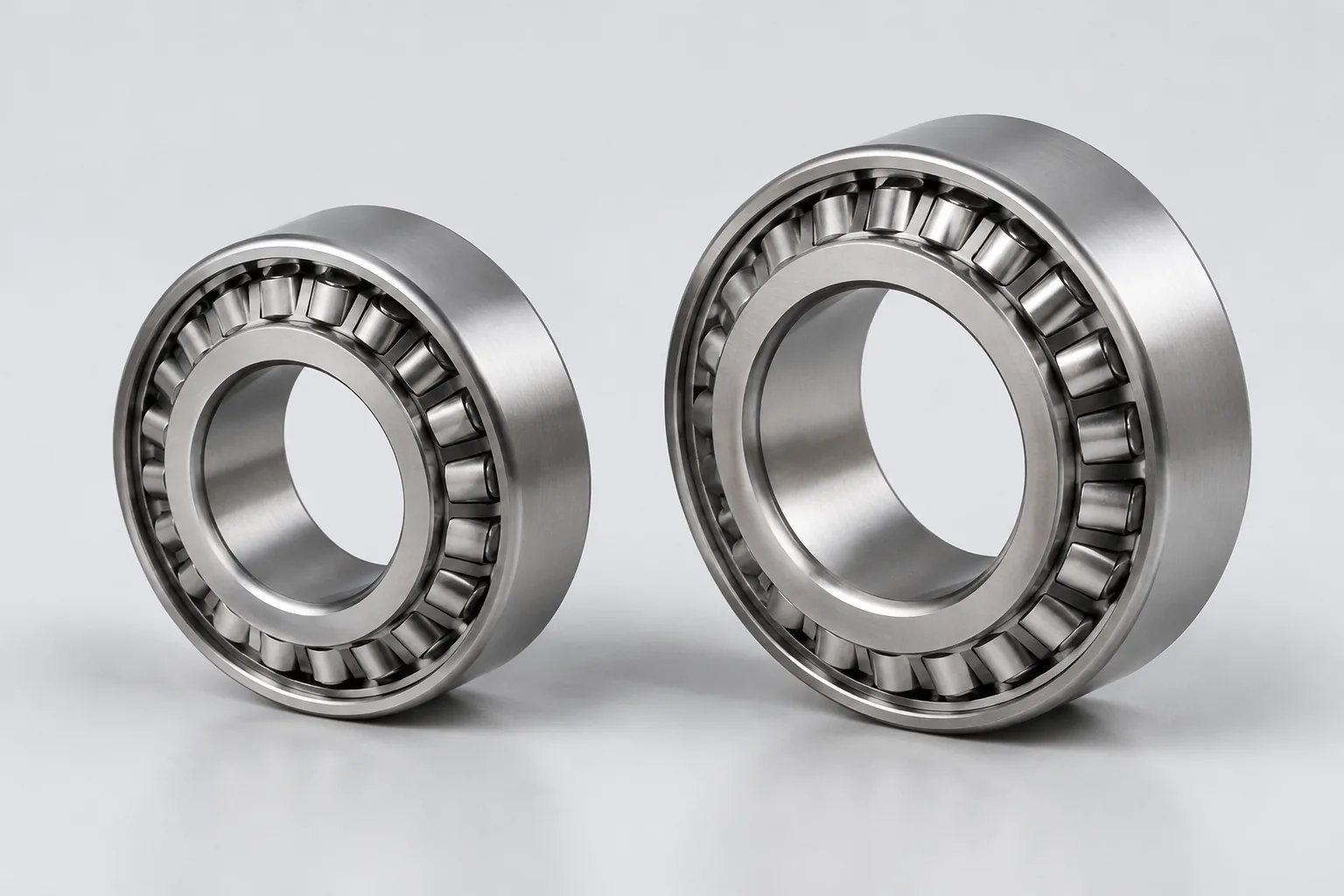
Bearings with the same 25 mm bore can have different outside diameters and widths:
- 32005X: 25 × 47 × 15 mm
- 30205: 25 × 52 × 16.25 mm
- 32205: 25 × 52 × 19.25 mm
- 33205: 25 × 52 × 22 mm
- 30305: 25 × 62 × 18.25 mm
- 32305: 25 × 62 × 25.25 mm
Matching only the bore diameter is unsafe for replacement or procurement. Check d × D × T and, where relevant, B, C, shaft and housing shoulders, chamfer limits, and the suffix. Even identical d × D × T entries may differ in internal design, tolerances, cone and cup combination, or suffix.
Worked Example: Complete 30205 Chart Entry
The 30205 entry below goes beyond d, D, T, B, and C and shows the kind of data a manufacturer may publish for one designation:
- Bearing designation: 30205
- Cone part number: X30205M
- Cup part number: Y30205M
- d: 25 mm / 0.9843 in
- D: 52 mm / 2.0472 in
- T: 16.250 mm / 0.6398 in
- B: 15.000 mm / 0.5906 in
- C: 13 mm / 0.5118 in
- Mass: 0.2 kg
- Basic dynamic radial load rating C1: 36,900 N / 8,300 lbf
- Basic static radial load rating C0: 38,300 N / 8,620 lbf
- Maximum shaft fillet radius: 1.020 mm
- Maximum housing fillet radius: 1.02 mm
These values are a metric product-data example for 30205. Load ratings and mass are manufacturer-specific and must not be generalized to every 30205 supplier.
Load Ratings, Speed, and Mass Are Separate from Boundary Dimensions
ISO 355 boundary dimensions do not include load ratings, speed limits, or mass. For C, C0, speed, and mass, use the manufacturer datasheet for the exact part number. The 30205 example lists C1 = 36,900 N and C0 = 38,300 N with a mass of 0.2 kg; those figures apply to that published part, not to every bearing with the same envelope.
A bearing can match d, D, T, B, and C and still differ in internal geometry, tolerance class, cage, lubrication, suffix, or load rating. That makes it dimensionally equivalent but not automatically functionally equivalent. A chart may include load ratings for convenience, but they remain manufacturer data rather than ISO boundary dimensions.
Tolerances, Chamfers, and Shoulder Dimensions
After basic size matching, tolerance class, chamfer limits, and shoulder dimensions decide whether the bearing fits the shaft and housing correctly. ISO 492:2023 covers radial bearing geometrical product specifications and tolerance values. ISO 582 covers chamfer dimension limits.
In a size table, da and db are shaft shoulder diameters, while Da and Db are housing shoulder diameters. For the 30205 example, the maximum shaft fillet radius is 1.020 mm and the maximum housing fillet radius is 1.02 mm. Use exact manufacturer values for shoulder and fillet checks; tolerance and shoulder limits may differ by manufacturer, suffix, or application-specific variant.
How to Use the Chart to Shortlist a Bearing
Use a step-by-step shortlisting process rather than a single-column lookup:
- Start with the required bore d and the available housing space for D and T.
- Filter by dimension series, then verify B, C, chamfer, and shoulder limits.
- Check load ratings, speed, suffix, and cone or cup combination before requesting a quote.
- Confirm availability and the exact manufacturer data before ordering.
Do not substitute a bearing on bore size alone or on a similar designation alone.
Common Size Chart Mistakes
- Mistaking T for B or C. T is the total assembled width, not a component width.
- Matching only by bore diameter or the last two designation digits. The same bore can have several outside diameters and widths.
- Mixing metric and inch dimensions without checking the table legend. The symbols and units may differ.
- Treating suffixes as meaningless or assuming they are universal. Suffix meaning can be manufacturer-specific.
- Assuming identical d × D × T means complete interchangeability. Check the full manufacturer specification.
Some same-size bearings may be interchangeable only after verifying the full manufacturer specification. Dimensions are the start of the check, not the end.
Conclusion
A taper roller bearing size chart is a shortlisting tool, not a complete interchange authority. Start with d × D × T, keep B and C separate, and then check the ISO series, bore code, tolerances, chamfers, shoulder limits, load ratings, mass, and suffix against the exact manufacturer data. The same bore diameter can lead to several different outside diameters and widths, so confirm the full part number and application before ordering.
FAQs
Q1: What do d, D, T, B, and C mean in a taper roller bearing size chart?
A: d is bore diameter, D is outside diameter, T is the total assembled bearing width, B is the inner-ring or cone width, and C is the outer-ring or cup width. Read the table legend as well, because some charts use C for a load rating in a separate column.
Q2: How do I read a taper roller bearing size chart?
A: Read the bore d first, then the outside diameter D and overall width T. Use B and C to check the cone and cup widths, then verify chamfer, shoulder, tolerance, suffix, and load data for the exact part number before ordering.
Q3: Can I replace a bearing using only its bore diameter?
A: No. A 25 mm bore can fit several different outside diameters and widths, and even the same d × D × T does not prove complete interchangeability. Check the full designation, cone and cup combination, B and C, shoulders, tolerances, suffix, and manufacturer data.
Q4: What is the difference between metric and inch taper roller bearing size charts?
A: Metric charts often use basic designations with bore codes and d, D, T, B, and C symbols. Inch charts often list separate cone and cup part numbers and may use a different letter set. Unit conversion alone does not identify an interchangeable bearing.
Q5: How is a 30205 bearing listed in a size chart?
A: A published 30205 entry shows d = 25 mm, D = 52 mm, T = 16.250 mm, B = 15.000 mm, and C = 13 mm. A complete entry may also list cone X30205M, cup Y30205M, mass 0.2 kg, C1 = 36,900 N, and C0 = 38,300 N.
Q6: Are load ratings included in ISO boundary dimensions?
A: No. ISO 355 boundary dimensions cover size and series, not load ratings, speed limits, or mass. Use the manufacturer datasheet for C, C0, speed, and mass for the exact part number.
Q7: What does a suffix such as X mean in a bearing designation?
A: A suffix such as X is part of the designation and may indicate a manufacturer-specific variant, internal design, or other modification. The same letter is not guaranteed to mean the same thing across ranges, so read the manufacturer designation key and confirm the exact part number.