Quick Answer
A bearing number is a standardized code that tells you the bearing’s type, dimensions, and features. The code has three parts: a Prefix (materials or special treatment), a Basic Designation (type, series, and bore size), and a Suffix (seals, clearance, and precision). In 6308, the 6 identifies a single-row deep groove ball bearing, the 3 indicates the medium series, and 08 translates to a 40 mm bore. Decode each section in order, and you can identify almost any bearing on the market.
Have you ever picked up a bearing and felt confused by the string of numbers and letters stamped on its side? You’re not alone. A code like 6308 or TS3-6308-2RS-C3 may appear random at first, but every character serves a purpose. Each digit and letter reveals something specific—whether it’s the bearing’s internal design, its size, how it’s sealed, or the level of precision to which it was manufactured.
Learning to read these codes pays off in practical ways. You’ll save time when ordering replacements, reduce the chance of ordering the wrong part, and gain confidence when specifying bearings for new projects. This guide explains the standardized system—what industry professionals call bearing nomenclature—that underpins almost every bearing code you will encounter. The system is used by SKF, NTN, NSK, FAG, Timken, and many others. While individual brands add their own prefixes and suffixes, the underlying structure remains consistent.
The Basic Structure of a Bearing Number
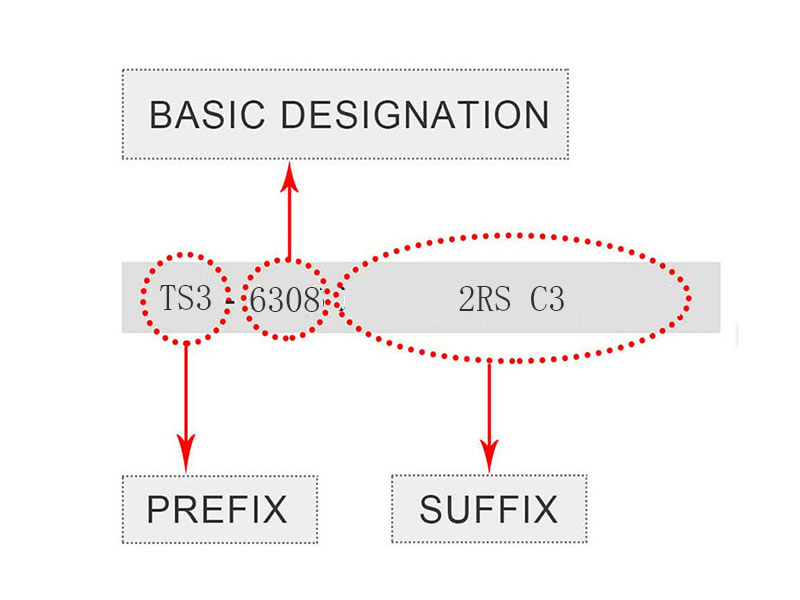
Almost every bearing number follows the same three-part formula:
Prefix + Basic Designation + Suffix
Let us see how this works with a real-world example:
TS3-6308-2RS-C3
| Part | Code | What It Tells You |
|---|---|---|
| Prefix | TS3 | Heat-stabilized steel, rated for up to approx. 390°F (200°C) |
| Basic Designation | 6308 | Bearing type, series, and bore diameter |
| Suffix | -2RS-C3 | Two rubber seals + greater than normal internal clearance |
Not every bearing carries all three parts. Some bear only the basic designation—6308 is a complete code on its own. Others omit the prefix but include suffixes, like 6308-2RS-C3. The basic designation usually runs three to five digits long and forms the backbone of the code: it tells you what the bearing is, what family it belongs to, and what size shaft it fits.
Once you have identified these three building blocks, you are ready to decode them one by one. Let us begin with the prefix.
Prefixes
Prefixes sit at the front of the bearing number. They usually signal something about the material, a special heat treatment, or a non-standard design feature.
Heat Stabilization – The NTN System
Bearings operate in a wide range of temperatures. Standard steel bearings are formulated for typical ambient conditions, but when temperatures rise, the steel can lose hardness or change dimensionally. NTN marks bearings with specific prefixes to show their heat tolerance:
| Prefix | Maximum Operating Temperature |
|---|---|
| (none) | 250°F (120°C) – standard steel |
| TS2 | 320°F (160°C) |
| TS3 | 390°F (200°C) |
| TS4 | Approx. 480°F (250°C) |
If you are working in a high-heat environment—such as near an oven, a kiln, or an engine block—choosing a bearing with the right TS prefix can mean the difference between months of reliable service and premature failure.
Material Codes
| Code | Material |
|---|---|
| (none) | High-carbon chromium steel (equivalent to AISI E52100) |
| F | Martensitic stainless steel (equivalent to AISI 440C) |
| N | Beryllium copper |
| 5S | Ceramic rolling elements |
| 7MC3 | MEGAOHM(R) ceramic-coated outer ring |
The 7MC3 prefix deserves special attention. Motors powered by variable frequency drives (VFDs) can induce stray electrical currents through the bearing. When these currents arc between the rolling elements and the raceways, they create localized heating that damages the steel surface. The ceramic coating on 7MC3 bearings blocks those currents, protecting the bearing from premature failure.
SKF Prefixes
SKF uses its own set of prefixes. Here are some of the most common:
| Prefix | Meaning |
|---|---|
| D/W | Stainless steel, inch-based dimensions |
| ICOS- | Oil-sealed bearing unit |
| W | Stainless steel, metric dimensions |
| WBB1 | Stainless steel, metric, non-ISO dimensions |
In specific product lines, SKF may use additional prefix codes. For the most up-to-date and complete information, always refer to the official SKF designation guide.
With the prefix decoded, you can now turn your attention to the heart of the bearing number: the basic designation.
Basic Designation – Breaking Down the Digits
The basic designation is the most informative part of the code. It usually contains three to five digits, and each one adds a layer of detail.
First Digit – What Kind of Bearing Is It?
The opening digit—or in some cases, a letter—tells you the fundamental bearing type. (Note: some codes may vary slightly between manufacturers; the table below follows the ISO/SKF standard.)
| Code | Bearing Type |
|---|---|
| 1 | Self-aligning ball bearing |
| 2 | Spherical roller bearing |
| 3 | Tapered roller bearing (in SKF/ISO system) |
| 4 | Double-row ball bearing |
| 5 | Thrust ball bearing |
| 6 | Single-row deep groove ball bearing |
| 7 | Single-row angular contact ball bearing |
| N | Cylindrical roller bearing |
| R | Inch-based bearing (imperial dimensions) |
| T | Tapered roller bearing (ISO 355) |
For bearings beginning with R, the digit that follows indicates the bore in sixteenths of an inch. An R8 bearing, for instance, has a bore of 8/16 = 0.5 inches.
The single-row deep groove ball bearing—code 6—is by far the most common type. You will find it in electric motors, conveyor systems, automotive wheel hubs, and general industrial equipment.
Second Digit – How Robust Is the Bearing?
The second digit tells you the bearing series, which reflects its overall ruggedness and load-carrying capacity.
| Code | Series Description |
|---|---|
| 0 | Extra light |
| 1 | Extra light thrust |
| 2 | Light series |
| 3 | Medium series |
| 4 | Heavy series |
| 8 | Very thin section |
| 9 | Extremely thin section |
In SKF’s system, the first two digits together define the ISO dimension series: the first identifies the width or height series, and the second pinpoints the diameter series.
Look at 6308 again:
- 6 = single-row deep groove ball bearing
- 3 = medium series
A medium-series bearing like the 6308 has heavier rolling elements and thicker raceways than a light-series bearing of the same bore size. If you are replacing a bearing in a conveyor roller or a pump, knowing whether you need a 62xx (light) or 63xx (medium) series is essential—they are not interchangeable even if the bore size is the same.
Third and Fourth Digits – What Shaft Size Does It Fit?
The last two digits of the basic designation give you the bore diameter—the hole that slides onto the shaft.
Standard bore code table:
| Code | Bore Diameter |
|---|---|
| 00 | 10 mm |
| 01 | 12 mm |
| 02 | 15 mm |
| 03 | 17 mm |
| 04 | 20 mm (4 x 5) |
| 05 | 25 mm (5 x 5) |
| 06 | 30 mm (6 x 5) |
| 07 | 35 mm (7 x 5) |
| 08 | 40 mm (8 x 5) |
| 09 | 45 mm (9 x 5) |
| 10 | 50 mm (10 x 5) |
The rule is simple: for codes 04 and above, multiply the code by 5 to get the bore in millimeters.
In 6308:
- 08 becomes 8 x 5 = 40 mm bore
This means a 6308 bearing fits a 40 mm diameter shaft. If your shaft measures 40 mm and you order a 6308, it will slide right on. If you accidentally order a 6208 (also 40 mm bore but light series), it will fit the shaft but may not handle the load.
Watch for these exceptions:
- Three-digit numbers: 608 means an 8 mm bore—the last digit stands alone.
- Bores under 10 mm or 500 mm and over: the bore is written directly after a slash, as in 618/8 (8 mm bore).
- 22 mm, 28 mm, or 32 mm bores: these also use a slash, e.g., 62/22 (22 mm bore).
- Some small bores: the millimeter value appears without a slash, as in 629 (9 mm bore).
Step-by-Step Decoding Example
Let us walk through a complete bearing number from start to finish:
Example: TS3-6308-2RS-C3
| Step | What You Do | Result |
|---|---|---|
| 1 | Split into three parts | TS3 + 6308 + 2RS-C3 |
| 2 | Decode the prefix | TS3 = heat-stabilized for up to approx. 390°F (200°C) |
| 3 | Decode the basic designation | 6 = deep groove ball bearing, 3 = medium series, 08 = 40 mm bore |
| 4 | Decode the suffix | 2RS = rubber seals on both sides, C3 = greater than normal clearance |
Full translation: A medium-series, single-row deep groove ball bearing with a 40 mm bore, heat-stabilized for 390°F operation, equipped with rubber seals on both sides, and with extra internal clearance for high-speed or high-temperature applications.
This step-by-step approach works for any standard bearing number you encounter.
Suffixes
Suffixes trail the basic designation. They capture all the deviations from the standard design—seals, shields, internal clearance, precision grade, cage type, and more.
Seals and Shields – Keeping Contaminants Out
Seals and shields do two jobs: they keep dirt and moisture away from the bearing’s internal surfaces, and they help retain lubricant.
| Suffix | Meaning |
|---|---|
| RS | Rubber seal on one side; the other side is open |
| 2RS | Rubber seals on both sides |
| Z | Metal shield on one side; the other side is open |
| 2Z / ZZ | Metal shields on both sides |
| V | Non-contact seal on one side |
| VV | Non-contact seals on both sides |
| DDU | Contact seals on both sides (splash-resistant) |
| LU | Contact seal on one side |
| LLU | Contact seals on both sides (splash-resistant) |
| LB | Non-contact seal on one side |
| LLB | Non-contact / low-friction seals on both sides |
| N | Groove for a snap ring on the outer ring |
| NR | Snap ring groove plus the snap ring itself |
When should you choose a rubber seal over a metal shield? If your bearing operates in a dusty, wet, or washdown environment—think food processing equipment or agricultural machinery—a rubber-sealed bearing (2RS or LLU) offers superior protection. Metal-shielded bearings (ZZ) are better suited to clean, dry conditions where low friction and high speed are the priorities, such as in electric motors running indoors.
What about 2RS versus LLU? Both indicate rubber seals on both sides. The difference is purely manufacturer-specific: 2RS is common across most brands, while LLU appears more frequently in NTN’s catalog. Functionally, they are the same.
NTN-Specific Seal Codes
| Code | Meaning |
|---|---|
| ZA, ZZA | Removable steel shield |
| ZA1, ZZA1 | Removable stainless steel shield |
| Z1, ZZ1 | Stainless steel shield |
| LB, LLB | Non-contact rubber seal |
| LU, LLU | Contact rubber seal |
| SA, SSA | Non-contact nylon seal |
SKF-Specific Seal Codes
| Code | Meaning |
|---|---|
| -RS1, -2RS1 | Contact seal (NBR rubber) |
| -RS2, -2RS2 | Contact seal (FKM rubber) |
| -RSH, -2RSH | Contact seal (NBR rubber) |
| -RSH2, -2RSH2 | Contact seal (FKM rubber) |
| -RSL, -2RSL | Low-friction seal (NBR rubber) |
| -RST, -2RST | Low-friction seal (NBR rubber) |
| -RZ, -2RZ | Non-contact seal (NBR rubber) |
| -ZNBR | One shield plus a snap ring groove |
| -ZNR | One shield plus a snap ring groove (ring on the opposite side) |
| -ZZNR | Two shields plus a snap ring groove |
Internal Clearance – The C Codes
Internal clearance refers to the amount of free play inside the bearing. Different applications call for different amounts of play.
| Code | Clearance Level |
|---|---|
| CN (or C0) | Normal radial clearance (standard; often not marked) |
| C2 | Less than normal clearance |
| C3 | Greater than normal clearance |
| C4 | Greater than C3 clearance |
| C5 | Greater than C4 clearance |
C3 and C4 are sometimes referred to as “high-speed” clearances. They leave extra room for thermal expansion when the bearing runs fast or hot. But keep in mind: extra clearance can reduce the bearing’s rigidity at low speeds, so it is not always the best choice. For a precision spindle that runs at a constant speed, C3 might be ideal. For a heavily loaded, slow-speed conveyor, normal clearance (CN) is often the better option.
Precision Classes
Precision class tells you how tightly the bearing was manufactured. The tighter the tolerances, the more accurate the bearing—and the higher the cost.
| ISO Class | ABEC Equivalent | Common Use Case |
|---|---|---|
| P0 (Normal; often unmarked) | ABEC 1 | General industrial machinery |
| P6 | ABEC 3 | Machine tools, electric motors |
| P5 | ABEC 5 | High-speed spindles |
| P4 | ABEC 7 | Ultra-precision grinding spindles |
| P2 | ABEC 9 | Gyroscopes and other extreme-precision instruments |
Tolerances become stricter as the ISO class number drops (P2 is the finest) or as the ABEC number rises (ABEC 9 is the finest). Bearings with P6 or higher precision cost more—often substantially more—because they require tighter manufacturing control. For most general-purpose applications, P0 is perfectly adequate. If you are rebuilding a machine tool spindle, however, you will likely need P5 or better.
Other Suffix Types
- Cage material: steel, polyamide/nylon (TN9), brass (GRB, M), or phenolic.
- Tapered bore: K indicates a 1:12 tapered bore.
- Matched sets: DB (back-to-back), DF (face-to-face), DT (tandem).
- Lubrication: some suffixes specify the exact grease or oil used.
Now that we have covered each component in detail, let us look at how to put this knowledge to work in real-world situations.
Practical Decoding Tips
Rely on Manufacturer Documentation
Every major manufacturer publishes detailed bearing designation guides. The SKF and NTN websites, in particular, offer comprehensive reference documents that explain their specific prefix and suffix codes. Bookmark these resources—they are the most reliable sources of information.
Always Start with the Three-Part Structure
Resist the temptation to jump straight to the digits. Separate the code into prefix, basic designation, and suffix first. That simple habit prevents confusion and helps you focus on one piece at a time.
Verify Your Reading
A single misplaced character can lead you to the wrong bearing. Compare 6308 with 6208, for example. Both have a 40 mm bore and both are deep groove ball bearings, but one is medium series and the other is light series. They have different load ratings and different dimensions—and they are not interchangeable. Or consider 6308 versus 6408: the 6408 is a heavy-series bearing with a much higher load capacity but a larger outside diameter and greater width.
Measure If the Number Is Missing or Worn
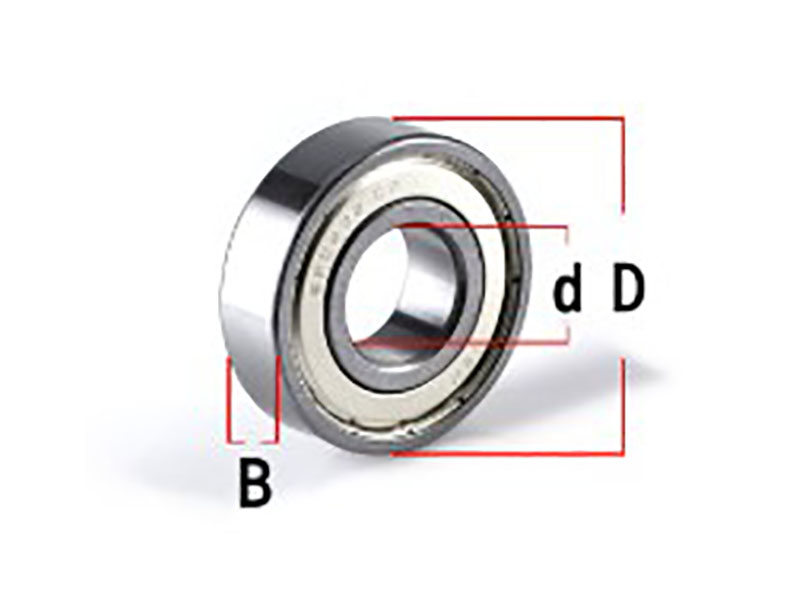
When the stamped number is illegible, you can still identify the bearing by its physical dimensions. Measure the Inner Diameter (ID), the Outer Diameter (OD), and the Width (W)—in that order. A digital caliper is accurate enough for most situations. For extremely tight tolerances, a micrometer gives you more precision. Once you have the three measurements, cross-reference them with manufacturer dimension tables to find the matching bearing number.
Real-world scenario: A maintenance technician finds a worn bearing on a failed conveyor motor. The stamp is scratched and unreadable. He measures: ID = 40 mm, OD = 90 mm, Width = 23 mm. He looks up these dimensions and finds they match a 6308 bearing. He orders a 6308-2RS-C3 (sealed, extra clearance) and gets the conveyor running again the next day.
Use Cross-Reference Tools
Several online tools let you enter a competitor’s bearing number and receive a list of equivalent bearings from other brands. SKF, NTN, and many independent distributors offer these tools for free. They are especially useful when you are trying to source a replacement from a different manufacturer.
Talk to a Specialist
If you have decoded the number, measured the dimensions, and still feel uncertain, reach out to a bearing specialist or the manufacturer’s technical support team. They can confirm your identification and recommend the right replacement for your specific application.
Watch Out for Counterfeit Bearings
One practical reason to master bearing number reading is counterfeit detection. Genuine bearings have clearly stamped numbers with consistent font, depth, and alignment. Fakes often have blurry or uneven stamping, incorrect suffix codes, or mismatched prefixes. If the number looks wrong—or if a bearing that should have a C3 suffix (extra clearance) arrives without it—you may be dealing with a counterfeit. Being able to read and verify the code is your first line of defense.
Conclusion
Decoding a bearing number is not difficult once you understand the three-part framework. The prefix signals materials and special treatments—heat stabilization, ceramic coatings, or stainless steel. The basic designation—the core of the number—tells you the bearing type (first digit), the series (second digit), and the bore size (last two digits). The suffix fills in the rest: seals, shields, internal clearance, precision, cage design, and more.
Keep these principles in mind:
- Start with the basic designation. It tells you the bearing’s identity.
- Calculate the bore size correctly. For codes 04 and above, multiply by 5. For 00 through 03, use the special table.
- Examine the suffixes carefully. They reveal critical details like 2RS (rubber seals), ZZ (metal shields), C3 (extra clearance), and P5 (higher precision).
- Measure when the code is unreadable. ID x OD x Width gives you the physical dimensions you need.
- Use manufacturer guides and cross-reference tools. Each brand has its own prefix and suffix system, but the ISO-based basic designation is universal.
- Check for counterfeits. Verify the stamping quality and confirm that all parts of the code make sense for the application.
Whether you are replacing a wheel bearing on a vehicle, maintaining industrial equipment, or specifying bearings for a new motor, reading the bearing number gives you confidence that you are ordering the correct part. The same logic applies whether the bearing comes from a global brand or a regional manufacturer. Learn the system once, and you will never be confused by a bearing code again.
FAQs
Q1: What information does a bearing number provide?
It tells you the bearing’s type, its principal dimensions, and any special features such as seals, internal clearance, or precision grade.
Q2: What is the correct way to read a bearing number?
Break it into three segments: Prefix (material/treatment) + Basic Designation (type, series, bore) + Suffix (seals, clearance, precision). Then decode each segment.
Q3: What does the opening digit of a bearing number indicate?
It indicates the bearing type. For example, 6 points to a single-row deep groove ball bearing, 7 to a single-row angular contact ball bearing, and N to a cylindrical roller bearing.
Q4: How can I determine the bore diameter from the number?
For codes 04 and above, multiply the last two digits by 5. For codes 00 to 03, use the fixed values: 00 = 10 mm, 01 = 12 mm, 02 = 15 mm, 03 = 17 mm.
Q5: What does a C3 suffix signify?
It means the bearing has greater than normal radial internal clearance, which accommodates thermal expansion at higher speeds or temperatures.
Q6: How do ZZ and 2RS suffixes differ?
ZZ indicates metal shields on both sides—these keep dust out but do not seal against moisture. 2RS indicates rubber seals on both sides—these offer better protection against both dust and moisture.
Q7: What does the TS3 prefix mean on an NTN bearing?
It means the bearing is heat-stabilized for continuous operation at temperatures up to approx. 390°F (200°C).
Q8: Can I replace a bearing with one from another brand if the number matches?
Generally yes—the basic designation (like 6308) is standardized. But always check the prefixes and suffixes, because they may differ in seals, clearance, or precision. Use a cross-reference tool to be certain.
Q9: How do I identify a bearing when the stamped number has worn away?
Measure its three key dimensions: Inner Diameter (ID), Outer Diameter (OD), and Width (W). Then compare those measurements against manufacturer dimension charts.
Q10: What do precision classes like P0, P6, and P5 represent?
They represent manufacturing tolerance levels. P0 is standard, suitable for general machinery. P6 and P5 are progressively tighter, used in higher-speed or more precise applications. P4 and P2 are reserved for ultra-precision work.