Quick Answer: A pillow block bearing size chart maps a unit’s shaft diameter and model code to its housing and mounting dimensions, including base-to-center height, overall housing size, and bolt-hole spacing. Use it to narrow a replacement by shaft size and code, then confirm insert bore, bolt layout, and unit system. The chart is a dimensional reference, not a load rating or a guarantee of interchangeability.
A pillow block bearing size chart helps you compare the physical envelope of a bearing unit before you order. It is most useful when you read the chart in a fixed order: shaft size first, code second, then housing and mounting dimensions. The chart does not replace a load rating, application review, or fitment confirmation.
What This Size Chart Covers
A pillow block bearing size chart covers pillow block bearing units and the housings and inserts that make up those units. The rows typically connect a nominal shaft diameter and a model or insert code to housing dimensions and bolt-hole dimensions. Some charts describe complete assembled units; others list housings only or inserts only. Check which scope applies before you compare a row with a replacement part.
Custom, obsolete, or non-standard sizes may not appear in a standard chart. Use the chart version that matches the exact product series and unit system, and request separate dimensional confirmation when a housing is discontinued or made to order.
How to Read the Pillow Block Bearing Size Chart
Read the chart in a sequence that prevents a wrong match. Start with the shaft diameter, then use the model or insert code to confirm the row. Read housing dimensions and bolt-hole dimensions separately from insert dimensions, because a chart may place them in different columns or on a separate page.
- Start with shaft diameter to narrow the possible unit size.
- Use the model or insert code to confirm the correct row.
- Read housing dimensions and bolt-hole dimensions separately from insert dimensions.
- Check units and tolerances before comparing values.
- Do not assume dimensional interchangeability across different series.
The chart must correspond to the exact series and unit system being used. If a chart lists insert dimensions separately from housing dimensions, match both before you treat the row as a fit.
Common Columns and What They Mean
Column names vary by chart version, but most pillow block bearing size charts use the same groups of dimensions. The table below shows what each group tells you and why it matters.
| Column group | What it tells you | Why it matters |
|---|---|---|
| Shaft diameter | Nominal shaft size used to identify the unit. | Narrows the size range before you check the code. |
| Model or insert code | Reference code used to match the chart row to the product. | Confirms that the row applies to the unit you have. |
| Housing length, width, and height | Overall envelope dimensions. | Shows clearance and the space the housing needs. |
| Bolt-hole center distance and bolt-hole size | Mounting layout dimensions. | Determines whether the base matches the mounting surface. |
| Base-to-center height | Height from the mounting base to the shaft center. | Critical for mounting height and alignment. |
Column naming may vary by chart version, so check the product datasheet for the exact labels and symbols. Not every chart includes every dimensional column; a missing column is a reason to request the full datasheet, not a reason to infer the value.
Metric and Inch Size Charts
Pillow block bearing size charts may be metric, inch, or dual-unit. Mixing units when you compare shaft size and mounting dimensions can produce an apparent mismatch, even when the unit is correct. Conversion and rounding can also create small differences between a converted value and the value printed in the original chart.
Use the unit system stated in the chart and product documentation. Before ordering, confirm shaft tolerance and bolt thread standard in the same unit system as the mounting structure. If a dual-unit chart rounds converted values, verify critical dimensions with the supplier rather than selecting from the converted number alone.
Common Pillow Block Series and Model Codes
Model codes often indicate housing style, mounting type, and insert features. Use the code to locate the correct chart row, then use the dimensions to confirm the fit. The same shaft size can have different housing and bolt-hole dimensions in different series, so shaft diameter alone is not enough.
Do not interpret suffix meanings without the manufacturer code definition. Special suffixes or custom codes may not follow standard naming, and a code that looks familiar can belong to a different housing style.
Key Dimensions for Fit and Installation
Several dimensions decide whether a pillow block unit will fit the shaft and the mounting surface. Check them together, not one at a time.
- Shaft diameter and insert bore must match the shaft.
- Base-to-center height affects mounting height and alignment.
- Bolt-hole center distance and bolt-hole size determine mounting compatibility.
- Overall housing dimensions affect clearance and the surrounding structure.
Confirm dimensions against the mounting surface before installation. Verify the actual structure before drilling or modification. A worn or damaged housing may not match catalog dimensions, so measure the part you have rather than assuming the original size.
How to Measure a Pillow Block Bearing When the Chart Is Not Available
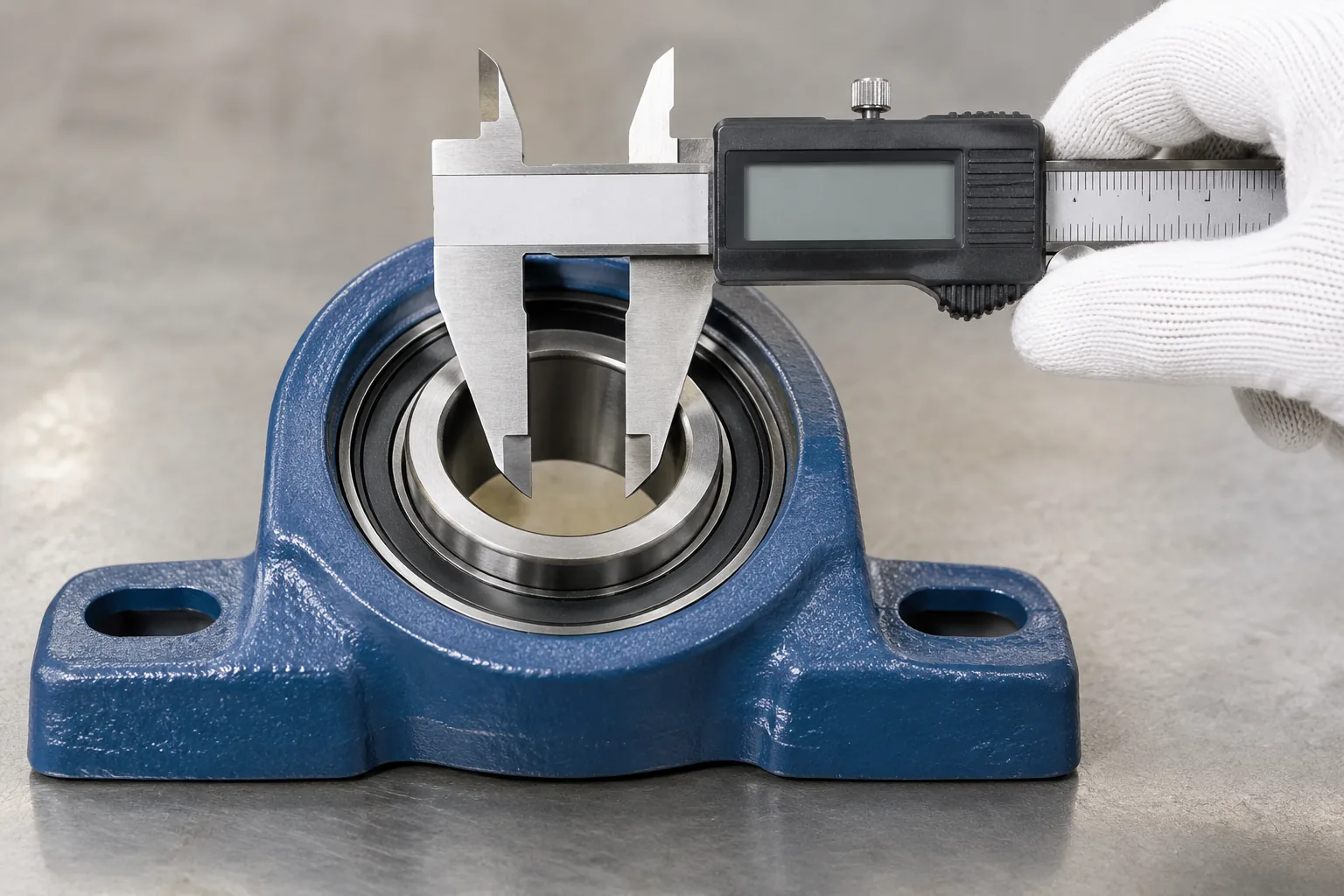
When the chart is not available, measure the unit directly and record the method with the values. Use a caliper or micrometer for the shaft diameter, and measure the mounting layout with the housing seated on a flat surface.
- Measure the shaft diameter with a caliper or micrometer.
- Measure bolt-hole center distance and base-to-center height.
- Measure housing overall length, width, and height.
- Record the insert or housing code if it is visible.
- Document the unit system and measurement conditions.
Clean the part and measure without load or distortion. Measurements from worn parts may not represent original catalog dimensions, so note any wear or damage before you use the values for a replacement.
Selection Checks Before Ordering
A pillow block bearing size chart is a dimensional matching tool. It does not confirm that a unit is suitable for the application. Before ordering, check the load direction, load capacity, speed, and environment against the product catalog. Also confirm housing material, sealing, lubrication, and mounting configuration.
Verify availability and replacement compatibility with the supplier. Final selection must combine dimensional data with application requirements. The size chart alone is not sufficient for safety-critical or high-load applications.
Limitations and Verification
The chart is a dimensional reference, not a guarantee of interchangeability. Tolerances and manufacturing variation may affect fit, so a row that matches on paper still needs verification on critical dimensions. Check that the chart is the current version and confirm critical dimensions with DUHUI or an authorized supplier before purchase.
Obsolete or custom products may require engineering confirmation. If a measured dimension does not match the chart, stop and verify the series, unit system, and part code before you order.
Conclusion
A pillow block bearing size chart is most reliable when you use it as a sequence: confirm shaft diameter, match the model or insert code, then check housing and bolt-hole dimensions in the correct unit system. Use the chart to narrow the options, not to prove interchangeability. Before ordering, verify critical dimensions against the current datasheet and combine the dimensional match with load, speed, sealing, lubrication, and mounting requirements.
FAQs
Q1: What does a pillow block bearing size chart show?
A: It shows the dimensional data used to match a pillow block unit to a shaft and mounting surface, typically shaft diameter, model or insert code, housing length, width, height, bolt-hole center distance, bolt-hole size, and base-to-center height. It is a dimensional reference, not a load rating.
Q2: How do I find the right pillow block size by shaft diameter?
A: Start with the nominal shaft diameter, then use the model or insert code to confirm the correct row. Check housing and bolt-hole dimensions separately, because more than one series can share a shaft size while having different mounting dimensions.
Q3: Are metric and inch pillow block bearing charts interchangeable?
A: Not directly. Use the unit system stated in the chart and confirm shaft tolerance and bolt thread standard before ordering. Conversion and rounding can create small apparent differences, so verify critical dimensions rather than relying on a converted value alone.
Q4: Can I use a size chart to determine load capacity?
A: No. A size chart gives dimensions, not load ratings. Check load direction, load capacity, speed, and environment against the product catalog, and confirm housing material, sealing, lubrication, and mounting configuration before selection.
Q5: What should I do if my measured dimensions do not match the chart?
A: Recheck the unit system, the model or insert code, and the measurement method. Clean the part and measure without load or distortion. If the difference remains, verify the current datasheet with the supplier before ordering.
Q6: How do I measure bolt-hole center distance on a pillow block housing?
A: Measure from the center of one bolt hole to the center of the opposite bolt hole along the mounting layout, using the same unit system as the chart. Record the bolt-hole size and base-to-center height at the same time, because those dimensions together determine mounting compatibility.