Quick Answer: Stud type and yoke type cam followers differ mainly in how they are mounted. A stud type cam follower has an integral threaded stud that threads into a housing, so one side supports the load and the unit fits a tight envelope. A yoke type track roller rides on a pin or shaft held in a yoke, so the pin is supported at both ends, giving a stiffer arrangement for heavier radial loads.
A cam follower stud type vs yoke type comparison usually starts with the roller, but the more useful starting point is the bracket. The way a follower attaches to the machine fixes the load path, the stiffness of the joint, the space needed around the roller, and how you relubricate and replace it. The sections below compare the two configurations on structure, mounting, load and rigidity, space, maintenance, cost and selection criteria, so the choice follows the application rather than habit.
Quick Comparison: Stud Type vs Yoke Type at a Glance
The table below summarizes the practical differences. Use it to screen the two configurations, then confirm the choice against the published load, speed and life ratings for the exact size you intend to use.
| Comparison point | Stud type cam follower | Yoke type track roller |
|---|---|---|
| Mounting | Integral threaded stud screwed into a tapped housing or bracket | Bore fitted over a pin or shaft held in a yoke or fork |
| Support | One side only; the stud is overhung | Both ends of the pin or shaft |
| Load path | Track load passes through the outer ring, rolling elements and stud thread into the housing | Track load passes through the outer ring and rolling elements into a pin with two supports |
| Rigidity | Lower for a given envelope because stud deflection adds to misalignment | Higher, because the pin is supported at both ends |
| Space | Compact; only one face needs access for the thread and nut | Needs fork, pin retention and assembly clearance on both sides |
| Relubrication | Usually fed through a hole in the stud end | Fed through the lubrication path provided in the roller or its mounting |
| Replacement | Unscrew the stud; no yoke machining is disturbed | Release axial retention, then slide the roller off the pin |
| Relative cost | One-piece unit with low installation work | Roller plus pin, yoke machining and alignment work |
The first filter is support. If a fork cannot be built around both sides of the roller, the stud type is the practical option. If both sides can be supported, the yoke type is the usual route to a stiffer joint.
What Is a Stud Type Cam Follower?
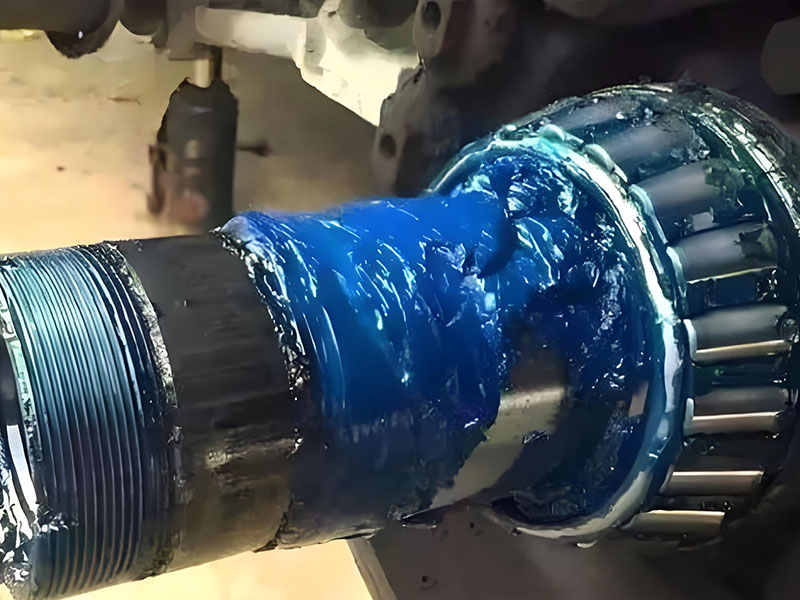
A stud type cam follower is a roller bearing in which a heavy-section threaded stud takes the place of the inner ring. The thick-walled outer ring runs on rolling elements around that stud, and many units are supplied sealed, pre-greased and ready to install. Because the stud is also the mounting feature, the roller is supported on one side only.
Stud Type Structure and Mounting
Four features decide how a stud type unit behaves in service:
- The stud and its thread carry the radial load into the housing and also resist the bending moment created by the overhung roller.
- The thick-walled outer ring runs directly on the track, and crowned profiles are used where slight angular misalignment must be tolerated.
- Rolling elements, cage and seals keep the roller turning with low friction while retaining grease and excluding dirt.
- The lubrication hole normally runs through the stud end so the bearing can be relubricated in place.
Mounting is direct: the stud is threaded into a tapped hole in the housing or bracket and secured with a nut. Thread engagement, housing material and tightening practice all affect the joint, so the stud is matched to the housing rather than chosen on roller diameter alone. Because the load is applied on one side, the stud carries a bending moment as well as a radial load.
Typical Stud Type Applications
Stud type cam followers are common where one face of the structure is accessible and the envelope is tight:
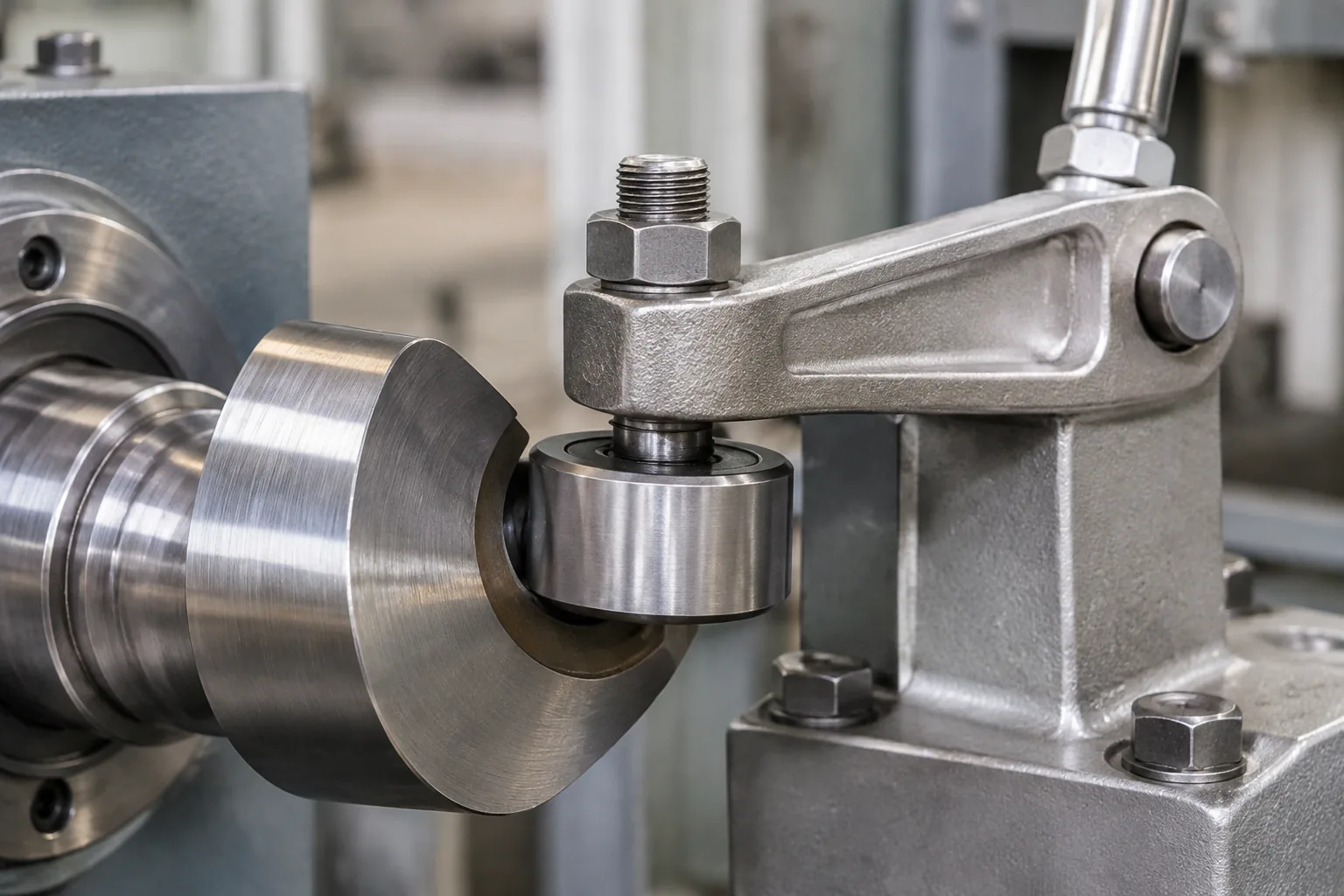
- Cam-driven and reciprocating mechanisms on packaging and light production machinery
- Guide rails, transfer tracks and linear motion elements
- Conveyor and indexing units where a roller must be bolted to a plate or lever
These are also the cases where radial load is moderate and the rating of the chosen stud size can be confirmed. Installation simplicity is the main advantage; single-side support is the main limitation.
What Is a Yoke Type Cam Follower?
A yoke type cam follower is a ready-to-fit roller bearing without an integral stud. Its bore fits over a pin or shaft held at both ends by a yoke, fork or pair of mounting plates. The outer ring still runs on the track, but the load now reaches two supports instead of one.
Yoke Type Structure and Mounting
Many yoke type rollers are supplied as self-contained bearings with a thick-walled outer ring, rolling elements, a cage and seals; some designs are available with or without an inner ring. The bore is the mounting interface. Installation involves:
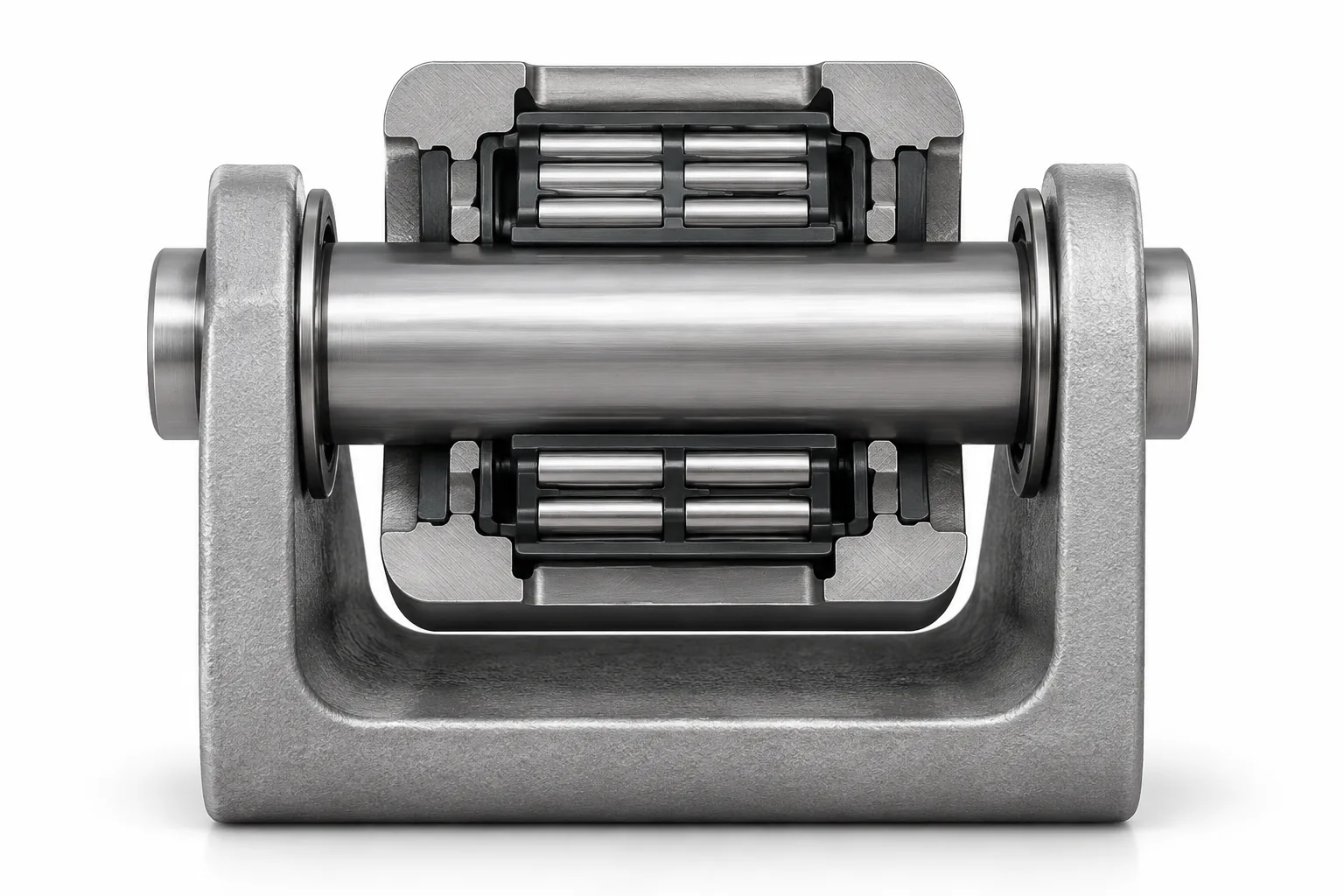
- Fitting the roller over a pin or shaft that is supported at both ends
- Retaining it axially with end plates, circlips or shoulders
- Aligning the yoke so the roller axis stays parallel to the track
Pin hardness, pin fit and yoke alignment influence both running accuracy and service life. An undersized pin lets the roller work on its seat, and a misaligned fork loads the edge of the outer ring instead of its center.
Typical Yoke Type Applications
- Heavy cam drives and cam tracks on production machinery
- Roller followers in lifting, handling and heavy equipment linkages
- Mechanisms where the roller must be supported on both sides to control deflection
In these positions double support and stiffness matter more than quick installation. Where access allows a fork to be built, the load is shared by two supports, which is why this layout is chosen for demanding tracks.
Mounting, Alignment, and Space Differences
The two configurations fail in different ways, and most of that difference comes from the mounting rather than the roller.
Stud type. The unit is fastened to one face. That keeps the design compact and lets a single part be removed without disturbing a shaft, but every load passes through an overhung stud. Stud deflection adds to roller misalignment, so the housing face must be square to the stud axis and the thread must be fully engaged.
Yoke type. The roller is captured between two supports. Bending loads go into the pin and the fork instead of a threaded joint, and alignment is set by the position of the yoke bores. The cost is space: the fork, the pin retention and assembly clearance must exist on both sides of the roller.
Both types run on a flat or curved track with a thick-walled outer ring, and crowned outer rings are specified where some angular misalignment between roller and track cannot be avoided. Whatever the type, edge loading from misalignment can shorten life and should be controlled during installation.
Load Capacity, Rigidity, and Speed Differences
The load path explains the general behavior:
- In a stud type follower, radial load crosses the outer ring and rolling elements, then enters the housing through the stud and its thread. The overhung stud also carries a bending moment, so the joint, not only the bearing, limits the usable load.
- In a yoke type roller, radial load crosses the outer ring and rolling elements, then passes into a pin supported at both ends. The pin carries the bending moment across two supports, which reduces deflection at the roller.
For that reason, yoke type rollers are generally preferred for higher radial loads and greater rigidity, while stud type followers suit lighter loads in compact layouts. That is a general tendency, not a ranking: the correct choice is the one whose published ratings cover the actual radial load, bending moment, speed and required life.
Three checks settle most load questions:
- Compare the applied radial load with the rating of the exact size, not with a similar size from another series.
- Estimate the bending moment on the stud or pin and compare it with the permissible value stated for that mounting.
- Confirm the speed limit at the lubrication and sealing condition the machine will actually run.
Maintenance, Lubrication, and Replacement
Lubrication access follows the mounting. A stud type follower is normally relubricated through a hole in the stud end, so the grease point is reachable from the accessible side. A yoke type roller is fed through the lubrication path built into the roller or its mounting, which means the feed line must be routed to a point that can be reached with the machine assembled.
Fill lubrication holes and feed pipes before commissioning. An empty feed passage delays grease reaching the raceway, and early running can influence later service life. Regular relubrication, at an interval set for the actual load, speed, temperature and contamination level, is what maintains service life.
Seals and contamination control deserve equal attention:
- Sealed designs retain grease and block dirt, but seal lips wear and should be inspected at each service.
- Water, washdown chemicals and abrasive dust attack grease and raceways, so the sealing arrangement must suit that environment.
- Heat, vibration and abnormal noise are the usual early signals. Confirm the cause before replacing parts.
Replacement differs mainly in what has to be dismantled:
- Stud type: release the nut, unscrew the stud, clean the thread and seat, then install and tighten to the published value for that stud.
- Yoke type: remove the axial retention, slide the roller off the pin, check the pin for wear and alignment, then fit the new roller and restore retention.
In both cases, inspect the track surface as well as the roller. A worn or damaged track will shorten the life of the replacement.
Cost and Total Cost of Ownership
The purchase price of the follower is only one line in the comparison.
- Part cost: a stud type follower is a single item, while a yoke type roller usually needs a pin, axial retention and a machined fork, so the assembly has more parts and more machining.
- Installation: a stud type unit needs a tapped hole and a nut; a yoke type needs bore alignment across two supports and correct pin fit.
- Downtime: a stud type follower can often be changed from one side, while a yoke type may require removing retention hardware or part of the linkage.
- Replacement frequency: a layout that keeps the roller aligned and rigid tends to return lower long-term cost even when the individual part costs more.
A lower unit price can be canceled out by shorter life or by repeated alignment work, and a stiffer arrangement can be the more expensive choice to build for a light-duty application. Compare total cost over the service interval, not the follower price alone.
Selection Checklist: When to Choose Stud Type vs Yoke Type
Work through the following points in order. Where two answers conflict, the load case and the available support usually decide the case.
- Load direction and magnitude – radial load and any bending moment the mounting will impose
- Available support – one accessible face, or a fork with two supports
- Space – envelope around the roller, nut clearance or fork and pin clearance
- Alignment – how square the housing face or yoke bores can be made and maintained
- Speed – the limit for the size, seal and lubrication that will be used
- Lubrication and maintenance access – relubrication point reachable in service
- Replacement practice – what must be dismantled to change the roller
When to Choose Stud Type
Choose a stud type cam follower when:
- Only one side of the structure can be machined or reached
- The envelope is tight and a fork cannot be accommodated
- Simple bolt-on installation and single-part replacement are valuable
Then confirm that stud strength and the housing thread can carry the calculated load and bending moment, and that track contact stays within the rated capacity of the size.
When to Choose Yoke Type
Choose a yoke type track roller when:
- Both sides of the roller can be supported by a yoke, fork or pair of plates
- Higher radial load or greater rigidity is the priority
- Bending moment or alignment control is critical to life
The fork, pin and roller bore must fit and align correctly, and the extra machining and assembly work must be acceptable for the application.
Exceptions and Hybrid Situations
- Some arrangements add a support block or modified yoke to a stud type follower, but the load path and rating must be reassessed.
- A modified yoke arrangement may be the only option where the load favors double support but space is limited.
- Load, space or maintenance constraints can override the usual preference, so verify against published data before ordering.
Common Design and Mounting Mistakes
- Insufficient support or an undersized pin in a yoke layout, which allows deflection and edge loading
- Wrong stud tightening or a damaged housing thread on a stud type installation, which loosens the joint or overstresses the stud
- Ignoring bending moment and deflection, so the follower is chosen on radial load alone
- Misalignment between roller and track, which concentrates load on one edge of the outer ring
- Poor lubrication or uncontrolled contamination, a common route to premature damage
- Selecting by envelope dimensions only, without checking load, speed and life ratings
These faults often show up as noise, vibration or a rise in temperature before a visible failure. Treat those signals as a prompt to inspect alignment, lubrication and the track, not as proof that the follower itself is at fault.
Conclusion
The cam follower stud type vs yoke type decision follows from the mounting that can be built. A stud type cam follower gives a compact, single-part installation with one-sided support, and it works well when space is tight and the stud, thread and housing can carry the resulting bending moment. A yoke type track roller needs a fork and pin, but the double support reduces deflection and is the better basis for heavier radial loads and higher rigidity.
Neither type is universally stronger. Confirm the radial load, bending moment, speed and lubrication condition against published ratings for the exact size, then check that alignment can be held in service. If you are unsure between two sizes or two layouts, compare the calculated load case with the rating before placing an order.
FAQs
Q1: Which is stronger, a stud type or a yoke type cam follower?
A: A yoke type is generally the stronger arrangement because the pin is supported at both ends, which reduces deflection under radial load. Strength still depends on the specific size, pin and yoke, so compare published ratings for the exact parts instead of assuming one configuration is always superior.
Q2: Can a stud type cam follower be used in a yoke mounting?
A: Not normally as a direct substitute. A stud type follower needs a tapped housing and leaves the roller overhung, while a yoke mounting provides a pin and two supports, so the bore and retention are different. A conversion is possible only with a redesigned bracket, and the load path and rating must be checked again.
Q3: How should a stud type cam follower be lubricated?
A: Through the lubrication hole in the stud end, with the grease reaching the rolling elements and raceway. Fill the hole and any feed pipe before commissioning, then relubricate at an interval set for the actual load, speed, temperature and contamination. Sealed units still need their seal lips and the track inspected at each service.
Q4: What causes cam follower failure?
A: Insufficient or incorrect lubrication, contaminated or damp grease, misalignment, and excessive load or bending moment are the usual causes. Wear, indentations, corrosion and fatigue on the raceway or outer ring show which mechanism was at work, so inspect the damage pattern and the track before fitting a replacement.
Q5: When should I use a yoke type instead of a stud type cam follower?
A: Use a yoke type when both sides of the roller can be supported and you need higher radial capacity or greater rigidity, especially where bending moment or alignment control matters. If only one face is accessible or the envelope is too tight for a fork, a stud type follower is the practical choice.
Q6: How do I choose the right cam follower size?
A: Start from the applied radial load and the bending moment the mounting imposes, then select a size whose published ratings cover that load case at your speed and required life. Check track contact, stud or pin strength, lubrication access, and the space available for the nut or fork before confirming the order.