Quick Answer: Take-up bearings are mounted bearing units used to adjust and maintain tension on conveyor belts and chains, compensating for stretch, wear, and thermal expansion. Selection requires evaluating shaft diameter, load type (radial, axial, or combined), speed requirements, operating environment, and frame compatibility. Key specifications include bore diameter, dynamic load rating, pull configuration (center, top, or bottom), slot width, and travel distance. Take-up frames accommodate ball, roller, and sleeve bearing inserts.
Take-up bearings are a type of mounted bearing used across various industries for adjusting and maintaining tension in conveyor belts, chains, and other driven systems. A mounted bearing consists of an insert bearing combined with a housing that mounts to a surface. Take-up units are a specific category of mounted bearings designed for applications where tension adjustment is required. This guide covers the core components, selection criteria, specifications, materials, frame types, and application considerations to help you choose the right take-up bearing for your needs.
What Are Take-up Bearings?
Take-up bearings are mounted bearing units primarily used for adjusting and maintaining conveyor belt and chain tension. The term “take-up” refers to the process of adjusting the length of a belt or chain to compensate for stretch, shrinkage, or wear, and to maintain proper tension throughout the system’s operation. Take-up bearings are used where shaft adjustment and belt-tightening devices are required, such as in conveyor applications.
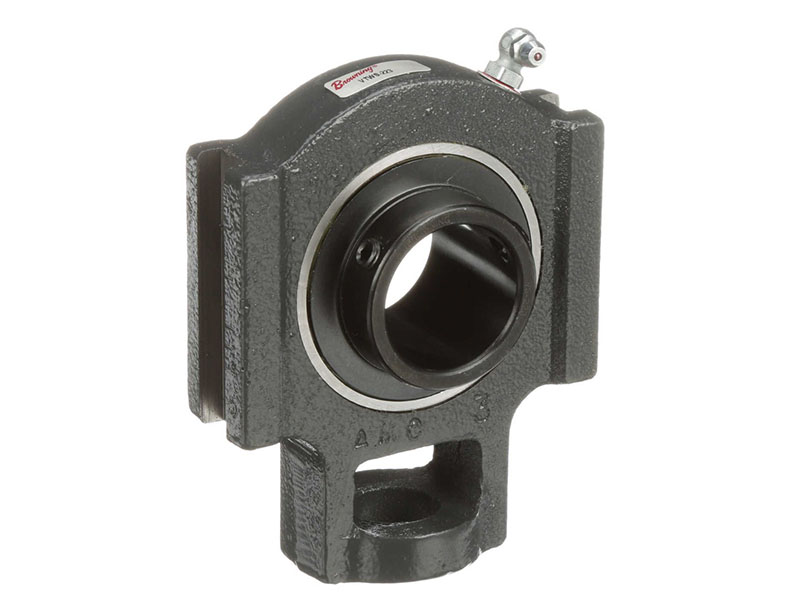
A take-up bearing unit consists of an insert bearing and a housing. The complete take-up assembly typically includes a bearing, housing, guiding frame, and positioning screw. A shaft connects two take-up bearings, one mounted on each side of the assembly, to ensure balanced tension across the conveyor system.
How They Work
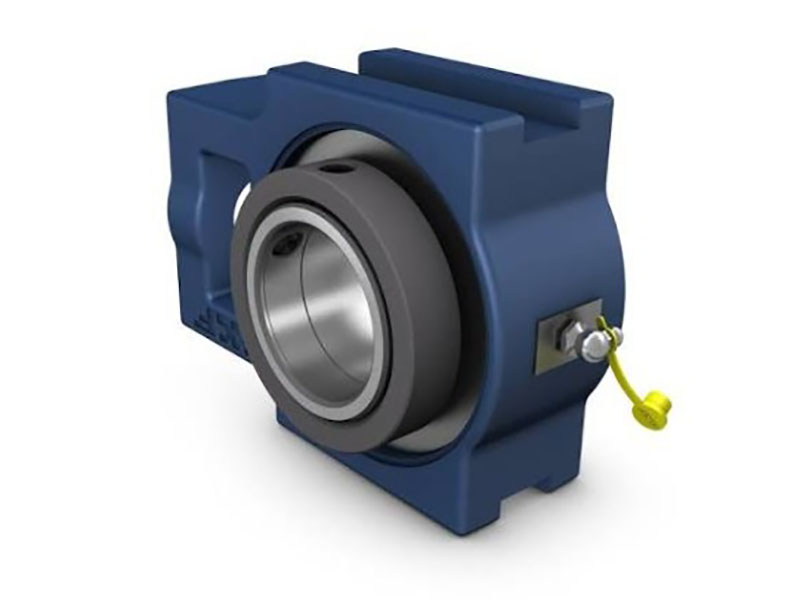
The working principle of a take-up bearing involves four integrated components:
- Insert bearing – The core component that supports the rotating shaft and reduces friction. Insert bearings are pre-assembled, ready-to-mount units that can be replaced when worn.
- Housing – A structural component that holds the insert bearing and mounts to the frame. Housings are typically made from cast iron or steel.
- Frame – A guiding structure that allows the bearing and housing to slide along a linear path for tension adjustment.
- Positioning screw – A screw that adjusts the bearing and housing’s location along the frame. A nut is inserted into the slot in the body of the unit, and a bolt threaded into the nut drives the adjustment.
The operational workflow follows a clear sequence: initial installation, tension adjustment via the positioning screw, alignment verification, locking the bearing in position, and periodic re-adjustment as belts stretch over time.
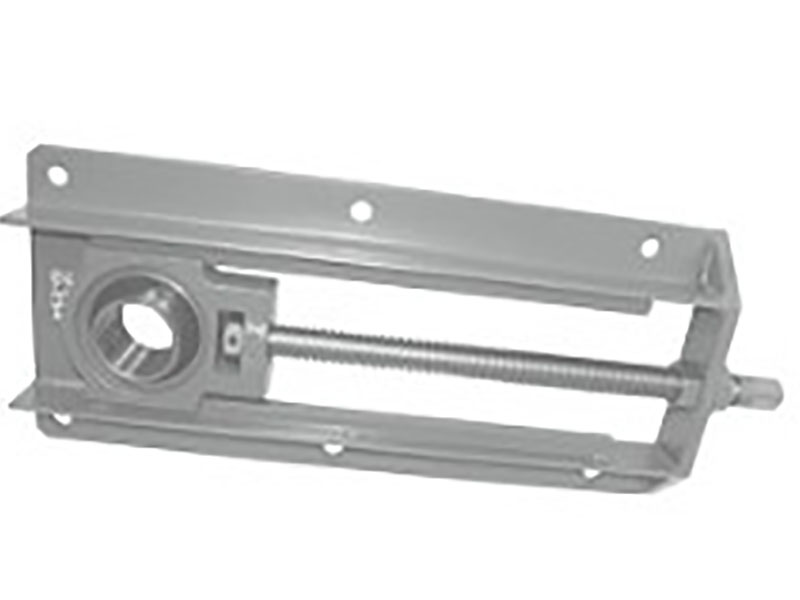
Component Types
Take-up bearings and frames are available in three component configurations:
- Take-up Bearing (Standalone) – The bearing element or bearing-housing unit only, without the frame. Used when replacing only the bearing insert in an existing frame.
- Take-up Frame (Standalone) – The frame structure without bearings. Available in various sizes and housing styles. Important: Many take-up frames, particularly center-pull frames, are not supplied with bearings. First match the take-up frame with the bearing size, then order the specific bearing.
Selection Guide
Selecting the right take-up bearing for your application requires a systematic approach. Here are the key steps:
Step 1: Application Requirements
Start by understanding your application’s demands:
- What type of load are you dealing with (radial, axial, or combined)?
- What is the operating speed?
- What shaft diameter is required?
- What environmental conditions will the bearing face?
Step 2: Shaft Diameter (Bore Size)
The bore diameter is the most critical physical dimension. The bearing must match the shaft size and tolerance. Ensure the unit matches the shaft size and tolerance.
Step 3: Load Types
Load evaluation is critical in bearing selection. There are three primary load types:
- Radial load – Force perpendicular to the shaft. For example, the downward force of material weight on a conveyor belt system.
- Axial load – Force parallel to the shaft. For example, thrust that pushes the shaft in one direction during mechanical operation. Take-up units can be used where peak loads or varying axial loads occur.
- Combined load – A combination of radial and axial loads, common in many real-world applications.
Determine the type of load first, then assess its magnitude. Consider the equipment’s operating conditions—dynamic loads in high-speed rotating machinery can differ significantly from static loads. Use engineering calculations or consult equipment manufacturer specifications for accurate load estimates.
Step 4: Speed Requirements
Mounted bearings are designed to operate within specific speed ranges. Exceeding these limits can lead to overheating, increased friction, and premature failure.
- Ball bearing inserts – Suitable for high-speed applications with lighter loads.
- Roller bearing inserts – Handle heavier loads but typically operate at lower speeds.
High-speed applications generate more heat and require bearings with better lubrication and lower friction characteristics.
Step 5: Operating Environment
Environmental factors significantly impact bearing performance and service life. Consider:
- Temperature – Extreme heat or cold can affect lubrication, material properties, and dimensional stability.
- Moisture and humidity – Can lead to corrosion and lubricant degradation.
- Dust and debris – Contaminants can enter the bearing and cause abrasive wear.
- Chemical exposure – Certain chemicals may attack bearing materials or seals.
For harsh environments, select bearings with protective seals, corrosion-resistant materials, and appropriate lubrication systems.
Step 6: Frame Type
Take-up frames are available in multiple configurations to suit different applications. The flexibility of take-up frames allow for the mounting of ball, roller, and sleeve bearings to encompass the vast range of conveyor, belt, and chain take-up applications. Consider the following frame types:
- Narrow Slot (NS) Ball Bearing Take-Up Frames – Available in five sizes with travels of 6 to 18 inches.
- Wide Slot (WS) Ball Bearing Take-Up Frames – Available in six sizes with travels of 1-1/2 to 30 inches.
- Telescoping Take-Up Frames (TS) – Space-saving design that quickly mounts to the side of a conveyor. Use any standard ball or roller bearing 2-bolt pillow block. Internal take-up frame screw is protected from the surrounding environment.
- Top Angle Take-Up Frames (TP) – Available in six sizes.
- Center Pull Take-Up Frames (CP) – Available for tapered roller bearings and spherical roller bearings. Center Pull Take-Up Frames are not supplied with bearings.
- Protected Screw Take-Up Frames – Available in Light Duty (LD) and Heavy Duty (HD) versions.
Bearing Specifications
Insert Bearing Types
Three broad categories of insert bearings are used in take-up applications:
- Ball Bearings – The most common type for take-up applications. Use balls between the inner and outer races. Ideal for high-speed, lighter-load applications. Available with various locking mechanisms including setscrew and eccentric collar designs.
- Roller Bearings – Use rollers between the inner and outer races. This category includes tapered roller bearings and spherical roller bearings. Handle heavier loads than ball bearings and often provide self-aligning capability.
- Sleeve Bearings (Plain Bearings) – Provide continuous surface contact between inner and outer races without rolling elements. Often made from bronze or engineered plastics. Available for take-up applications, though ball and roller bearings are more widely used.
Dimensions
Take-up bearings vary in physical dimensions. Key measurements include:
- Bore Diameter – The inner diameter of the bearing that fits onto the shaft. Available in both inch (fractions of an inch) and metric (mm) sizes. This is the most critical dimension.
- Bearing Width – Proportional to the maximum load the bearing can support. When specifying a replacement bearing, select the appropriate width to ensure compatibility with the take-up frame.
- Housing Overall Width – The width of the housing unit, which must fit within the frame’s guide slot.
Operating Specs
Two operating specifications are critical for take-up bearing selection:
- Maximum Speed – The top rotational speed of the take-up bearing in revolutions per minute (rpm). Determined by bearing size, lubrication, bearing material, cage material, and desired lifespan.
- Dynamic Load Rating – Measured in pounds (lbs) or kilonewtons (kN). Represents the maximum rated radial load for a defined bearing life at the rated speed.
Bearing Materials
Material selection directly impacts bearing longevity and performance:
- Insert Bearings (Ball and Roller) – Typically manufactured from carbon steel or stainless steel. Chrome steel (52100 bearing steel) is common for standard applications.
- Sleeve Bearings (Plain Bearings) – Made from bronze or engineering plastics, including:
- Bronze – Often oil-impregnated for self-lubrication.
- PTFE (Polytetrafluoroethylene) – An insoluble compound with high chemical resistance and low coefficient of friction.
- Nylon – A general-purpose material that is tough, resistant, and has good pressure ratings.
- Acetal – Semi-crystalline polymers offering excellent inherent lubricity, fatigue resistance, and chemical resistance. Note that acetals may experience outgassing at elevated temperatures and become brittle at low temperatures.
- Housings and Frames – Bearing housings are typically manufactured from cast iron or steel. Take-up frames are commonly made of steel or cast iron.
Bearing Features
Modern take-up bearings can be designed with features that enhance performance in specific applications:
- Self-lubricating – Materials that self-lubricate or require no external lubrication. Ideal for inaccessible locations.
- Lubrication Port – An opening (port) for providing grease or oil relubrication, allowing for scheduled maintenance.
- Corrosion Resistant – Bearings resistant to corrosion, rust, pitting, and discoloration. Essential for applications in wet or chemically aggressive environments.
- Self-aligning – Bearings that can correct for small amounts of angular misalignment. Take-up units feature self-aligning spherical outside diameters that compensate for shaft misalignment.
- Split Housing – The housing is split into two pieces and bolted together, simplifying installation and replacement in confined spaces.
- Locking Method – Various methods including setscrew locking and eccentric collar designs.
Frame Specifications
The frame holds the bearing and comes with its own set of specifications:
Pull Configuration
The positioning screw’s location determines the pull configuration. Take-up frames can be center-pull, top-pull, or bottom-pull depending on the positioning screw’s location in the assembly:
- Center-pull – The adjustment pull axis passes through the center of the bearing. The threaded rod is in the center of the frame and bearing, helping to ensure even tensioning during operation.
- Top-pull – The pull screw drive is located on the topside of the bearing. The bolted top angle protects the threaded rod and allows for relatively simple bearing removal and replacement.
- Bottom-pull – The pull screw drives are on the bottom of the bearing.
Frame Types
Take-up frames are available in several basic types to suit different applications:
- Narrow Slot (NS) Take-Up Frames – For ball bearings. Five sizes with travels of 6 to 18 inches.
- Wide Slot (WS) Take-Up Frames – For ball bearings. Six sizes with travels of 1-1/2 to 30 inches.
- Telescoping Take-Up Frames (TS) – Space-saving design with internal screw protection. Use any standard ball or roller bearing 2-bolt pillow block.
- Top Angle Take-Up Frames (TP) – Six sizes available.
- Center Pull Take-Up Frames (CP) – For tapered roller and spherical roller bearings. Not supplied with bearings.
- Protected Screw Take-Up Frames – Available in Light Duty (LD) and Heavy Duty (HD) versions.
Frame Dimensions
Key structural specifications for take-up frames include:
- Frame Length – Determined by the length of the drum or system the frame will be attached to. Must be long enough to ensure sufficient tension can be placed on the conveyor when tightened.
- Frame Width – The width of the frame structure, which determines the slot width compatibility.
- Slot Width – Take-up frames are available with either narrow slot or wide slot configurations for ball bearing frames. Narrow Slot and Wide Slot are subcategories of ball bearing take-up frames. Ensure the bearing fits and runs smoothly on the width of the slot in the frame.
- Take-up Travel – The total adjustment range of the bearing within the frame. Available in various travel lengths to suit different application requirements.
- Protected Screw – The screw has a shield or cover for protection against debris, liquids, and contaminants. Particularly valuable in dirty or wet environments where the adjustment mechanism could otherwise become clogged or corroded.
- Top Angle – The top of the frame is shaped triangularly, with the top angle protecting the threaded adjustment rod.
Applications
Take-up bearings are used across a wide range of industries and applications:
- Conveyor belt systems – The primary application, maintaining proper belt tension for optimal performance and tracking.
- Belt and chain conveyors – Made to provide tension and shaft centers on a variety of belt and chain-type conveyors.
- Air handling, fans, and blowers – Adjustable shaft support for ventilation and air handling equipment.
- Food and beverage processing – Bearings must often meet specific hygiene and corrosion resistance requirements.
- Pharmaceutical – Applications requiring clean, reliable bearing solutions.
- Water and wastewater – Corrosion-resistant bearings for wet environments.
- Agricultural equipment – Farm machinery such as harvesters, conveyors, and material handling systems.
- Elevator pulleys – Used to align conveyor tracks and to tension conveyor belts and elevator pulleys.
Conclusion
Selecting the right take-up bearing requires a clear understanding of your application’s shaft diameter, load characteristics, speed requirements, operating environment, and frame compatibility. Start with the bore diameter—match it precisely to your shaft. Then evaluate load type and magnitude, followed by speed requirements and environmental factors.
Take-up frames allow for the mounting of ball, roller, and sleeve bearings. Ball bearing inserts suit high-speed, lighter-load applications. Roller bearing inserts handle heavier loads and provide self-aligning capability for demanding conveyor applications. Sleeve bearings are available for specific applications where rolling-element bearings are not suitable.
Pay close attention to frame specifications: slot width (narrow or wide for ball bearing frames), pull configuration (center, top, or bottom), and travel distance must all match your application requirements. Consider telescoping frames for space-saving installations with internal screw protection.
Many take-up frames—particularly center-pull frames—are sold without bearings. Always verify whether your chosen frame includes the bearing or requires separate ordering. Check dynamic load ratings and L10 life calculations for heavy-load applications. And don’t forget environmental protection features like corrosion-resistant materials, protective seals, and guarded adjustment screws where conditions demand them.
FAQs
Q1: What is the difference between a take-up bearing and a regular mounted bearing?
Take-up bearings are a specific type of mounted bearing that includes an adjustable mounting system. Unlike fixed mounted bearings (such as pillow blocks or flange bearings), take-up units allow the bearing to move along a linear path, enabling precise tension adjustment of belts, chains, and other flexible drive elements. Regular mounted bearings are fixed in position and cannot compensate for belt stretch or thermal expansion.
Q2: What types of insert bearings are used in take-up applications?
Take-up bearings use three broad categories of insert bearings: ball bearings, roller bearings (including tapered roller and spherical roller bearings), and sleeve bearings (plain bearings). Ball bearings are most common for standard-duty applications, while roller bearings are used for heavy-duty applications requiring higher load capacity.
Q3: Should I buy take-up bearings and frames together or separately?
Both options are available. Take-up bearings and frames can be purchased as a complete take-up assembly or as individual components. However, many take-up frames—particularly center-pull frames—are not supplied with bearings. You must first match the frame with the correct bearing size, then order the bearing separately.
Q4: What is the difference between narrow slot and wide slot take-up frames?
Narrow Slot and Wide Slot are subcategories of ball bearing take-up frames. Narrow Slot frames are available in five sizes with travels of 6 to 18 inches. Wide Slot frames are available in six sizes with travels of 1-1/2 to 30 inches. Selection depends on the specific bearing series and application requirements—ensure the bearing fits and runs smoothly on the width of the slot in the frame.
Q5: What is a take-up pull configuration?
Take-up frames can be center-pull, top-pull, or bottom-pull depending on the positioning screw’s location in the assembly. Center-pull units have the adjustment screw aligned with the bearing center for even tensioning. Top-pull and bottom-pull units have the screw located above or below the bearing respectively, offering different mounting and access options.
Q6: What is a telescoping take-up frame?
A telescoping take-up frame (TS) is a space-saving design that quickly mounts to the side of a conveyor. It uses any standard ball or roller bearing 2-bolt pillow block. The internal take-up frame screw is protected from the surrounding environment, making it suitable for dirty or wet applications.
Q7: What maintenance do take-up bearings require?
Take-up bearings require periodic inspection and maintenance. As belts and chains stretch over time, the adjustment mechanism allows for easy re-tensioning without major system disassembly. Choose bearings with built-in lubrication ports, protective seals, and other features to reduce maintenance frequency. For heavy or continuous-duty applications, regular lubrication and condition monitoring (such as temperature and vibration checks) are recommended.