Quick Answer
Plummer block bearings and pillow block bearings are both housed bearing units that support rotating shafts. The key difference? Pillow blocks are designed for light to medium loads with a simpler, often solid housing. Plummer blocks are built for heavy industrial loads with a split housing design, extra fasteners, and easier maintenance—you can replace the bearing without removing the entire shaft. Choose based on your load, environment, and maintenance needs.
If you have ever shopped for bearing housings, you have probably run into both terms: plummer block bearings and pillow block bearings. They look similar—so similar that many assume they are the same product. But choosing the wrong one can lead to premature failure and unplanned downtime. So what is the actual difference?
The confusion is understandable. Both are mounted bearing units designed to support rotating shafts. Both house a bearing inside a block that bolts to a foundation. But when it comes to performance, load capacity, and maintenance, they serve very different purposes.
This article breaks down:
- What each type is and how they work
- Where they are similar and where they differ
- How to choose the right one for your application
By the end, you will know exactly which bearing housing fits your needs—and why getting this right matters for equipment reliability and maintenance costs.
What is a Plummer Block Bearing?
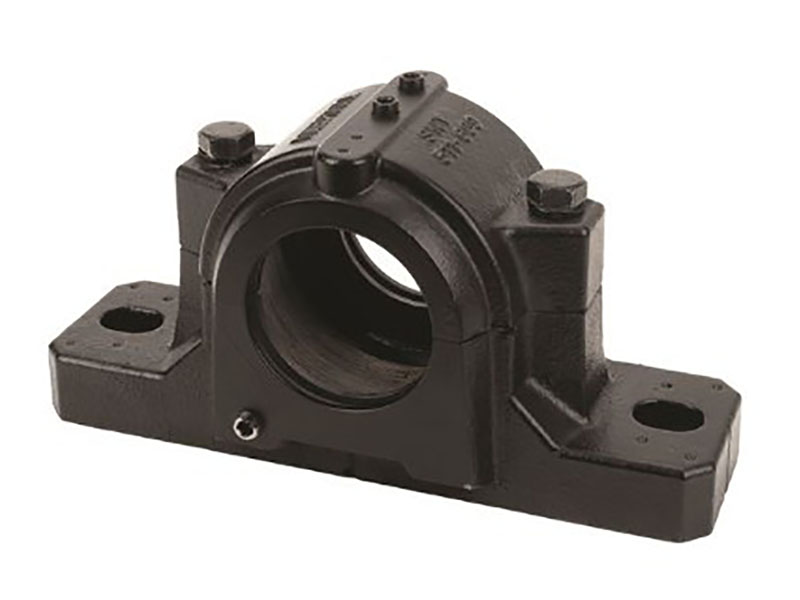
A plummer block bearing (also called a split bearing housing) is a mounted bearing unit designed for heavy-duty industrial applications. Its primary job is to safely house a bearing, keeping the outer ring stationary while allowing the inner ring and shaft to rotate freely.
Here is what defines a plummer block:
Split housing design. The housing comes in two halves—a base and a cap. This split design is a major advantage: you can inspect, replace, or service the bearing without removing the entire shaft from the machine. That means less downtime and lower maintenance costs.
Extra fasteners. Because plummer blocks handle heavier loads, they come with an additional set of nuts and bolts compared to pillow blocks. These extra fasteners provide the clamping force needed to keep everything secure under high power and vibration.
Typical bearing types. Plummer blocks usually pair with spherical roller bearings or self-aligning ball bearings. Spherical roller bearings handle both radial and axial loads and perform well under heavy, shock-type loads. Self-aligning ball bearings can accommodate slight shaft misalignment—common in large industrial systems.
Housing materials. Most plummer blocks use cast iron or cast steel housings. Cast steel offers better strength and corrosion resistance for harsh or corrosive environments. Cast iron works well for general heavy-duty use.
Common applications. You will find plummer blocks in:
- Conveyor systems
- Crushers and shredders
- Industrial fans and blowers
- Large electric motors
- Mining equipment
- Steel mills
Industry standard. ISO 113 sets globally recognized dimensional specifications for plummer block housings. This international standard ensures that replacement units from different manufacturers will fit your existing mounting dimensions, shaft height, and bore size.
What is a Pillow Block Bearing?
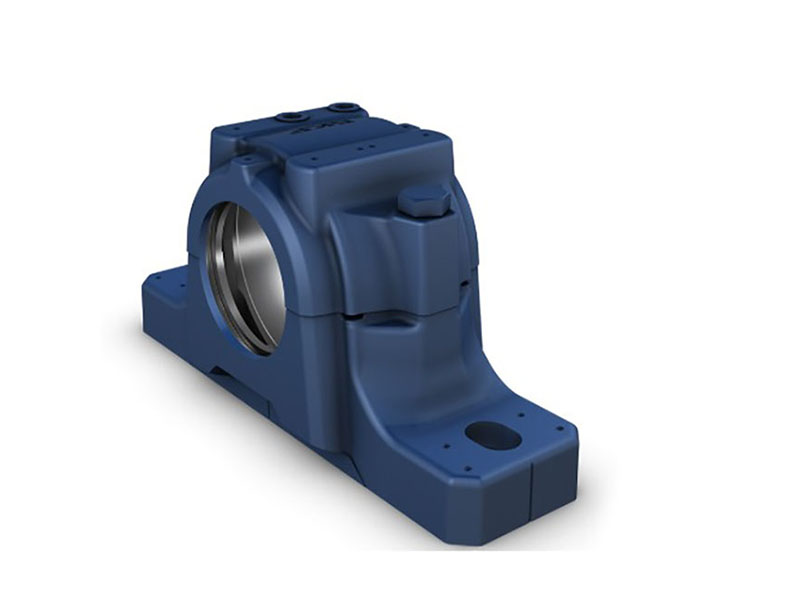
A pillow block bearing (also called a housed bearing unit) is a mounted bearing designed for light to medium-duty applications. Like the plummer block, it houses a bearing that supports a rotating shaft—outer ring stationary, inner ring and shaft rotating freely.
Here is what sets pillow blocks apart:
Solid or split housing. Pillow blocks come in both solid (one-piece) and split (two-piece) designs. Solid housings are more common for light-duty applications—they are simpler, cheaper, and sufficient for lower loads. Split housings appear in some pillow block designs but are less typical than in plummer blocks.
No extra fasteners. Pillow blocks lack the additional nuts and bolts found on plummer blocks. The standard mounting bolts through the base are enough for lighter loads. This makes them lighter and more compact overall.
Typical bearing types. Pillow blocks commonly use ball bearings or self-aligning ball bearings. Ball bearings handle radial loads well at moderate speeds and are cost-effective. Self-aligning variants compensate for minor shaft misalignment.
Housing materials. Pillow block housings are typically cast iron, pressed steel, or ductile iron. Cast iron is the most common—durable enough for general use without the cost of cast steel.
Common applications. You will find pillow blocks in:
- Light conveyor systems
- Packaging equipment
- Agricultural machinery
- Material handling systems
- General manufacturing equipment
Cleaner . Pillow blocks are typically used in cleaner environments with less exposure to contaminants, moistenvironmentsure, or corrosive materials. They are designed for general industrial conditions, not extreme or harsh settings.
How are they similar?
Despite their differences, plummer blocks and pillow blocks share fundamental design principles:
- Same basic function. Both are designed to safely mount a bearing and support a rotating shaft. The housing holds the bearing’s outer ring stationary while allowing the inner ring (and the shaft running through it) to rotate freely.
- Same structural concept. Both consist of a mounting block that houses a bearing. The block bolts to a foundation or machine frame through holes in the base. A shaft passes through the bearing’s inner ring, and the whole assembly maintains shaft alignment while reducing friction.
- Same installation orientation. Both are mounted parallel to the shaft axis—the base sits on a flat surface, and the shaft runs horizontally through the housing. This distinguishes them from flange-mounted units, which mount perpendicular to the shaft.
- Same bearing compatibility. Both housing types can accommodate multiple bearing types—ball bearings, roller bearings, and tapered varieties. The housing itself does not dictate the bearing type; the application’s load and speed requirements do.
- Same sealing and lubrication needs. Both use integrated seals to keep contaminants out and lubricant in. Both have lubrication fittings (grease nipples) for maintenance. The complexity of the sealing system may differ, but the basic principle is identical.
- Same installation process. For both, you: bolt the housing to the foundation, insert the shaft through the bearing, and secure the bearing to the shaft (using set screws, locking collars, or adapter sleeves).
- Same terminology confusion. In some parts of the world, “pillow block” and “plummer block” are used interchangeably. This is technically incorrect but common enough that you will encounter it. Always confirm the specific design and load rating, not just the name.
How are they different?
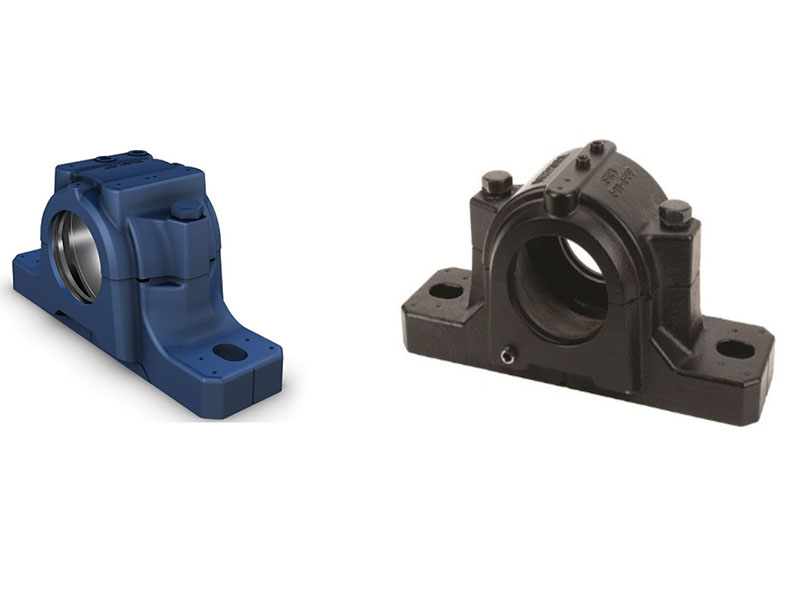
The differences between plummer blocks and pillow blocks come down to load capacity and design complexity. Here is a direct comparison:
| Feature | Pillow Block | Plummer Block |
|---|---|---|
| Load capacity | Light to medium loads | Heavy industrial loads |
| Housing design | Usually solid (one-piece); split also available | Split (two-piece: base + cap) |
| Extra fasteners | None—standard mounting bolts only | Additional set of nuts and bolts for heavy loads |
| Maintenance | May require shaft removal to change bearing | Bearing can be replaced without removing shaft |
| Sealing and lubrication | Standard seals for clean environments | Can accommodate complex sealing for harsh environments |
| Typical bearing | Ball bearings, self-aligning ball bearings | Spherical roller bearings, self-aligning ball bearings |
| Housing material | Cast iron, pressed steel, ductile iron | Cast iron or cast steel |
| Environment | Cleaner, general industrial | Can handle corrosive or harsh conditions |
| Weight | Lighter and more compact | Heavier due to extra fasteners and stronger housing |
The core difference is load. Pillow blocks handle lighter loads with simpler designs. Plummer blocks handle heavier loads with split housings, extra fasteners, and stronger materials. The split design is not just about convenience—it is necessary for heavy-duty applications where shaft removal would be impractical or impossible.
Dimensional standards. Plummer blocks follow ISO 113 dimensional specifications, while pillow blocks adhere to separate dimensional standards. Always verify the applicable standard when sourcing replacement units to ensure proper fit.
How to choose
Choosing between a plummer block and a pillow block is not complicated—just work through these factors in order:
1. Load capacity (the primary factor)
Start with your load requirements. This is the single most important decision factor.
- Light to medium loads, low torque → Pillow block
- Heavy loads, high power transmission, shock loads → Plummer block
If you are unsure, choose the higher-capacity option. Undersizing leads to premature failure, downtime, and replacement costs that far outweigh the upfront price difference.
2. Shaft size and bore diameter
Match the bore diameter to your shaft precisely. An incorrect fit compromises performance and safety.
- Measure your shaft diameter accurately
- Select a housing with the matching bore
- Consider shaft height (distance from base to shaft center) for proper alignment
3. Maintenance frequency
How often will you need to access the bearing?
- Rare maintenance, can shut down and disassemble → Pillow block works fine
- Frequent inspection or replacement, cannot afford long downtime → Choose plummer block (split design allows bearing replacement without shaft removal)
4. Operating environment
Consider your working conditions:
| Environment | Recommended housing material |
|---|---|
| Clean, dry, general industrial | Cast iron (cost-effective) |
| Wet, dusty, or corrosive | Cast steel (better corrosion resistance) |
| Mildly corrosive or humid | Surface-coated cast iron (e.g., zinc-plated or painted) offers a cost-effective middle-ground |
| Extreme temperatures or chemicals | Consult manufacturer for specialized materials |
5. Installation space and weight constraints
- Limited space, weight-sensitive → Pillow block (lighter, more compact)
- Space available, stability is priority → Plummer block (heavier, more robust)
6. Shaft alignment needs
- Well-aligned shaft, minimal thermal expansion → Either works
- Potential misalignment from thermal expansion or deflection → Choose a housing that accommodates self-aligning bearings
Quick selection guide
| Your application | Choose this |
|---|---|
| Light conveyor, packaging, agriculture | Pillow block |
| Heavy conveyor, crusher, mining, steel mill | Plummer block |
| Frequent bearing changes, cannot remove shaft | Plummer block |
| Tight budget, simple installation | Pillow block |
| Corrosive or harsh environment | Plummer block (cast steel housing) |
| Clean factory, standard conditions | Pillow block (cast iron housing) |
| Mildly corrosive environment, budget-conscious | Pillow block (coated cast iron housing) |
Remember: Both housing types can use the same bearing types. Your choice is not about the bearing itself—it is about the housing design, load capacity, and maintenance access you need.
Conclusion
Plummer block bearings and pillow block bearings serve the same fundamental purpose—supporting rotating shafts in housed bearing units. But they are not interchangeable.
The key difference is load capacity:
- Pillow blocks are lighter, simpler, and designed for light to medium loads
- Plummer blocks are heavier, split-design units built for heavy industrial loads with easier maintenance access
The choice comes down to four questions:
- How heavy is your load? (primary factor)
- How often do you need to service the bearing? (maintenance access)
- What is your operating environment? (material selection)
- Do you have space and weight constraints? (physical limitations)
A simple rule: Light loads, clean environments, and rare maintenance → pillow block. Heavy loads, harsh conditions, or frequent servicing → plummer block.
When in doubt, size up. The cost of a heavier-duty housing is negligible compared to the cost of unexpected downtime from an undersized unit.
For applications requiring specialized bearing housings or custom solutions, consult with a manufacturer that understands both product lines. DUHUI Bearing, established in 2003, manufactures bearing housings and support bearings for both automotive and industrial applications, with export experience to over 120 countries.
FAQs
Q1: Do plummer blocks and pillow blocks use the same type of bearing?
Yes and no. Both housing types can accommodate the same bearing types—ball bearings, roller bearings, and tapered varieties. However, typical configurations differ: plummer blocks for heavy loads usually use spherical roller bearings or self-aligning ball bearings, while pillow blocks for lighter loads commonly use standard ball bearings. The housing itself does not force a specific bearing type—your application’s load and speed requirements do.
Q2: Does a plummer block come with a bearing included?
Not always. Some suppliers sell plummer blocks as housings only—you purchase and install the bearing separately. Others sell them as complete assembled units. Pillow blocks are more commonly sold as pre-assembled units with the bearing already fitted. Always check the product description: “housing only” means you supply the bearing; “housed bearing unit” means it is complete.
Q3: Can I use a pillow block for a heavy-load application?
Not recommended. Pillow blocks lack the split housing design and extra fasteners that plummer blocks use to handle heavy loads. Using a pillow block beyond its rated capacity leads to housing deformation, fastener failure, and premature bearing wear. If your application involves high power transmission, heavy loads, or shock loading, choose a plummer block.
Q4: Why does a plummer block have extra nuts and bolts?
The additional fasteners provide extra clamping force to keep the housing securely closed under heavy loads and vibration. Plummer blocks handle high-power transmission and heavy industrial loads—conditions that would loosen standard fasteners over time. The extra hardware ensures the split housing stays tightly closed, maintaining bearing alignment and preventing premature failure.
Q5: Are the installation methods the same?
Yes. Both mount the same way: bolt the housing to a foundation or machine frame through holes in the base, insert the shaft through the bearing, and secure the bearing to the shaft. Both are mounted parallel to the shaft axis (unlike flange units, which mount perpendicular). The installation process is identical—only the hardware and housing design differ.
Q6: How do I choose the right housing material?
Cast iron is the default choice for most applications—it is durable, cost-effective, and sufficient for general industrial use. Choose cast steel if your application involves corrosive environments, extreme moisture, or chemical exposure. For mildly corrosive conditions, surface-coated cast iron (zinc-plated or painted) offers a cost-effective middle-ground. For specialized conditions (extreme temperatures, food-grade, etc.), consult the manufacturer for material options.
Q7: What does ISO 113 specify?
ISO 113 establishes internationally recognized dimensional standards for plummer block housings. This means you can source replacement units from different manufacturers with confidence that critical dimensions—mounting hole spacing, shaft center height, and bore diameter—will match your existing setup. Pillow blocks follow separate dimensional standards.
Q8: Why are the names sometimes used interchangeably?
In some regions and industries, “pillow block” and “plummer block” are used as synonyms. This is technically incorrect—they are different products with different load ratings and designs. The confusion persists because both are housed bearing units that look similar from the outside. Always confirm the specific design, load rating, and housing type when specifying or ordering, rather than relying on the name alone.