In the world of mechanical power transmission, efficiently supporting a rotating shaft while securing it to a machine frame is a fundamental challenge. The solution, more often than not, is the pillow block bearing. This seemingly simple component is a sophisticated, pre-assembled unit that combines a bearing and a housing to provide reliable support for countless industrial applications.
DUHUI will provide a comprehensive overview of pillow block bearings, from their basic definition to advanced selection criteria, helping you make the best choice for your machinery.
What is a Pillow Block Bearing?
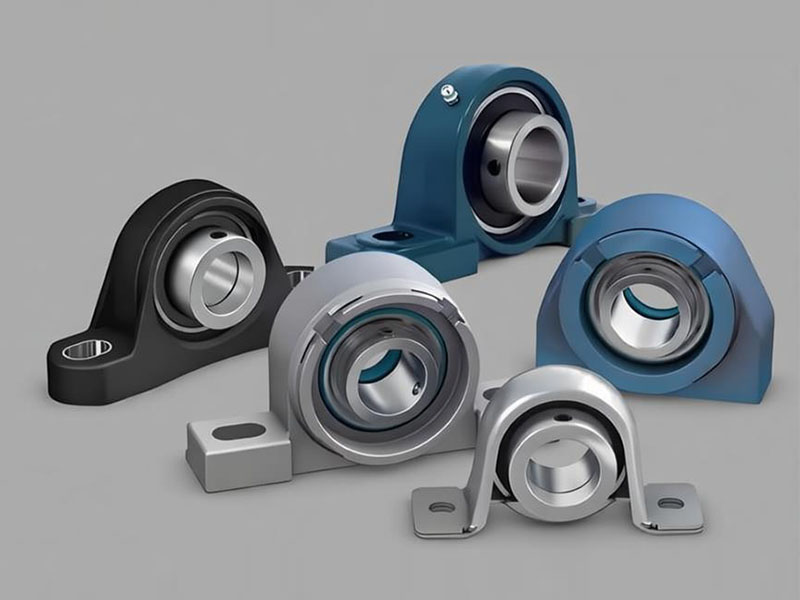
A pillow block bearing, sometimes loosely referred to as a plummer block, is a mounted bearing unit designed to support a rotating shaft. Its defining characteristic is a housing with a base that mounts on a surface parallel to the shaft axis . Think of it as a “pillow” for the shaft.
It consists of two main components working in tandem:
- The Bearing Insert: This is the inner part that directly supports the shaft. It typically contains an inner ring, rolling elements (balls or rollers), a cage, and precision raceways.
- The Housing (or Block): This is the outer shell, usually made of cast iron, steel, or other materials. It features a precise cavity to hold the bearing insert and a base with bolt holes for secure mounting to a structure .
This pre-assembled design simplifies procurement, installation, and replacement, making it a cornerstone of modern machine design.
Pillow Block Bearing vs. Plummer Block
While the terms are often used interchangeably, a critical technical distinction exists between a pillow block and a plummer block. Understanding this difference is key when sourcing components for engineering specifications.
The core difference lies in what is included in the assembly. A pillow block bearing is a complete, ready-to-mount unit that comes with the bearing pre-installed inside the housing. In contrast, a plummer block is just the housing; the bearing must be selected and installed separately .
| Feature | Pillow Block Bearings | Plummer Block Bearings |
| Assembly | Pre-assembled unit with bearing included | Housing only; bearing installed separately |
| Load | Generally for light to medium-heavy loads | Often for higher, more robust applications |
| Environment | Versatile, with sealed options for various conditions | Frequently used in corrosive/harsh environments requiring custom bearings |
Types of Pillow Block Bearings
The variety of pillow block bearings available can be categorized by their insert, housing, and locking mechanism, each tailored for specific operational demands.
By Bearing Insert Type:
- Ball Bearing Units: The most common type, ideal for high-speed applications and moderate radial and axial loads .
- Spherical Roller Bearing Units: Designed for extremely heavy radial loads and capable of handling significant misalignment .
- Tapered Roller Bearing Units: Excellent for combined radial and heavy thrust loads.
By Housing Configuration:
- Standard Pillow Blocks: Feature a solid base for general-purpose mounting .
- High-Center Pillow Blocks: Provide extra clearance for shafts with large collars or attachments.
- Split Pillow Blocks: The housing cap can be removed, allowing for bearing inspection or replacement without disturbing the shaft, which is crucial for long or fixed shafts .
By Locking Mechanism:
- Set Screw Locking: The most common method, using cup-point set screws to lock the inner ring to the shaft. Suitable for moderate loads and direction changes .
- Eccentric Locking Collar: A collar on the inner ring engages the shaft; effective for applications with reversing loads .
- Concentric Collar: Provides a more precise, balanced grip around the shaft, reducing vibration at high speeds .
Materials of Pillow Block Bearings
The performance and longevity of a pillow block bearing are directly tied to the materials from which it is made.
Bearing Insert Materials:
- AISI 52100 Chrome Steel: The industry standard for rolling elements. This high-carbon chromium steel offers exceptional hardness, wear resistance, and load-carrying capacity, making it suitable for the vast majority of applications .
- Stainless Steel: Essential for applications requiring corrosion resistance, such as in food processing, pharmaceutical, or chemical environments .
- Ceramic: Used in hybrid bearings, ceramic balls are lighter, harder, and generate less heat, making them ideal for ultra-high-speed or electrically insulating applications.
Housing Materials:
- Cast Iron: The workhorse material, prized for its excellent vibration damping, rigidity, and cost-effectiveness .
- Cast Steel: Chosen for applications involving high impact or shock loads where maximum housing strength is required .
- Stainless Steel: Offers the highest level of corrosion protection for wash-down and harsh chemical environments .
- Engineered Thermoplastics: Lightweight, corrosion-proof, and cost-effective, these are ideal for light-duty applications in food processing or other wet environments .
How to Choose the Right Pillow Block Bearing
Selecting the correct pillow block bearing is a systematic process. Use these criteria to guide your decision:
- Load Characteristics: Determine the type (radial, axial, combined) and magnitude of loads, including any shock loads .
- Shaft Size and Speed: The bearing’s bore diameter must precisely match your shaft. Consider the operating RPM against the bearing’s speed rating .
- Operating Environment: Assess the presence of moisture, chemicals, extreme temperatures, and contaminants. This dictates the choice of housing material, seal type, and lubricant .
- Misalignment: Will the application experience shaft deflection or mounting inaccuracies? A self-aligning insert can compensate for up to ±2° of misalignment .
Sealing and Lubrication of Pillow Block Bearings
Effective sealing and proper lubrication are the two most critical factors in maximizing bearing life.
Seal Types: Seals protect the bearing internals.
- Lip Seals: Provide excellent protection against contaminants by making light contact with the inner ring .
- Labyrinth Seals: Non-contact design that prevents contaminant ingress without adding friction, ideal for high-speed applications .
- Taconite Seals: Heavy-duty, multi-component seals designed for extreme environments like mining and aggregate processing.
- Pre-lubricated / Sealed-for-Life: Many units come factory-filled with grease and are sealed, requiring no maintenance for the life of the bearing .
- Relubricatable Units: For demanding applications involving high temperatures, heavy loads, or contamination, units with grease fittings allow for periodic fresh grease to be introduced, purging old grease and contaminants .
Applications of Pillow Block Bearings
The versatility of pillow block bearings makes them indispensable across a wide spectrum of industries.
- Agricultural Machinery: In the dusty, wet, and high-vibration environment of farms, pillow blocks are found on harvesters, balers, and conveyors, where rugged seals and durable housings are a must .
- Material Handling & Conveyors: This is the most common application. From package sorting to bulk material transport, pillow blocks support drive pulleys and idler rolls .
- Food Processing: Stainless steel housings and special H1 food-grade grease ensure hygiene and corrosion resistance in wash-down environments on equipment like ovens and sorting lines .
- Mining & Aggregate: Heavy-duty, split housings and taconite seals are used on crushers and screens to withstand severe shock loads and abrasive contamination .
Installation and Common Failure of Pillow Block Bearings
Even the best bearing will fail prematurely if not installed and maintained correctly.
Installation Guide:
- Prepare the Shaft: Ensure the shaft is clean, burr-free, and within specified tolerance.
- Position the Unit: Slide the bearing onto the shaft and bolt the housing loosely to the mounting structure.
- Lock the Bearing: Tighten the locking mechanism (set screws or collar) to the manufacturer’s specified torque, often in an alternating sequence .
- Align and Tighten: Align the unit properly and fully tighten the housing mounting bolts.
Avoiding Failure:
- Overheating: Often caused by misalignment, over-lubrication, or insufficient radial clearance.
- Abnormal Noise: Can indicate contamination, brinelling (damage from shock loads), or the onset of fatigue .
- Inner Ring Spinning (“Creep”): A sign that the locking mechanism is insufficient or the shaft tolerance is too loose .
- Seal Failure: Usually results from excessive shaft speed, high temperatures, or damage from abrasive contaminants.
Frequently Asked Questions (FAQ)
1. What is the difference between a pillow block bearing and a flange bearing?
A pillow block bearing (plummer block) has a base that is mounted parallel to the shaft axis, with two bolt holes on a flat bottom. It is used where the shaft runs parallel to the mounting surface. A flange bearing, in contrast, has a mounting flange perpendicular to the shaft axis and is bolted to a vertical or angled surface. Flange bearings are preferred when space is limited or the shaft enters a housing wall. Both are housed units, but the mounting orientation and footprint differ fundamentally.
2. How do you determine the correct shaft fit for a pillow block bearing?
The shaft fit depends on the type of insert bearing (e.g., set screw, eccentric locking collar, or tapered adapter sleeve) and the operating conditions. For a standard set‑screw bearing on a solid steel shaft, a tolerance of h6 to j6 (ISO 286) is common for most general applications. For higher loads or vibrations, an m6 interference fit may be used. Always consult the bearing manufacturer’s catalogue for the recommended shaft tolerance. The shaft surface should be ground or turned to Ra ≤ 1.6 µm to avoid false brinelling.
3. What are the most common causes of premature pillow block bearing failure?
Field data indicates four dominant causes:
Inadequate lubrication (40‑50% of failures) – wrong grease type, insufficient relubrication intervals, or mixing incompatible greases.
Misalignment (20‑30%) – exceeding the permissible angular misalignment (typically ≤ 1.5° for standard units, ≤ 3° for self‑aligning inserts).
Improper shaft fit – too loose a fit leads to fretting corrosion; too tight a fit reduces internal radial clearance.
Contamination – ingress of dust, water, or process particles degrades lubricant and causes abrasive wear.
Other causes include over‑tightening set screws and excessive belt tension.
4. Can pillow block bearings be used in high‑temperature environments?
Yes, but the maximum operating temperature is limited by the bearing insert’s material, grease, and seals. Standard pillow block bearings with chrome steel (GCr15 / 52100) and standard mineral grease are rated from ‑20°C to +100°C continuous. For higher temperatures:
- Up to +150°C – use heat‑stabilised steel (dimensional stabilisation S1 or S2) and synthetic grease (e.g., perfluoropolyether).
- Up to +250°C – consider special high‑temperature bearing steel (e.g., M50 tool steel) and solid lubricants.
Above +250°C, ceramic hybrid bearings or external cooling of the housing is required. Always check the grease’s drop point and base oil viscosity.
5. How often should pillow block bearings be relubricated, and what type of grease is recommended?
Relubrication frequency depends on speed, load, temperature, and environment. A common formula for normal conditions (70°C housing temperature, moderate load) is:
Interval (hours) = 14 × 10⁶ / (n × √d) – where *n* = shaft speed (rpm) and *d* = shaft diameter (mm).
For example, a 50 mm shaft at 1500 rpm gives an interval of roughly 1,600 hours (about 4 months of 8‑hour shifts).
Grease recommendation: NLGI grade 2 lithium‑complex grease with a base oil viscosity of 100–150 cSt at 40°C for normal speeds. For wet or dusty environments, add a high‑viscosity oil (≥ 220 cSt) and an EP additive. Never mix lithium‑complex with polyurea or clay‑based greases.
6. What is the load rating of a pillow block bearing, and how does it affect selection?
Pillow block bearings are rated with basic dynamic load rating (C) and static load rating (C₀) in Newtons (or kN). C is the constant radial load that 90% of a group of identical bearings will survive for 1 million revolutions. To select a unit, calculate the equivalent dynamic load (P) from your radial and axial loads, then compute the required L₁₀ life (million revolutions) using:
L₁₀ = (C / P)³ for ball bearings.
Typical industrial applications aim for L₁₀ = 20,000–50,000 hours. The static load rating C₀ must exceed the peak static load (including shock) by a safety factor of 1.5–2.0. Never exceed the rated static load – it causes permanent deformation of raceways.
7. How do you align a pillow block bearing to prevent shaft misalignment?
Even self‑aligning inserts have limits. Follow these steps:
- Mount the shaft on temporary supports, ensuring it is level within 0.05 mm per metre using a dial indicator or laser shaft alignment tool.
- Place the pillow block housings loosely on the mounting base without tightening bolts.
- Slide each housing along the shaft until it contacts the shoulder or spacer.
- Tighten the set screws or locking collar on the shaft first, then torque the base bolts gradually, cross‑pattern.
- Verify final alignment – after mounting, rotate the shaft by hand; resistance should be uniform. For non‑self‑aligning units (e.g., double row angular contact), parallel misalignment must be ≤ 0.05 mm and angular ≤ 0.03 mm per 100 mm of span.
8. What sealing options are available for pillow block bearings, and how do they differ?
Three main seal types are integrated into pillow block inserts:
- Contact seals (e.g., rubber lip seals) – provide the best protection against dust and water (IP54 to IP66) but generate higher friction and heat; suitable for speeds ≤ 4,000 rpm (depending on size).
- Non‑contact labyrinth seals – allow higher speeds (≥ 6,000 rpm) and lower drag, but only block coarse particles; need regular relubrication to purge contaminants.
- Triple‑lip or heavy‑duty seals – a combination of contact and labyrinth, used in wet or abrasive environments (e.g., mining, agriculture).
Choose seals based on the contamination level: for clean indoor applications, labyrinth is sufficient; for outdoor or dusty conditions, always specify contact seals.
9. How can you detect internal wear or damage in a pillow block bearing without disassembly?
Use condition monitoring methods:
- Vibration analysis – an increase in high‑frequency peaks (2× to 10× running speed) indicates raceway spalling or ball damage. ISO 10816‑3 gives alarm limits.
- Temperature monitoring – a sudden rise of +15°C above baseline or exceeding +95°C on the housing suggests lubrication breakdown or internal friction.
- Noise – a clicking or grinding sound during manual rotation (engine stethoscope) points to fatigue or contamination.
- Torque measurement – if shaft turning torque increases by more than 25% compared to a new bearing, inspect internally.
Regularly record baseline values after installation.
10. How do you measure a pillow block bearing to replace it with an equivalent unit?
Take five critical dimensions (in mm or inches):
- Shaft diameter (d) – measure the shaft journal with a micrometer.
- Housing centre height (H) – from base to shaft centreline (e.g., 42.9 mm for a standard UCP205).
- Bolt hole spacing (J) – centre‑to‑centre distance of the two base mounting holes.
- Overall housing length (L) – extreme end‑to‑end length.
- Bolt hole size (N) – diameter of the mounting slots/holes.
Also note the bearing insert number (e.g., UC205) stamped on the locking collar or housing. Most pillow block bearings follow ISO 3228 or metric dimensions, but US industrial units may follow AFBMA standards. Cross‑reference with major manufacturer catalogues to confirm interchangeability – note that some brands use different base heights or bolt patterns.
Conclusion
Pillow block bearings are a critical component in nearly every industry, providing a simple yet effective solution for shaft support. By understanding the nuances of types, materials, and selection criteria, you can ensure optimal performance and longevity from your machinery. Proper installation and attention to operating conditions are the final pieces of the puzzle.
At DUHUI Bearing, we are more than just a manufacturer; we are a technical partner. We are equipped to provide standard solutions or develop custom-engineered products to meet your unique needs.