Quick Answer
Spherical roller bearings combine self-aligning capability with extremely high radial and axial load capacity, making them ideal for heavy-duty applications where misalignment is unavoidable. They can accommodate 1° to 2.5° of misalignment (sealed types: 0.5°), handle heavy loads in both directions, and offer excellent shock and vibration resistance. However, they have limited speed capability (lower than cylindrical roller bearings and ball bearings), require complex installation, and are larger and more expensive than simpler bearing types. Choose them for demanding environments like mining, wind turbines, steel mills, and heavy industrial gearboxes.
When your equipment faces heavy loads, shock, vibration, and shaft misalignment all at once, spherical roller bearings are often the only solution. They combine self-alignment with extreme load capacity—a combination few other bearing types can match.
What makes spherical roller bearings different from cylindrical roller bearings? How much misalignment can they handle? Can they take axial loads? How fast can they run? This article answers these questions by breaking down what spherical roller bearings are, how they work, and—most importantly—their advantages and disadvantages.
What Is a Spherical Roller Bearing and How Does It Work?
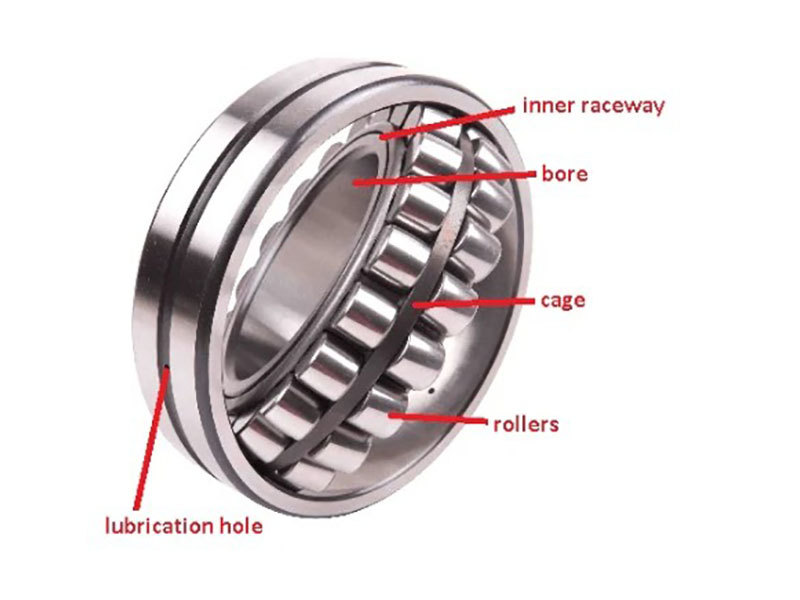
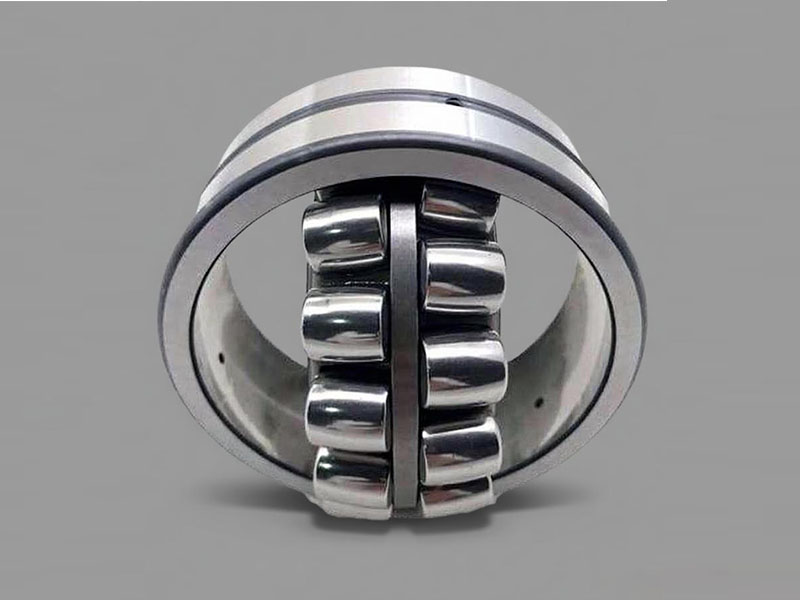
A spherical roller bearing is a double-row rolling-element bearing that uses barrel-shaped (convex) rollers running on a spherical outer ring raceway and two raceways on the inner ring that are inclined relative to the bearing axis. The center of the outer ring’s spherical raceway coincides with the bearing axis—this is what enables the bearing’s self-aligning capability.
Basic structure: A spherical outer ring (with a spherical raceway), an inner ring (with two raceways inclined relative to the bearing axis), two rows of barrel-shaped rollers, and a cage. The bearing is self-retaining and cannot be disassembled—the outer ring, inner ring, and roller assembly form a single unit.
Main types:
- CA type: One-piece machined brass cage, symmetrical rollers, inner ring-guided. Used in large bearings for high radial loads and moderate bidirectional axial loads.
- CC type: Two-piece pressed steel cage, symmetrical rollers. Used in medium-sized bearings for medium-to-high speed operation.
- MB type: Two-piece machined brass cage, asymmetrical rollers with a center flange on the inner ring. Used in medium-sized bearings for medium-to-high speed operation.
- MA type: One-piece machined brass cage, symmetrical rollers, outer ring-guided. Used in medium-to-large bearings.
- ECA type: Optimized roller set based on CA design with higher load capacity. Used in large bearings.
- EA/C/CD type: Pressed steel cage designs for various applications.
- Symmetrical roller designs (RH/RHR): Two rows of longer symmetrical rollers with pressed steel cages and a center guide ring.
- Asymmetrical roller designs (R/RR): Two rows of crowned asymmetrical rollers separated by a center inner ring flange—reduces sliding friction and roller skewing tendencies.
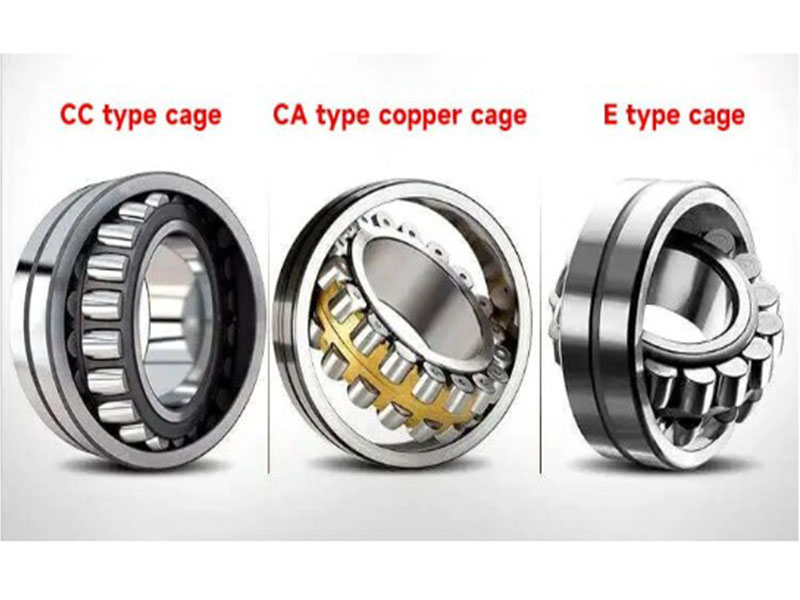
Cage materials: Pressed steel cages (CC, EA types) or machined brass cages (CA, MB, MA types). Brass cages generally enable higher operating speeds.
Precision standards: Conform to ISO 15 for boundary dimensions and ISO 492 for tolerances. JIS/ISO standards ensure global interchangeability.
How it works: The barrel-shaped rollers roll between the spherical outer raceway and the inclined inner ring raceways. Because the outer raceway is spherical, the bearing can automatically adjust to angular misalignment between the shaft and housing. The two rows of rollers are arranged at opposing angles, which enables the bearing to handle thrust loads in both directions. The rollers are crowned (convex-shaped) to distribute loads evenly and reduce edge stresses.
Load handling:
- Radial loads: Primary function—extremely high radial load capacity. Spherical roller bearings are among the highest-capacity rolling bearings for radial loads.
- Axial loads: Can handle heavy axial loads in both directions simultaneously with radial loads. However, they do not handle pure axial loads as well as thrust bearings.
- Combined loads: Excellent capability for simultaneous radial and axial loads.
- Shock loads: Exceptional tolerance to shock and vibration.
Misalignment tolerance: Spherical roller bearings can accommodate 1° to 2.5° of angular misalignment depending on the bearing series, load, and size. Typical values range from 1° to 2° under normal load conditions. Some series allow up to 2.5°. The general range is ±1.5° to ±3.5° depending on the series. Sealed types have reduced misalignment capability—typically 0.5°.
Speed capability: Spherical roller bearings have limited speed capability and are not well-suited for high-speed applications. They have lower limiting speeds than cylindrical roller bearings and ball bearings. They are suitable for low to medium operational speeds. Specific limiting speeds vary by size, lubrication, and cage type—brass-caged designs generally offer higher speed capability. As an example, SKF 222 series bearings have reference speeds ranging from 3,400 rpm to 8,000 rpm depending on size and variant.
Installation characteristics: Available with cylindrical bore or tapered bore (1:12 or 1:30 taper). Tapered bore bearings are mounted using adapter sleeves or withdrawal sleeves. Installation requires precise clearance control—over-driving the adapter sleeve can result in clearance loss after mounting, leading to elevated temperatures and premature failure. The bearing is not separable—all components form a single unit.
Advantages of Spherical Roller Bearings
Pro 1. Self-aligning capability (misalignment compensation)
This is the defining advantage. As explained in the working principle section above, the spherical outer raceway allows the bearing to accommodate 1° to 2.5° of angular misalignment (sealed types: 0.5°). The practical result: shafts can bend, housings can shift, and alignment tolerances can be looser—without sacrificing bearing life. Self-alignment reduces edge loading and extends service life compared to non-self-aligning types.
Pro 2. Extremely high radial and axial load capacity
Spherical roller bearings offer among the highest radial load capacities of any rolling bearing type. They can simultaneously handle heavy radial loads and heavy axial loads in both directions. The large number of barrel-shaped rollers and the double-row design distribute loads evenly across a wide contact area, making them ideal for the most demanding applications.
Pro 3. Excellent shock and vibration resistance
Spherical roller bearings have exceptional tolerance to shock loads and vibration. They perform consistently even under extreme conditions, including application-specific stress and marginal lubrication. They are specifically designed for vibratory applications such as vibrating screens and crushers.
Pro 4. Long service life
Industry data indicates that spherical roller bearings can achieve significantly longer service life than conventional bearings in demanding applications. Their robust design, high-quality materials, and self-aligning capability reduce premature failure from uneven load distribution. Premium designs offer very high running accuracy and reduced wear.
Pro 5. Bidirectional axial load capacity
Unlike cylindrical roller bearings, which have limited axial capacity, spherical roller bearings can handle heavy axial loads in both directions simultaneously with radial loads. The two rows of rollers are arranged at opposing angles, resisting thrust in either direction.
Pro 6. Accommodates shaft thermal expansion (axial floating)
Spherical roller bearings permit axial floating of the shaft, allowing thermal expansion and contraction without imposing additional stress on the bearing. This is critical in applications with significant temperature variations, such as turbopump designs and industrial gearboxes.
Pro 7. Sealed options available
Sealed spherical roller bearings (2RS) provide protection against contaminants, water, and dust while retaining lubricant. They are designed for high contamination environments and offer long service life in harsh conditions. However, sealed types have reduced misalignment capability (0.5°).
Disadvantages of Spherical Roller Bearings
Con 1. Limited speed capability
Spherical roller bearings are not suitable for high-speed applications. They have lower limiting speeds than cylindrical roller bearings and ball bearings. They are designed for low to medium operational speeds. While brass-caged designs offer higher speed capability, they still cannot match the speed potential of cylindrical roller bearings or ball bearings of comparable size.
Con 2. Misalignment beyond limits causes edge loading and premature failure
Despite their self-aligning nature, spherical roller bearings cannot tolerate unlimited misalignment. Exceeding the catalog limit creates edge loading—stress concentrations at the roller ends. Symptoms include: heat on one side of the raceway, localized scuffing, and early spalling. Common causes: structural deflection beyond bearing capability, housing deformation, or poor foundation.
Con 3. Complex installation requiring skilled technicians
Installation is more complex than simpler bearing types. Tapered bore bearings mounted on adapter sleeves require precise clearance control—over-driving the sleeve causes clearance loss after mounting, leading to temperature rise, increased torque, and a low “roaring” sound. Installation requires skilled technicians and proper tools.
Con 4. Larger size and heavier weight
Spherical roller bearings are larger in size and heavier in weight compared to other bearing types with similar load ratings. This can be a disadvantage in space-constrained or weight-sensitive applications.
Con 5. Higher cost
Spherical roller bearings are more expensive than simpler bearing types such as deep groove ball bearings or cylindrical roller bearings. Precision manufacturing, high-quality materials, and complex designs drive up the cost.
Con 6. Sensitivity to contamination
While robust, spherical roller bearings are sensitive to dust, dirt, and moisture. Contamination leads to premature wear and reduced service life. Proper sealing and maintenance are essential. Sealed versions address this but reduce misalignment capability.
Con 7. Cannot be disassembled (non-separable)
Spherical roller bearings cannot be disassembled—the outer ring, inner ring, and roller assembly form a single unit. This means individual components cannot be inspected or replaced separately, making maintenance and inspection more challenging.
Conclusion
Spherical roller bearings are the go-to choice when equipment faces heavy loads, shock, vibration, and misalignment simultaneously. Their self-aligning capability, extreme load capacity, and shock resistance make them indispensable in mining, steel mills, wind turbines, and heavy industrial gearboxes.
Choose spherical roller bearings when:
- Misalignment is unavoidable—shaft bending, housing shift, or installation tolerances are expected (1°–2.5° capability)
- Loads combine heavy radial and bidirectional axial components
- Shock and vibration are present—they have exceptional tolerance
- Medium to low speeds are acceptable—they are not for high-speed applications
- Applications include mining equipment, steel mills, wind turbines, paper mills, marine propulsion, and heavy gearboxes
Consider alternatives when:
- High speeds are required—use cylindrical roller bearings or ball bearings
- Space and weight are critical—they are larger and heavier
- Cost is the primary constraint—simpler bearing types are more economical
- Installation expertise is unavailable—they require skilled installation
- Pure axial loads are dominant—use thrust bearings
Understanding the trade-offs—self-alignment vs. speed, load capacity vs. size, and durability vs. cost—is the key to making the right selection.
At DUHUI Bearing, we have been manufacturing automotive and industrial bearings since 2003, serving customers in over 60 countries. Our spherical roller bearings are produced to international standards (ISO 15, ISO 492) with precision grades up to P5 and above. Whether you need standard sizes or custom configurations, we are here to help you find the right bearing solution for your application.
Frequently Asked Questions (FAQs)
Q1: How much misalignment can a spherical roller bearing tolerate?
Generally 1° to 2.5° depending on the bearing series, load, and size. Under normal load conditions, typical allowable misalignment is 1° to 2°. Some series allow up to 2.5°. The general range is ±1.5° to ±3.5° depending on the series. Sealed types have reduced capability—typically 0.5°. Exceeding these limits causes edge loading and premature failure.
Q2: What is the main difference between spherical roller bearings and cylindrical roller bearings?
The key difference is self-aligning capability. Spherical roller bearings have a spherical outer raceway that allows 1°–2.5° of misalignment and can handle radial + bidirectional axial loads. Cylindrical roller bearings have straight raceways, cannot accommodate misalignment, and have limited axial capacity (except ribbed designs). Cylindrical roller bearings offer higher speed capability—they are the highest-speed roller bearing type—while spherical roller bearings are limited to low to medium speeds.
Q3: Can spherical roller bearings handle axial loads?
Yes. Spherical roller bearings can handle heavy axial loads in both directions simultaneously with radial loads. The two rows of rollers are arranged at opposing angles, resisting thrust in either direction. However, for pure axial loads or sustained high axial loads, tapered roller bearings or thrust spherical roller bearings may be more suitable.
Q4: What is the speed capability of spherical roller bearings?
Spherical roller bearings have limited speed capability and are not suitable for high-speed applications. They have lower limiting speeds than cylindrical roller bearings and ball bearings. They are designed for low to medium operational speeds. Brass-caged designs generally offer higher speed capability than steel-caged designs. Specific speed limits vary by size and variant.
Q5: What are the typical applications of spherical roller bearings?
Spherical roller bearings are used in mining equipment (crushers, vibrating screens, conveyors), steel mills (rolling mills), wind turbines (main shafts), paper mills, marine propulsion, heavy industrial gearboxes, fans and blowers, and construction equipment.
Q6: What are the different types of spherical roller bearings?
CA type: One-piece brass cage, symmetrical rollers, inner ring-guided. CC type: Two-piece steel cage, symmetrical rollers. MB type: Two-piece brass cage, asymmetrical rollers with center flange. MA type: One-piece brass cage, symmetrical rollers, outer ring-guided. ECA type: Optimized roller set based on CA design. EA/C/CD: Pressed steel cage designs.
Q7: What are the common failure modes of spherical roller bearings?
Edge loading / misalignment beyond limits: Heat on one raceway side, localized scuffing, early spalling—fix the structure or upsize. Clearance lost after mounting (sleeve drive-up): Temperature rise, torque increase, low “roaring” sound—reinstall to specification. Smearing / scuffing: Caused by shock loads or poor lubrication film—improve lubrication, control shock. Contamination: Dust, dirt, moisture cause premature wear—use sealed types or improve sealing. Overload: Exceeding rated capacity causes fatigue failure.
Q8: What are the special installation requirements for spherical roller bearings?
Installation is more complex than simpler bearing types. Tapered bore bearings are mounted using adapter sleeves or withdrawal sleeves. Precise clearance control is critical—over-driving the sleeve causes clearance loss after mounting, leading to elevated temperatures and premature failure. Installation requires skilled technicians and proper tools. The bearings are non-separable—all components form a single unit.
Q9: When should I choose spherical roller bearings over other types?
Choose spherical roller bearings when misalignment is unavoidable (shaft bending, housing shift, installation tolerances), loads combine heavy radial and bidirectional axial components, shock and vibration are present, and medium to low speeds are acceptable. For high-speed applications with good alignment, choose cylindrical roller bearings or ball bearings. For pure axial loads, choose thrust bearings.