Quick Answer
Needle roller bearings use long, thin cylindrical rollers with a length-to-diameter ratio of at least 4:1 to deliver extremely high radial load capacity in the smallest radial cross-section of any rolling bearing. Key advantages include high load capacity in confined spaces, high rigidity, low inertia, and suitability for oscillating motion. However, they have very limited axial load capacity, are sensitive to misalignment, generate higher friction than ball bearings, and require careful installation. Choose them when radial space is extremely limited and loads are primarily radial at moderate speeds—applications include automotive transmissions, pumps, compressors, and compact gearboxes.
When radial space is at a premium but you still need to carry heavy loads, needle roller bearings are often the answer. They deliver high radial load capacity in a remarkably compact package—a combination no other rolling bearing can match.
What makes needle roller bearings different from other roller bearings? Can they handle axial loads? How fast can they run? This article answers these questions by breaking down what needle roller bearings are, how they work, and—most importantly—their advantages and disadvantages.
What Is a Needle Roller Bearing and How Does It Work?
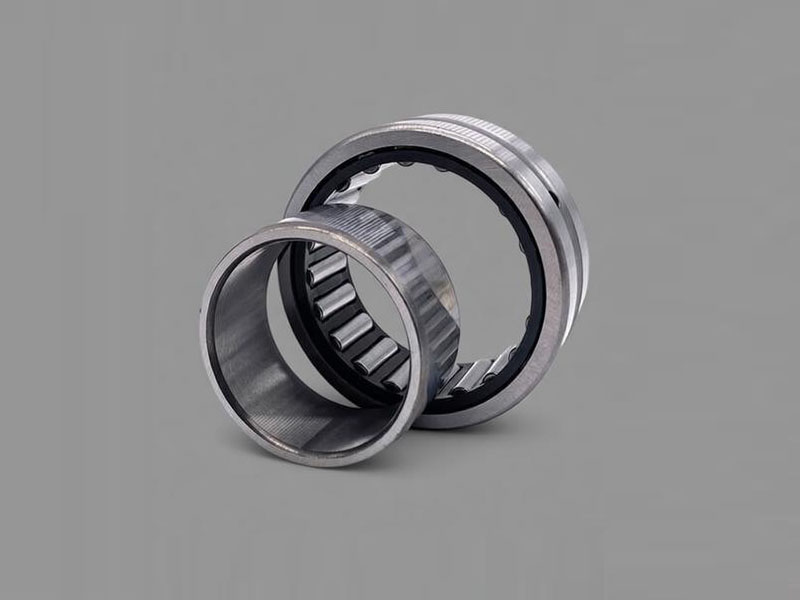
A needle roller bearing is a type of cylindrical roller bearing in which the rollers are significantly longer than they are wide—with a length-to-diameter ratio of at least 4:1. Some sources define the ratio as greater than 3:1. NSK defines needle rollers as those with a diameter of 6 mm or less and a length 3–10 times the diameter.
Basic structure: A needle roller bearing consists of an outer ring (drawn cup or machined ring), an inner ring (optional—some designs run directly on the shaft), needle rollers, and a cage (retainer) in caged designs. The rollers are long and thin, with a small diameter relative to their length.
Core distinguishing feature: Needle roller bearings have the lowest radial cross-sectional height of any rolling bearing. This compactness is achieved by using many small-diameter rollers packed closely together, maximizing load-carrying surface area within a minimal radial envelope.
Main types:
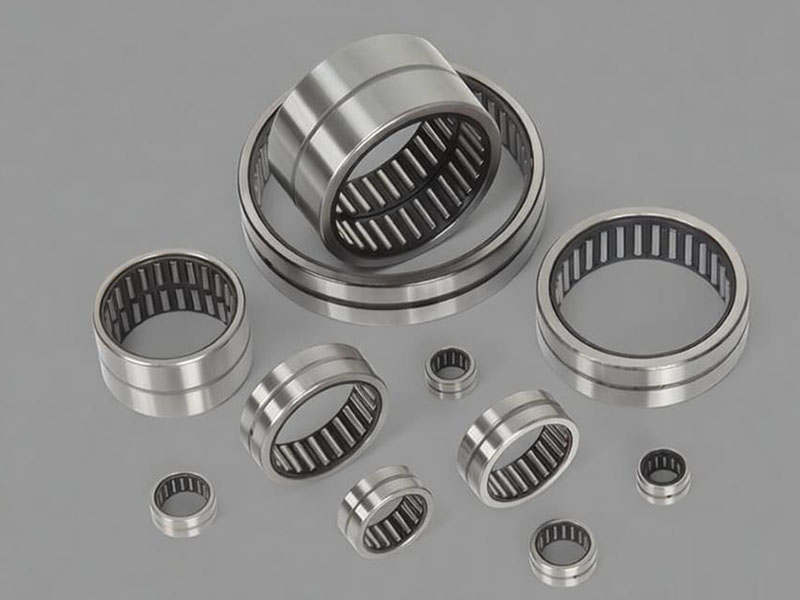
- Drawn cup (shell type): Thin-walled, deep-drawn steel outer ring that serves as the outer raceway. Most compact and economical option. Typically press-fitted into the housing. Suitable for tight envelopes and press-fit housings.
- Machined ring (solid type): Machined from carbon chromium bearing steel with thicker walls. Provides higher stiffness and shock resistance than drawn cup designs. Available with or without flanges on the outer ring.
- Needle roller and cage assemblies: Self-contained units without inner or outer rings. The shaft and housing bore serve as raceways. Require minimal radial space.
- Thrust needle roller bearings: Designed specifically for axial loads.
- Track rollers / cam followers: Heavy-duty needle bearings with integral stud or inner ring.
With inner ring vs. without inner ring:
- With inner ring (NA type): Used when the shaft cannot be hardened and ground to serve as a raceway. The inner ring provides a proper rolling surface.
- Without inner ring (RNA type): The shaft itself serves as the inner raceway. More compact but requires the shaft to be hardened and ground to bearing quality.
Caged vs. full complement:
- Caged (with cage): A cage separates and guides the rollers. Higher speed capability—retainers prevent high-velocity rubbing between adjacent needles. Lower friction, better lubrication flow, and more effective roller guidance. Typically 50% less friction than full-complement designs.
- Full complement (no cage): Contains the maximum number of rollers the internal geometry permits. Higher radial load capacity but significantly lower speed capability. Full complement designs generate roughly 1.5 to 2 times the frictional torque of caged bearings. Suitable for heavy-load, low-speed applications or oscillating motion.
Cage materials: One-piece steel cages, engineering polymer cages (polyamide), or brass cages.
Roller materials: Bearing-grade chromium steel (52100 / GCr15).
Precision standards: ISO 3096, DIN 5402-3, ISO 1206 (for machined ring types).
How it works: The long, thin needle rollers roll between the inner and outer raceways. The extended surface contact between the rollers and the raceways allows for better load distribution. Because the rollers are numerous and closely packed, the load is distributed across many line contacts, enabling high radial load capacity within a very small radial space.
Load handling:
- Radial loads: Primary function—extremely high radial load capacity relative to bearing size. Needle roller bearings can withstand 2 to 3 times more load than ball bearings or cylindrical roller bearings of the same shaft diameter.
- Axial loads: Very limited. Standard radial needle roller bearings are not an axial solution—axial loads require pairing with a thrust bearing or using a separate axial bearing.
- Oscillating motion: Particularly well suited for applications that do not require complete revolutions but only pivot through an angle.
Speed capability: Caged designs support high speeds—the cage prevents roller-to-roller rubbing and improves lubricant distribution. Full complement designs have significantly lower speed limits due to increased friction between rollers. Loose-needle (cageless) bearings have speed capability about one-third that of caged assemblies.
Advantages of Needle Roller Bearings
Pro 1. Extremely high radial load capacity in confined spaces
Needle roller bearings deliver high load-carrying capacity within a very small design envelope. The extended surface contact between the many small-diameter rollers and the raceways allows for better load distribution. They can withstand 2 to 3 times more load than ball bearings or cylindrical roller bearings of the same shaft diameter. This makes them the highest load capacity for a given radial space of all rolling-element bearings.
Pro 2. Smallest radial cross-section of any rolling bearing
Needle roller bearings have the lowest radial sectional height of any rolling bearing type. The thin, drawn cup outer rings and the option to run directly on the shaft (without an inner ring) minimize the radial space required. This compactness is the primary reason engineers choose needle bearings over other types.
Pro 3. High rigidity and stiffness
The large number of small-diameter rollers packed closely together provides high rigidity and stiffness. The slender cylindrical shape of the rollers ensures excellent load distribution, minimizing the risk of roller deformation under heavy loads. This rigidity maintains precise alignment and minimizes deflection under load. Drawn cup needle roller bearings have a high load carrying capacity and stiffness owing to their large number of rollers.
Pro 4. Separable design simplifies installation and maintenance
Needle roller and cage assemblies are self-contained, ready-to-mount units. The separable components allow independent mounting of the cage assembly and the outer ring. Drawn cup types are press-fitted into the housing and require no axial positioning fixtures. This simplifies both installation and replacement.
Pro 5. Low inertia
The small diameter and low mass of each needle roller reduce the centrifugal forces during rotation, resulting in decreased heat generation and improved operating speed. This low inertia makes needle bearings suitable for applications requiring rapid acceleration and deceleration.
Pro 6. Excellent for oscillating and swinging motion
Needle roller bearings are particularly well suited for applications that do not require complete revolutions but only pivot through an angle. They perform effectively in oscillatory motion and are used in rocker arm pivots and similar applications. Full complement designs are especially suitable for oscillation at low speed.
Pro 7. Raceway versatility—use shaft as the raceway
In many applications, no inner ring is required—the hardened shaft itself serves as the inner raceway. This reduces the radial space requirement even further and simplifies the bearing arrangement. Needle roller and cage assemblies can be used to create bearing arrangements that require minimal radial space when the shaft and housing bore can serve as raceways.
Disadvantages of Needle Roller Bearings
Con 1. Very limited axial load capacity
Standard radial needle roller bearings are not designed to handle axial loads—they are radial load solutions. They exhibit lower thrust capacity compared to other bearing types. If your application requires axial load support, you must pair the needle roller bearing with a thrust bearing or use a separate axial bearing arrangement.
Con 2. Sensitivity to misalignment
Needle roller bearings are sensitive to shaft misalignment, which can lead to premature wear and failure if not properly managed. Standard types only allow slight misalignment of the bearing axis. Misalignment causes uneven load distribution and edge stresses that significantly reduce bearing life. (Note: special aligning needle roller bearings can compensate for up to 3° of static misalignment, but these are specialized variants.)
Con 3. Higher friction than ball bearings
Because needle rollers cannot be manufactured as accurately as larger diameter cylindrical rollers, needle roller bearings typically have greater frictional losses than other cylindrical roller bearings. The increased contact area between rollers and raceways, while beneficial for load capacity, also results in higher friction compared to bearings with smaller contact points. Full complement designs generate roughly 1.5 to 2 times the frictional torque of caged bearings.
Con 4. Complex installation requiring precision
The assembly of needle roller bearings requires precision and attention to detail. The numerous small cylindrical rollers need to be aligned properly within the cage during installation. Some designs require separate thrust washers or other components for proper performance. The installation accuracy requirement is high—correct installation position and accuracy must be ensured.
Con 5. Vulnerability to contamination
The open-end design of many needle roller bearings attracts contaminants such as dust, dirt, and moisture. Contamination leads to premature wear and reduced bearing life. While sealing options are available, they increase complexity and may limit operating speed.
Con 6. Full complement designs have low speed capability
Full complement needle roller bearings (without cages) have significantly lower speed limits than caged designs. The roller-to-roller rubbing at high speeds generates excessive heat and friction. Full complement bearings are suitable for heavy-load, low-speed applications but cannot match the speed capability of caged bearings.
Con 7. Rollers may fall out during maintenance (full complement)
With full complement needle bearings, whenever the shaft is removed to perform maintenance or to lubricate the bearing, the rollers tend to fall out of the outer bearing ring. This creates handling difficulties during maintenance and increases the risk of losing or damaging rollers. Caged designs retain the rollers securely, eliminating this issue.
Conclusion
Needle roller bearings are the go-to choice when radial space is extremely limited but high radial load capacity is required. Their smallest-in-class radial cross-section, high rigidity, and excellent load-carrying capability make them indispensable in compact gearboxes, transmissions, pumps, compressors, and automotive components.
Choose needle roller bearings when:
- Radial space is extremely limited—they have the smallest radial cross-section of any rolling bearing
- High radial load capacity is required in a compact envelope
- High rigidity and stiffness are needed
- Moderate speeds are acceptable (caged designs for higher speeds, full complement for lower speeds)
- Axial loads are limited or can be handled by separate thrust bearings
- Applications include automotive transmissions, planetary gears, pumps, compressors, small motors, rocker arm pivots, industrial gearboxes, textile machinery, and robotics
Consider alternatives when:
- Significant axial loads are present—use angular contact ball bearings or tapered roller bearings
- Misalignment cannot be avoided—use self-aligning ball bearings or spherical roller bearings
- Lowest possible friction is critical—use ball bearings
- Extremely high speeds are required—use ball bearings or caged cylindrical roller bearings
- Shock loads are frequent—use machined ring types instead of drawn cup
Understanding the trade-offs—compactness vs. axial capacity, load capacity vs. speed, and caged vs. full complement—is the key to making the right selection.
At DUHUI Bearing, we have been manufacturing automotive and industrial bearings since 2003, serving customers in over 60 countries. Our needle roller bearings are produced to international standards (ISO 3096, DIN 5402-3) with precision grades up to P5 and above. Whether you need drawn cup, machined ring, caged, or full complement designs, we are here to help you find the right bearing solution for your application.
Frequently Asked Questions (FAQs)
Q1: Can needle roller bearings handle axial loads?
Very limited. Standard radial needle roller bearings are not designed for axial loads—they are radial load solutions. If your application requires axial load support, you must pair the needle roller bearing with a thrust bearing or use a separate axial bearing arrangement.
Q2: What is the main difference between needle roller bearings and ball bearings?
The core differences are contact type and radial space efficiency. Needle roller bearings use line contact (rollers) and deliver 2 to 3 times higher radial load capacity than ball bearings of the same shaft diameter. Ball bearings use point contact (balls) and have lower friction and higher speed capability. Needle bearings have the smallest radial cross-section of any rolling bearing, while ball bearings are larger for equivalent load capacity.
Q3: What is the difference between needle roller bearings and cylindrical roller bearings?
The key difference is roller geometry and radial section height. Needle roller bearings have rollers with a length-to-diameter ratio of at least 4:1 (or 3:1), while standard cylindrical roller bearings have shorter, thicker rollers. Needle bearings have a much smaller radial cross-section but higher friction than cylindrical roller bearings due to manufacturing limitations. Needle bearings are used where space is extremely limited; cylindrical roller bearings are used where space is less constrained and lower friction is desired.
Q4: What is the difference between caged and full complement needle roller bearings?
Caged bearings have a cage that separates and guides the rollers—they offer higher speed capability, lower friction, and better lubrication flow but lower radial load capacity. Full complement bearings have no cage and contain the maximum number of rollers—they offer higher radial load capacity but significantly lower speed limits. Full complement designs typically generate 1.5 to 2 times the frictional torque of caged bearings.
Q5: What is the difference between drawn cup and machined ring needle roller bearings?
Drawn cup bearings have a thin-walled, deep-drawn steel outer ring. They are the most compact and economical option, suitable for tight envelopes and press-fit housings. Machined ring bearings are machined from carbon chromium bearing steel. They offer higher stiffness and shock resistance and are suitable for heavier-duty applications.
Q6: What is the difference between bearings with and without an inner ring?
With inner ring (NA type): Used when the shaft cannot be hardened and ground to serve as a raceway. Provides a proper rolling surface. Without inner ring (RNA type): The shaft itself serves as the inner raceway. More compact but requires the shaft to be hardened and ground to bearing quality.
Q7: What are the typical applications of needle roller bearings?
Needle roller bearings are used in automotive transmissions and planetary gears, pumps and compressors, small motors and tools, rocker arm pivots, industrial gearboxes, textile machinery, robotics and robot speed reducers, agricultural and construction equipment, and aircraft controls.
Q8: What is the speed capability of needle roller bearings?
Speed capability depends on design: Caged designs support high speeds—the cage prevents roller-to-roller rubbing and improves lubricant distribution. Full complement designs have significantly lower speed limits due to increased friction between rollers. Loose-needle (cageless) bearings have speed capability about one-third that of caged assemblies. For high-speed applications, choose caged designs.
Q9: What are the common failure modes of needle roller bearings?
Common failure modes include: Shaft raceway wear / galling—caused by shaft too soft/rough, inadequate lubrication, or contamination. False brinelling / fretting—caused by idle vibration, leaving pitch-spaced dents and reddish-brown oxide. Contamination—dust, dirt, and moisture cause premature wear. Misalignment—uneven load distribution and edge stresses reduce life. Lubrication failure—inadequate lubrication leads to burn-up and adhesion failures. Improper assembly—excessive deformation and misalignment from unbalanced loading and improper assembly.