Quick Answer: Static load ratings (C0) describe what a bearing can carry when its rings do not move relative to each other, or move only very slowly, and they protect the raceways from permanent deformation. Dynamic load ratings (C) apply to rotating service and feed the basic rating life calculation L10 = (C/P)^p. The two ratings sit in the same catalog row but answer different questions, so most bearing selections check static safety and fatigue life separately.
A bearing can be ruined by one overloaded event or worn out over millions of ordinary revolutions, and the same catalog table covers both cases with two different ratings. Mixing them up is one of the most common reasons a bearing is either oversized or fails early in service. The sections below treat static and dynamic load separately, show how C0 and C are used in calculations, and explain which one governs a given application.
What Is Static Load in Bearings?
Static load is the load a bearing carries while its rings have no relative movement, or while relative motion is so slow that rolling contact fatigue does not develop. Parked machinery, a heavy assembly resting on a pivot, a lever that oscillates through a few degrees, and a press that clamps without turning are all static cases.
The rating that covers them is the basic static load rating C0. It is the load that produces a defined, permissible amount of permanent deformation at the most heavily loaded contact between a rolling element and its raceway, and it is defined by ISO 76. Every catalog bearing carries a C0 value next to its dynamic rating.
C0 is a deformation limit, not a fracture limit and not a working maximum. Loads above C0 do not break the bearing instantly, but the contact damage grows beyond the amount the rating allows, and the resulting indentations remain after the load is removed.
Shock belongs in this category even when it lasts a fraction of a second:
- A housing dropped during handling or mounting
- A hydraulic cylinder that bottoms out at the end of its stroke
- A vehicle landing hard after a curb strike or a pothole
- A machine that starts under full load before any rotation begins
What Is Dynamic Load in Bearings?
Dynamic load is the load a rotating bearing carries in service. The rating is the basic dynamic load rating C: the constant load, applied in a fixed direction, that gives a basic rating life of one million revolutions. It is the number used for rolling contact fatigue work and it is tied to ISO 281.
Rating life follows the standard relationship:
L10 = (C/P)^p
Here P is the equivalent dynamic load and p is the life exponent, which is 3 for ball bearings and 10/3 for roller bearings. L10 is the life reached or exceeded by 90 percent of a large group of apparently identical bearings running under the same conditions.
Typical rotating applications include:
- Electric motor shafts, where the load is steady and the speed is constant
- Gearbox shafts carrying combined radial and axial loads
- Conveyor rollers running long duty cycles
- Wheel hub bearings on a moving vehicle
The boundary between static and dynamic is a matter of relative motion, not of a fixed speed. A bearing that rocks through a small angle many times per minute often still behaves as a static application, while a bearing that turns continuously spends its working life in the dynamic regime.
Key Differences Between Static and Dynamic Load
The two load cases differ in bearing state, in the damage they cause, and in the criterion used to accept or reject a design.
| Attribute | Static load | Dynamic load |
|---|---|---|
| Bearing state | Stationary, or relative motion near zero | Continuous rotation under load |
| Dominant failure mode | Permanent deformation of raceway and rolling element | Rolling contact fatigue and spalling |
| Rating parameter | Basic static load rating C0 | Basic dynamic load rating C |
| Selection criterion | Static safety factor s0 = C0/P0 | Basic rating life L10 from C/P |
| Typical check | Peak load at rest, during handling or during shock | Load spectrum, speed and required service life |
Deformation and fatigue are different physical processes with different fixes. A deformed raceway needs a larger bearing or a lower peak load; a fatigued raceway needs more rating life, which may come from a larger bearing, a lower equivalent load, or better lubrication and cleanliness.
Bearing Load Ratings: Static (C0) vs Dynamic (C)
Manufacturers calculate both ratings from the internal geometry of the bearing: the number and size of the rolling elements, the contact angle and the raceway curvature. The values are published in catalog tables and are not transferable between bearing types or sizes. A 40 mm bore deep groove ball bearing and a 40 mm bore spherical roller bearing have very different C and C0 values.
C0 answers a deformation question. It marks the load at which contact stress produces the permissible permanent deformation. It does not say how long the bearing will run, and it says nothing about fatigue.
C answers a fatigue question. It is the reference point for the L10 calculation. A load above C is not forbidden; it simply gives a rating life below one million revolutions, and the application has to decide whether that shorter life is acceptable.
Neither value replaces the other. A bearing chosen only on C can still be dented by a static shock load, and a bearing chosen only on C0 can still spall after a few hundred hours of rotation.
Equivalent Load Calculations
Real loads are rarely purely radial or purely axial, and they rarely stay constant. The standard approach reduces the actual load case to one equivalent load that has the same effect as the combined loading.
For dynamic conditions:
P = XFr + YFa
For static conditions:
P0 = X0Fr + Y0Fa
Fr is the radial load, Fa is the axial load, and X, Y, X0 and Y0 are factors taken from the bearing manufacturer’s tables. Those factors depend on bearing type, contact angle and the ratio between axial and radial load, so they cannot be carried across bearing families.
Two simplifications are common:
- For a purely radial load, P reduces to Fr and P0 reduces to Fr
- For a purely axial load on a thrust bearing, P reduces to Fa and P0 reduces to Fa
Where the load varies over a duty cycle, the equivalent load is normally calculated as a weighted value across the cycle before it is compared with C or C0. Using a single average figure for a peaky load case will overstate fatigue life and understate the static check.
When to Use Static vs Dynamic Load Ratings
The choice follows the operating condition, not the bearing size:
- Use C0 for bearings that stand still for long periods, oscillate slowly, or take heavy loads at rest, during handling or during shock.
- Use C for bearings that rotate continuously or for a significant part of the duty cycle, and whenever a rating life has to be calculated.
- Use both when a rotating bearing also sees impact or high peak loads, which is typical of wheel hubs, crushers, presses and steering columns.
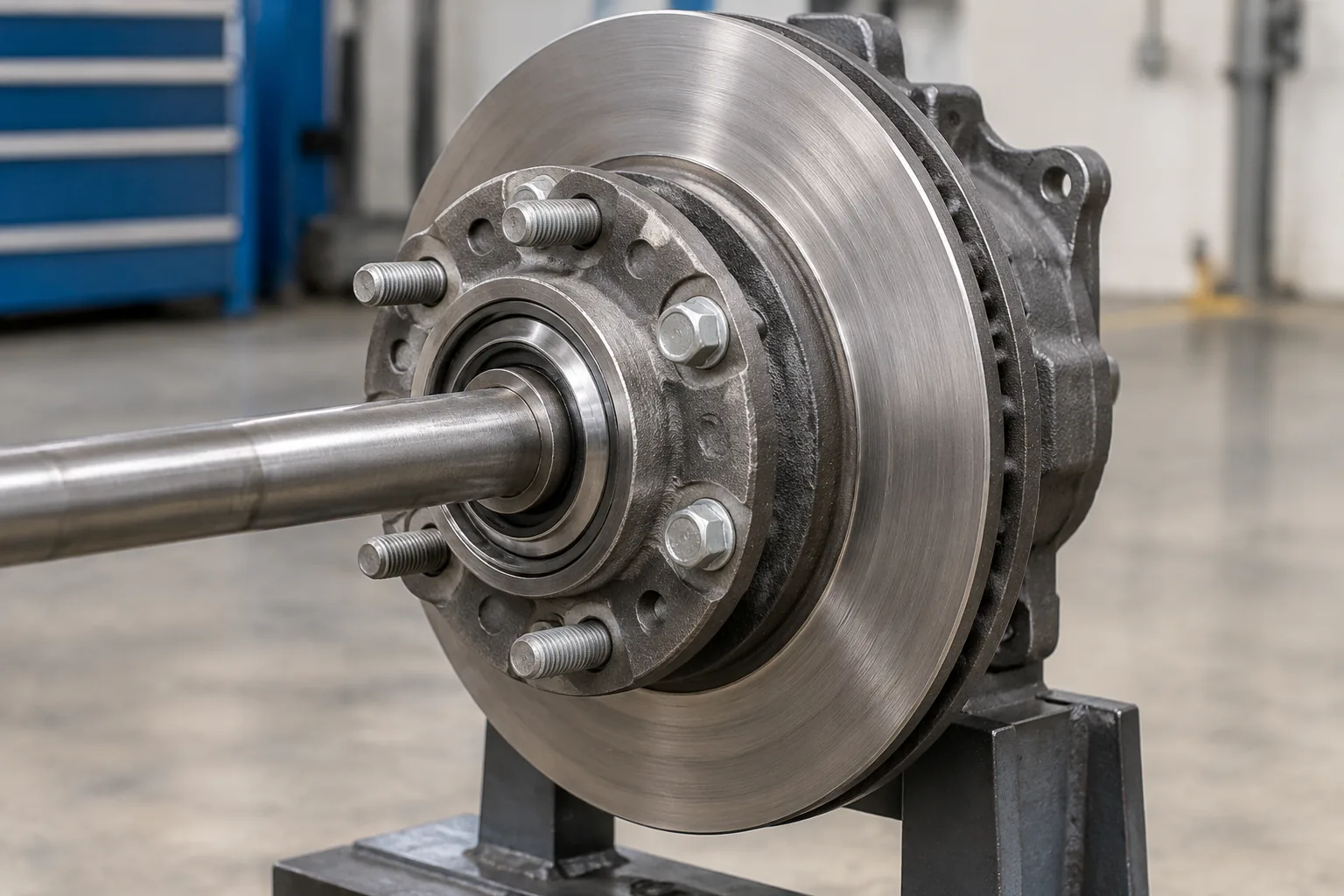
A wheel hub bearing shows the split clearly. The corner weight of a parked vehicle is a static load on the bearing; the same weight plus cornering forces, braking forces and road impacts is the dynamic load while the vehicle moves. Both cases must be safe, and each is judged by a different criterion.
Speed, load direction, required life and the consequence of failure all influence the final decision. Where a bearing runs at high speed or under a varying load, the static check usually acts as a secondary confirmation rather than the governing criterion.
Safety Factors for Static and Dynamic Loads
Static safety is expressed as a factor:
s0 = C0/P0
where P0 is the equivalent static load, including the largest shock or peak load the application can apply. A factor close to 1.0 means the bearing is loaded at its rating with almost no margin for estimation error, misalignment or unexpected impact.
Recommended values are application specific. Smooth, well-aligned machinery with accurately known loads can work with a lower factor, while applications with heavy shock, vibration, poor mounting control or uncertain load estimates need a higher one. Use the ranges published by the bearing manufacturer or the applicable industry standard rather than a general rule of thumb.
Dynamic safety is not expressed as a single factor. It is assessed through rating life: calculate P, divide C by P, apply the life exponent, and compare the result with the service life the application needs. Reliability requirements, lubrication condition and contamination can be handled with the additional life modification factors published with the bearing data.
Common Misconceptions and Practical Tips
A handful of assumptions cause most of the avoidable errors in bearing selection.
Misconception: static load only applies when the shaft is completely stopped. Slow oscillation and small rocking movements belong to the static regime as well, because the contact does not complete enough rolling cycles to develop fatigue before deformation and surface damage dominate.
Misconception: the dynamic load rating is the maximum allowable load. It is a reference load for the life calculation. Higher loads are permitted; they simply shorten L10.
Misconception: the static load rating is a limit that must never be exceeded. A slight exceedance may be tolerable where the resulting deformation does not disturb smooth running, but that judgement belongs to the application engineer and to the bearing supplier’s data, not to a general rule.
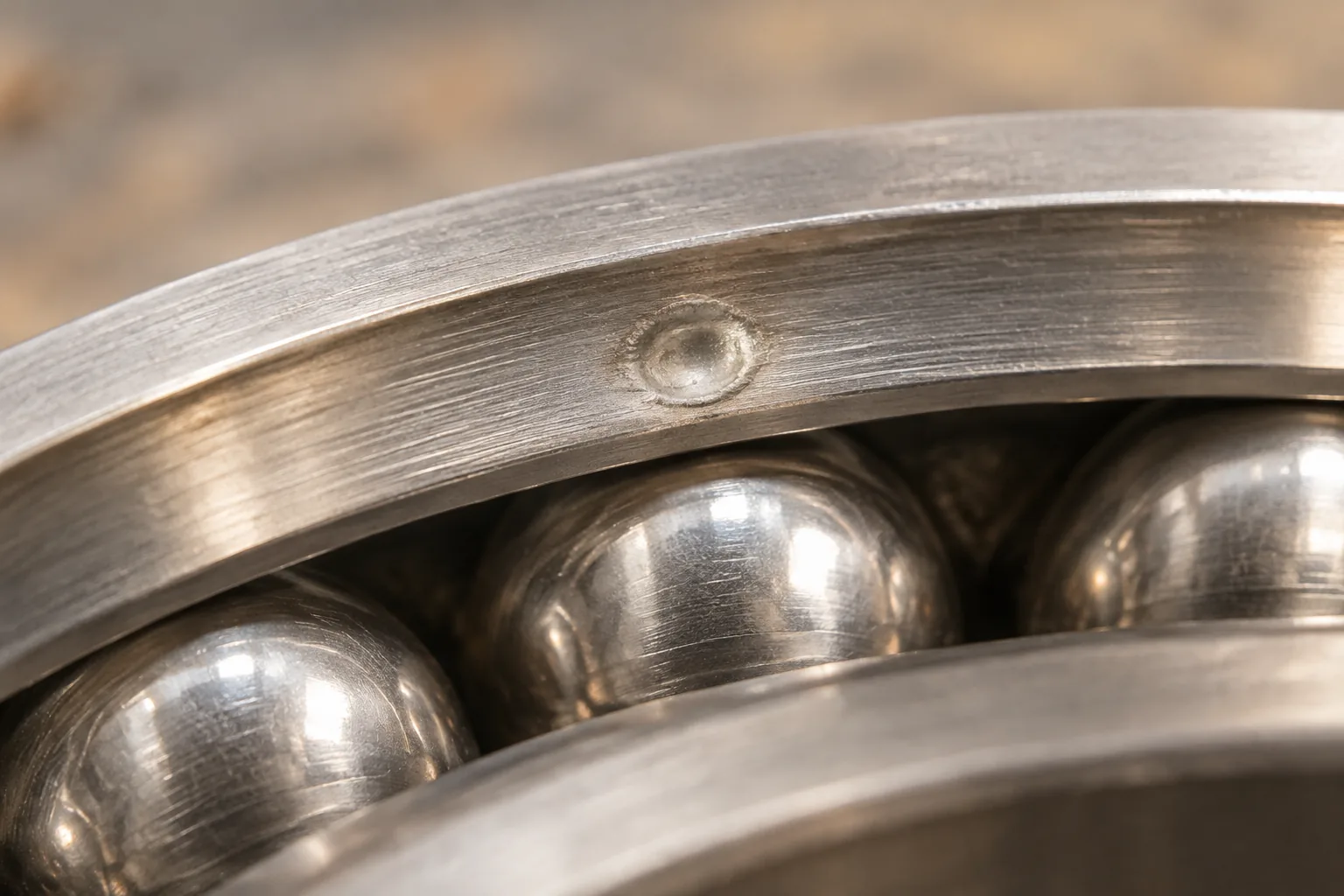
Misconception: if the bearing rotates, only the dynamic rating matters. Impact during rotation can still produce brinelling, and the static check catches the peak loads that a life calculation averages away.
Practical steps that reduce risk:
- Establish the real load spectrum, including starting, stopping and abnormal events
- Resolve combined loads into an equivalent dynamic load and an equivalent static load
- Take X, Y, X0 and Y0 factors from the data for the exact bearing type and size
- Check the static factor against peak load and the rating life against required service life
- Review mounting, handling and alignment, since impact during fitting and incorrect mounting are recognized causes of early damage
Conclusion
Static load and dynamic load describe two working states and two failure mechanisms. C0 protects the raceway against permanent deformation when the bearing is at rest, oscillating slowly or absorbing a shock, while C drives the fatigue life calculation for a rotating bearing. Building the equivalent loads with the correct factors, then checking the static safety factor and the rating life against the application, is what makes a bearing selection defensible. Where the load case is uncertain, the safe next step is to obtain catalog data for the exact bearing and confirm the peak loads before release.
FAQs
Q1: What is the difference between static load and dynamic load in bearings?
A: A static load acts while the rings have no relative movement, or move so slowly that fatigue does not govern, and it is checked against the basic static load rating C0 to prevent permanent raceway deformation. A dynamic load acts while the bearing rotates, and it is checked against the basic dynamic load rating C to calculate the basic rating life L10. The same bearing carries both ratings, and a complete selection usually checks both.
Q2: How do I calculate equivalent dynamic load?
A: Use P = XFr + YFa, where Fr is the radial load, Fa is the axial load, and X and Y come from the manufacturer’s table for that bearing type and load ratio. For a purely radial load the axial term drops out and P equals Fr. Take the factors from the exact catalog entry, because they change with contact angle and with the ratio between axial and radial load.
Q3: When should I use static load rating vs dynamic load rating?
A: Use C0 when the bearing stands still for long periods, oscillates slowly, or has to survive heavy peaks and shocks at rest, such as a parked machine or a clamped fixture. Use C when the bearing rotates for a meaningful part of its duty cycle and a life figure is required. Rotating equipment that also sees impact needs both checks.
Q4: What is a safe static safety factor?
A: There is no universal number. The static safety factor s0 = C0/P0 has to be higher when the load estimate is rough, when shock and vibration are present, or when alignment and mounting control are poor, and it can be lower for smooth applications with well-defined loads. Use the ranges published by the bearing manufacturer or the applicable industry standard for that application.
Q5: Can a bearing handle loads higher than its dynamic load rating?
A: Yes. The dynamic load rating is a reference load that gives a basic rating life of one million revolutions, not a maximum load. A higher equivalent load simply produces a shorter L10, and the question becomes whether the resulting life still covers the service interval. Very large overloads or impact events should also be checked against the static rating.
Q6: What is the difference between C0 and C in bearing catalogs?
A: C0 is the basic static load rating and relates to permanent deformation of the contact surfaces under stationary or very slow-moving conditions. C is the basic dynamic load rating and is used for the rating life calculation of a rotating bearing. Both appear in the same catalog row but answer different questions, so neither substitutes for the other.