Quick Answer: Sprocket tooth count sets the drive ratio between the driver and driven sprockets. With chain pitch matched, a larger driven sprocket lowers output speed and raises torque; a smaller driven sprocket does the reverse. Tooth count also changes how sharply each link articulates, so smaller sprockets generally accelerate wear while larger ones run more smoothly but need more space. Final choice balances speed, torque, chain life, and package limits.
Sprocket tooth count is often treated as a single specification line, but it sets the ratio between the driver and driven sprockets and influences how a chain drive behaves in service. A change that raises output speed usually lowers available torque, and a change that improves smoothness can alter package size, chain length, and wear patterns. The useful question is not which count is best in general, but which combination meets the drive’s speed, torque, space, and maintenance requirements.
Chain Drive Ratio Basics: What Tooth Count Actually Changes
In a two-sprocket chain drive, the driver sprocket is the input and the driven sprocket is the output. When chain pitch and sprocket geometry are compatible, tooth count sets the drive ratio. The ratio is i = N driven / N driver. For steady-state operation with losses ignored, output speed is n out = n in x N driver / N driven, and output torque is T out = T in x N driven / N driver.
These are ideal relationships. Efficiency losses, shock loads, and chordal action can make real behavior differ, so use them to establish the direction and approximate size of a change before checking the full drive design.
How Sprocket Tooth Count Affects Speed
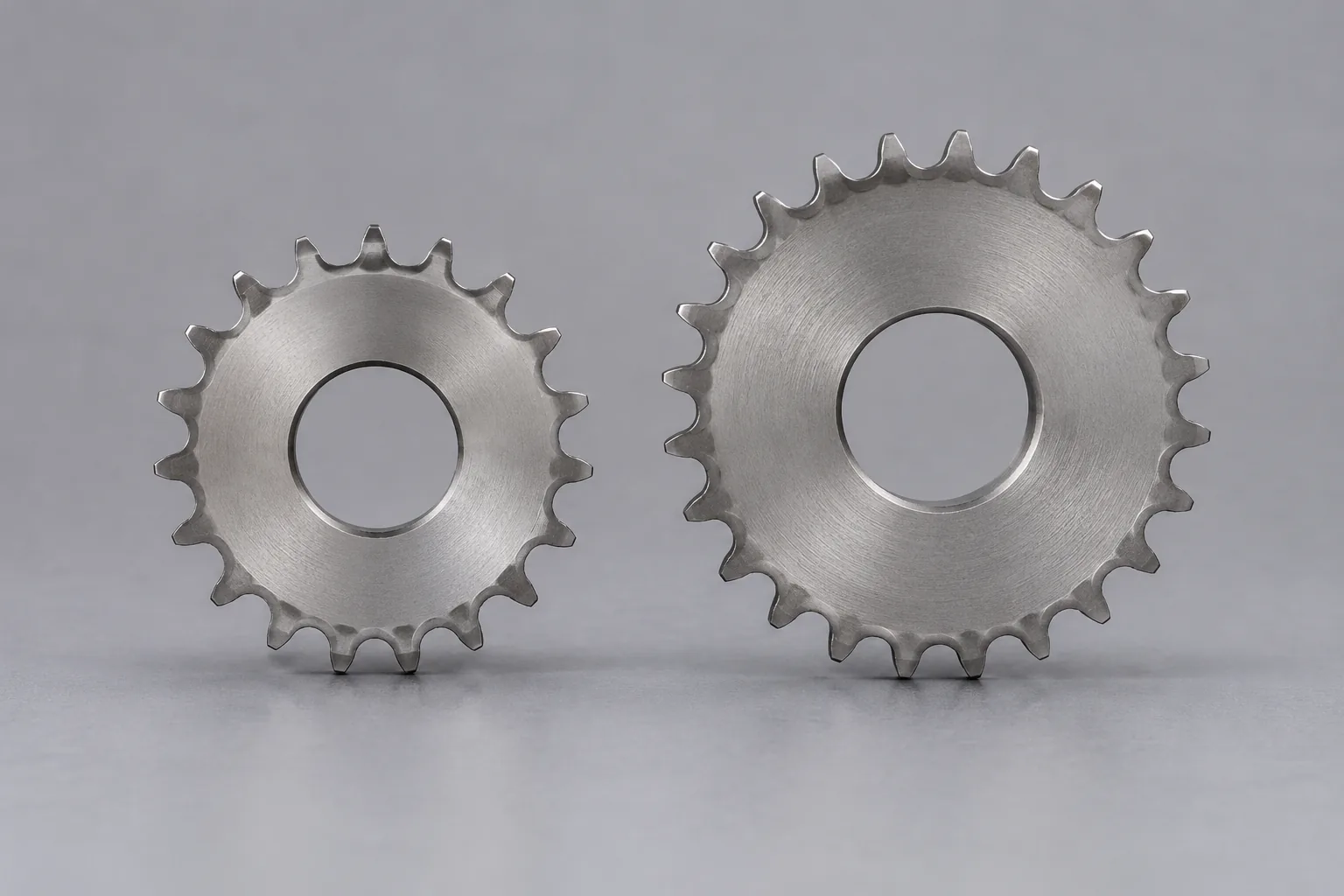
With input rpm fixed, increasing the driven sprocket’s tooth count lowers output speed because the ratio rises. Reducing driven teeth raises output speed. Changing the driver has the opposite effect for a fixed driven count: more driver teeth increase output speed, while fewer driver teeth reduce it.
The change is proportional to the tooth-count ratio rather than to chain speed alone. Simple ratio math assumes fixed input rpm, matching chain pitch, and steady-state operation. It does not capture slip, shock, or efficiency losses.
How Sprocket Tooth Count Affects Torque
At a given input power or torque, torque multiplication follows the drive ratio. A larger driven sprocket increases output torque while reducing output speed. A smaller driven sprocket reduces available output torque while increasing output speed.
Sprocket changes trade speed against torque; they do not create additional power. Use the ideal torque relationship only when input power or torque is held constant for comparison. Efficiency losses, load limits, and motor or controller limits affect real output.
How Sprocket Tooth Count Affects Chain Life
Smaller sprockets increase the articulation angle per engagement, so each link flexes more as it enters and leaves the sprocket. That generally increases link flexing and wear. Larger tooth counts reduce articulation severity and pulsation, but they add size, weight, and clearance considerations.
Chain life depends on load, lubrication, alignment, tension, environment, and sprocket wear, not tooth count alone. Minimum recommended tooth counts vary by speed and load, so treat any single number as application-dependent.
Articulation Angle and Polygonal Effect
Smaller tooth counts cause greater link articulation and stronger chordal action, the polygonal effect that makes chain speed rise and fall slightly as each tooth engages. The result can appear as vibration, pulsation, and a greater wear tendency. Larger sprockets smooth chain motion but may not fit constrained spaces. High-speed drives need additional dynamic considerations beyond simple articulation geometry.
Wear Factors Beyond Tooth Count
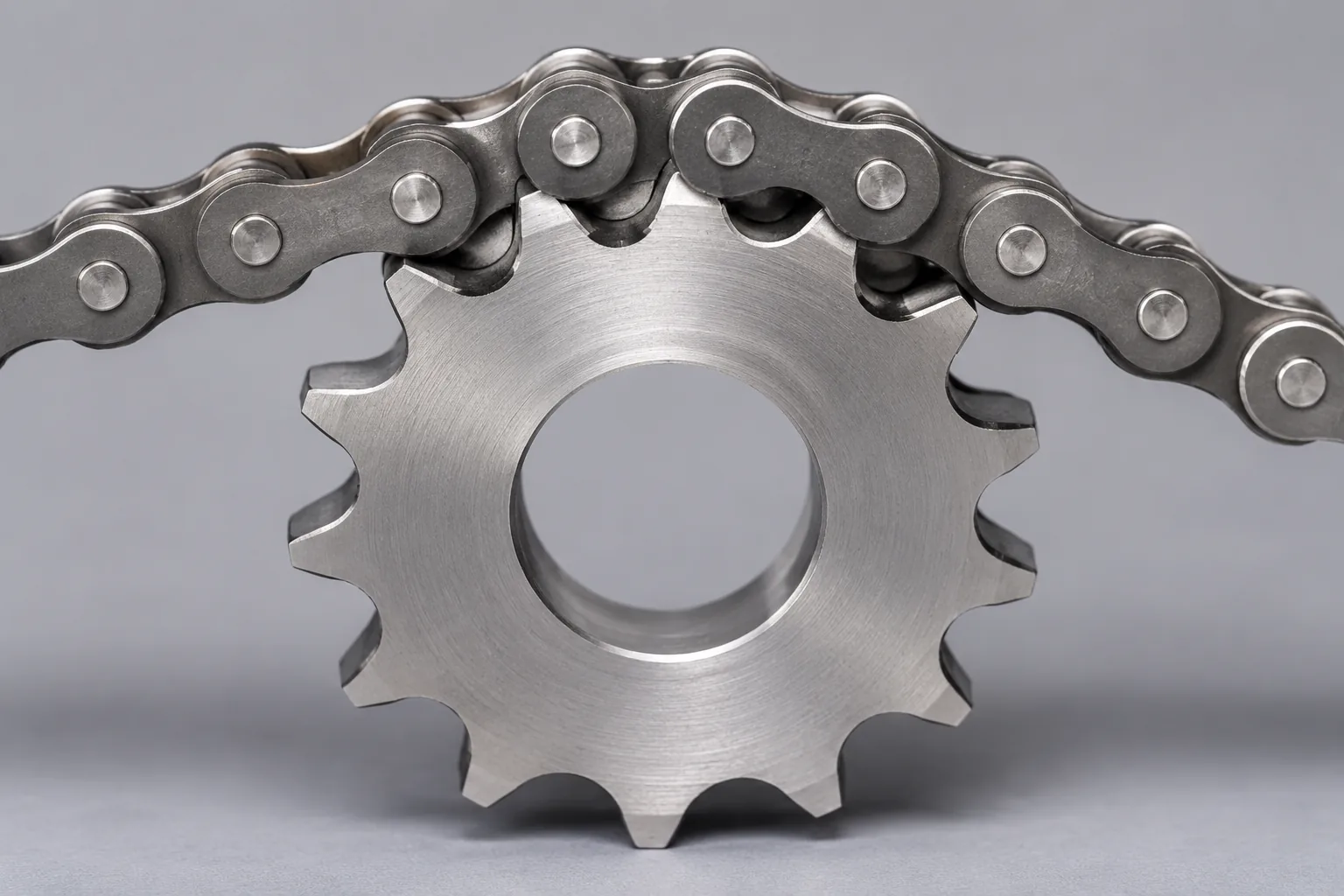
Tooth count is only one life factor. Load, lubrication, alignment, tension, contamination, and sprocket condition often decide whether a drive reaches its expected service life. Select tooth count together with a maintenance plan and the actual operating conditions.
No specific tooth count guarantees a specific chain life. Severe contamination or overload can invalidate general life expectations.
The Trade-off Between Speed, Torque, and Chain Life
There is no universally best tooth count. The right choice depends on required output speed, output torque, package size, and life target. Changing one sprocket alters the ratio and can affect chain length, center distance, clearance, and tensioning.
Selection should meet performance targets while keeping tooth counts within practical limits for the application. Existing hardware constraints may force a compromise between ratio and sprocket size.
Practical Selection Checklist for Sprocket Tooth Count
- Define required output speed, output torque, input rpm or power, duty cycle, and space limits.
- Choose a drive ratio and convert it into a compatible driver and driven tooth-count pair.
- Check minimum tooth count, chain wrap, clearance, chain length, and tensioning requirements.
- Confirm lubrication, alignment, and a maintenance plan for the intended life target.
This checklist fits a new design or a controlled retrofit with verifiable input data. A retrofit also requires confirming existing shaft, hub, and chain compatibility before ordering parts.
Common Misconceptions About Sprocket Tooth Count
- More teeth is not universally better. Larger sprockets reduce articulation but change ratio and package size.
- Changing tooth count does not create power. It trades speed against torque.
- A tooth-count change may require a system review. Check chain length, center distance, and tensioner travel.
Application-specific constraints can make an otherwise favorable tooth count impractical.
Key Takeaways
- Tooth count controls drive ratio and therefore affects speed, torque, and chain articulation.
- Smaller sprockets generally increase articulation and wear risk; larger sprockets generally reduce articulation but add size.
- Final selection should balance speed, torque, chain life, package constraints, and maintenance conditions.
Conclusion
Understanding sprocket tooth count means treating the driver and driven sprockets as a pair. Tooth count sets the ratio that trades output speed against torque, and it changes the articulation that influences chain wear. A smaller sprocket can raise speed or reduce size, but it usually increases articulation and wear risk; a larger one can smooth operation and reduce articulation, but it needs space and changes the ratio.
Before changing a sprocket, calculate the new ratio, confirm chain length and clearance, and check lubrication and tension. The safe next step is to verify the complete drive against the equipment manufacturer’s specifications rather than selecting a count in isolation.
FAQs
Q1: Does a larger sprocket increase speed or torque?
A: It depends on which sprocket changes. A larger driven sprocket increases output torque and reduces output speed. A larger driver sprocket increases output speed and reduces output torque for a fixed driven count. Confirm the position and the resulting ratio before changing either sprocket.
Q2: How does tooth count affect chain life?
A: Smaller sprockets generally increase the articulation angle per engagement, which adds link flexing and wear risk. Larger sprockets reduce articulation severity and pulsation but may add size and weight. Load, lubrication, alignment, tension, contamination, and sprocket condition remain major life factors, so tooth count alone does not determine service life.
Q3: What is the minimum recommended sprocket tooth count?
A: There is no universal minimum that applies to every drive. Minimum tooth count depends on chain pitch, speed, load, available space, and the chain or equipment manufacturer’s guidance. Low counts increase articulation and pulsation, so verify the limit for the specific drive rather than copying a number from another application.
Q4: Can I change only the front or rear sprocket?
A: You can change one sprocket, but the drive ratio will change and the rest of the system may need attention. Check chain length, center distance, tensioner travel, clearance, and the wear condition of the mating sprocket. A single-sprocket change is a ratio decision, not an isolated part swap.
Q5: How do I calculate speed and torque from sprocket tooth count?
A: Use the tooth-count ratio i = N driven / N driver. With losses ignored, output speed is n in x N driver / N driven, and ideal output torque is T in x N driven / N driver. Treat these as ideal relationships; efficiency losses, shock loads, and operating limits affect the real result.
Q6: Does changing tooth count change chain length?
A: It often does when center distance is fixed, because the required chain length depends on both sprocket sizes. Recalculate chain length and confirm tensioner adjustment range before ordering. Also check that the new sprocket clears the frame, guard, and nearby components.