A journal bearing supports a rotating shaft using a thin fluid film rather than rolling elements. Unlike ball or roller bearings, journal bearings operate without metal-to-metal contact once the shaft reaches operating speed. But how do you choose the right type for your turbomachinery, compressor, or gearbox application? This guide explains how journal bearings work, outlines the key selection parameters, compares common design types, and describes typical failure modes encountered in industrial service.
What Is a Journal Bearing?
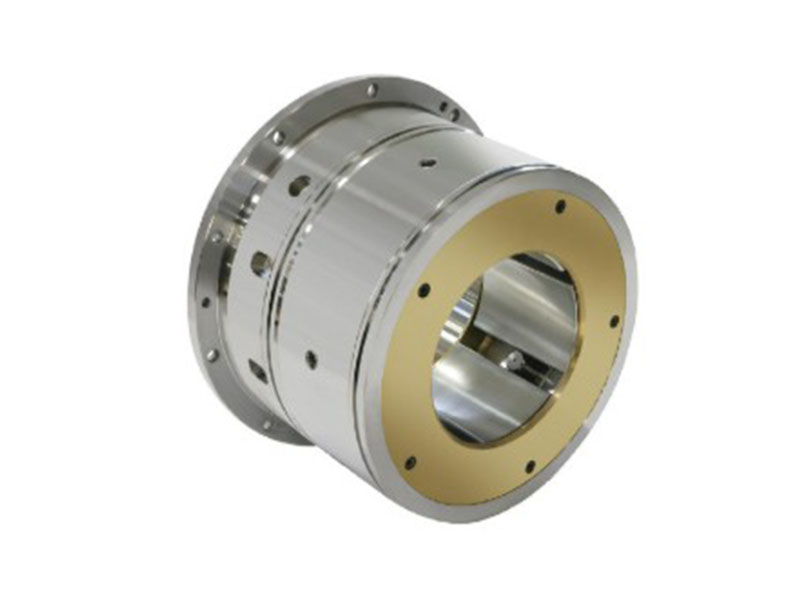
A journal bearing is a fluid-film bearing that supports a radially loaded rotating shaft — known as the journal. The bearing consists of a cylindrical shell lined with a soft material (typically babbitt or similar alloy), with a precisely controlled clearance between the shaft and the bearing surface. Lubricating oil is introduced into this clearance, forming a load-carrying film that separates the two metal surfaces under normal operating conditions.
Journal bearings offer several distinct characteristics: they can support very high radial loads, provide excellent vibration damping, and operate with low noise. These properties make them well-suited for heavy rotating machinery such as turbines, compressors, motors, generators, and large pumps.
How Does a Journal Bearing Work?
The operating principle of a journal bearing is based on fluid-film lubrication. There are two primary lubrication regimes: hydrodynamic and hydrostatic.
Hydrodynamic journal bearings rely on the relative motion between the shaft and the bearing to generate the fluid film. As the shaft rotates, it draws oil into a converging wedge-shaped gap. The viscous oil builds up pressure within this wedge, lifting the shaft and creating a self-sustaining film. This mechanism is known as the hydrodynamic wedge effect. A key characteristic is that the load-carrying capacity increases with rotational speed — at zero speed, no hydrodynamic film exists, meaning the shaft contacts the bearing surface during start-up and shut-down.
Hydrostatic journal bearings use an external high-pressure pump to supply oil directly into the bearing clearance. This arrangement maintains a fluid film even when the shaft is stationary, making hydrostatic designs suitable for low-speed applications or equipment that undergoes frequent start-stop cycles.
Hybrid journal bearings combine both principles: hydrostatic lift for low-speed or starting conditions, transitioning to hydrodynamic operation at normal running speeds.
How to Select a Journal Bearing
Selecting the appropriate journal bearing requires balancing multiple engineering parameters. The following factors should be evaluated systematically:
- Duty and Operating Regime
Continuous high-speed operation favors hydrodynamic designs. Frequent start-stop or very low-speed duty points toward hydrostatic or hybrid types. - Load and L/D Ratio
The length-to-diameter (L/D) ratio directly affects unit load capacity. Higher L/D ratios support heavier radial loads but generate more heat. High-speed applications require careful management of both load and L/D to control temperature rise. Typical L/D values range from 0.5 to 1.5 for most industrial journal bearings. - Clearance Ratio
Bearing clearance must be set according to shaft diameter, operating speed, and oil viscosity. Diametral clearance typically ranges from 0.001 to 0.0025 inches per inch of shaft diameter for conventional hydrodynamic journal bearings. The clearance must be verified to maintain minimum film thickness under worst-case misalignment and thermal expansion. - Grooves and Oil Supply Configuration
Oil inlet groove design — axial groove, circumferential groove, or offset configurations — determines lubricant distribution and heat dissipation. Pressure-fed bearings require proper restrictor sizing for hydrostatic designs. - Shaft and Housing Alignment
Misalignment is a leading cause of premature journal bearing failure. Shaft runout and housing squareness tolerances must be controlled to maintain a uniform oil film across the full bearing width. - Lubricant Filtration and Cleanliness
Oil cleanliness directly determines journal bearing life. Use β-rated filtration and monitor differential pressure across filters. Contamination accounts for a significant percentage of premature failures in industrial journal bearings. - Standby Condition and Corrosion Protection
For equipment exposed to moisture or aggressive environments, specify corrosion-resistant journal materials or protective coatings. Ensure proper dry-out procedures for standby periods.
Types of Journal Bearings
Journal bearings are broadly categorized into hydrodynamic and hydrostatic designs, with several geometric variations within each category.
Hydrodynamic Journal Bearings
- Fixed (Cylindrical) Sleeve Bearings are the simplest design. A plain cylindrical bore with a single oil inlet groove. The hydrodynamic wedge forms as the shaft rotates eccentrically inside the bore. Strengths: simplicity, low manufacturing cost, broad availability. Limitations: susceptible to subsynchronous oil whirl at high speeds; edge loading under misalignment. Typical applications: general-purpose pumps, motors, gearboxes.
- Two-Lobe (Lemon / Elliptical) Bearings feature a non-circular bore with two lobes offset from the shaft center. The ellipticity preloads the oil film, increasing stability margin and reducing cross-coupled stiffness that causes whirl. Strengths: better high-speed stability than plain cylindrical designs. Limitations: tighter machining tolerance requirements; clearance distribution is critical. Typical applications: high-speed compressors, turbines, blowers.
- Pressure-Dam and Offset-Groove Bearings incorporate a machined pocket or dam that creates a localized high-pressure region, artificially loading the shaft to improve stability. Strengths: improved rotordynamic stability and start-up behavior. Limitations: abrupt geometry features can promote cavitation if not properly designed. Typical applications: high-speed shafts requiring extra stability margin without moving pads.
- Tilting-Pad Journal Bearings (TPJB) consist of multiple pads, each mounted on a pivot that allows the pad to tilt independently. Each pad self-forms a converging wedge, providing exceptional damping and stability. Strengths: tolerant of misalignment; robust against oil whirl and subsynchronous vibration; wide speed range. Limitations: higher cost and complexity; requires monitoring of pad temperatures and pivot wear. Typical applications: critical high-speed turbomachinery, steam turbines, large compressors.
Hydrostatic and Hybrid Journal Bearings
- Hydrostatic Journal Bearings use an external high-pressure oil supply to maintain the fluid film at any speed, including standstill. Strengths: zero wear during start-stop; high positional stiffness for precision applications. Limitations: requires complex restrictor design; contamination-sensitive; continuous power draw. Typical applications: heavy machine tools, precision mills, positioning equipment.
- Hybrid Journal Bearings combine hydrostatic lift for low-speed operation with hydrodynamic operation at speed. Strengths: reduced wear during start-stop; efficient cruise operation. Limitations: switchover control complexity; higher system cost. Typical applications: variable-speed process equipment with frequent cycling.
Common Journal Bearing Failures
Premature failures in journal bearings are most frequently associated with lubrication-related issues including oil starvation, contamination, and cavitation. The following four failure modes occur most commonly in industrial service.
Wiping / Seizure
- Symptoms: Smearing, melting, or transfer of babbitt material across the bearing surface; scoring on the journal; visible metal-to-metal contact marks.
- Likely causes: Insufficient lubricant supply; excessive load during start-up or shut-down; operational overload; inadequate or lost clearance; excessive vibration; misalignment. Misalignment may present as parabolic-shaped wiping or an angled wear pattern across the bearing surface.
- Checks: Verify oil supply pressure and flow rate; measure running clearance; inspect shaft alignment and housing condition; review start-stop frequency and loading conditions.
- Non-coating actions: Correct oil supply deficiencies; realign shaft; adjust or replace bearing to restore proper clearance; increase oil flow rate for cooling.
- When surface treatments help: Thin, hard coatings may protect journals during start-stop events, but do not address root causes such as misalignment or oil starvation.
Lining Fatigue / Spalling
- Symptoms: Cracks on the babbitt surface; pieces of babbitt missing; progressive surface deterioration originating from the loaded region. Cracks initiate at the surface and propagate toward the bond line.
- Likely causes: Cyclic dynamic loads from vibration; high peak film pressure fluctuations; high operating temperatures (fatigue strength decreases with temperature). Typically observed when bearings operate near their fatigue limit under sustained dynamic loading.
- Checks: Analyze vibration data for peak amplitudes and frequencies; measure operating temperatures; examine babbitt surface under magnification for crack patterns.
- Non-coating actions: Reduce vibration at source; lower operating temperature (review cooling system); consider thinner babbitt application to utilize backing material strength.
- When surface treatments help: Limited — fatigue is a bulk material property issue. Address root causes through improved operating conditions and bearing design rather than coatings.
Cavitation Erosion
- Symptoms: Localized pitting on the bearing surface; rough, spongy texture; material loss in low-pressure regions of the oil film.
- Likely causes: Rapid pressure changes in the lubricant causing vapor bubble formation and collapse; abrupt geometry features (e.g., sharp dam edges) that create pressure gradients; high-speed oil flow with pressure fluctuations.
- Checks: Review groove and oil feed geometry; examine bearing surface for characteristic pitting patterns (distinct from electrical discharge damage or corrosion).
- Non-coating actions: Modify groove design to eliminate abrupt pressure transitions; adjust oil supply pressure and temperature; select babbitt or alternative lining material with higher cavitation resistance.
- When surface treatments help: Certain coatings with high hardness and fatigue strength may extend life in mild cavitation conditions, but geometry modification is the primary correction.
Corrosion / Water Ingress
- Symptoms: Surface discoloration; etching or pitting (non-mechanical appearance); oxidized or darkened oil; visible water droplets in oil samples.
- Likely causes: Water contamination in lubricant; chemical attack from aggressive process media; improper lubricant selection for environment; extended standby with moisture accumulation.
- Checks: Perform oil analysis (water content, acid number); inspect bearing surface for chemical attack pattern; verify seal integrity.
- Non-coating actions: Upgrade seals; install breathers and desiccators; implement oil conditioning system; use rust-preventive oils; ensure proper dry-out procedures during equipment standby.
- When surface treatments help: Coatings and plated finishes provide corrosion protection when material substitution is not practical. Monitor for coating wear over time.
Journal Bearing Maintenance Tips
- Lubrication management is the most critical maintenance task. Maintain oil cleanliness to ISO 4406 standards (recommended target 16/14/11 or better for high-speed journal bearings). Monitor viscosity, water content, and additive depletion through routine oil analysis.
- Vibration monitoring detects developing failure conditions before damage becomes severe. For cylindrical journal bearings, oil whirl appears at approximately 0.4–0.48 times running speed. Tilting-pad designs generally resist whirl but require monitoring of individual pad vibrations.
- Temperature monitoring provides direct indication of bearing health. Sudden temperature rises often precede wiping events. Install bearing metal thermocouples or oil drain temperature sensors with appropriate alarm set points.
- Scheduled inspection intervals — typically during planned outages — should include clearance measurement, visual inspection of babbitt surfaces, and verification of oil feed system cleanliness. Do not clean bearings before inspection, as diagnostic evidence may be lost.
- Run-in / Bedding-in procedure for new journal bearings
New journal bearings or bearings following major repair should undergo a controlled run-in procedure. The run-in process allows surface asperities to be smoothed gradually, promoting better oil film formation and reducing the risk of early wiping. Typical steps include: starting at reduced load (25–50% of normal load) and speed for a defined period (e.g., 2–4 hours), gradually increasing to full conditions while monitoring temperature and vibration, and finally changing the oil after run-in to remove initial wear debris. Always follow the original equipment manufacturer’s recommended run-in schedule.
Conclusion
Journal bearings provide reliable, high-load-capacity support for rotating shafts across a wide range of industrial machinery. Understanding the distinction between hydrodynamic and hydrostatic designs, properly selecting bearing type based on load and speed parameters, and recognizing common failure modes are essential for ensuring long service life. For equipment manufacturers and maintenance engineers working with compressors, turbines, pumps, or motors, proper journal bearing selection and regular monitoring of lubrication condition, clearance, alignment, and vibration directly translate to improved reliability and reduced unplanned downtime.
FAQs About Journal Bearings
Q1: What is a journal bearing used for?
A1: Journal bearings support rotating shafts in heavy industrial machinery including turbines, compressors, large electric motors, generators, pumps, marine propulsion shafts, and gearboxes where high radial loads and vibration damping are required.
Q2: What is the difference between a journal bearing and a ball bearing?
A2: Journal bearings are fluid-film bearings — they support shafts on a thin layer of oil with no rolling elements. Ball bearings are rolling-element bearings with point or line contact at the rolling interface. Journal bearings offer higher load capacity per size, greater damping, and quieter operation, but require proper lubrication and have higher starting friction. Ball bearings handle both radial and axial loads in compact form and start with lower friction, but have finite fatigue life.
Q3: Why do journal bearings fail?
A3: Most journal bearing failures trace to lubrication problems — oil starvation, contamination, excessive temperature, or incorrect viscosity. External factors such as misalignment, excessive vibration, overloading, and electrical discharge also cause premature failure.
Q4: How do you select a journal bearing for an application?
A4: Selection involves balancing shaft speed, radial load, operating temperature range, start-stop frequency, and available oil supply. Hydrodynamic designs suit continuous high-speed operation. Hydrostatic or hybrid types are appropriate for low-speed or frequent start-stop conditions. Tilting-pad bearings provide best stability for high-speed critical turbomachinery.
Q5: What is the typical lifespan of a journal bearing?
A5: With proper lubrication, alignment, and operating conditions, hydrodynamic journal bearings can serve for decades. The limiting factors are operating hours and start-stop cycles. Frequent starts cause accelerated wear because the fluid film collapses during each start-stop sequence.
Q6: What are journal bearing clearances?
A6: Clearance is the controlled gap between the journal (shaft) and the bearing bore, necessary for oil film formation and accommodating thermal expansion. Diametral clearance typically ranges from 0.001 to 0.0025 inches per inch of journal diameter, depending on speed, load, and thermal conditions. Tighter clearances (near 0.001) suit lower speeds or steady loads, while larger clearances (up to 0.0025) accommodate higher speeds and temperature variations.
Q7: What is the typical oil grade for a journal bearing?
A7: The correct oil viscosity depends on operating temperature, shaft speed, and bearing load. For moderate-speed industrial journal bearings (e.g., 1500–3600 rpm) at typical ambient to 60°C oil temperature, ISO VG 32 to VG 68 mineral or synthetic oils are common. Higher temperatures require higher viscosity to maintain film thickness (e.g., ISO VG 100 or 150 above 80°C). High-speed machines (above 10,000 rpm) often use lower viscosity oils such as ISO VG 10 to VG 32 to reduce frictional heat. Always consult the equipment manual and use oil grade recommendations based on the actual bearing operating temperature.
Q8: What bearing materials are used for journal bearings?
A8: The bearing lining material is critical for conformability, embeddability, and fatigue strength. Babbitt (tin-based or lead-based) is the most common lining for high-speed journal bearings because it offers excellent embeddability and anti-seizure properties, though fatigue strength is limited. Aluminum alloys (e.g., AlSn6Cu, AlSn20Cu) provide higher fatigue strength and corrosion resistance, often used in diesel engines and compressors. Copper-based alloys (bronze, brass) are used for heavy-load, low-speed applications where babbitt would fatigue. The backing material is typically steel or bronze. Selection depends on load, speed, temperature, and contamination tolerance.