Quick Answer: Needle bearing maintenance is a cycle of identifying the exact bearing and lubrication state, using the specified grease and quantity, controlling contamination, mounting without roller damage, and monitoring noise, vibration, and temperature. Relubrication intervals and grease fill are application-specific, so the bearing model and OEM manual set the final values. Record trends and inspect lubricant condition so maintenance decisions follow evidence.
Needle bearings are compact, so the maintenance choices that matter most are often the ones that protect a small lubricant reservoir and a narrow rolling contact. This guide covers identification, lubrication, contamination control, mounting, dismounting, operating checks, damage inspection, and storage. It gives practical checkpoints, not a universal grease quantity or interval; the exact bearing model and the equipment manufacturer’s manual take priority.
Why Needle Bearings Need Targeted Maintenance
Needle roller bearings have little internal space, so they hold a relatively small amount of lubricant. Lubricant must also travel through a long, narrow bearing section, and that can be harder in wide arrangements. In full-complement designs, rollers can slide against one another as well as roll. These features make lubrication and contamination control especially important.
Axial needle roller bearings generally need more frequent relubrication than radial bearings. The maintenance approach also depends on the product: open bearings, sealed or shielded bearings, greased-for-life bearings, and relubricatable bearings do not share the same service routine. A sealed or pre-greased unit may need no added grease, while an open bearing may need planned relubrication and inspection.
Identify the Bearing Type and Lubrication State First
Before cleaning, greasing, or mounting, confirm what the bearing is. Check whether it is open, sealed, shielded, pre-greased, or supplied without lubricant. Review the product data for a relubrication feature and for the required lubricant. Do not assume that every needle bearing arrives pre-lubricated.
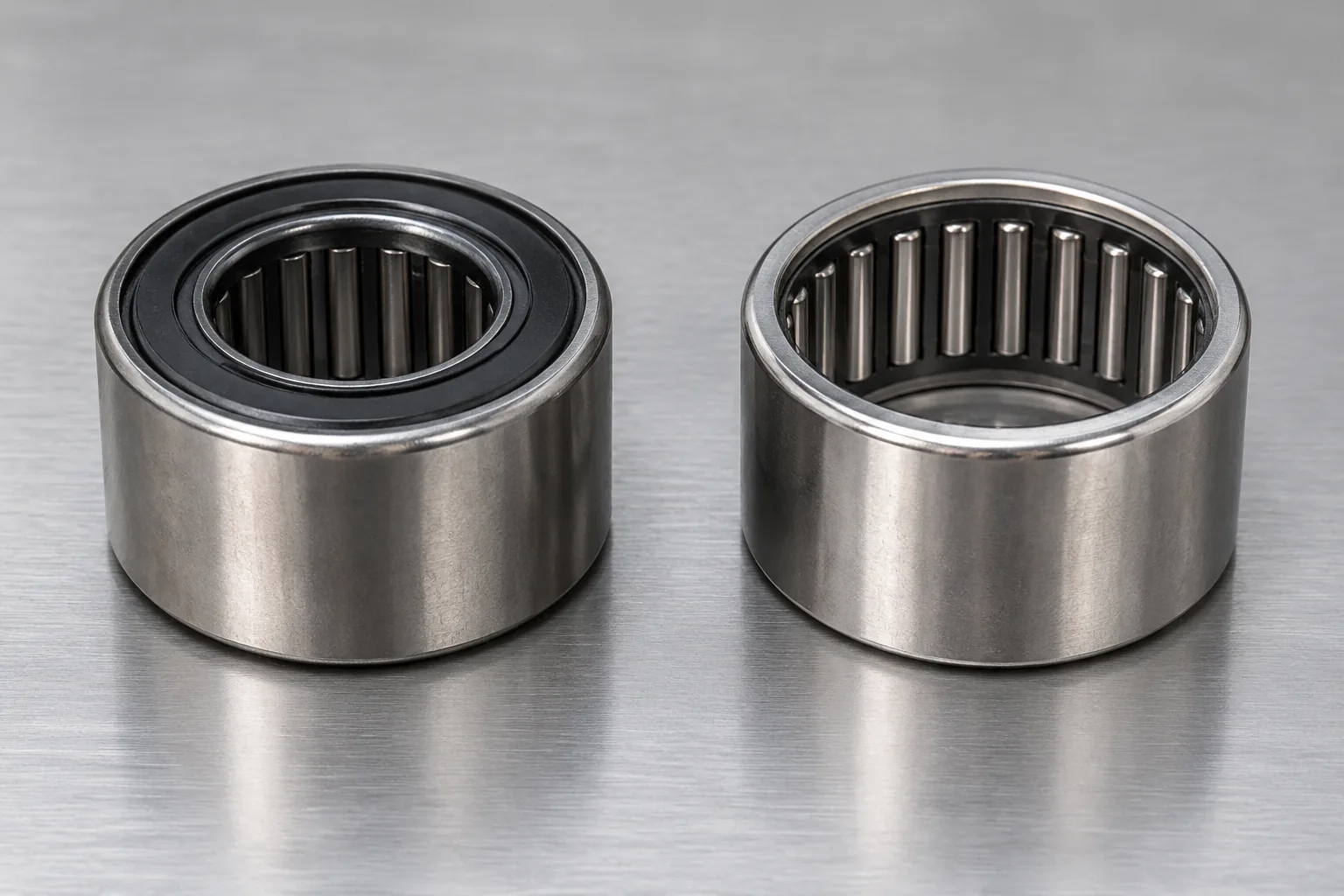
For example, the product data for HK 2216 lists Lubricant: None and Relubrication feature: Without. That record is a reminder that bearing families can contain very different supply states. Some aerospace or specialty needle roller bearings may be pre-filled with grease, but that must be verified for the exact product.
Use the model datasheet and the OEM manual to settle four values: grease type, fill quantity, relubrication interval, and maximum heating temperature. The model and the machine manual outrank general shop practice.
Set a Maintenance and Relubrication Interval
Relubrication intervals are application-specific. Establish them from OEM guidance and operating experience, then adjust them when the evidence changes. Noise, vibration, and temperature trends are useful inputs; a single reading is weaker than a comparison with a baseline.
For the needle roller assemblies covered by Schaeffler TPI 203, relubrication is required at intervals not exceeding one year, and also after long shutdowns or exposure to high humidity. That one-year limit belongs to the covered assemblies in that document, not to every needle bearing. Axial bearings, high-contamination areas, and high-moisture applications deserve closer attention.
Lubricate With the Right Grease and Quantity
Lubrication lowers friction and wear, shields the bearing from corrosion and contaminants, and supports longer service life. Use the lubricant specified or originally supplied when the manufacturer requires it. Do not mix greases unless compatibility is verified.
For a compatible grease mix, TPI 203 calls for the same base oil and thickener type, the same NLGI consistency class, and a base oil viscosity difference of no more than one ISO VG grade. When those conditions are uncertain, consult the lubricant maker rather than blending products.
Quantity matters as much as type. Published bearing maintenance guidance indicates that over-greasing can push grease past a lip seal, break the sealing contact, and let water or contaminants enter. Where the equipment allows it, adding grease while the machine runs can reduce the risk of overfilling.
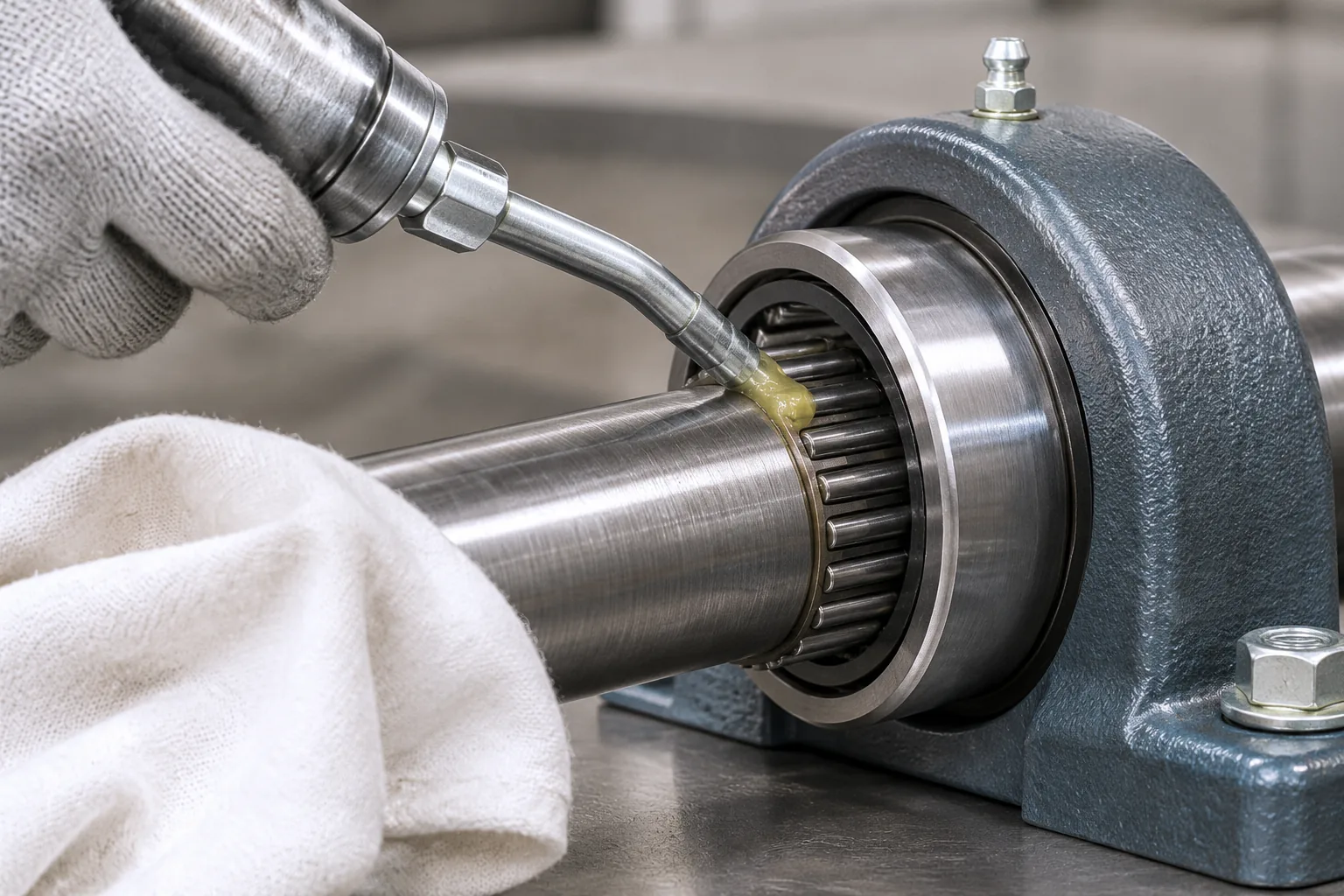
For axial needle bearings with grease lubrication, feed grease from the inside of the bearing toward the outside. Sealed, shielded, or pre-filled bearings should not be routinely washed or re-greased unless the manufacturer permits it.
Control Contamination Before and During Maintenance
Keep bearings in their original packaging until installation. Keep tools, lubricants, cleaning fluids, and the work area clean. Dust and moisture shorten bearing life, and a clean bench is part of the maintenance method, not a cosmetic detail.
Do not routinely wash sealed bearings, shielded bearings, one-way clutches, or other grease-prefilled products. Washing can remove or damage the factory lubricant. New open bearings normally do not require washing, because they are packaged for direct use. If a rust preventive must be removed for oil lubrication or lubricant compatibility, follow the product manufacturer’s instruction.
For removed open bearings that will be reused or inspected, use two-stage cleaning with light oil, kerosene, or a mild solvent. Keep a rough-cleaning container and a fine-cleaning container separate. Do not rotate a contaminated bearing during cleaning, and apply rust protection immediately after cleaning. These cleaning steps apply to open bearings intended for reuse or inspection, not to sealed or pre-greased units.
Mount Needle Bearings Without Roller Damage
Never transmit mounting force through the rolling elements. Use a press and suitable installation tools so the force goes through the ring that is being fitted. Drawn-cup needle bearings need dedicated installation tools; hammering can dent, crack, or chip raceways and rollers.
Before mounting, inspect shaft and housing dimensions, geometry, and cleanliness. Keep the mounting area as dust-free as possible, and lightly lubricate seat surfaces only as the specification allows. For a tight-fit inner ring, Catalog 352 gives an example mounting temperature of about 80°C / 175°F using an induction heater, oil bath, or oven. That figure is an example, not a substitute for the maximum heating limit of the exact bearing.
Avoid freezing a bearing to make it fit. Condensation can form and corrode the bearing and housing. For separable inner rings, pre-lubricate the rollers and raceways, then rotate the shaft during insertion to help the rollers align and to avoid raceway scratching.
Dismount and Handle Bearings for Reuse or Failure Analysis
When a bearing will be reused, do not transmit dismounting force through the rolling elements. Use a method that pulls or presses on the appropriate ring. Handle the removed bearing carefully and keep it protected from contamination before inspection or reinstallation.
If the root cause of damage is unknown or failures repeat, preserve the evidence. Do not clean or disassemble the damaged bearing first. Keep lubricant residue, grease samples, mounting orientation, and installation position so a failure analysis can still examine them.
Monitor Noise, Vibration, Temperature, and Lubricant Condition
Abnormal noise, increasing vibration, and rising temperature are maintenance signals. Compare readings with trends or baseline values rather than judging from one measurement. Record the operating conditions and findings so the next interval can be adjusted on evidence.
Inspect the lubricant as well as the bearing. Look for bearing or component fragments, sand, steel chips, water, coolant, aging, color change, coking, and additive condition. Contaminant type and lubricant aging are diagnostic information, not just housekeeping issues.
Inspect for Common Damage Modes
Use a structured checklist for visible damage. Common modes include:
- Flaking, peeling, and spalling
- Smearing, wear, and discoloration
- Indentations, cracking, and seizing
- Rust, corrosion, and fretting
- Electrical pitting and roller-path skewing
- Cage damage and creeping
A published damage guide lists these visible modes, and ISO 15243:2017 provides terms, characteristics, and causes for rolling bearing damage and failures. Use the standard to classify what you see and to connect appearance with possible causes. If damage is severe or recurring, preserve the bearing and lubricant evidence before cleaning or replacing parts.
Store Needle Bearings Correctly
Store bearings in their original packaging, flat, in a dry, vibration-free area with a stable temperature. Keep them packaged until installation. Control humidity according to the manufacturer’s limits.
Technical data 2300E specifies storage at room temperature with relative humidity not exceeding 60%. A bearing maintenance handbook gives humidity limits of 75% at 20°C, 60% at 22°C, and 50% at 25°C. Shelf-life guidance also differs by product: under suitable storage conditions, open bearings have about five years of original rust protection, while sealed bearings are recommended for no more than three years because internal lubricant can age. These figures assume suitable storage and original packaging.
Practical Needle Bearing Maintenance Checklist
- Identify the exact bearing model and lubrication state before work begins.
- Verify storage conditions and keep the bearing packaged until installation.
- Clean the workspace, tools, and lubricant handling equipment.
- Use the correct lubricant, quantity, and relubrication interval from OEM guidance.
- Mount and dismount with tools that do not load the rollers.
- Monitor noise, vibration, temperature, and lubricant condition during operation.
- Record damage findings and preserve evidence if failure analysis is required.
Reference Documents for Maintenance Decisions
Use manufacturer catalogs and handbooks for model-specific lubrication, mounting, dismounting, and storage requirements. Use ISO 15243:2017 as the reference terminology for rolling bearing damage and failure characteristics.
Useful examples of manufacturer documents include:
- Schaeffler INA Needle Roller Bearings Catalog 352; the manufacturer is based in Herzogenaurach, Germany
- Schaeffler TPI 203, cited above for the one-year relubrication interval and grease-mixing criteria
- NTN Needle Roller Bearings Technical Data 2300E; the manufacturer is based in Osaka, Japan
- JTEKT/Koyo Needle Roller Bearings Catalog BS010EN
- SKF bearing maintenance handbooks
Conclusion
Needle bearing maintenance works best as a controlled routine: identify the exact product, confirm its lubrication state, use the specified grease and fill, protect the bearing from contamination, and mount or dismount it without loading the rollers. Set relubrication intervals from OEM guidance and operating evidence, and adjust them when noise, vibration, temperature, or lubricant condition changes.
The safe next step is to open the bearing model datasheet and the equipment manual before the next service. Use the model-specific grease, quantity, interval, and heating limit, and keep records so later checks can compare against a known baseline.
FAQs
Q1: How often should needle bearings be relubricated?
A: There is no universal interval. Use the OEM manual and operating experience. For assemblies covered by TPI 203, the interval must not exceed one year, with extra relubrication after long shutdowns or high-humidity exposure. Axial bearings and contaminated or wet applications may need closer attention.
Q2: Can I mix two greases in a needle bearing?
A: Only after confirming compatibility. The greases should share the same base oil and thickener type and the same NLGI consistency class, and their base oil viscosity should differ by no more than one ISO VG grade. If any of those points is uncertain, use the specified lubricant or ask the lubricant manufacturer.
Q3: Should I wash a new needle bearing before installation?
A: New open bearings normally do not need washing because they are packaged for direct use. Do not routinely wash sealed, shielded, one-way clutch, or grease-prefilled products. If a rust preventive must be removed for oil lubrication or compatibility, follow the bearing manufacturer’s instruction.
Q4: How can I avoid damaging rollers during mounting?
A: Apply mounting force through the ring, never through the rolling elements. Use a press and the correct installation tool; drawn-cup bearings need dedicated tools, and hammering can dent, crack, or chip raceways and rollers. Pre-lubricate separable inner-ring parts and rotate the shaft during insertion to help alignment.
Q5: What signs show that a needle bearing needs attention?
A: Abnormal noise, increasing vibration, and rising temperature are common signals. Compare them with baseline trends instead of one reading. Inspect the lubricant for fragments, sand, steel chips, water, coolant, aging, color change, coking, and additive condition, and record the findings with the operating conditions.
Q6: How should needle bearings be stored?
A: Keep them in original packaging, flat, dry, vibration-free, and at a stable temperature. Technical data 2300E gives a relative humidity limit of 60%, while a bearing maintenance handbook lists 75% at 20°C, 60% at 22°C, and 50% at 25°C. Under suitable storage, open bearings have about five years of rust protection, and sealed bearings are recommended for no more than three years.
Q7: What should I do if a needle bearing fails?
A: Preserve the evidence before cleaning or disassembling it. Keep lubricant residue, grease samples, mounting orientation, and installation position, and inspect for damage modes such as flaking, wear, indentations, rust, fretting, electrical pitting, cage damage, or creeping. Use ISO 15243:2017 terminology and correct the root cause, not only the bearing.