In the world of rotating machinery, supporting a shaft is a fundamental requirement. While there are many ways to achieve this, the challenge often lies in the mounting surface. What happens when you need to support a shaft that runs perpendicular to a machine frame or a vertical bulkhead? This is where the flange mounted bearing becomes the engineer’s component of choice.
Flange mounted bearing units (also known as flanged bearing blocks) are pre-assembled units that combine a bearing insert inside a flanged housing. This design allows for direct bolting onto a perpendicular surface, offering a unique blend of support, compactness, and ease of use.
DUHUI will walk you through the specific uses, types, and selection criteria for these indispensable components, helping you make the best choice for your machinery.
What is a Flange Mounted Bearing?
Before diving into applications, it is essential to understand the construction. A flange mounted bearing unit consists of two main parts:
- The Insert Bearing: This is a deep groove ball bearing or roller bearing, typically sealed for life and designed to accommodate slight misalignments.
- The Flanged Housing: This is a block with a flange (a rim with holes) that acts as the mounting interface. The housing material determines the unit’s strength and environmental resistance .
The key distinction from a standard bearing is that the housing is integrated, eliminating the need for a separate, machined housing and making installation as simple as bolting the unit to a frame .
Types of Flange Mounted Bearings
To understand their use, one must first appreciate the variety available. Flange bearings are classified by their flange shape, internal bearing type, and housing material.
By Flange Configuration (Mounting Holes)
The number and arrangement of bolt holes determine the unit’s load capacity and stability.
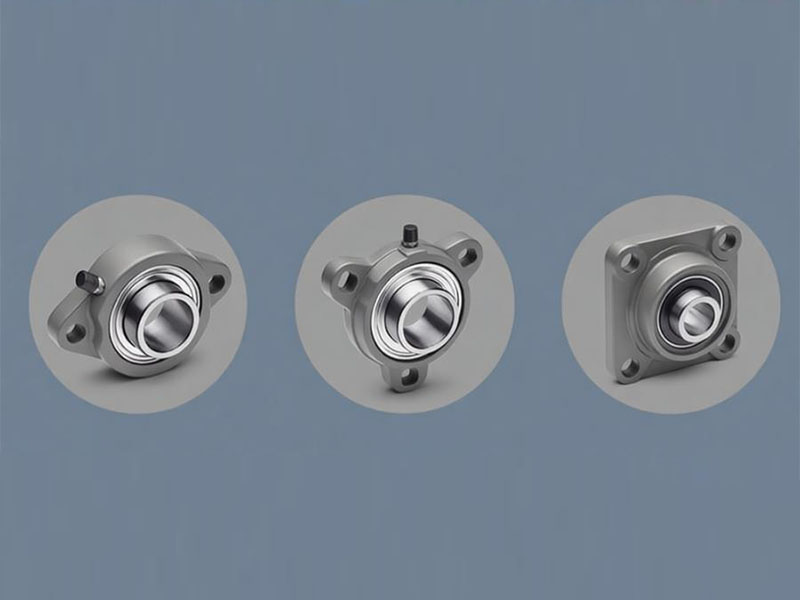
- Two-Bolt Flange Bearings: Often diamond-shaped, these are the most compact. They are ideal for light to medium-duty applications where space is limited, such as on small conveyors or packaging machines. The bolt holes are aligned along the axis of the bearing .
- Three-Bolt Flange Bearings: These can have holes arranged at 120-degree intervals or in an offset triangular pattern. The offset version is particularly useful for guiding or tracking applications, often found in conveyor systems to fine-tune belt alignment .
- Four-Bolt Flange Bearings: Usually featuring a square or round housing, these provide the most rigid and secure mounting. They are the preferred choice for heavy-duty applications involving high radial loads or significant vibration, such as in large fans or heavy material handling equipment .
By Bearing Insert Type (Internal Rolling Elements)
The “guts” of the unit dictate its load and speed capabilities.
- Ball Bearing Inserts: The most common type. They are versatile, handling both radial and moderate axial (thrust) loads with low friction, making them suitable for high-speed operations like in textile spindles or HVAC fans .
- Roller Bearing Inserts: For applications demanding extreme radial load capacity or resistance to shock loads. For instance, spherical roller bearings are excellent for applications with heavy loads and potential misalignment, such as agricultural equipment or mining conveyors .
By Housing Material & Environmental Resistance
The housing protects the bearing and secures it to the machine.
- Cast Iron: The workhorse material. It offers excellent strength, vibration dampening, and affordability for general industrial use .
- Pressed Steel (Stamped Steel): A lightweight, cost-effective option for light-duty applications like small agricultural implements or simple power transmission lines.
- Stainless Steel: Essential for industries with strict hygiene or corrosion concerns. In food processing or pharmaceutical environments, stainless steel housings withstand frequent washdowns with harsh chemicals without rusting .
- Engineered Composites (Plastic): These are lightweight, corrosion-proof, and sometimes self-lubricating. They are ideal for applications requiring electrical insulation or operation in chemically aggressive environments .
Primary Applications: Where Are They Used?
Given their versatility, these bearings are found across nearly every industry. Here are the primary applications where they excel:
- Material Handling & Conveyor Systems: This is the most ubiquitous application. Flange bearings support the rollers that move products in warehouses, assembly lines, and distribution centers. Their easy bolt-on design allows for quick replacement, minimizing costly downtime .
- Food & Beverage Processing: In this sector, equipment must endure frequent sanitation. Flange units with stainless steel housings and food-grade solid lubricants prevent bacterial growth and corrosion, ensuring compliance with safety standards in mixers, conveyors, and packaging equipment .
- Agricultural Machinery: Equipment like balers, harvesters, and seeders operate in dusty, wet, and high-vibration environments. Flange mounted bearings, often with self-aligning features and heavy-duty seals, provide the durability and reliability required for these demanding conditions .
- HVAC Systems: Large industrial fans and blowers rely on flange bearings to support the fan shaft. The flange mount is perfect for attaching to the fan housing, while precision ball bearings ensure quiet, vibration-free operation essential for occupant comfort .
- Textile and Packaging Machinery: These applications require high-speed operation and precise shaft alignment. Compact two-bolt flange ball bearings provide the low-friction, high-speed performance needed for looms, printing rollers, and wrapping machines .
- Airport Baggage Handling: The reliability of flange bearings ensures that the miles of conveyor systems in airports run smoothly 24/7, handling heavy loads with minimal maintenance .
Key Advantages: Why Choose Flange Mounted Bearings?
Understanding the “why” behind the selection helps in specifying the right part.
- Simplified Installation & Maintenance: They eliminate the need to machine precise bearing pockets. Mounting is simply a matter of bolting the unit to a pre-drilled surface, which significantly speeds up assembly and replacement .
- Space Efficiency: By mounting directly on the machine frame, they save space compared to foot-mounted pillow blocks, especially when supporting a shaft running perpendicular to the mounting surface.
- Load Versatility: Depending on the insert chosen, they can handle pure radial loads, pure thrust loads, or any combination in between. This is critical in applications like gear drives where forces are complex .
- Misalignment Compensation: Many flange units feature a spherical outer ring that can pivot within the housing. This self-aligning feature compensates for minor shaft deflections or mounting inaccuracies, preventing premature bearing failure .
Installation & Maintenance Tips of Flange Mounted Bearings
Even the best bearing will fail prematurely if not handled correctly. As a manufacturer, we recommend these best practices:
Pre-Installation Checks:
- Surface Matters: The mounting surface must be flat and rigid. An uneven surface will distort the housing, which in turn distorts the bearing raceways, leading to premature failure. Flatness should be within 0.05mm .
- Shaft Preparation: Remove burrs and ensure the shaft diameter is within tolerance. For set screw locking, machining a small flat spot on the shaft where the set screw contacts can vastly improve holding power .
Proper Mounting Procedure:
- Do not hammer or strike the bearing flange directly. This transfers shock through the balls and creates brinelling (indentations) on the raceways .
- Tighten mounting bolts evenly to the recommended torque. Over-tightening can crack the flange or distort the housing .
Shaft Locking Methods:
- Set Screw Locking: Common for moderate loads. Tighten the two set screws alternately to center the shaft.
- Eccentric Locking Collar: Used in applications with direction changes or vibration. The collar grips the shaft as it is turned in the direction of rotation .
Lubrication: If the unit has a grease fitting, follow a regular relubrication schedule. For sealed units, recognize that they have a finite life based on the grease’s lubrication life.
How to Select the Right Flange Mounted Bearings
Choosing the wrong bearing can lead to system failure. Focus on these critical factors:
- Load Characteristics: Calculate the total radial and axial (thrust) loads. For high radial loads, lean toward roller bearings. For combined loads, angular contact bearings may be necessary .
- Operating Environment: If the environment is wet or corrosive, stainless steel is non-negotiable. If it’s just dusty, good contact seals (like triple-lip seals) are sufficient.
- Speed and Temperature: High-speed applications require precision ball bearings with high-temperature grease and possibly metal cages. Verify the bearing’s maximum speed rating against your application’s RPM .
- Shaft Size and Fits: Ensure the bearing’s bore diameter matches your shaft. The method of locking (set screw, eccentric collar, or tapered adapter) should be chosen based on the direction and consistency of the load .
Conclusion
Flange mounted bearings are the unsung heroes of mechanical motion, providing a simple, elegant solution for supporting shafts in virtually every type of industrial machinery. From the conveyors that move our packages to the fans that ventilate our buildings, their versatility, ease of use, and robust performance make them an indispensable tool for engineers and maintenance teams worldwide.
Looking for the perfect flange mounted bearing for your next project? Contact DUHUI Bearing today, we can help you select, customize, and supply the ideal solution for your flange mounted bearings.