Quick Answer
Deep-groove ball bearings are the most widely used rolling bearing type. They handle both radial and moderate axial loads in two directions, run at high speeds with low friction, and are cost-effective. However, they have strict alignment requirements (0.05–0.1 degrees), limited axial load capacity (25–35% of static radial rating), and lower shock resistance than roller bearings. Choose them for radial-dominant, high-speed applications; avoid them for heavy axial loads or misaligned shafts.
Deep-groove ball bearings are everywhere. Open the hood of a car, look inside an electric motor, or examine a conveyor system—you will find them. They are the most common type of rolling bearing, and for good reason. But like any mechanical component, they come with trade-offs.
This article breaks down what deep-groove ball bearings are, how they work, and—most importantly—their advantages and disadvantages. Whether you are selecting bearings for a new design or troubleshooting a field failure, understanding these strengths and limitations will help you make the right choice.
What Is a Deep-Groove Ball Bearing and How Does It Work?
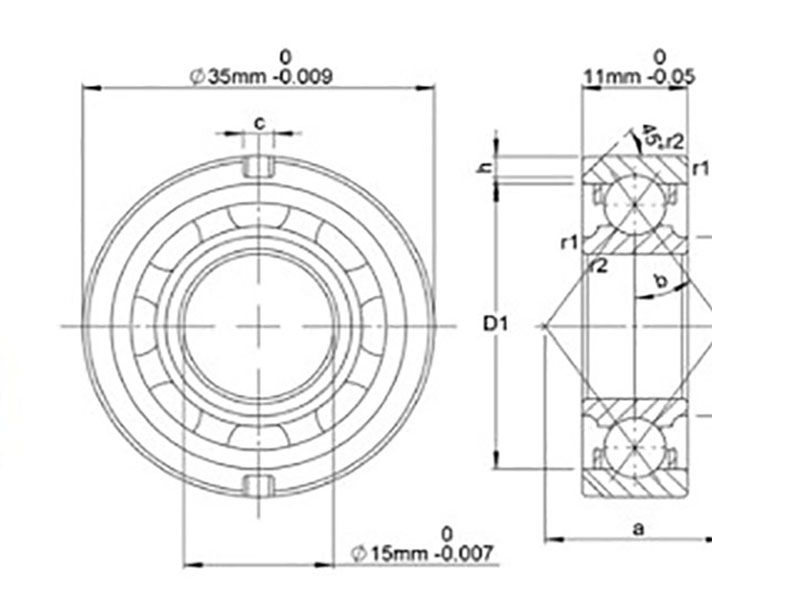
A deep-groove ball bearing is a rolling-element bearing with deep, continuous raceway grooves on both the inner and outer rings. These deep grooves allow the bearing to accommodate radial loads, axial loads, and combined loads in both directions simultaneously.
Basic structure: Four main components—an inner ring, an outer ring, a cage (retainer), and steel balls.
Main types:
- Single-row: Most common; optimized for radial loads with moderate combined loads
- Double-row: Two rows of balls; higher radial capacity and rigidity; less suited for high speed
- Multi-row: Specialized heavy-duty applications
Sealing configurations:
- Open: No seals; lowest friction; highest speed; requires external lubrication
- Shielded (ZZ/2Z): Metal shields; low friction; protects against large particles; pre-lubricated
- Sealed (RS/2RS): Rubber contact seals; best protection against moisture and contaminants; slightly higher friction; lower speed limits
Materials:
- Rings and balls: Chrome steel (GCr15/SUJ2/100Cr6) standard; stainless steel or hybrid ceramic optional
- Cages: Pressed steel, machined brass, or polymer/nylon
Standards: Conform to ISO 15 (boundary dimensions) and ISO 492 (tolerances, grades P0–P2), ensuring global interchangeability.
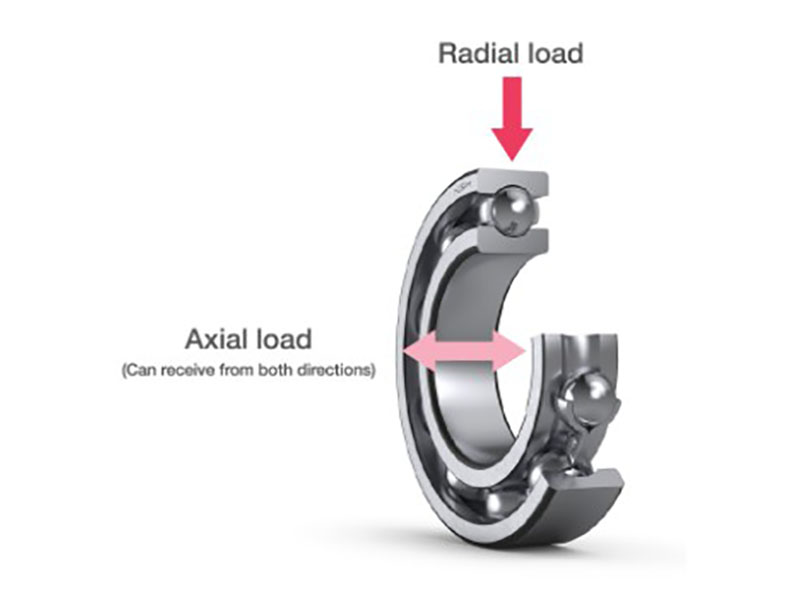
How it works: Deep-groove ball bearings are non-separable—the rings, balls, and cage form a single assembly that cannot be taken apart. The defining feature is point contact between the balls and raceways. This small contact area keeps friction torque low, enabling high-speed operation. The deep raceway arc wraps around a large portion of each ball, giving the bearing its ability to handle axial loads in both directions.
Load handling:
- Radial loads (perpendicular to shaft): Primary function; forces distribute across multiple balls
- Axial loads (parallel to shaft): Deep races “capture” the balls, preventing slip-out under thrust—but capacity is limited (25–35% of static radial rating C₀)
Speed capability: High rotational speeds—typically 5,000 to over 20,000 RPM depending on size, lubrication, and sealing. Oil lubrication allows higher speeds than grease; open bearings run faster than sealed ones.
Advantages of Deep-Groove Ball Bearings
Pro 1. Simultaneous radial and bidirectional axial load support
A single deep-groove ball bearing can handle radial loads and axial loads in both directions simultaneously. This versatility means one bearing can do the job of multiple specialized bearings in many applications. However, the axial capacity is significantly lower than the radial capacity—typically 25–35% of the static radial load rating (C₀).
Pro 2. Low friction and high-speed capability
The point contact between balls and raceways creates low friction and low running temperatures. This translates to:
- High limiting speeds
- Low energy consumption
- Reduced heat generation
- Quiet, smooth operation with low vibration
These characteristics make deep-groove ball bearings ideal for precision machinery, electric motors, and household appliances.
Pro 3. Simple structure, easy mounting, and low maintenance
Deep-groove ball bearings have a straightforward design that makes them easy to install and maintain. Their maintenance requirements are lower than many other bearing types. Shielded and sealed versions come pre-lubricated and are virtually maintenance-free for their service life.
Pro 4. Long service life and reliable operation
When properly selected, installed, and maintained, deep-groove ball bearings offer long, reliable service. Their simple design minimizes the number of potential failure points. Manufacturers continuously optimize designs to extend fatigue life and reduce energy consumption.
Pro 5. Low noise and vibration
The close conformity between balls and raceways enables quiet, smooth operation. This is critical in applications like household appliances, automotive cabins, and precision instruments where noise matters.
Pro 6. Wide availability and cost-effectiveness
Deep-groove ball bearings are the most widely produced and used bearing type. Mass production makes them:
- Readily available in thousands of sizes and configurations
- Significantly less expensive than specialty bearings of comparable size
- Interchangeable across manufacturers due to ISO standardization
Pro 7. Multiple sealing and shielding options
Deep-groove ball bearings are available in open, shielded, and sealed configurations to suit different operating environments:
- Open: Maximum speed, requires external lubrication
- Shielded: Good protection with low friction
- Sealed: Best contamination protection, pre-lubricated
Disadvantages of Deep-Groove Ball Bearings
Con 1. Limited axial load capacity
While deep-groove ball bearings can handle axial loads, their capacity is significantly lower than their radial capacity. As mentioned in the load handling section above, axial load capacity is approximately 25–35% of the static radial load rating (C₀). Pure axial load should generally not exceed 0.5 C₀. When axial load exceeds approximately 30–40% of radial load, angular contact bearings or tandem arrangements should be considered.
For applications dominated by heavy axial loads, angular contact ball bearings or tapered roller bearings are better choices.
Con 2. Extreme sensitivity to misalignment
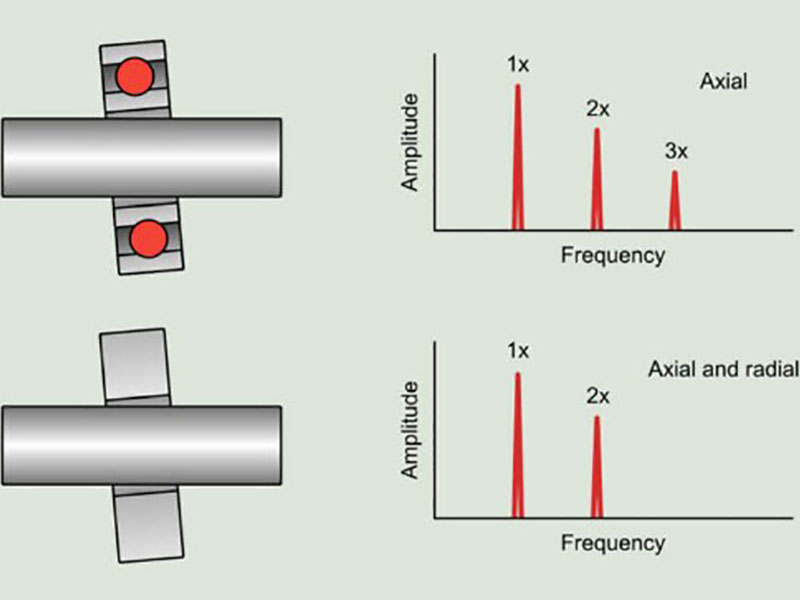
This is one of the most critical limitations. Standard deep-groove ball bearings have very strict alignment requirements—optimal performance requires alignment within 0.05 to 0.1 degrees. Even 0.5 degrees of misalignment can cause failure. Shaft-to-housing eccentricity must be controlled to within approximately 0.05 mm.
Why? The rigid raceway grooves force balls to run in a straight line. Any misalignment causes uneven load distribution, leading to raceway indentation, abnormal noise, vibration, and premature failure.
Even within the allowable range, any misalignment reduces bearing life. Exceeding the recommended limits accelerates wear exponentially—life can be reduced by 50% or more when only slightly beyond specifications.
By comparison, self-aligning ball bearings tolerate about 3 degrees of misalignment, and spherical roller bearings tolerate 0.5 to 2 degrees.
Con 3. Lower load capacity than roller bearings
Because deep-groove ball bearings use point contact between balls and raceways, the contact area is small. Roller bearings use line contact, which distributes loads over a larger area. The result:
- Roller bearings have significantly higher load-carrying capacity—up to 60% higher than ball bearings of the same size
- Deep-groove ball bearings are less suitable for heavy loads or high-impact applications
Con 4. Vulnerability to shock loads and impact
Deep-groove ball bearings are not resistant to impact. Shock loads can cause brinelling (permanent indentations in raceways), raceway fracture, or cage damage.
Applications with frequent impact or vibration may require roller bearings or specially reinforced designs. Understanding common bearing failure modes—such as brinelling, fatigue, and contamination—is essential for proper selection and maintenance.
Con 5. Reduced life at high speed under heavy load
While deep-groove ball bearings excel at high speeds, the combination of high speed and heavy load shortens service life. At very high speeds:
- Centrifugal forces on the balls increase
- Effective axial load capacity decreases
- Heat generation accelerates lubricant degradation
- Fatigue life is reduced
Operating near the bearing’s speed limit under significant load requires careful consideration of lubrication, cooling, and maintenance intervals. When making your bearing selection, always balance speed, load, and operating temperature.
Conclusion
Deep-groove ball bearings are the workhorse of the bearing world—and for good reason. They combine versatility, high-speed capability, low friction, and cost-effectiveness in a single, simple package. Their ability to handle radial loads while accommodating moderate axial loads in both directions makes them the default choice for countless applications across automotive, industrial, and consumer sectors.
Choose deep-groove ball bearings when:
- Loads are primarily radial with only moderate axial components
- High rotational speeds are required
- Low friction and low noise are priorities
- Cost and availability are important factors
- Shaft alignment can be maintained within tight tolerances
Consider alternatives when:
- Axial loads are heavy or dominant—use angular contact or tapered roller bearings
- Shaft misalignment cannot be controlled within 0.05–0.1 degrees—use self-aligning bearings
- Shock loads or heavy impact are present—use roller bearings
- Maximum possible load capacity is needed in limited space—use roller bearings
For most general-purpose rotating machinery, deep-groove ball bearings offer an optimal balance of performance, reliability, and economy. Understanding their limitations—particularly the strict alignment requirements and limited axial capacity—is the key to successful bearing selection and long service life.
At DUHUI Bearing, we have been manufacturing automotive bearings since 2003, serving customers in over 60 countries. Our deep-groove ball bearings are produced to international standards (ISO 15, ISO 492) with precision grades up to P5 and above. Whether you need standard sizes or custom configurations, we are here to help you find the right bearing solution for your application.
Frequently Asked Questions (FAQs)
Q1: Can deep-groove ball bearings handle both radial and axial loads?
Yes. Deep-groove ball bearings can handle radial loads and axial loads in both directions simultaneously. However, axial capacity is significantly lower—typically 25–35% of the static radial load rating (C₀). Under combined loading, axial load should generally not exceed 30–40% of radial load.
Q2: Are deep-groove ball bearings suitable for high-speed applications?
Yes. Their point-contact design creates low friction, making them excellent for high-speed operation. Speed capability depends on size, lubrication type (oil allows higher speeds than grease), and sealing configuration (open bearings have the highest speed limits).
Q3: How much misalignment can a deep-groove ball bearing tolerate?
Very little. Standard deep-groove ball bearings require alignment within 0.05 to 0.1 degrees for optimal performance. Even 0.5 degrees can cause failure. Shaft-to-housing eccentricity should be controlled to within approximately 0.05 mm.
Q4: What is the difference between open, shielded, and sealed bearings?
Open: No seals; lowest friction; highest speed; requires external lubrication. Shielded (ZZ/2Z): Metal shields; low friction; protects against large particles; pre-lubricated. Sealed (RS/2RS): Rubber contact seals; best protection against moisture, dust, and contaminants; slightly higher friction; lower speed limits.
Q5: What is the difference between deep-groove ball bearings and angular contact ball bearings?
Deep-groove ball bearings can handle axial loads in both directions. Single-row angular contact ball bearings can only handle axial loads in one direction. Angular contact bearings have higher axial load capacity and are better for applications with significant, sustained axial loads.
Q6: What are the typical applications of deep-groove ball bearings?
Deep-groove ball bearings are used in electric motors, generators, pumps, compressors, fans, conveyors, gearboxes, automotive components (alternators, water pumps, tensioners, wheel hubs), and household appliances (washing machines, dryers, power tools).
Q7: What causes premature failure in deep-groove ball bearings?
Common causes include: Contamination (abrasive particles accelerate wear); improper lubrication (wrong type, insufficient, or excessive); misalignment (even small misalignment drastically reduces life); and improper installation (forceful mounting, incorrect fits, or damage during assembly). Prevention: Use appropriate seals, correct lubrication, proper installation tools and methods, and maintain alignment within specifications. Regular condition monitoring can also help detect early signs of bearing failure before it leads to downtime.
Q8: What is the axial load limit for deep-groove ball bearings?
As a general rule, axial load should not exceed 25–35% of the static radial load rating (C₀). For pure axial load, the limit is approximately 0.5 C₀. When axial load consistently exceeds 30–40% of radial load, consider angular contact bearings or tandem arrangements.