Quick answer: How do you read a ball bearing size chart? First, measure three key dimensions with a caliper: inner diameter (bore), outer diameter, and width. Then decode the bearing number—for example, in 6203, “6” means deep groove, “2” is the series, and “03” means 17mm bore (code×5 for sizes ≥20mm). The chart lists these dimensions with load ratings (dynamic C and static C0). Also consider seal type (ZZ or 2RS) and internal clearance (C3 for high speed or heat).
Finding the correct ball bearing for your machinery can be a daunting task. With thousands of variations available, a reliable ball bearing size chart is an essential tool for engineers, maintenance professionals, and hobbyists. A small error in measurement can lead to premature failure, equipment damage, or costly downtime. In this guide, DUHUI will walk you through everything you need to know—from understanding what a ball bearing is, to accurately measuring dimensions, decoding bearing numbers, and finally, selecting the right bearing from our detailed size charts.
What is a Ball Bearing?
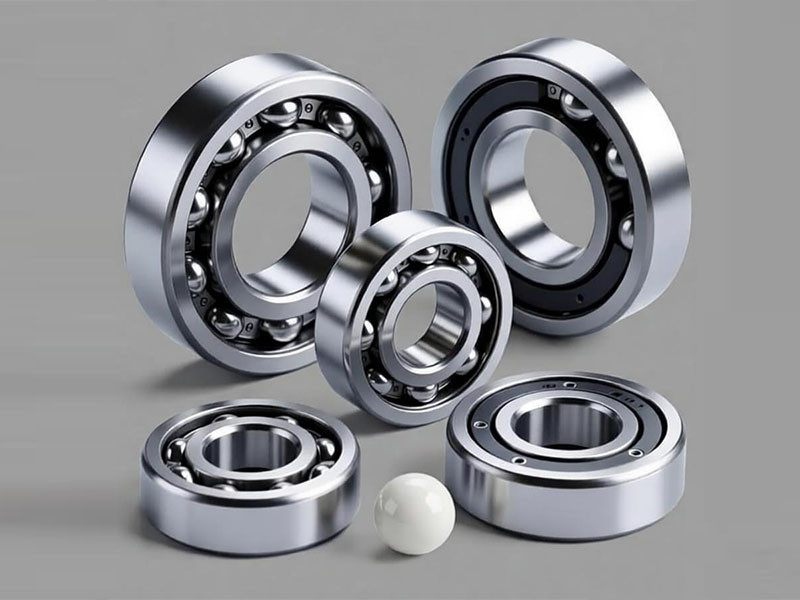
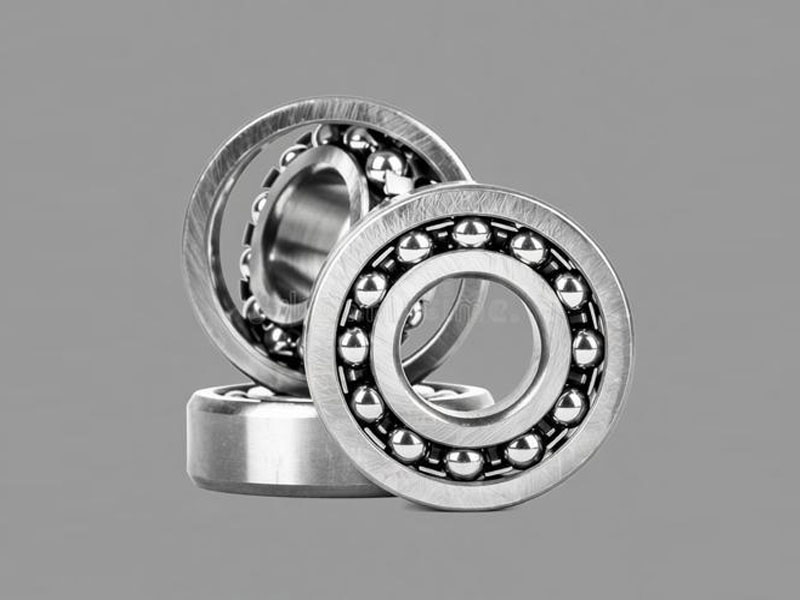
At its core, a ball bearing is a precision mechanical component designed to reduce rotational friction and support radial and axial loads. It acts as the interface between a rotating shaft and a stationary housing.
Core Components:
- Inner Ring: The part that fits onto the rotating shaft.
- Outer Ring: The part that fits into the stationary housing.
- Rolling Elements (Balls): The spherical components that facilitate smooth motion and carry the load.
- Cage (Retainer): A component that evenly spaces the balls, preventing them from contacting each other and reducing friction.
The primary functions of a ball bearing are to support the rotating shaft, carry loads (both radial and axial), minimize friction to improve energy efficiency, and maintain high rotational accuracy.
How to Measure and Decode Ball Bearing Sizes
Before you can consult a size chart, you need to know what you’re looking for. This involves both physical measurement and understanding the bearing’s identification code.
How to Measure the Three Critical Dimensions?
All standard ball bearings are defined by three key dimensions. Using a digital caliper is the most accurate way to measure these.
- Inner Diameter (ID): Also known as the bore. This is the diameter of the hole in the inner ring, which fits onto the shaft. Measure directly across the inside of the bearing.
- Outer Diameter (OD): The total diameter of the outer ring. Measure across the widest part of the bearing.
- Width (W): Also known as the thickness or height. Measure the overall thickness of the bearing from one side face to the other.
How to Read a Ball Bearing Number?
Most bearings have a standardized number printed on their seal or side. This number is not random; it follows an ISO system that encodes the bearing’s dimensions and type.
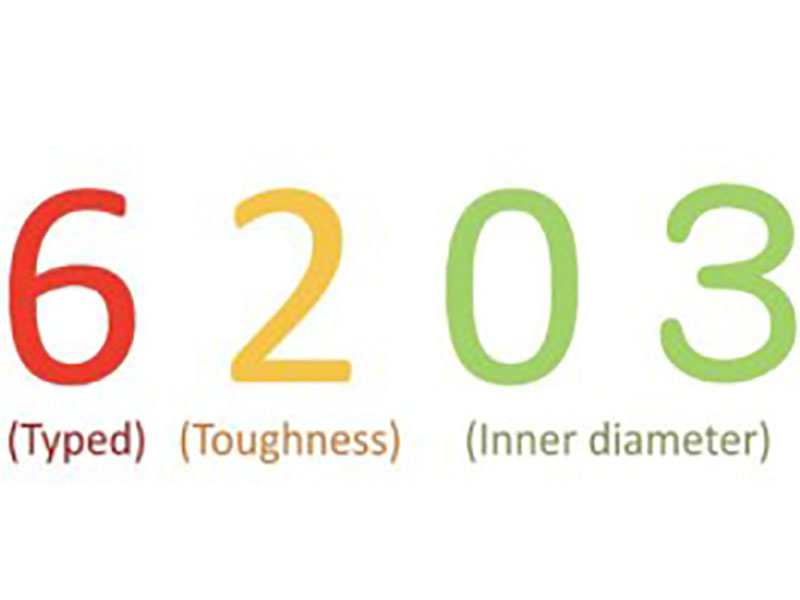
Case Study: Decoding the 6203 Bearing
Let’s take the widely used 6203 bearing as an example. Here’s how to break it down:
6: This is the type series, indicating it is a single-row deep groove ball bearing—the most common type.
2: This is the diameter series, representing the relationship between the bearing’s outer diameter and width. It helps define the load-carrying capacity.
03: This is the bore size code. For bearings with a bore diameter of 20mm or more, a simple formula applies: bore = code × 5. However, for codes 00, 01, 02, and 03, there are exceptions:
- 00 = 10mm
- 01 = 12mm
- 02 = 15mm
- 03 = 17mm
- So, a 6203 bearing has a 17mm inner diameter.
Understanding Suffixes
The basic number is often followed by suffixes that provide critical details:
- ZZ or 2Z: Non-contact metal shields on one or both sides. They protect against large debris but allow high speeds.
- 2RS or 2RSH: Contact rubber seals on both sides. They provide excellent protection against dust and moisture but have a slightly higher friction torque.
- C3: Indicates a greater internal radial clearance than standard (CN). This is used in applications with high speeds or significant temperature differences.
International Standards
To ensure global interchangeability, bearings are manufactured according to standards set by organizations like the American Bearing Manufacturers Association (ABMA) and the International Organization for Standardization (ISO). A bearing from a manufacturer in Asia will have the same dimensions and tolerances as one from Europe or North America if they conform to these standards. This is why a 6203 bearing from DUHUI Bearing is dimensionally interchangeable with any other ISO-standard 6203.
Standard Ball Bearing Size Charts
Below are several ball bearing size charts to help you quickly identify the bearing you need. The first two tables offer quick reference for metric and inch series, while the subsequent detailed tables provide load ratings and other specifications for popular series.
Metric Series Quick Reference Chart
| Bearing Number | Inner Diameter (ID) (mm) | Outer Diameter (OD) (mm) | Width (W) (mm) |
| 6200 | 10 | 30 | 9 |
| 6201 | 12 | 32 | 10 |
| 6203 | 17 | 40 | 12 |
| 6004 | 20 | 42 | 12 |
| 6005 | 25 | 47 | 12 |
| 6300 | 10 | 35 | 11 |
Inch Series Quick Reference Chart
| Bearing Number | Inner Diameter (ID) (inches) | Outer Diameter (OD) (inches) | Width (W) (inches) |
| R2 | 0.125 | 0.375 | 0.140 |
| R4 | 0.250 | 0.625 | 0.196 |
| R6 | 0.375 | 0.875 | 0.281 |
| R8 | 0.500 | 1.125 | 0.312 |
| R10 | 0.625 | 1.375 | 0.312 |
Detailed Size Charts by Series (With Load Ratings)
For a more complete technical overview, the following tables include corner radius, weight, and dynamic/static load ratings. These are crucial for engineering and replacement decisions.
6000 Series (Light & Thin Section)
| Bearing Number | ID (mm) | OD (mm) | Width (mm) | Corner Radius (mm) | Weight (kg) | Dynamic Load (kN) | Static Load (kN) |
| 6000 | 10 | 26 | 8 | 0.3 | 0.019 | 5.6 | 2.36 |
| 6001 | 12 | 28 | 8 | 0.3 | 0.021 | 6.35 | 2.75 |
| 6002 | 15 | 32 | 9 | 0.3 | 0.03 | 7.28 | 3.1 |
| 6003 | 17 | 35 | 10 | 0.3 | 0.036 | 7.88 | 3.55 |
| 6004 | 20 | 42 | 12 | 0.6 | 0.072 | 9.35 | 4.3 |
| 6005 | 25 | 47 | 12 | 1.0 | 0.081 | 12.5 | 5.35 |
6200 Series (Light & Medium Duty)
| Bearing Number | ID (mm) | OD (mm) | Width (mm) | Corner Radius (mm) | Weight (kg) | Dynamic Load (kN) | Static Load (kN) |
| 6200 | 10 | 30 | 9 | 0.6 | 0.032 | 7.28 | 3.1 |
| 6201 | 12 | 32 | 10 | 0.6 | 0.037 | 7.88 | 3.55 |
| 6202 | 15 | 35 | 11 | 0.6 | 0.045 | 9.35 | 4.3 |
| 6203 | 17 | 40 | 12 | 0.6 | 0.065 | 10.2 | 5.05 |
| 6204 | 20 | 47 | 14 | 1.0 | 0.11 | 12.8 | 6.65 |
| 6205 | 25 | 52 | 15 | 1.0 | 0.15 | 14.3 | 7.4 |
6300 Series (Medium & Heavy Duty)
| Bearing Number | ID (mm) | OD (mm) | Width (mm) | Corner Radius (mm) | Weight (kg) | Dynamic Load (kN) | Static Load (kN) |
| 6300 | 10 | 35 | 11 | 0.6 | 0.053 | 9.57 | 4.2 |
| 6301 | 12 | 37 | 12 | 0.6 | 0.06 | 10.1 | 4.45 |
| 6302 | 15 | 42 | 13 | 1.0 | 0.082 | 12.5 | 5.35 |
| 6303 | 17 | 47 | 14 | 1.1 | 0.112 | 14.0 | 6.2 |
| 6304 | 20 | 52 | 15 | 1.1 | 0.142 | 15.3 | 7.55 |
| 6305 | 25 | 62 | 17 | 1.5 | 0.23 | 18.4 | 9.1 |
How to Choose the Right Ball Bearing for Your Application
Selecting the correct bearing involves more than just matching dimensions. Here are the key factors to consider based on your specific application:
- Load: First, determine the direction and magnitude of the load. Deep groove ball bearings are designed for primarily radial loads but can handle some axial load. The size chart includes Dynamic Load (C) , which represents the load under which a bearing can operate for one million revolutions, and Static Load (C0) , which is the maximum load the bearing can withstand without permanent deformation.
- Speed Rating: Bearings have maximum speed limits, influenced by their design, cage type, lubrication, and internal clearance. High-speed applications often require precision grades, lighter cages, and C3 clearance.
- Material: Standard bearings are made from chrome steel (GCr15), which offers excellent hardness and fatigue life. For applications involving water, chemicals, or extreme temperatures, stainless steel (AISI 440C) bearings are preferred for their corrosion resistance.
- Seals & Shields: The environment is a deciding factor.
Open Bearings: Best for high-speed, clean environments where proper lubrication can be maintained.
ZZ (Metal Shielded): Good for protecting against large particles without increasing friction.
2RS (Rubber Sealed): Ideal for dusty, moist, or contaminated environments, providing the best protection. - Clearance: Most standard applications use normal (CN) clearance. If your application involves high operating temperatures (which cause the shaft to expand) or high speeds, a C3 (increased) clearance is recommended to prevent the bearing from seizing.
Frequently Asked Questions (FAQ)
Where can I find a bearing size chart and download a PDF?
You can find detailed size charts like the ones above on many manufacturers’ websites. For a printable version, you can often contact the manufacturer directly. At DUHUI Bearing, we provide technical datasheets for all our products upon request.
What issues arise from mismatched ball bearing sizes?
Using a bearing with an incorrect inner diameter (ID) can lead to spinning on the shaft, causing shaft damage. An incorrect outer diameter (OD) can cause the bearing to spin in its housing (fretting corrosion). In either case, the result is misalignment, excessive heat generation, vibration, and ultimately, premature bearing failure.
What do the numbers in a ball bearing size code (e.g., 6204) mean?
The standard ball bearing numbering system (ISO 15) encodes critical dimensions. Taking 6204 as an example:
- 6 → single‑row deep groove ball bearing (series)
- 2 → width or diameter series (light to heavy)
- 04 → bore size code: multiply by 5 → 20 mm bore diameter
For codes ≥ 04, bore = code × 5 mm. Codes 00, 01, 02, 03 represent 10 mm, 12 mm, 15 mm, 17 mm respectively.
Prefixes (e.g., “62”) and suffixes (e.g., “‑2RS”) indicate modified designs or seals, but the base number always defines the size family.
How can I determine the correct ball bearing size if the number is worn off?
Measure the three critical dimensions with a calibrated caliper (0.01 mm resolution):
- Bore (d) – inner ring diameter
- Outer diameter (D) – outer ring diameter
- Width (B) – overall thickness
Then compare your measurements to standard size tables (e.g., ISO 15 or ANSI/ABMA Std 20). For metric bearings, common bore diameters increase in 5 mm steps from 10 mm to 100 mm. If your dimensions match a standard combination, you can infer the bearing series and load rating. Avoid using worn or deformed rings for measurement – replace the bearing if dimensions deviate from nominal by more than the tolerance grade (e.g., P0 tolerance allows ±0.005 mm for a 20 mm bore).
What is the difference between metric and inch series ball bearings, and can they be interchanged?
- Metric series – dimensions in millimeters; conform to ISO 15. Bore sizes: 10, 12, 15, 17, 20, 25 mm, etc. Most common worldwide.
- Inch series – dimensions in inches; conform to ABMA Std 20. Bore sizes: 0.25″, 0.375″, 0.5″, 0.625″, 0.75″, etc. Used primarily in North American legacy equipment and aerospace applications.
Interchangeability: Only possible if both metric and inch bearings have identical bore, OD, and width within tolerance. This rarely occurs because metric and inch dimensions are not exact multiples. Example: 0.5″ = 12.7 mm, not 12 mm or 13 mm. Forcing an interchange risks improper fit, reduced fatigue life, or housing damage. Always replace it with the original series.
How does the size of a ball bearing affect its dynamic load rating (C)?
For identical bearing series and material, the dynamic load rating (C) increases approximately with the square of the outer diameter and linearly with the width.
A more practical rule: within the same series (e.g., 62xx), increasing the bore size by 5 mm typically raises C by 20‑40%.
Example from ISO 281 data:
- 6204 (20 mm bore) → C ≈ 12.8 kN
- 6205 (25 mm bore) → C ≈ 14.0 kN
- 6206 (30 mm bore) → C ≈ 19.5 kN
Larger bearings have larger rolling elements and raceway contact areas, distributing load better. However, for high‑speed applications, a larger bearing may generate more centrifugal force and heat – consult the speed limits (n·dm value) for the specific size.
What are the standard dimensional tolerances for ball bearings (ABEC / ISO grades)?
Ball bearing tolerances are defined by ABEC (Annular Bearing Engineering Committee, USA) or ISO 492 (international). Common grades from widest to tightest:
| ISO 492 class | ABEC equivalent | Typical applications |
| Normal (P0) | ABEC‑1 | General industrial, conveyor rollers |
| Class 6 (P6) | ABEC‑3 | Electric motors, pumps |
| Class 5 (P5) | ABEC‑5 | Machine tool spindles, precision gearboxes |
| Class 4 (P4) | ABEC‑7 | High‑speed spindles, aerospace |
| Class 2 (P2) | ABEC‑9 | Ultra‑precision instruments, gyroscopes |
For the same nominal size, a P0 bearing allows bore deviation up to ±0.005 mm (for 20 mm bore), while P4 allows ±0.002 mm. Size charts typically list dimensions for P0. If your application requires higher precision, apply the tolerance reduction from ISO 492.
Can I replace a ball bearing with one of a slightly different inner diameter using a sleeve or adapter?
Not recommended for radial ball bearings in rotating applications.
- A sleeve changes the effective fit from interference to clearance, allowing micro‑movement and fretting corrosion.
- Adapter sleeves are designed for tapered bore bearings (e.g., 222 series spherical roller bearings), not for deep groove ball bearings.
If the correct size is unavailable, consider:
- Re‑machining the shaft to match an available bearing size (only if shaft diameter reduction does not compromise strength).
- Selecting a bearing with the same OD and width but different bore (e.g., 6204 → 6304 has larger bore but different load rating). Always recalculate fit, radial internal clearance, and speed capability.
- In non‑critical low‑speed applications (e.g., manual wheels), a thin‑wall shim can be used – but this is a temporary fix, not a standard engineering practice.
How do I measure radial internal clearance and why is it important for size selection?
Radial internal clearance is the total play between the rolling elements and raceways, measured in micrometers. It is not directly given by the size chart’s bore/OD dimensions.
Clearance classes (ISO 5753):
- C2 – smaller than normal
- CN (normal) – standard for most applications
- C3 – larger than normal
- C4 – extra large
Measurement method: press the outer ring down while measuring radial displacement with a dial gauge (standardized in ISO 5753‑1).
Why important:
- Tight clearance (C2) → higher rigidity but sensitive to thermal expansion. Use for small temperature swings (e.g., instrument bearings).
- Normal (CN) → general purpose, up to 70 °C temperature rise.
- C3 / C4 → required for high‑speed (d·n > 300,000 mm·rpm) or high‑temperature (>100 °C) operation to prevent preload seizure.
When selecting from a size chart, also specify the clearance class – two bearings of identical dimensions but different clearance are not interchangeable.
What safety factor should I use when selecting bearing size for a given load?
Use the basic rating life safety factor (ISO 281):
SF=C/P
where C = dynamic load rating (from size chart), P = equivalent dynamic bearing load.
Recommended minimum SF values:
- SF ≥ 1.5 – continuous operation, low shock, clean environment (e.g., fans, conveyors)
- SF ≥ 2.0 – moderate shock, intermittent overload (e.g., agricultural machinery)
- SF ≥ 3.0 – high shock, vibration, poor lubrication (e.g., construction equipment)
- SF ≥ 5.0 – safety‑critical applications (e.g., aircraft control bearings)
If the calculated life (L10) from your load and speed is lower than the required service hours, either increase the bearing size (higher C) or select a different series (e.g., 63xx instead of 62xx for heavier cross‑section). Do not rely solely on static safety factors (C0/P0) – dynamic load governs fatigue life.