Quick Answer: Choosing the right ceramic balls starts with the application, not the word ceramic. Bearing duty usually points to bearing-grade silicon nitride, general wear and high temperature often favor alumina, and impact or high-toughness duty can justify stabilized zirconia or ZTA. Confirm chemistry, grade, dimensions, surface limits, and operating conditions before ordering. Selection also depends on the standard system, tolerances, sphericity, and the load, speed, lubrication, and temperature of the application.
Ceramic balls are not a single commodity. Two balls of the same diameter can differ in chemistry, purity, microstructure, density, toughness, and dimensional grade, and those differences change how they perform in a bearing, mill, valve, pump, or downhole tool. The practical task is to match the material family and the certified specification to the duty, then verify the numbers on the purchase document.
Start With the Application, Not the Word Ceramic
Ceramic balls serve different duties. They may be bearing rolling elements, grinding or milling media, valve and flow-meter balls, chemical-pump balls, or oil and gas downhole components. A ball that works well as a bearing rolling element may be a poor choice as a grinding medium, and the reverse is also true.
Bearing rolling elements usually use silicon nitride. Grinding media commonly use alumina and zirconia. Valves, flow meters, and chemical pumps emphasize corrosion resistance, wear resistance, sealing surface quality, and impact load.
The selection criteria change with the duty. For bearings, ask about fatigue life, electrical insulation, stiffness, and speed. For grinding, ask about wear rate, contamination, and impact energy. For valves and pumps, ask about sealing, pressure differential, and media compatibility.
Compare the Main Ceramic Ball Materials
Four material families cover most requests: silicon nitride, alumina, zirconia, and zirconia-toughened alumina. The table gives published values that help with an initial comparison, but the final choice must use the certified grade and the real operating conditions.
| Material | Density | Strength and toughness | Elastic modulus | Thermal notes | Typical use |
|---|---|---|---|---|---|
| Silicon nitride, bearing grade | About 3.2 g/cm3; steel about 7.9 g/cm3 | Hardness about 1,600 HV10; steel about 700 HV10. Flexural strength 900-1,000 MPa; fracture toughness 5.5-6.5 MPa*m1/2 | About 310 GPa; steel about 210 GPa | CTE about 3×10^-6/K; steel about 12×10^-6/K. Thermal conductivity 14-34 W/mK | High-speed bearings, hybrid bearings, electrical insulation |
| Alumina, 94%-99.9% Al2O3 | 3.70-3.92 g/cm3 | Four-point flexural strength 298-360 MPa; compressive strength 2,068-2,700 MPa | 303-386 GPa | Ball blanks thermally stable up to 1,800°C under suitable conditions | General wear, high temperature, cost-sensitive industrial use |
| Zirconia, stabilized | 5.72-6.07 g/cm3 | Fracture toughness 8.5-13 MPa*m1/2; flexural strength 620-1,720 MPa; compressive strength 1,750-2,500 MPa | About 200-210 GPa | Thermal conductivity about 2.2 W/mK at 20°C; CTE 10.2-10.3×10^-6/°C from 25-1,000°C | Impact milling, fatigue loading, maximum ceramic toughness |
| Zirconia-toughened alumina | Composite dependent | Intermediate; specify alumina and zirconia content | Specify by grade | Specify by grade | Compromise between alumina wear and cost, and zirconia toughness |
Ceramic alone does not define chemistry, purity, stabilizer, microstructure, or grade. An alumina ball with 94% Al2O3 is not equivalent to a 99.9% grade, and a zirconia ball without a named stabilizer system is an incomplete specification.
Silicon Nitride for High-Speed and Bearing Applications
Silicon nitride is the usual bearing-grade ceramic because its low density reduces centrifugal and inertial forces as speed rises. Lower rotating mass also reduces friction and heat in high-speed operation. Hardness around 1,600 HV10 supports wear resistance when hard particles are present or lubrication is briefly interrupted.
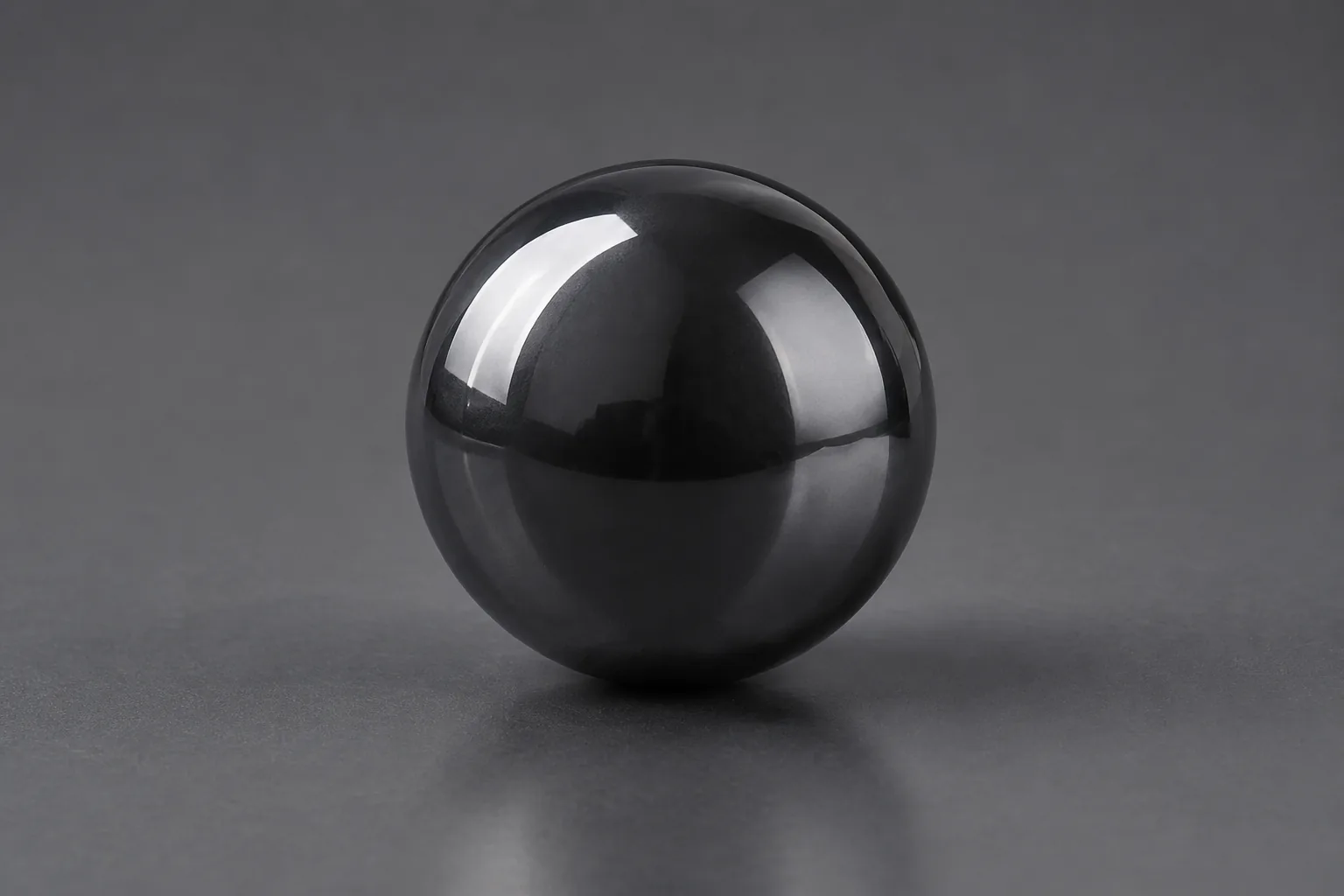
Its elastic modulus is higher than steel, about 310 GPa versus about 210 GPa. That raises stiffness, but it also changes the contact ellipse and contact stress. Do not copy load calculations from an all-steel bearing without recalculating the ceramic-steel contact.
Silicon nitride is also electrically insulating. Published values include electrical resistivity around 10^12 ohm*m and dielectric strength around 15 kV/mm. Hybrid bearings use steel rings with silicon nitride rolling elements to interrupt current paths in motors, generators, machine-tool spindles, compressors, and pumps.
Grade and microstructure matter. Published silicon nitride grades show room-temperature flexural strength of 900-1,000 MPa, fracture toughness of 5.5-6.5 MPa*m1/2, and 20°C thermal conductivity of 14-34 W/mK. Typical published values for one silicon nitride grade are density 3.304 g/cm3, Young’s modulus 315 GPa, Poisson ratio 0.25, and CTE 3.2×10^-6/°C. These ranges are a warning: specify the grade, not just the chemistry.
Do not substitute ceramic balls into an existing bearing design without checking ring geometry, internal clearance or preload, cage, lubrication, and thermal-expansion mismatch. A ball change alone is not a bearing redesign.
Alumina for General Wear Resistance and Cost Control
Alumina is the most commonly used technical ceramic. It is generally selected for a balance of hardness, wear resistance, mechanical strength, and price-to-performance. For many industrial duties, that balance is more important than the highest possible toughness.
Purity is not interchangeable. 94%, 96%, 99.5%, and 99.9% Al2O3 are different materials. Lower-purity grades can contain glass phases or additives that become contamination sources in grinding. Published 94%-99.9% alumina grades cover density 3.70-3.92 g/cm3, four-point flexural strength 298-360 MPa, elastic modulus 303-386 GPa, and compressive strength 2,068-2,700 MPa.
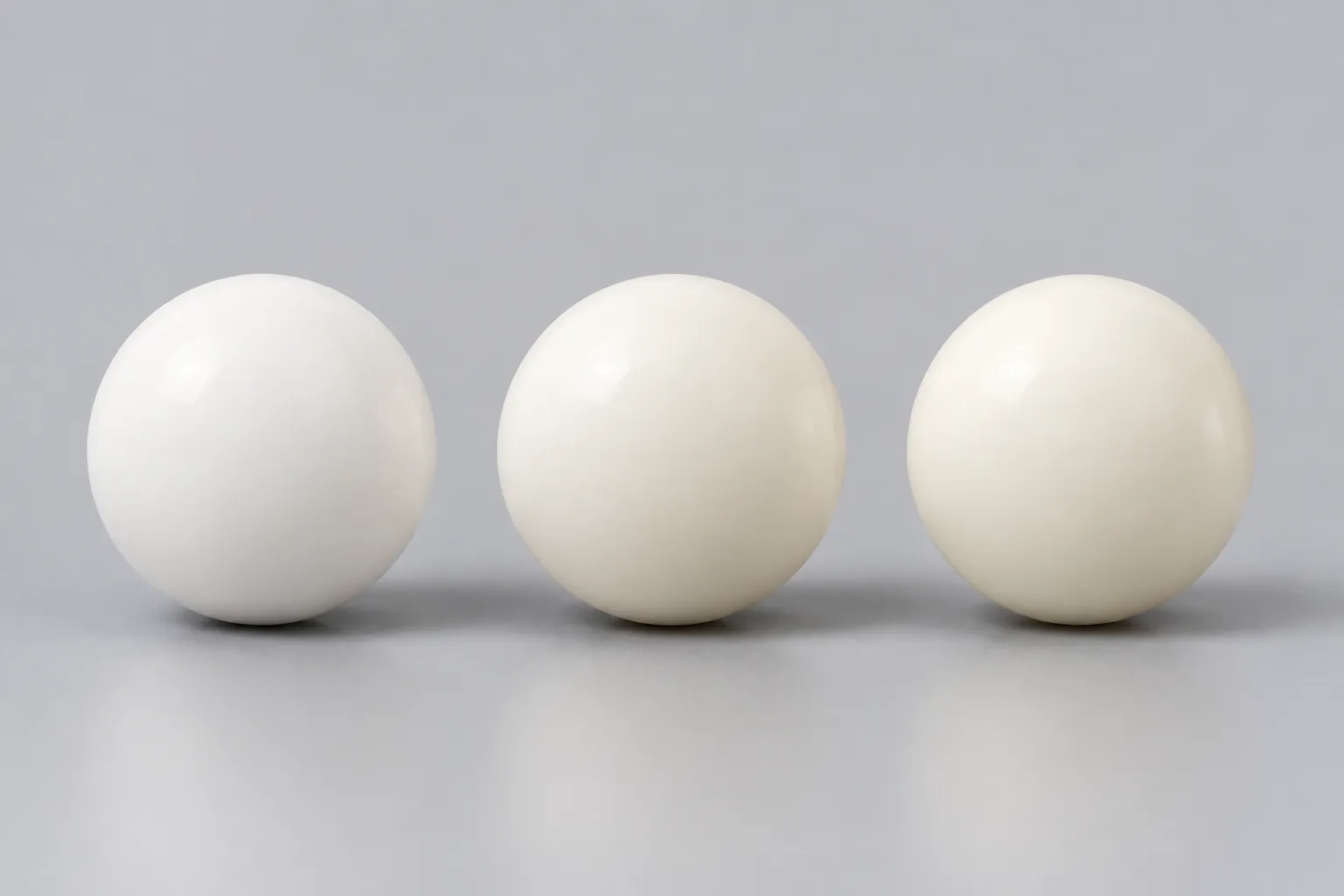
Alumina ball blanks can stay thermally stable up to 1,800°C, but the actual component limit is set by load, atmosphere, seals, and lubricants. For grinding media, specify Al2O3 purity, wear-rate test conditions, allowed media-element contamination, and target particle size.
Do not compare wear rates from different suppliers unless the mill and slurry conditions match. A wear number without test conditions is not a purchasing specification.
Zirconia for Impact Toughness and Grinding Energy
Zirconia offers much higher density and fracture toughness than either alumina or silicon nitride. Density of 5.72-6.07 g/cm3 can deliver greater impact energy in milling, while fracture toughness of 8.5-13 MPa*m1/2 supports impact and fatigue loading. Flexural strength is 620-1,720 MPa, elastic modulus is about 200-210 GPa, and compressive strength is 1,750-2,500 MPa.
Thermal behavior is the trade-off. Thermal conductivity is about 2.2 W/mK at 20°C, and CTE is about 10.2-10.3×10^-6/°C from 25-1,000°C. In rapid temperature cycling or heat-removal duty, do not select zirconia on toughness alone.
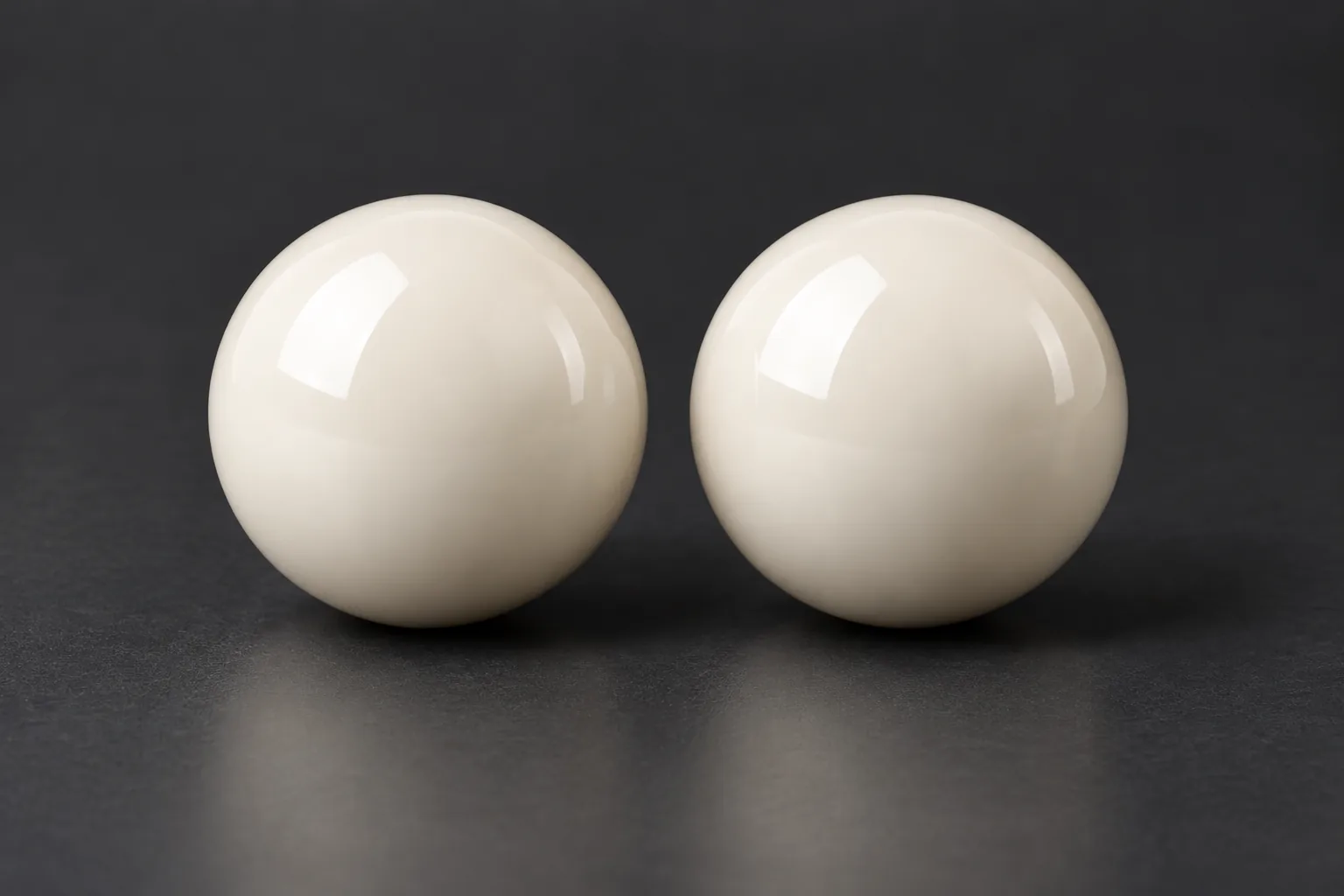
Specify the stabilizer system. Y-TZP (yttria-stabilized tetragonal zirconia) and Mg-PSZ (magnesia partially stabilized zirconia) are not equivalent. The word zirconia alone does not determine density, strength, or toughness.
Use stabilized zirconia for high-impact milling, severe fatigue, or applications that need maximum ceramic toughness. Check thermal conductivity and expansion before using it in rapid cycling or heat-removal service.
Zirconia-Toughened Alumina as a Compromise
Zirconia-toughened alumina is a composite family that combines alumina hardness and cost with zirconia toughness. It is a practical option when alumina toughness is insufficient but full zirconia density or cost is not required.
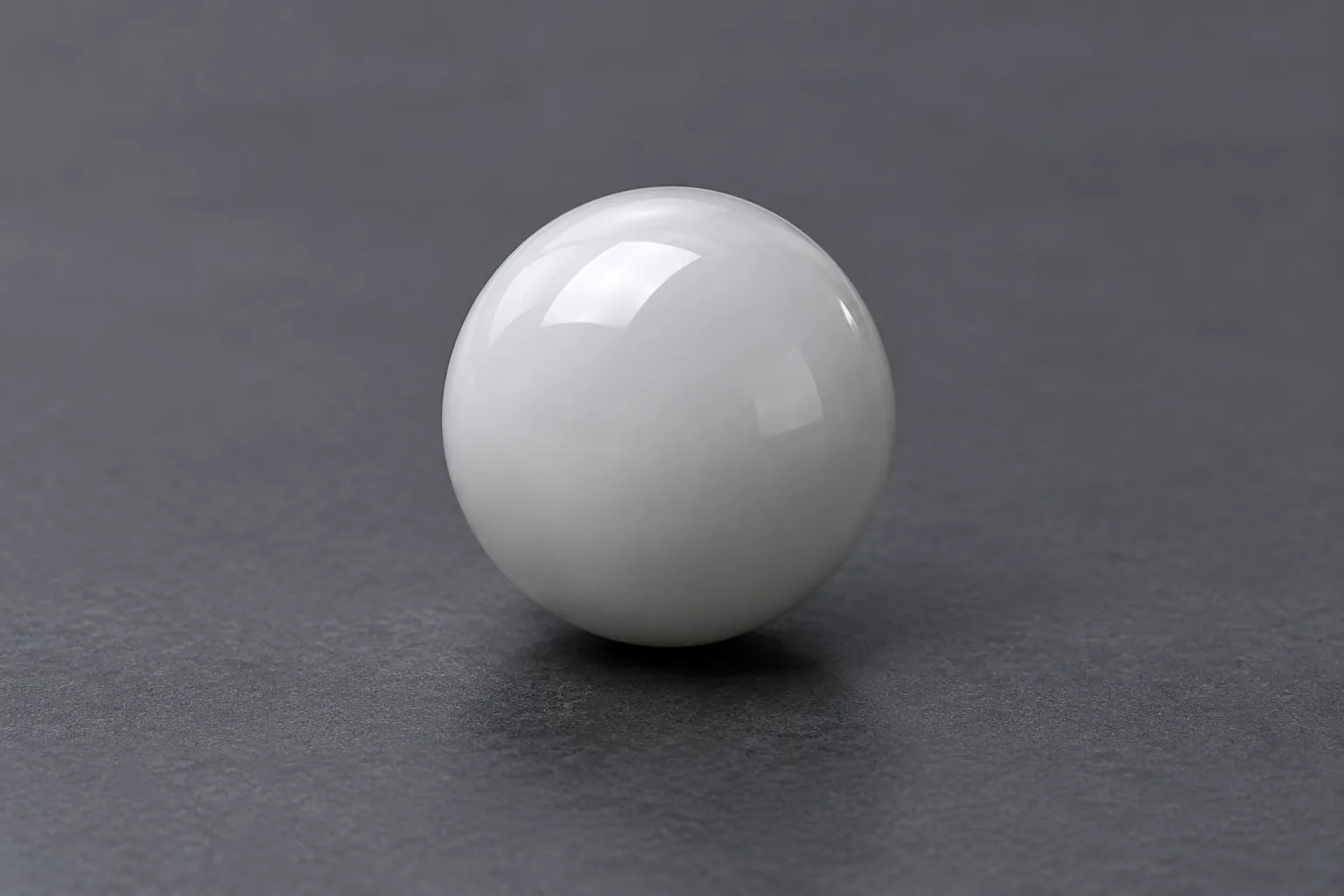
ZTA is not a single grade. Alumina content, zirconia content, and microstructure must be specified. Consider ZTA only after the application duty and material comparison show that an intermediate balance of toughness and wear resistance is the real requirement.
Specify Dimensions, Grade, and Standards Correctly
A ball grade is meaningless without the standard system behind it. Do not write only Grade 5 or Grade 10. State the standard, ball diameter, diameter tolerance, sphericity, lot diameter variation, surface roughness, and visual-defect acceptance criteria.
- ISO 3290-2:2014 covers finished silicon nitride bearing balls and was confirmed in 2025.
- ISO 26602:2017 covers preprocessed silicon nitride material for bearing balls and rollers, with three categories, and was confirmed in 2023.
- ASTM F2094/F2094M-18a covers Class I, II, and III silicon nitride bearing balls.
- ISO 19843:2018 covers notched-ball strength testing for finished ceramic bearing balls, preferentially silicon nitride, for diameters of 3-50 mm.
- ISO 3643:2024 classifies and describes surface defects but does not set acceptance limits. Limits must be agreed between buyer and supplier.
- ISO 20056-2 provides static load rating methods for hybrid bearings and connects silicon nitride balls to ISO 26602 and ISO 3290-2.
For hybrid bearings, the ball standard is only one part of the specification. The ring, cage, preload, lubrication, and thermal fit also belong in the design record.
Build a Verifiable Purchase Specification
A useful purchase specification lets a supplier prove what was made and lets the buyer reject what does not match. Include the following items.
- Material chemistry: silicon nitride, alumina, Y-TZP, Mg-PSZ, or ZTA. Do not write only ceramic.
- Purity and additives: Al2O3 percentage, stabilizer type and content, and any sintering additives.
- Physical and mechanical data: density, hardness, fracture toughness, and elastic modulus where relevant.
- Dimensions: ball diameter, diameter tolerance, sphericity, lot diameter variation, and surface roughness.
- Appearance: visual-defect acceptance criteria and the inspection method.
- Certification: batch reports for chemistry, density, hardness, microstructure, and dimensions. For bearing silicon nitride, require conformity to ISO 26602, ISO 3290-2, or ASTM F2094/F2094M where applicable.
- Operating environment: media chemistry, maximum continuous temperature, thermal cycling, load, speed, lubrication state, and allowable contamination.
Add duty-specific requirements. For grinding media, include ball-size distribution, wear-rate test conditions, allowed element contamination, and target material particle size. For valves, include ball-to-seat material pairing, sealing surface, pressure differential, impact load, and media compatibility.
For bearings, validate ring geometry, internal clearance or preload, cage, lubrication, and thermal-expansion differences. Replacing steel balls with ceramic balls does not by itself create a qualified high-speed bearing design.
Common Selection Mistakes and Exceptions
- Treating ceramic ball as a specification instead of a material family.
- Selecting by color or a generic label instead of certified grade, chemistry, and microstructure.
- Assuming a ball grade alone guarantees bearing performance without ring, cage, lubrication, and preload validation.
- Ignoring thermal-expansion mismatch between steel rings and ceramic balls.
- Ignoring changed contact stress because silicon nitride elastic modulus differs from steel.
- Using alumina purity interchangeably in grinding without checking contamination.
- Specifying zirconia without the stabilizer system.
- Treating ISO 3643 defect descriptions as automatic acceptance limits.
Conclusion
Choosing the right ceramic balls is a specification task, not a color or catalog-label decision. Start with the duty: bearing-grade silicon nitride for high speed and electrical insulation, alumina for general wear and high temperature, stabilized zirconia for impact toughness, and ZTA when an intermediate balance is needed. Then lock the grade, dimensions, surface limits, and operating conditions into a verifiable purchase document. Before approval, confirm that the ball, ring, cage, lubrication, and thermal fit work together in the actual application.
FAQs
Q1: How do I choose between silicon nitride and zirconia for a bearing?
A: Start with the duty. Silicon nitride is the usual bearing-grade choice when high speed, low rotating mass, or electrical insulation matters. Zirconia offers higher toughness and density, but its lower thermal conductivity and higher expansion must be checked against the bearing design and temperature cycle.
Q2: Is a Grade 5 ceramic ball enough to specify?
A: No. A grade number only has meaning inside a named standard system. Also state ball diameter, diameter tolerance, sphericity, lot diameter variation, surface roughness, visual-defect limits, material chemistry, and the required batch reports.
Q3: Can I replace steel balls with ceramic balls in an existing bearing?
A: Not as a drop-in change. Silicon nitride has a different elastic modulus and thermal expansion from steel, so contact stress, clearance or preload, cage loading, lubrication, and ring fit must be recalculated and validated.
Q4: Which alumina purity should I specify for grinding media?
A: It depends on contamination limits and wear duty. 94%, 96%, 99.5%, and 99.9% Al2O3 are not equivalent, and lower-purity grades can release glass phases or additives. State the purity, wear-rate test conditions, allowed element contamination, and target particle size.
Q5: Does ISO 3643:2024 set acceptance limits for surface defects?
A: No. It classifies and describes defects but does not set acceptance limits. The buyer and supplier must agree on limits and inspection methods in the purchase specification.
Q6: What is the main advantage of ZTA?
A: ZTA is a composite that aims for a balance between alumina hardness and cost and zirconia toughness. Specify its alumina content, zirconia content, and microstructure, because ZTA is a family rather than one fixed grade.