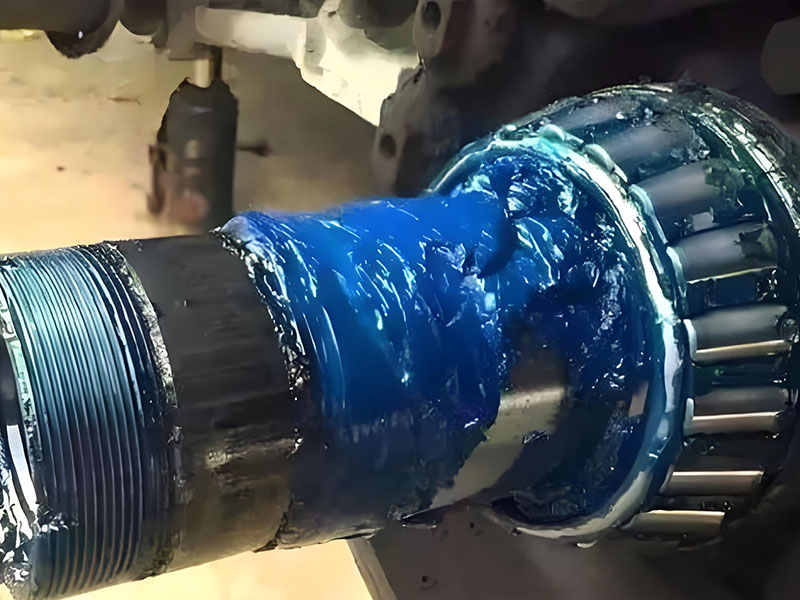
Quick Answer: For cam follower vs roller follower, a cam follower is normally a stud-type track roller with an integral threaded stud, mounted cantilever-style and secured with a nut. A roller follower is normally a yoke-type track roller with a bore, mounted on a separate shaft or pin. Both use a thick-walled outer ring that rolls directly on a cam plate, rail, or guideway. Use the names as a terminology map, not as proof that every manufacturer classifies products the same way.
Cam follower vs roller follower is a mounting-interface decision before it is a product-name decision. The two families share track-roller geometry, but they install differently and place different demands on the surrounding structure. The comparison below keeps the terms separate, shows where catalog naming can mislead, and gives selection checks that matter before ordering or designing a mounting.
The Core Difference: Cam Follower vs Roller Follower
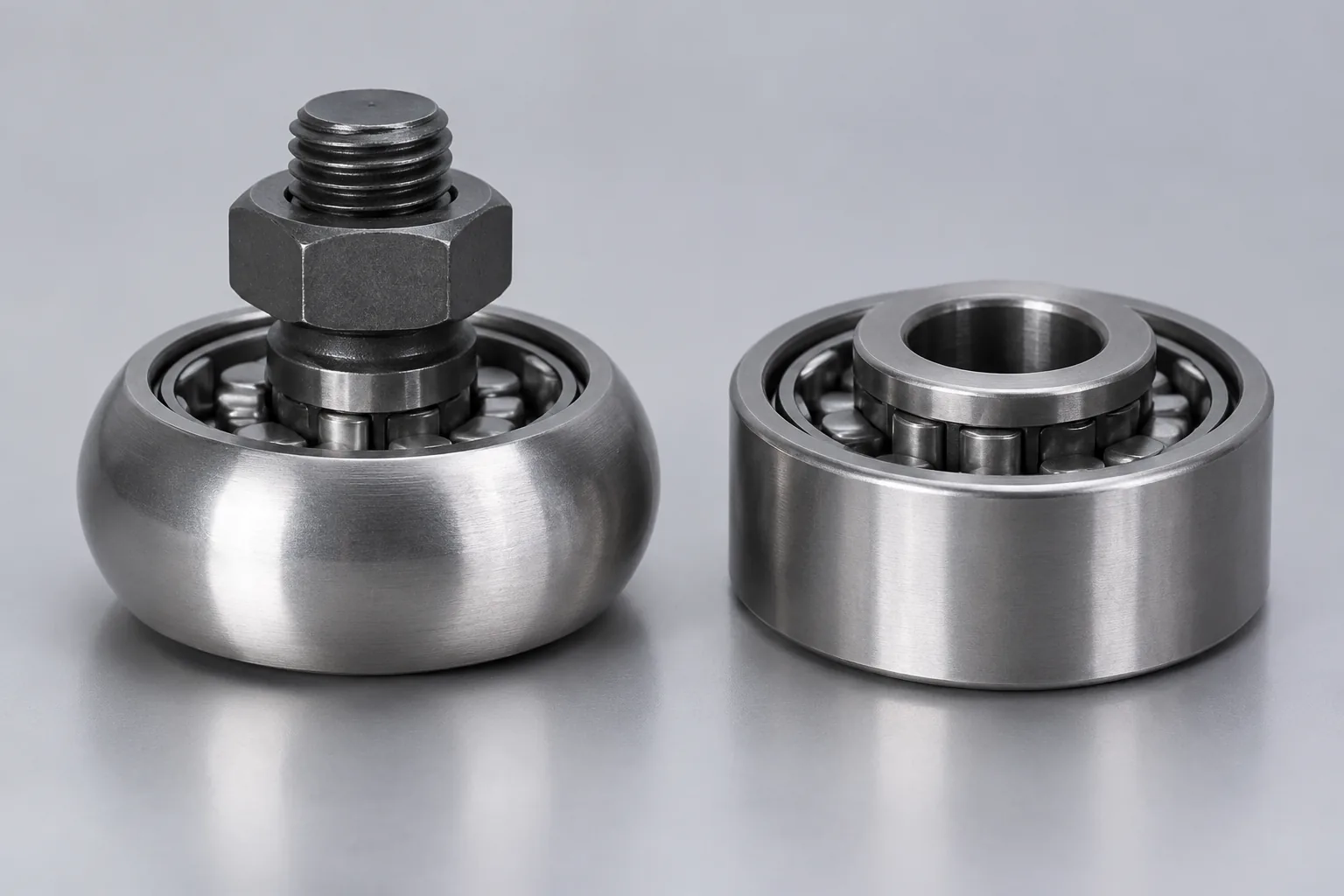
A cam follower is normally a stud-type track roller with an integral threaded stud. The stud passes through a mounting hole and is secured with a nut, so the support is commonly cantilever-style. A roller follower is normally a yoke-type track roller with a bore. It runs on a separate shaft or pin supplied by the equipment, so the surrounding structure carries the support and alignment.
| Comparison point | Cam follower | Roller follower |
|---|---|---|
| Common catalog term | Stud-type track roller | Yoke-type track roller |
| Mounting interface | Integral threaded stud | Bore for a separate shaft or pin |
| Typical support | Cantilever stud and nut | Shaft or pin supported by the machine structure |
| Outer ring function | Thick-walled ring rolls on the track | Thick-walled ring rolls on the track |
| Replacement style | Often replaced as a complete unit | Separable designs may allow inner and outer ring separation |
Both are track-roller families with thick-walled outer rings that roll directly on a cam plate, rail, or guideway. The central distinction is the mounting interface, not the rolling action. Use the quick comparison as a terminology map, not as a claim that every manufacturer uses the same product names.
Why the Names Are Often Confused
Several major bearing catalogs generally align cam follower with stud-type track rollers and roller follower with yoke-type track rollers. Some technical guides use the parallel terms stud-type track roller and yoke-type track roller. Some manufacturers, however, use cam follower as an umbrella term for the entire track-roller category. That is why a catalog name alone is not a reliable selection check.
ISO 7063:2018 covers both yoke-type and stud-type needle roller bearing track rollers, which reinforces that both belong to one broader track-roller family. The standard does not remove the need to identify the mounting interface. When reading a catalog, map the product to its mounting interface and drawing before comparing it with another brand. A part named cam follower should still be checked for an integral stud versus a bore.
Structural Differences
At family level, compare the two products by mounting interface, bearing elements, outer ring, inner ring or stud, seals or shields, and replacement method. Exact construction varies by series, cage type, and sealing option, so the comparison should stay at family level until the exact catalog drawing is checked.
Cam Follower: Integral Stud Design
Typical construction includes a thick-walled outer ring, needle or cylindrical rollers, side plates or seals, and an integral threaded stud. The stud passes through a mounting hole and is secured with a nut. The mounting is commonly cantilever-style, so stud strength, nut access, and mounting-hole rigidity are critical selection checks. Some cam followers include a hex hole, a screwdriver slot, or an internal grease nipple for installation or lubrication.
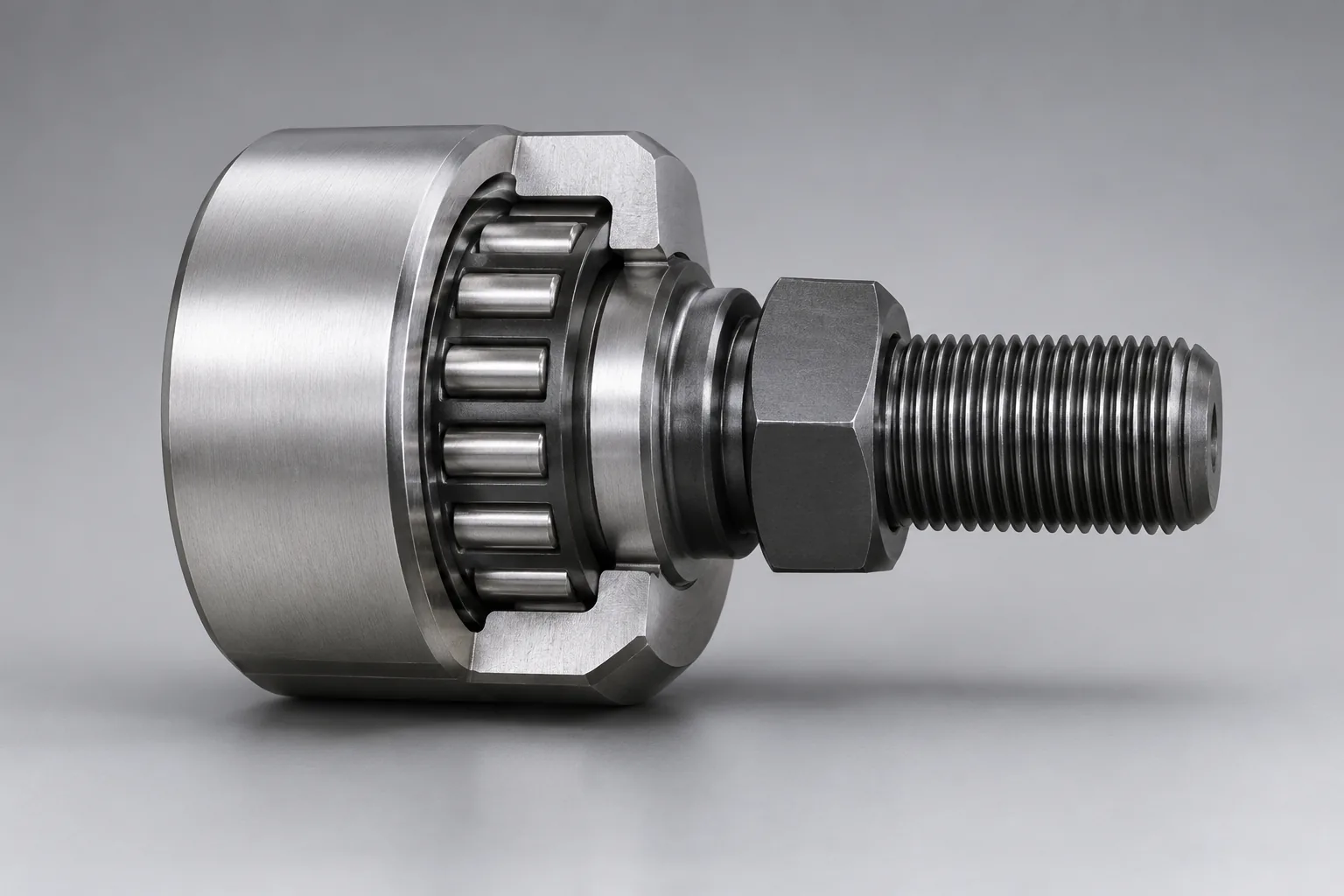
Published size and load examples: one compact cam-follower series covers stud diameters from 3 mm to 30 mm. A full-complement version of that family lists basic dynamic load ratings of 13.4-67.6 kN, basic static load ratings of 19.8-145 kN, and stud diameters of 12-30 mm. These values apply to that series and version, not to every cam follower. Use a cam follower when a compact cantilever mounting with an integral stud is acceptable, and do not use the example load range as a category-wide rating.
Roller Follower: Bore-Mounted Yoke Design
Typical construction includes an outer ring, rollers, an optional inner ring, seals or shields, and side plates, but no integral mounting stud. The roller follower is mounted on a shaft or pin provided by the equipment. Roller followers may be separable or non-separable; separable designs can allow inner and outer ring separation. No-inner-ring versions save radial space, but they require the shaft surface to act as the inner raceway.
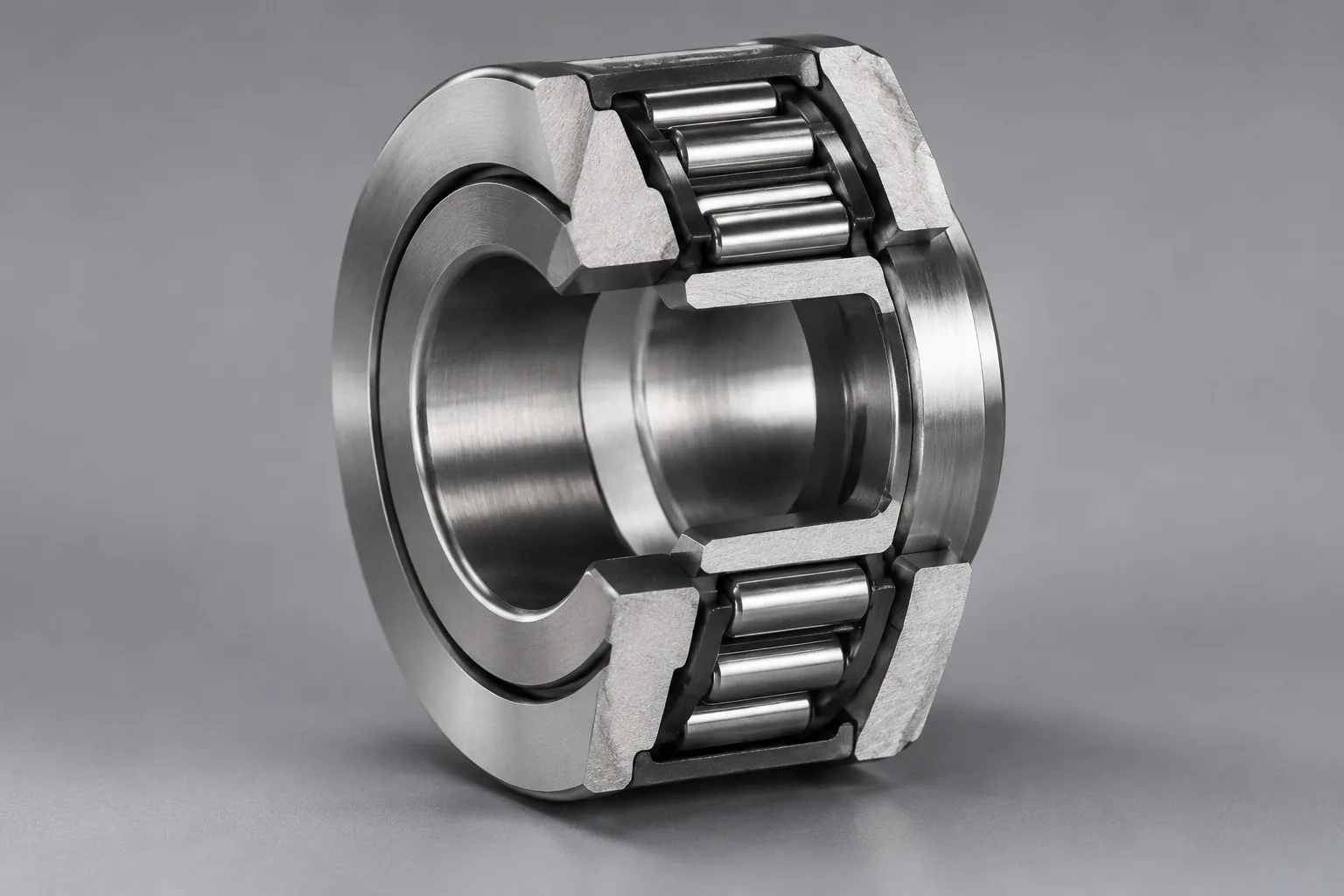
Published size examples: one roller-follower family includes separable NAST/RNAST with 6-60 mm nominal bore, NART-R with 5-50 mm bore, and NURT double-row cylindrical roller series with 15-50 mm bore. A separate roller-follower line lists RNAST at 7-60 mm bore and 16-90 mm roller outside diameter, NAST at 6-50 mm bore and 19-90 mm outside diameter, and NART at 5-50 mm bore and 16-90 mm outside diameter. Series designations such as NAST and RNAST appear in more than one manufacturer catalog with different bore ranges, so confirm which catalog each example comes from.
Use a roller follower when the machine can provide a separate shaft or pin and when a yoke-type support arrangement is preferred. A yoke-type track roller may be mounted on shafts or studs, but it still uses a bore and separate support rather than an integral mounting stud.
Installation and Support
Cam follower installation: insert the stud through the mounting hole, prevent stud rotation, and tighten the nut on the stud. One catalog specifies using a screwdriver or hex key to prevent stud rotation while tightening the hexagon nut. Roller follower installation: support the bore on a shaft or pin, and make the surrounding structure provide the required alignment and support.
No-inner-ring roller followers require a hardened and ground shaft surface suitable for use as a raceway. One RNAST series is designed for direct mounting on a hardened and ground shaft. A technical guide states that no-inner-ring yoke-type track rollers require the shaft surface to meet rolling-bearing raceway quality. Use no-inner-ring roller followers only when shaft hardness, finish, and dimensional accuracy are controlled.
Mounting rigidity, alignment, and shaft or stud strength directly affect service life. A yoke-type roller follower mounted on a stud still relies on a separate shaft or pin interface, not an integral threaded stud.
Load Capacity and Speed: Avoid Category-Level Assumptions
Both cam followers and roller followers use thick-walled outer rings because the outer ring rolls directly on the track and must withstand contact stress, bending, and impact. Do not state that roller followers always have higher load capacity than cam followers. Compare the same manufacturer, the same size, the roller structure, the speed, and the track load rating.
Caged rollers are generally suitable for higher speed. Full-complement rollers generally provide higher load capacity but are suited to lower speed. Double-row cylindrical roller designs can further increase load capacity within a product family. Use full-complement designs when high load capacity is needed and the operating speed is compatible.
Product-line examples: one roller-follower line lists a maximum basic dynamic load rating of 142 kN; within that line NART reaches 84 kN, NURT reaches 96.3 kN, and CRY reaches 142 kN. The 142 kN figure is a product-line maximum, not a universal roller-follower rating. Cam followers can also carry substantial loads depending on series and size, so compare verified catalog ratings for the exact series rather than product-family names.
Outer Ring Profile: Crowned vs Cylindrical
Crowned or spherical outer rings compensate for slight mounting error, axis tilt, or skewed running and reduce edge stress. Cylindrical outer rings provide greater contact area and lower contact pressure on a flat track. Choose a crowned outer ring when misalignment is expected or difficult to eliminate; choose a cylindrical outer ring when alignment is controlled and maximum track contact area is required. A crowned profile compensates for slight misalignment but does not replace proper installation and alignment practice.
Selection Checklist: Cam Follower or Roller Follower?
- Choose a cam follower when the design needs a compact cantilever mounting, an integral threaded stud, fewer mounting parts, and straightforward whole-unit replacement.
- Choose a roller follower when the design can provide a separate shaft or pin, when a yoke-type support is preferred, or when separable or no-inner-ring options are needed.
- Check load, speed, stud or shaft strength, track hardness, misalignment, lubrication access, contamination exposure, and replacement method.
- Use manufacturer catalog ratings for the exact series and size; do not select by product-family name alone.
If mounting space is tight and a stud can be supported cantilever-style, evaluate cam followers first. If the machine structure can support a separate shaft or pin and requires higher support stiffness or separable maintenance, evaluate roller followers first. There is no universal winner; the correct choice depends on the mounting interface and verified catalog ratings.
Size and Product Examples: Use as Reference Only
Product examples show available size ranges and construction options, not a ranking of the two families. Dimensions and load ratings apply only to the named series and manufacturer. Avoid implying that one example represents all cam followers or all roller followers.
- One roller-follower product line lists a total bore range of 5-60 mm, a roller outside diameter range of 16-110 mm, and a maximum basic dynamic load rating of 142 kN.
- Within a roller-follower line, NAST is a caged separable type with 6-50 mm bore, 19-90 mm outside diameter, and a maximum basic dynamic load rating of 38.9 kN.
- A double-row cylindrical roller follower series covers 15-50 mm bore.
Compare only product series with the same mounting type and roller arrangement. Do not transfer maximum load figures from one manufacturer or series to another.
Lubrication and Maintenance
Cam follower stud ends may include a grease hole for relubrication through a grease nipple. Sealed and full-complement products may be pre-filled with lithium-soap grease. Relubrication intervals depend on operating conditions; published intervals are reference values, not guarantees.
Reference intervals: one catalog gives 6 months to 2 years for caged types and 1 to 6 months for full-complement types. Some cam followers with stud diameter not exceeding 10 mm have no relubrication hole and receive initial lubrication only. A product without a relubrication hole cannot be treated as relubricable in service.
Confirm grease access, seal type, and relubrication interval from the exact catalog for the selected series. Contamination, moisture, high speed, and high temperature can shorten grease life and should be checked against the application conditions.
Standards and Specification Language
ISO 7063:2018 is the relevant boundary-dimension and tolerance standard for needle roller bearing track rollers. Its title is Rolling bearings – Needle roller bearing track rollers – Boundary dimensions, geometrical product specifications (GPS) and tolerance values. The standard covers both yoke-type and stud-type track rollers, so specifications should still state the mounting type explicitly.
Standard details: ISO 7063:2018 is the 3rd edition, published 2018-07-19, with an English and French corrected version in 2020-02; ISO reaffirmed it in 2024. It has 11 pages, is managed by ISO/TC 4/SC 5 Roller Bearings, and has ICS code 21.100.20.
Use standard terms carefully: stud-type track roller for cam follower equivalents and yoke-type track roller for roller follower equivalents. When manufacturer terminology differs, include both the catalog name and the mounting type in the specification. Use the standard to specify boundary dimensions and tolerances, not as a substitute for application-specific load and life calculation. A standard product name does not override the need to confirm the mounting interface in the manufacturer drawing.
Conclusion
Cam follower vs roller follower is not a contest with a universal winner. Choose by mounting interface first: integral stud and cantilever support versus bore and separate shaft or pin support. Then verify load, speed, outer-ring profile, shaft or stud strength, track condition, lubrication, and standard dimensions for the exact catalog series. Confirm the selected series in the manufacturer catalog before ordering or designing the mounting.
FAQs
Q1: Are a cam follower and a roller follower the same product?
A: They are related track-roller families but not necessarily the same product. A cam follower is normally a stud-type track roller with an integral threaded stud, while a roller follower is normally a yoke-type track roller with a bore for a separate shaft or pin. Some manufacturers use cam follower as an umbrella term, so confirm the drawing.
Q2: Which has higher load capacity?
A: There is no category-level answer. Compare the same manufacturer, size, roller arrangement, speed, and track rating. Full-complement rollers can have a higher rated load than caged rollers but suit lower speed, and double-row designs can increase capacity. Product-line maxima are not transferable between series.
Q3: When should I choose a crowned or cylindrical outer ring?
A: Choose a crowned outer ring when misalignment or skewed running is expected, because it helps reduce edge stress. Choose a cylindrical outer ring when alignment is controlled and maximum contact area or lower contact pressure on a flat track is required. A crowned profile does not replace proper alignment.
Q4: Can a roller follower be used without an inner ring?
A: Yes. A no-inner-ring roller follower saves radial space, but the shaft must be hardened and ground and must act as the inner raceway. Confirm shaft hardness, finish, and dimensional accuracy before using this design.
Q5: How often should cam followers be relubricated?
A: It depends on operating conditions. One catalog gives reference intervals of 6 months to 2 years for caged types and 1 to 6 months for full-complement types. Some cam followers with stud diameter not exceeding 10 mm have no relubrication hole and receive initial lubrication only. Confirm the exact catalog for the selected series.
Q6: Which ISO standard covers cam followers and roller followers?
A: ISO 7063:2018 covers boundary dimensions, geometrical product specifications, and tolerances for needle roller bearing track rollers, including both yoke-type and stud-type designs. It does not replace application-specific load and life calculation.