Quick Answer: A hybrid vehicle wheel bearing is the wheel-end hub bearing on a hybrid electric vehicle (HEV) or plug-in hybrid electric vehicle (PHEV). It carries radial, axial and tilting loads from the wheel and body. It is not a hybrid ceramic bearing, which uses steel rings and ceramic rolling elements for electrical insulation in motors or e-drive units. Electrification raises load and efficiency demands, so low-friction design, sealing and correct installation matter; electrical erosion is mainly an e-drive issue.
Electric hybrid vehicle wheel bearings are often confused with hybrid ceramic bearings. The first is a wheel-end hub unit on an HEV or PHEV; the second is a motor or e-drive bearing with ceramic rolling elements. This article explains function, load and friction requirements, common designs, electrical-erosion limits, diagnosis, selection, installation and the standards that support ratings and damage classification.
What Hybrid Vehicle Wheel Bearing Means and What It Does Not Mean
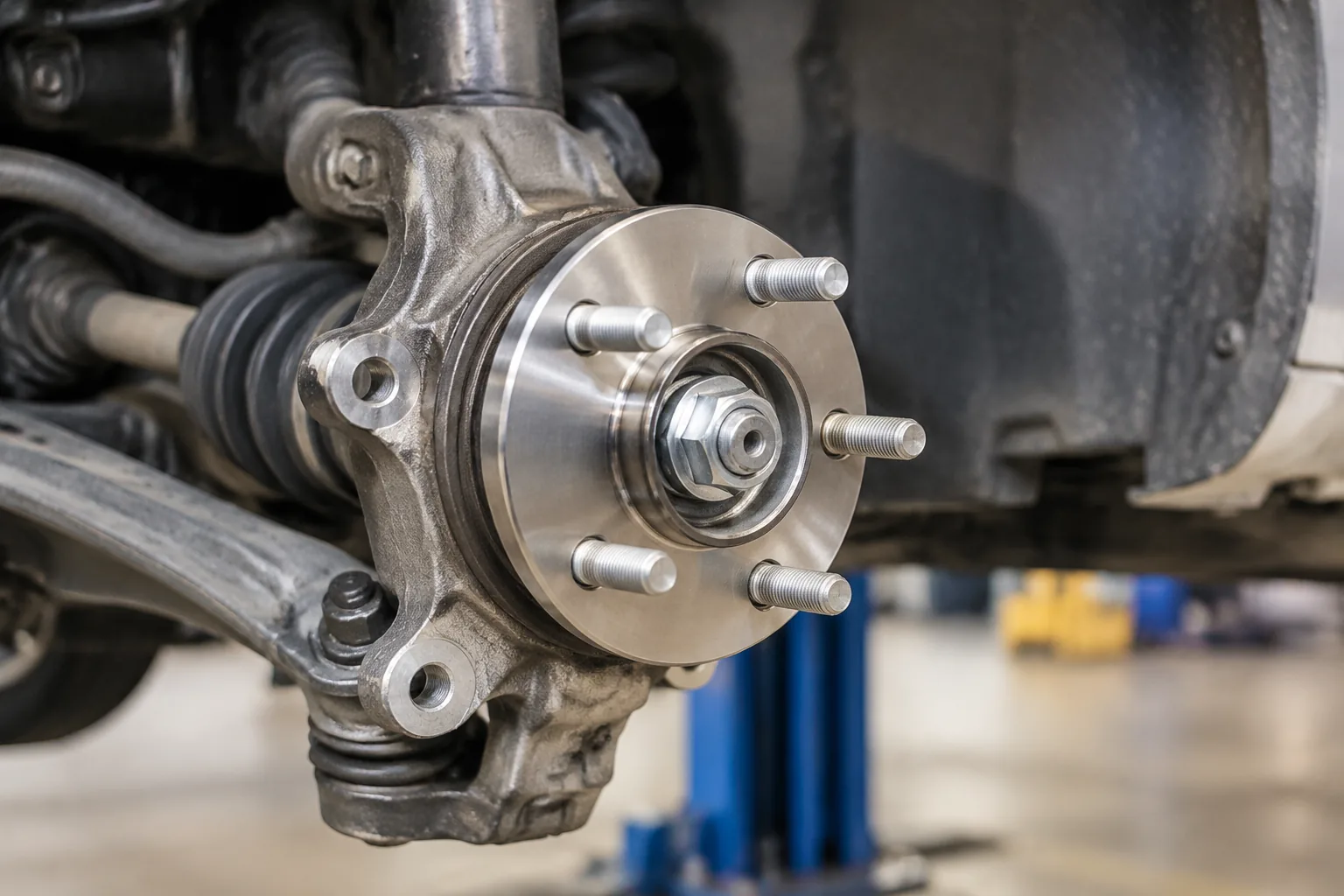
The term hybrid vehicle wheel bearing is often used loosely. In this article it means the hub bearing at the wheel end of a hybrid electric vehicle (HEV) or plug-in hybrid electric vehicle (PHEV). It connects the wheel to the body-side mounting, carries radial loads, axial loads and tilting moments, and lets the wheel rotate smoothly.
A hybrid bearing is a different product. It usually means a rolling bearing with steel rings and ceramic rolling elements, commonly silicon nitride. SKF notes that silicon nitride rolling elements in hybrid bearings are insulating. That construction is used where electrical insulation is needed in motors or e-drive systems, not because the vehicle is a hybrid.
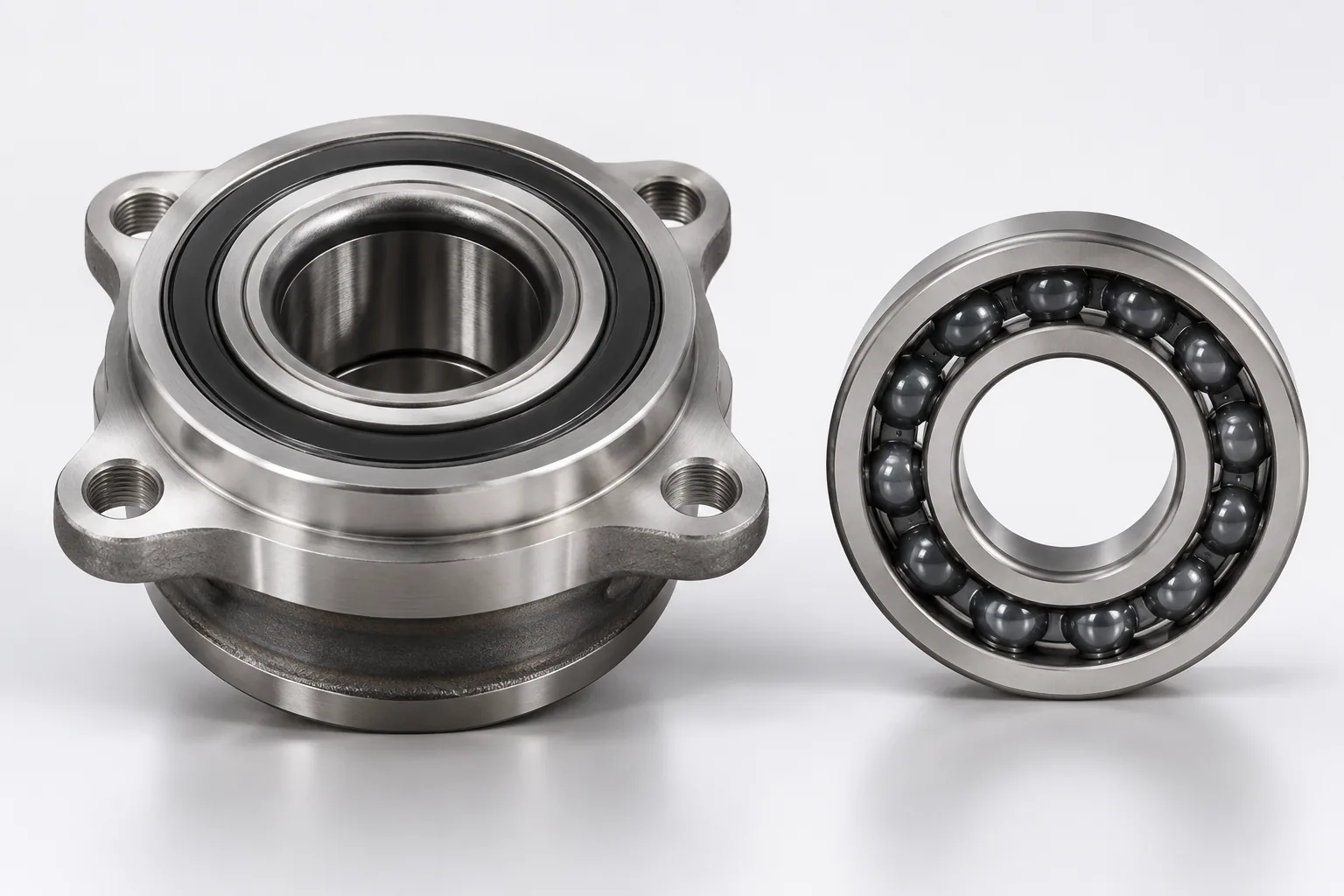
The practical consequence is important: motor-bearing electrical erosion claims cannot be transferred automatically to every EV or HEV wheel hub bearing. The wheel end and the electric machine see different operating conditions and current paths.
| Item | Hybrid vehicle wheel bearing | Hybrid ceramic bearing |
|---|---|---|
| Location | Wheel end, hub unit | Motor, e-drive or other electrical machine |
| Main loads | Radial, axial and tilting loads from wheel and body | Loads defined by the machine rotor and drive system |
| Typical electrical risk | Not an inherent electrical-erosion part; current path must be confirmed | Insulation or current management is a design concern |
| Terminology use | Vehicle application: HEV or PHEV wheel end | Bearing construction: steel rings with ceramic rolling elements |
A wheel hub bearing may include a wheel-speed sensor or a seal, but that does not make it an insulated motor bearing.
Why HEV and PHEV Vehicles Change Wheel Bearing Requirements
Electrification changes wheel-end requirements through higher vehicle mass, lower tolerance for parasitic friction, tighter sealing demands and greater integration of sensors. The three subsections below separate these effects.
Higher Wheel-End Loads From Battery Mass
A large battery pack increases vehicle mass and can raise the load the wheel-end bearing must carry. Timken states that its wheel-end bearing design for electric trucks changes internal geometry to handle additional system power or load requirements caused by battery weight within a given size envelope.
That load increase makes static and dynamic rating checks more important, but no universal load value applies to all HEVs or PHEVs. Load values must come from the specific vehicle or bearing application data.
Lower Friction for Efficiency and Range
Lower wheel bearing friction directly reduces energy consumption and can support range. That is why low-friction hub bearings are a core design target for EV and HEV applications.
NTN reports that its Low Friction Hub Bearing series can reduce rotational friction by up to 64% compared with conventional designs for EV and HEV use. This is NTN product comparison data, not an industry-wide value.
Schaeffler reports that its TriFinity design, compared with a standard double-row ball bearing, provides 33% higher stiffness, 24% higher load capacity and 53% lower friction in the same installation space. These are manufacturer comparisons for that product and comparator.
Schaeffler also reports that friction-optimized wheel bearings can reduce friction by up to 50% versus standard solutions, and that an example EV powertrain showed 0.6% lower electrical energy demand. In an FTP75 calculation for the TriFinity design, moving from a preloaded tapered roller bearing unit to a ball bearing solution improved friction torque and stiffness, with 0.7% energy saving per vehicle.
In 2025 capital markets material, Schaeffler states that the next-generation TriFinity wheel bearing can reduce friction by up to 70% versus conventional volume designs and transmit up to 50% higher torque. The up to qualifiers must be retained.
None of these percentages is a universal fuel-saving or range-improvement figure.
Sealing, Grease and Integrated Sensors
Wheel bearing efficiency is not only about rolling elements. Schaeffler identifies optimized seals, low-friction grease and internal design as key ways to reduce hub bearing friction. Sealing lip friction and grease formulation affect drag and protection, so a low-friction bearing still needs a seal that keeps water and contamination out.
SKF and Protean Electric developed custom hub bearing units for hybrid and pure electric wheel-hub motors with integrated seals and sensors. An integrated sensor supports wheel-speed or system functions, but sensor integration does not by itself mean the bearing is electrically insulated.
Seal type, grease and sensor configuration are application-specific and must be confirmed against the bearing drawing or vehicle specification.
Wheel Bearing Designs Used on Electrified Vehicles
Modern passenger car wheel hub bearing units are usually customized components. SKF states that dimensions, tolerances and internal axial clearance vary by application and are specified on engineering drawings. SKF also gives a typical passenger car hub bearing unit maximum speed of about 2,000 r/min as an application reference, not as a limit for every design.
Three design references matter here: double-row ball hub units as a common standard comparator, three-row angular contact ball designs such as Schaeffler TriFinity, and preloaded tapered roller bearing units that can be replaced by ball bearing solutions in some electrified applications. Design choice depends on axle load, available space, stiffness, friction target and sealing requirements.
Use design names only for the manufacturers and products that source them; do not generalize one design to all HEV or PHEV wheel ends.
Double-Row Ball Hub Units
The double-row ball hub unit is the standard-design comparator used in Schaeffler’s TriFinity data. This design can be optimized for lower friction and sealing drag, but final performance depends on the specific bearing, grease, seal and application. Do not claim that every double-row ball hub unit has the same load capacity or friction level.
Three-Row Angular Contact Wheel Bearings
Schaeffler TriFinity is a specific three-row angular contact ball bearing for electrified vehicles. Against a standard double-row ball bearing, Schaeffler reports 33% higher stiffness, 24% higher load capacity and 53% lower friction in the same installation space.
Higher stiffness can help control wheel-end deflection under load, while lower friction supports efficiency.
Tapered Roller Units and Preload
Preloaded tapered roller bearing units are one design option at the wheel end. Schaeffler reports that moving from a preloaded tapered roller bearing unit to a ball bearing solution improved friction torque and stiffness in its TriFinity FTP75 calculation, with 0.7% energy saving per vehicle.
Preload and internal clearance must follow the bearing or vehicle specification because incorrect preload affects friction, heat and life. Do not state a universal preload.
Do Hybrid Wheel Bearings Suffer Electrical Erosion?
When stray current passes through a rolling bearing, electrical discharge can occur at the rolling element and raceway contact. SKF describes the result as micro-cratering and later fluting or washboarding damage.
Electrical erosion is mainly a motor or e-axle bearing issue, not a default failure mode of every EV or HEV wheel hub bearing. The mechanism requires a current path through the bearing. Without stray current, the mechanism does not apply.
SKF INSOCOAT is an insulation example for motor and drive bearings: a plasma-sprayed aluminum oxide coating, a standard insulation breakdown voltage of 1,000 VDC, resistance greater than 50 MΩ, and ceramic coating thickness up to 300 μm for special applications. Do not apply these figures to ordinary passenger car wheel hub bearings.
SKF’s 2024 e-axle example shows system-level mitigation: a conductive brush ring provides a grounding path for the rotor shaft, while a hybrid ceramic ball bearing provides insulation at the other end. That is an e-drive bearing system, not a default wheel-hub specification.
ISO 281:2007 basic rating life does not cover electrical erosion, corrosion or wear. A calculated L10 life therefore does not prove freedom from electrical damage.
Noise, Wear and Failure Diagnosis at the Wheel End
ISO 15243:2017, Rolling bearings – Damage and failures – Terms, characteristics and causes, is the terminology basis for classifying in-service bearing damage by appearance and possible root cause.
Misalignment of hub bearing inner and outer rings creates additional loads between rolling elements and raceways and can cause running noise and reduced life, as stated by SKF.
Symptoms are not diagnosis. Noise, vibration, play or ABS-related warnings indicate that the wheel end needs inspection, but they do not prove that the bearing alone has failed. Tires, brakes, suspension, driveline and sensor circuits can produce similar symptoms and must be checked before replacing the bearing.
Useful inspection checks include:
- Wheel-end play.
- Rotation noise.
- Seal condition.
- Mounting surfaces.
- Signs of misalignment or impact damage.
Use ISO 15243 terminology for damage description, but do not diagnose a specific cause without inspection evidence. A wheel-speed sensor or ABS warning can have causes outside the bearing and requires proper diagnostic testing.
Selection and Installation Checks for HEV and PHEV Wheel Bearings
Selection starts with the vehicle application:
- Axle position.
- Load.
- Space envelope.
- Sensor requirement.
- Seal type.
- Internal clearance or preload.
Each of these must match the specification.
Dimensions alone do not prove interchangeability. SKF notes that hub bearing unit dimensions, tolerances and internal axial clearance are application-specific and specified on drawings.
Installation practices protect bearing life:
- Press on the correct ring.
- Avoid impact through the rolling elements.
- Keep the seal and grease clean.
- Check mounting surfaces for damage or misalignment.
IATF 16949 is often described incorrectly. It certifies a quality management system, not an individual wheel bearing product. Write manufactured by an IATF 16949-certified facility or supplier, never the wheel bearing is IATF-certified.
Direct readers to the vehicle or bearing specification for torque, preload and clearance values rather than stating universal numbers. Part numbers, fitment and interchange must be confirmed through the vehicle identification number, OEM electronic parts catalog or supplier application data. Do not infer interchangeability from bearing dimensions or from a similar model year.
Matching the Bearing to the Vehicle
Check the following for each application:
- Correct axle.
- Confirmed part number.
- Sensor or non-sensor version.
- Seal design.
- Internal clearance or preload.
- Load rating for the application.
A low-friction design is useful only when it also meets the required load, stiffness and sealing conditions.
Installation Practices That Protect Bearing Life
- Keep the bearing in its packaging until installation.
- Avoid dropping it.
- Do not force it by the cage or rolling elements.
- Use the specified press tools.
Misalignment during installation can create the same additional raceway loads described by SKF and can lead to noise or short life. Torque, preload and clearance values must come from the vehicle service information or bearing drawing.
What IATF 16949 Does and Does Not Certify
IATF 16949 certification applies to a supplier’s quality management system and does not certify a specific bearing product, manufacturing process or process capability. IATF official guidance states that IATF 16949 certification is a QMS certification, not a product certification. Use precise wording such as manufactured by an IATF 16949-certified facility; avoid the wheel bearing is IATF-certified.
Standards That Support Load Ratings and Damage Classification
Use each standard only within its stated scope.
| Standard | Scope | Practical use |
|---|---|---|
| ISO 281:2007 | Basic dynamic load ratings and basic rating life; basic rating life corresponds to 90% reliability and excludes electrical erosion, corrosion and wear. | Dynamic life comparison; not proof of electrical endurance. |
| ISO 76:2006 | Basic static load ratings, static equivalent loads and guidance on static safety factors for heavily loaded applications. | Checks static capacity and safety factor when battery mass raises wheel-end load. |
| ISO 15:2017 | Preferred boundary dimensions for radial bearings; includes diameter series 7, 8, 9, 0, 1, 2, 3 and 4. | Boundary dimension reference; does not confirm application fitment. |
| ISO 20056-1:2017 | Dynamic load ratings for hybrid bearings with ceramic rolling elements. | Rating reference for hybrid bearing construction, not a hybrid vehicle standard. |
| ISO 20056-2:2017 | Static load ratings for hybrid bearings with ceramic rolling elements. | Rating reference for hybrid bearing construction, not a hybrid vehicle standard. |
| ISO 15243:2017 | Damage and failure terms, characteristics and causes for rolling bearings. | Damage classification vocabulary for inspection reports. |
Conclusion
Understanding electric hybrid vehicle wheel bearings depends on one distinction: a hybrid vehicle wheel bearing is a wheel-end hub bearing on an HEV or PHEV, while a hybrid ceramic bearing is a motor or e-drive component with insulating ceramic rolling elements.
For electrified vehicles, battery mass raises load, low friction supports efficiency, sealing and grease affect drag and protection, and sensors may be integrated into the hub unit. Electrical erosion is mainly an e-drive issue and should not be written as a default wheel-hub failure.
Before ordering, confirm the vehicle application, part number, sensor and clearance requirements, and use qualified suppliers whose quality management system claims are stated accurately.
FAQs
Q1: Is a hybrid vehicle wheel bearing the same as a hybrid ceramic bearing?
A: No. A hybrid vehicle wheel bearing is the wheel-end hub bearing on an HEV or PHEV. A hybrid ceramic bearing uses steel rings with ceramic rolling elements, commonly silicon nitride, and is used where electrical insulation is needed in motors or e-drive systems.
Q2: Do HEV and PHEV wheel bearings need low-friction designs?
A: Low friction is a major design target because it reduces energy loss and can support range, but the required design depends on vehicle load, space, sealing and stiffness requirements. NTN and Schaeffler figures cited in this article are manufacturer product comparisons, not universal results.
Q3: Can wheel hub bearings suffer electrical erosion in electric cars?
A: Electrical erosion can occur when stray current passes through a rolling bearing and discharges at the rolling element and raceway contact, causing micro-cratering and later fluting. It is mainly a motor or e-axle bearing issue and is not a default failure mode of every EV or HEV wheel hub bearing.
Q4: Are hybrid wheel bearings insulated?
A: Do not assume so. Insulation features such as SKF INSOCOAT are described for motor and drive bearings, with a standard breakdown voltage of 1,000 VDC and resistance greater than 50 MΩ. A wheel hub bearing should be treated as insulated only when the manufacturer specifies it.
Q5: Can I use a standard wheel bearing on a hybrid vehicle?
A: Only when the confirmed application data specify that bearing. Hub bearing unit dimensions, tolerances and internal axial clearance are application-specific, and dimensions alone do not prove interchangeability. Confirm by VIN, OEM electronic parts catalog or supplier application data.
Q6: Which standards should a buyer check for wheel bearing load ratings?
A: ISO 281:2007 covers basic dynamic load ratings and basic rating life at 90% reliability. ISO 76:2006 covers basic static load ratings and static safety factors. ISO 20056-1 and ISO 20056-2 cover load ratings for hybrid bearings with ceramic rolling elements, and ISO 15243:2017 provides damage terminology.