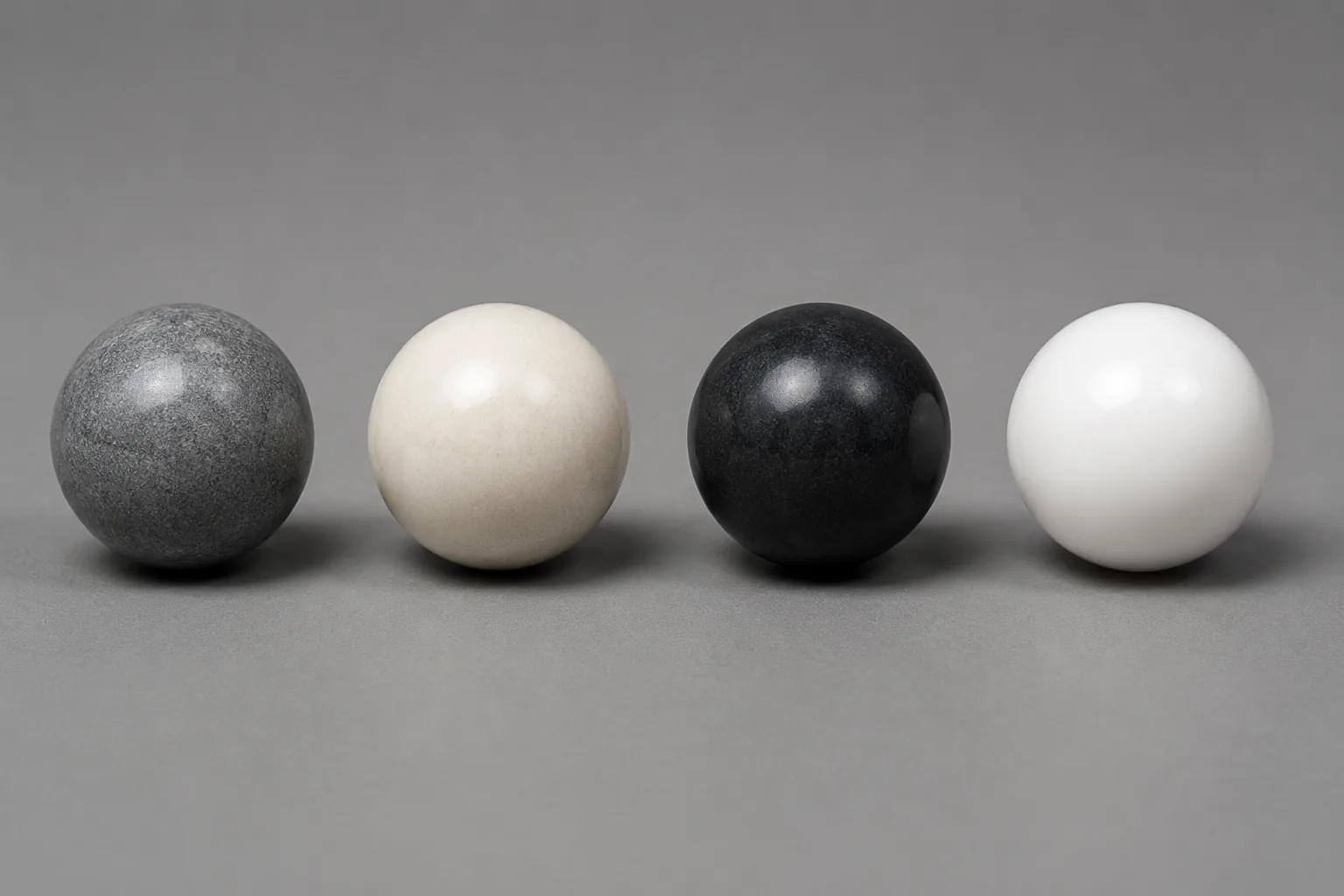
Quick Answer: Bearing-grade silicon nitride (Si3N4) is the default high-performance ceramic for rolling bearings because it combines low density, high hardness, electrical insulation, and good rolling fatigue resistance. Zirconia (ZrO2) suits low-temperature aqueous or alkaline corrosion but is dense and limited in heat. Silicon carbide (SiC) leads in heat and strong-acid resistance, while alumina (Al2O3) is mainly for cost-sensitive or light-duty balls, not high-load bearing service.
This comparison of ceramic bearing materials focuses on rolling bearing balls and rings, not on generic ceramic data. The practical decision depends on load, speed, density, heat, corrosion media, electrical insulation, and whether a bearing-grade standard exists for the material. Si3N4 is the mature default; ZrO2, SiC, and Al2O3 fit narrower cases.
How to Read This Comparison: Typical Values, Grades, and Processes
Use the numbers in this ceramic bearing materials comparison for orientation, not as guaranteed minimums. Actual density, hardness, strength, and toughness vary with powder purity, stabilizers, sintering aids, porosity, and manufacturing route such as hot isostatic pressing or gas-pressure sintering.
Do not treat a chemical formula as a complete specification. Published supplier ranges for the same ceramic family show that different grades can differ in density and hardness. For example, Si3N4 grades are listed at 3.1-3.3 g/cm3 and 1,500-2,000 HV, while Al2O3 grades are listed at 3.6-3.9 g/cm3 and 1,900-2,700 HV.
Before a bearing design is released, confirm the exact supplier grade, lot data, microstructure requirements, and the applicable standard. A generic table cannot replace a material certificate or a qualified bearing-grade specification.
Quick Comparison Table for Ceramic Bearing Materials
The table below uses typical bearing-maker values and published grade ranges to show the main selection differences. The values are reference points, not minimums for every commercial grade.
| Material | Density | Hardness | Young’s modulus | CTE | Heat reference | Load rating | Bearing position |
|---|---|---|---|---|---|---|---|
| Si3N4 | 3.2 g/cm3 typical; 3.1-3.3 g/cm3 range | 1,500 HV typical; 1,500-2,000 HV range | 320 GPa | 3.2 x 10^-6/K | 800 C | Excellent | Standard ceramic bearing material |
| ZrO2 | 6.0 g/cm3 typical; 5.8-6.1 g/cm3 range | 1,200 HV typical; separate published grade range 1,300-1,500 HV | 220 GPa | 10.5 x 10^-6/K | 200 C | Good | Special-environment material |
| SiC | 3.1 g/cm3 typical; 3.1-3.2 g/cm3 range | 2,200 HV typical; 1,800-2,500 HV range | 380 GPa | 3.9 x 10^-6/K | Above 1,000 C | Good | High-corrosion-resistance material |
| Al2O3 | 3.8 g/cm3 typical; 3.6-3.9 g/cm3 range | 1,600 HV typical; separate published grade range 1,900-2,700 HV | 350 GPa | 7.1 x 10^-6/K | About 800 C | General or lower | Traditional Al2O3 is not suitable as a general high-load rolling bearing material |
The pattern is clear: Si3N4 offers the best overall bearing balance; ZrO2 is dense and best suited to low-temperature corrosion; SiC is the hardest and most heat- and acid-resistant; Al2O3 is the cost-sensitive option but not a high-load bearing default.
Corrosion ratings are media-specific. Concentration, temperature, grade, and surface condition can change performance, so a general rating is not an approval for every process stream.
Si3N4: The Standard High-Performance Bearing Ceramic
After rolling-fatigue and material-property evaluation, bearing manufacturers have adopted HIP silicon nitride as the standard ceramic bearing material. Its balance of low density, high hardness, high stiffness, and rolling fatigue resistance is why it appears in high-speed, high-load, vacuum, corrosion-resistant, heat-resistant, non-magnetic, and high-stiffness applications.
Bearing-grade Si3N4 rolling elements are specified in ultra-precision hybrid bearings under ISO 26602. A published bearing-grade data set lists density 3.2 g/cm3, hardness 1,600 HV10, elastic modulus 310 GPa, CTE 3 x 10^-6/K, electrical resistivity 10^12 ohm-m, and dielectric strength 15 kV/mm.
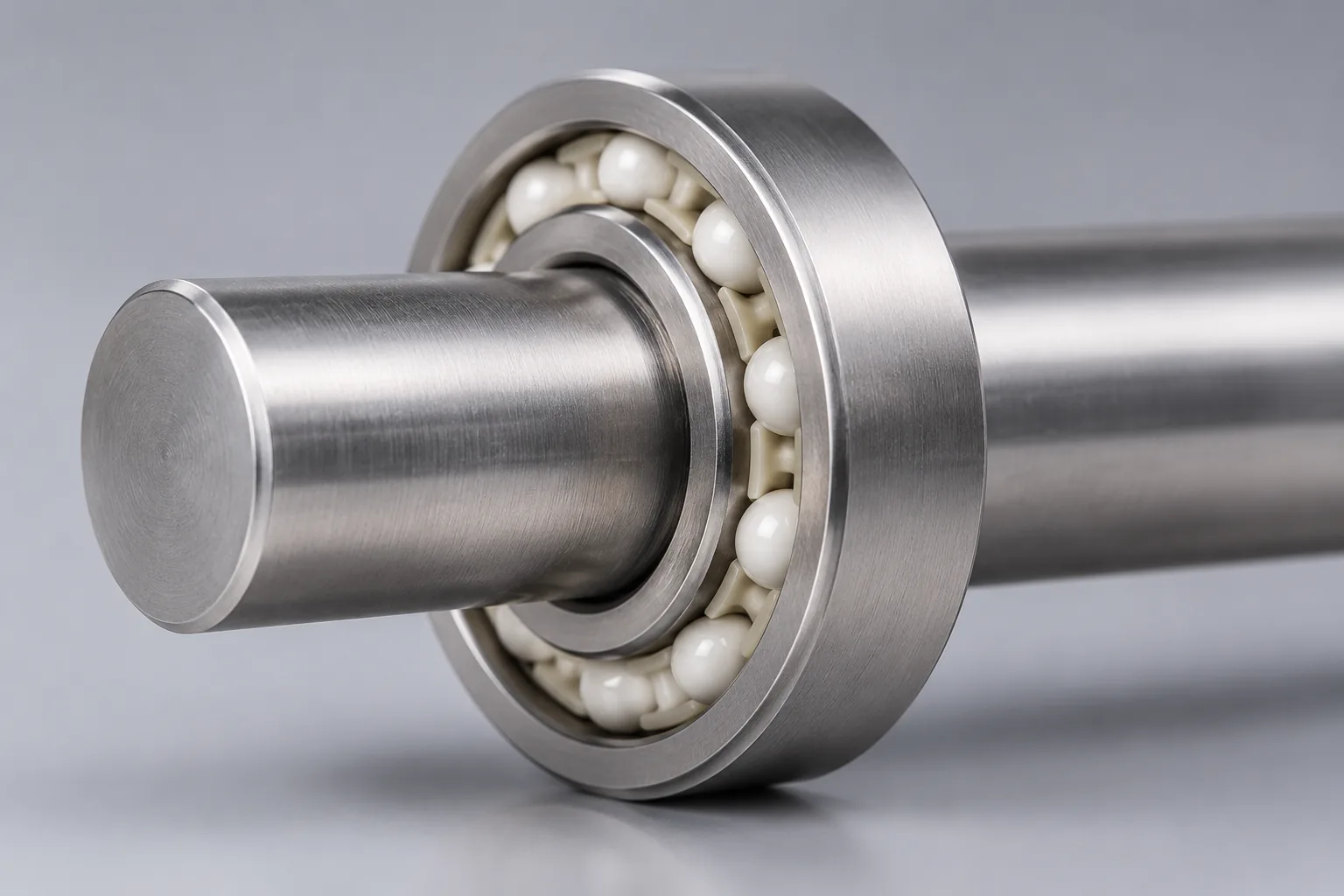
Compared with 100Cr6-type bearing steel, that Si3N4 data set gives density about 41% of steel, CTE about 25% of steel, hardness about 2.3 times steel, and elastic modulus about 48% higher. Those differences support lower rolling-element centrifugal load, electrical insulation, and high stiffness.
Material data also describe Si3N4 as low density with good thermal shock performance and relatively high fracture toughness, with bearing balls and rolling elements as target applications.
Limit: Si3N4 is not fully inert in all acids. Published bearing-maker corrosion tables rate it as possibly slightly affected by hydrochloric, sulfuric, nitric, and hydrofluoric acids. Strong-acid service may need SiC or a specifically qualified corrosion-resistant Si3N4 grade.
ZrO2: High Density and Low-Temperature Aqueous Corrosion Resistance
ZrO2 has a typical density around 6.0 g/cm3, nearly twice that of Si3N4. Same-size ZrO2 rolling elements therefore create more inertia and higher centrifugal load at speed.
Its Young’s modulus around 220 GPa is close to bearing steel, and its CTE around 10.5 x 10^-6/K is closer to the roughly 12.5 x 10^-6/K of bearing steel than the other ceramics.
Published bearing-maker ratings list ZrO2 rolling-bearing suitability as good, but its heat reference value is only about 200 C. That makes ZrO2 unsuitable as the first choice for high-temperature bearings.
In corrosion tables, ZrO2 is basically unaffected by hydrochloric, sulfuric, nitric, and phosphoric acids and by sodium hydroxide. It is rated as possibly affected by hydrofluoric acid.
ZrO2 rings and balls are used in corrosion-resistant bearings for saline water and weak acid or weak alkali environments. The material is a special-environment choice, not a general high-speed substitute for Si3N4.
Exceptions matter: do not select ZrO2 for high-temperature duty, for high-speed applications where low rolling-element mass is critical, or for hydrofluoric acid service without a specific material qualification.
SiC: Extreme Heat and Strong Acid Resistance With High Stiffness
SiC has the highest typical hardness in this comparison at 2,200 HV, with low density at 3.1 g/cm3, high Young’s modulus at 380 GPa, and CTE around 3.9 x 10^-6/K. Its heat reference is above 1,000 C, and it is positioned as a high-corrosion-resistance material rather than a general standard bearing material.
Published SiC grade data show room-temperature thermal conductivity of about 80-170 W/(m*K) and fracture toughness of about 3.2-6.0 MPa*m^1/2. Those values depend on reaction-bonded, pressureless-sintered, or liquid-phase-sintered processing.
SiC is rated as unaffected by hydrochloric, sulfuric, nitric, phosphoric, and hydrofluoric acids. Strong alkalis are rated as possibly slightly affected, so alkaline service still needs verification.
SiC full-ceramic bearings are aimed at strong acids, strong alkalis, and corrosive gases. The material is not the default for general high-load rolling bearings.
Exception: very high stiffness and a lower load rating than Si3N4 require careful control of impact, assembly misalignment, and contact stress. A SiC bearing should be selected only after the housing and shaft conditions are reviewed.
Al2O3: Cost-Sensitive or Light-Duty Ceramic Balls, Not a High-Load Si3N4 Substitute
Typical Al2O3 values are about 3.8 g/cm3 density, 1,600 HV hardness, 350 GPa Young’s modulus, and 7.1 x 10^-6/K CTE. These values make Al2O3 attractive for some precision-ball and light-duty uses, but they do not establish rolling fatigue capacity.
Published bearing-maker ratings describe traditional Al2O3 load capacity as general and explicitly note small load capacity, not suitable for bearings. It should not be presented as a direct high-load substitute for bearing-grade Si3N4.
Precision-ball data list more than 99.5% Al2O3 balls from 1.000 mm to 75.525 mm diameter in precision grades G10-G200. Commercial availability proves that Al2O3 can be made into precision balls, not that it is suitable for high-load rolling fatigue.
Keep pure Al2O3 separate from Al2O3-ZrO2 composites. A reported Al2O3-ZrO2 composite ball performed well in high-temperature rolling fatigue, wear, and corrosion testing, but that is a composite qualification and cannot be used as evidence for ordinary Al2O3.
Exceptions: do not treat traditional pure Al2O3 as equivalent to bearing-grade Si3N4 for high-load applications. Composite Al2O3-ZrO2 materials require separate qualification and should not be conflated with standard Al2O3.
Application Selection Guide by Bearing Requirement
| Bearing requirement | First material to evaluate | Why and limit |
|---|---|---|
| High speed, high load, electrical insulation, hybrid bearings | Bearing-grade Si3N4 | Best overall balance of density, hardness, stiffness, insulation, and rolling fatigue resistance, with established bearing-grade standards. |
| Low-temperature aqueous or alkaline corrosion | Stabilized ZrO2 | Good resistance in saline water and weak acid or weak alkali service, but high density and a heat reference of only about 200 C. |
| Extreme heat and strong acids | SiC | Heat reference above 1,000 C and strong acid resistance, but high stiffness and a lower load rating than Si3N4 keep it out of general high-load duty. |
| Cost-sensitive ceramic balls or light-duty uses | Al2O3 | Precision balls are commercially available, but traditional Al2O3 is not a high-load Si3N4 substitute. |
Use a checklist before selecting a material:
- Operating speed and rolling-element mass
- Radial and axial load, including peak loads
- Continuous and peak temperature
- Corrosion media, concentration, and temperature
- Electrical insulation or grounding requirements
- Magnetic requirements
- Dimensional constraints and ball size
- Available bearing-grade standards and supplier qualification
- Lubrication and sealing conditions
Standards and Quality Requirements for Ceramic Bearing Materials
| Standard | Scope | Status or note |
|---|---|---|
| ISO 26602:2017 | Pre-machined Si3N4 material requirements for rolling bearing balls and rollers; three categories by physical, mechanical, and microstructural properties | Published October 2017; confirmed in 2023 |
| ISO 3290-2:2014 | Finished Si3N4 balls for rolling bearings | Published September 2014; confirmed in 2025 |
| ISO 19843:2018 | Notched-ball strength testing for finished ceramic bearing balls, preferentially Si3N4 balls of 3-50 mm diameter | Notes scatter caused by defect-controlled brittle fracture |
| ASTM F2094/F2094M-18a | Silicon nitride bearing balls, Classes I, II, and III | Quality, physical and mechanical, and test requirements |
| ISO 3643:2024 | Terminology and characteristics of surface defects on ceramic rolling elements | Surface-defect vocabulary for ceramic rolling elements |
The dedicated material and ball standards here are centered on Si3N4; ISO 3643 adds surface-defect terminology for ceramic rolling elements more broadly. This concentration supports Si3N4 as the mature bearing-grade ceramic system.
Check the current revision and scope before specifying a standard. Do not assume that standards covering Si3N4 automatically qualify ZrO2, SiC, or Al2O3 bearing components.
Common Mis-Selections and Material Limits
- ZrO2 for high temperature or high speed: its density is about 6.0 g/cm3 and its heat reference is only about 200 C, so it is not a general high-speed or high-temperature choice.
- SiC only because it is hardest: high stiffness can worsen impact and misalignment sensitivity, and SiC is not the default for general high-load rolling bearings.
- Al2O3 precision balls as a Si3N4 substitute: commercial precision balls do not prove high-load rolling fatigue capacity.
- Si3N4 as universal against all acids: published ratings show possible slight attack by hydrochloric, sulfuric, nitric, and hydrofluoric acids.
- Corrosion tables as approvals: concentration, temperature, grade, and surface condition can change performance, so each process stream needs verification.
Conclusion
When ceramic bearing materials are compared for rolling service, Si3N4 remains the reference because it has the broadest balance of load, speed, insulation, and available bearing-grade standards. ZrO2 is a dense, low-temperature corrosion option; SiC is the heat and strong-acid specialist; Al2O3 is a cost-sensitive or light-duty ball material, not a high-load substitute. Confirm the exact grade, standard, and media conditions before release.
FAQs
Q1: Which ceramic bearing material is best overall?
A: Bearing-grade Si3N4 is the best overall default for rolling bearings because it combines low density, high hardness, electrical insulation, and rolling fatigue resistance with mature bearing-grade standards. ZrO2, SiC, and Al2O3 are narrower choices.
Q2: Is ZrO2 better than Si3N4 for bearings?
A: ZrO2 is better only in specific low-temperature aqueous or alkaline corrosion cases. It is about 6.0 g/cm3, nearly twice the density of Si3N4, and its heat reference is only about 200 C, so it is not a general high-speed or high-temperature replacement.
Q3: Can Al2O3 be used in rolling bearings?
A: Al2O3 can be made into precision balls and can serve light-duty or cost-sensitive uses, but traditional Al2O3 is rated as having small load capacity and is not suitable as a general high-load rolling bearing material. Do not treat it as equivalent to bearing-grade Si3N4.
Q4: Which ceramic material is best for high-temperature bearings?
A: SiC has the highest heat reference in this comparison, above 1,000 C, so it is the first material to evaluate for extreme heat. Al2O3 and Si3N4 are listed at about 800 C, and ZrO2 at only about 200 C; actual limits depend on grade, load, atmosphere, and test conditions.
Q5: Which ceramic bearing material resists strong acids?
A: SiC is rated as unaffected by hydrochloric, sulfuric, nitric, phosphoric, and hydrofluoric acids, making it the strongest acid-resistant choice here. ZrO2 is basically unaffected by several acids but may be affected by hydrofluoric acid, and Si3N4 may be slightly affected by the strong acids listed.
Q6: Are ZrO2, SiC, and Al2O3 covered by the same bearing standards as Si3N4?
A: No. The dedicated rolling-bearing ceramic standards in this comparison focus on Si3N4, including ISO 26602, ISO 3290-2, ISO 19843, and ASTM F2094/F2094M. Do not assume those Si3N4 standards automatically qualify ZrO2, SiC, or Al2O3 components.
Q7: Which ceramic bearing material is best for high speed?
A: Bearing-grade Si3N4 is normally the first choice for high speed because its density is about 41% of bearing steel, which reduces rolling-element centrifugal load, and it has high stiffness and electrical insulation. ZrO2 is less suitable when low mass is critical because its density is about 6.0 g/cm3.
Q8: Which ceramic is best for corrosive chemicals?
A: The answer depends on the chemical. SiC is the strongest choice for strong acids and corrosive gases, ZrO2 fits saline water and weak acid or weak alkali service at low temperature, and Si3N4 is a general corrosion-resistant option that still needs a check for strong acids. Confirm concentration, temperature, and grade.
Q9: Why is Si3N4 the standard bearing ceramic?
A: Si3N4 became the standard because it offers the broadest balance of rolling fatigue resistance, low density, hardness, stiffness, electrical insulation, and heat resistance, and because bearing-grade standards and supplier grades are established for it. ZrO2, SiC, and Al2O3 serve more specific niches.
Q10: When should Al2O3 be considered?
A: Consider Al2O3 for cost-sensitive ceramic balls or light-duty uses where high load capacity is not required. It is not the default for high-load rolling contact, and Al2O3-ZrO2 composites require separate qualification.
Q11: What does ISO 26602 cover?
A: ISO 26602:2017 covers pre-machined Si3N4 material requirements for rolling bearing balls and rollers and divides material into three categories based on physical, mechanical, and microstructural properties. It does not by itself qualify finished ZrO2, SiC, or Al2O3 bearing components.