Quick Answer: Aerospace spherical bearings are self-aligning plain bearings used in airframe joints where high load, low-speed oscillation, and shaft-to-housing misalignment occur. The main families are PTFE-lined self-lubricating bearings and metal-to-metal bearings, with all-metal, high-misalignment, loader-slot, split-ball, rod-end, and lightweight variants serving narrower duties. Selection starts with load, motion, life, temperature, lubrication access, environment, and mounting method, not bore size alone. Applicable SAE standards and a qualified supplier’s process approvals should be confirmed before release.
Aerospace spherical bearings are compact joints that combine load carrying with self-alignment. They appear in airframe structures, flight-control linkages, landing gear, rotor systems, and engine attachments, where a plain spherical interface can absorb misalignment that a rolling bearing cannot. The practical question is not only which bearing fits the envelope, but which construction and standard match the load, motion, temperature, lubrication, and verification requirements.
Definition and Operating Principle
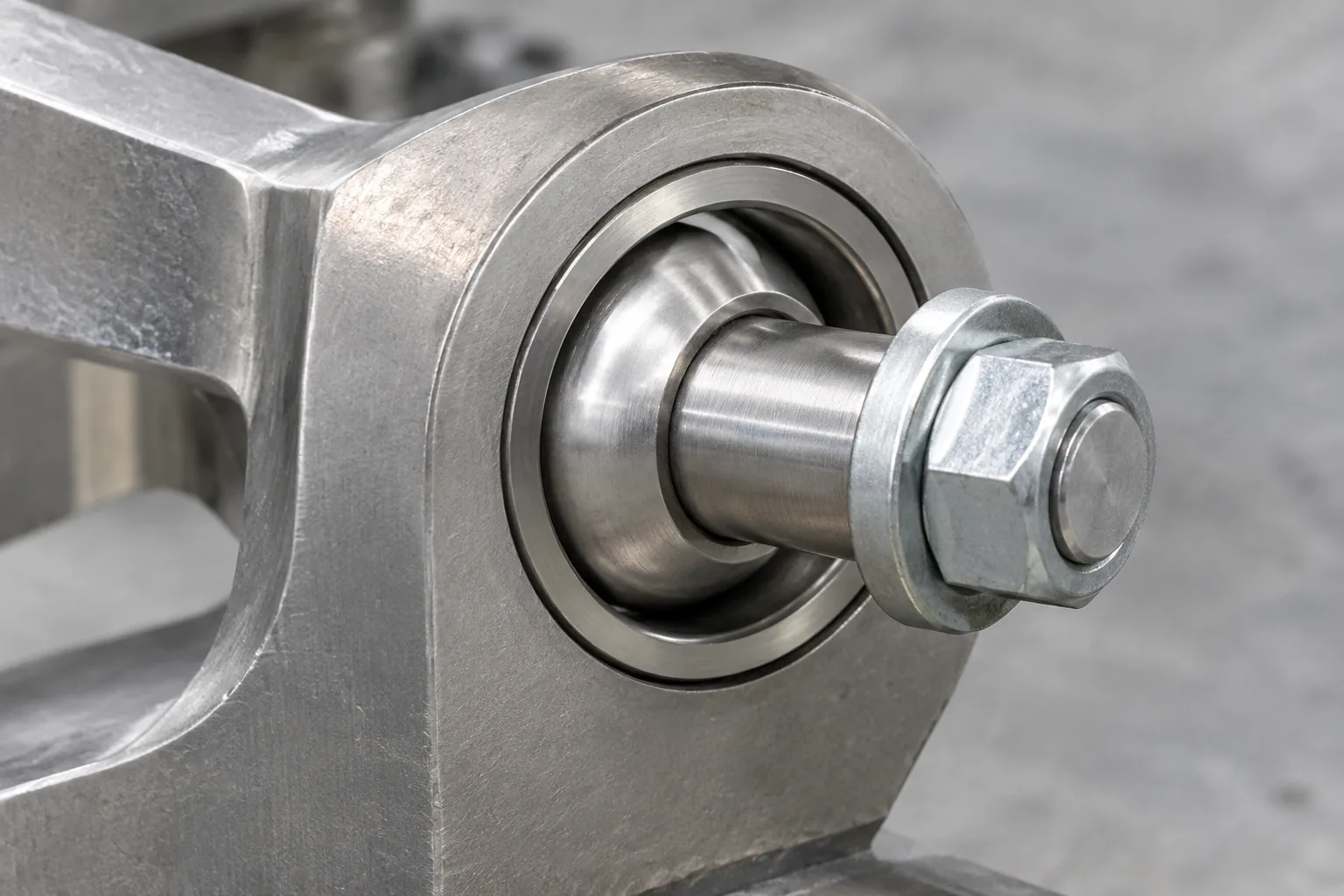
Aerospace spherical plain bearings are self-aligning plain bearings. A spherical sliding interface lets the inner ring or ball rotate and tilt relative to the outer ring, so the joint can carry load while absorbing angular offset. In airframe use, these bearings support high loads, permit oscillation in several directions at relatively low speed, and compensate for misalignment between a shaft and its housing bore.
The common aerospace classification separates self-lubricating (SL) and metal-to-metal (MM) designs. SL bearings use a liner; MM bearings rely on a lubricated metal-to-metal sliding pair. Spherical plain bearings are mainly for oscillating and low-speed motion. They should not be assumed suitable for continuous high-speed rotation unless the selected standard and qualification support that duty.
Aerospace Spherical Bearing Types
Type selection is driven by load case, motion profile, lubrication access, temperature, misalignment, weight, and installation method. The sub-sections below compare each type against those criteria.
Self-Lubricating / PTFE-Lined Spherical Bearings
A PTFE fabric or composite liner sits between the spherical inner ring and the outer ring. The liner supplies the low-friction sliding surface and removes the need for routine grease in many joints. SAE AS81820 defines self-aligning, self-lubricating spherical plain bearings for low-speed oscillation. Its standard temperature range is -65°F to +325°F (-54°C to +163°C), and the standard was originally published on 1998-03-01.
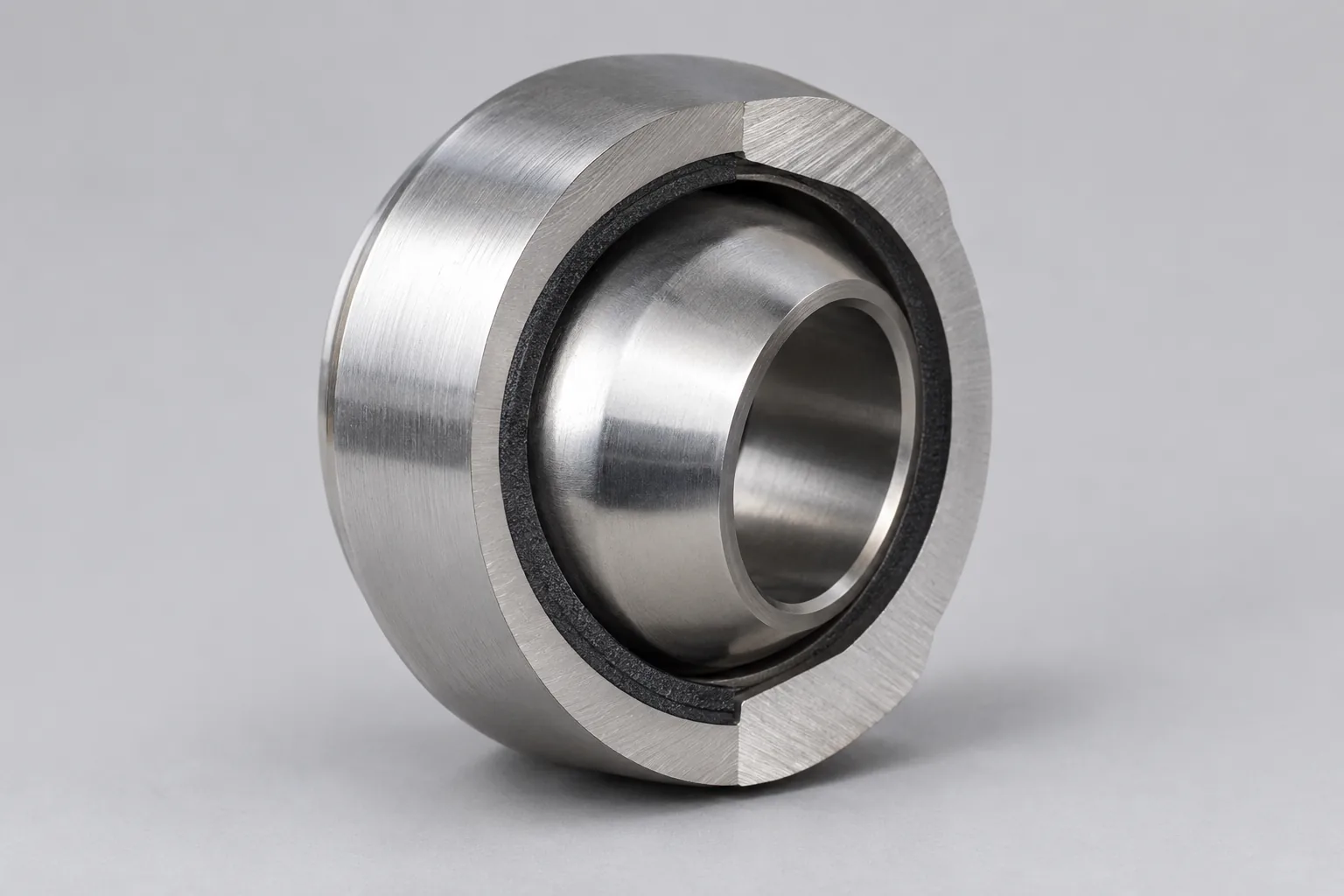
These bearings suit heavy load, oscillating motion, angular misalignment, and locations where lubrication is restricted or undesirable. Composite liners are thin, PTFE-bearing layers bonded to a metal substrate, according to manufacturer selection guidance. For full life, the design should accommodate approximately 0.005 in (0.127 mm) of liner wear.
Typical PTFE-lined applications include:
- Hydraulic actuators.
- Landing-gear doors.
- Vibration-damping devices.
- Control-surface hinges and actuation links.
- Flap and leading-edge-slat guides.
- Power-control-system drive linkages.
Some liner designs are maintenance-free and must not be lubricated. Adding grease to a PTFE-lined bearing that prohibits lubrication can damage its designed friction and wear performance. Confirm the liner rule for the exact part before any lubrication step.
Metal-to-Metal Spherical Bearings
Metal-to-metal spherical bearings are usually evaluated where static load dominates, periodic lubrication is allowed, and permanent deformation after high load must remain small. Aircraft landing gear is a typical case: most motion occurs at low load, while the locked gear imposes a near-static impact load.
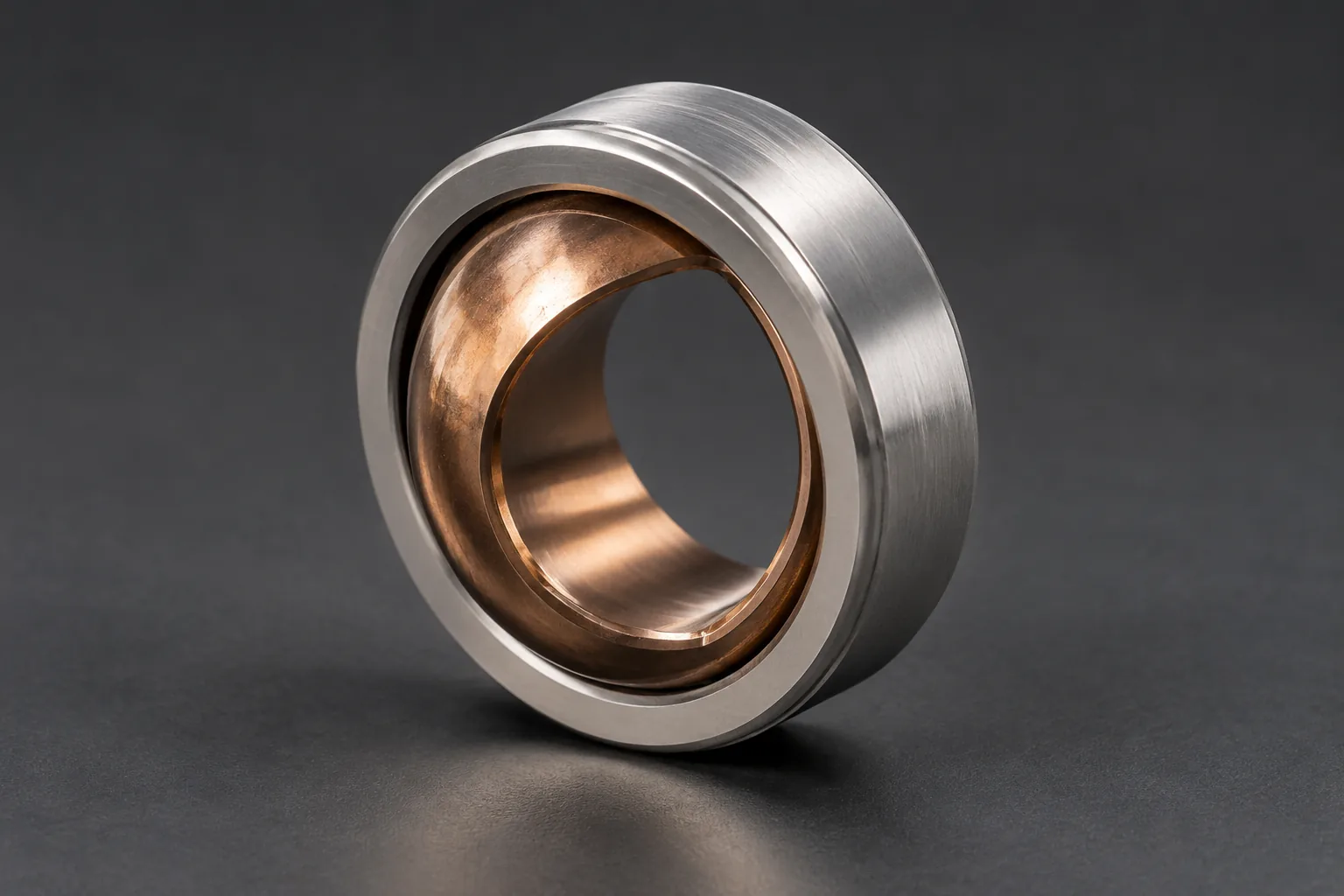
SAE AS81936 covers aerospace metal-to-metal spherical bearing series. M81936/1 and M81936/2 appear on the published approved list; these parts pair a 17-4PH outer ring with a beryllium-copper inner ring. These bearings require a defined lubrication and maintenance plan.
All-Metal Airframe Bearings (SAE AS8976)
SAE AS8976 applies to aerospace structural self-aligning all-metal spherical plain bearings. Its standard temperature range is -65°F to +250°F (about -54°C to +121°C), and it was published on 1999-08-01. Use it when all-metal construction and that temperature envelope match the application.
Do not substitute AS8976 for PTFE-lined low-speed or high-cycle standards without checking temperature and liner requirements. The construction and the standard must be treated as a pair.
Low-Speed vs High-Speed Oscillation Bearings
SAE AS81820 is the low-speed oscillation, PTFE-lined, self-aligning spherical bearing standard. For high-cycle-speed oscillation, SAE AS81819B addresses self-lubricating spherical, sleeve, and thrust plain bearings.
AS81820 covers -65°F to +325°F (-54°C to +163°C). AS81819B has a standard ambient temperature range of -65°F to +160°F (about -54°C to +71°C), and it was published on 2024-11-21. Standard AS81820 product forms include narrow, wide, extended-life Type A, lined-bore, and sealed series. Select by oscillation cycle rate and temperature, not bore size alone.
High-Misalignment Bearings
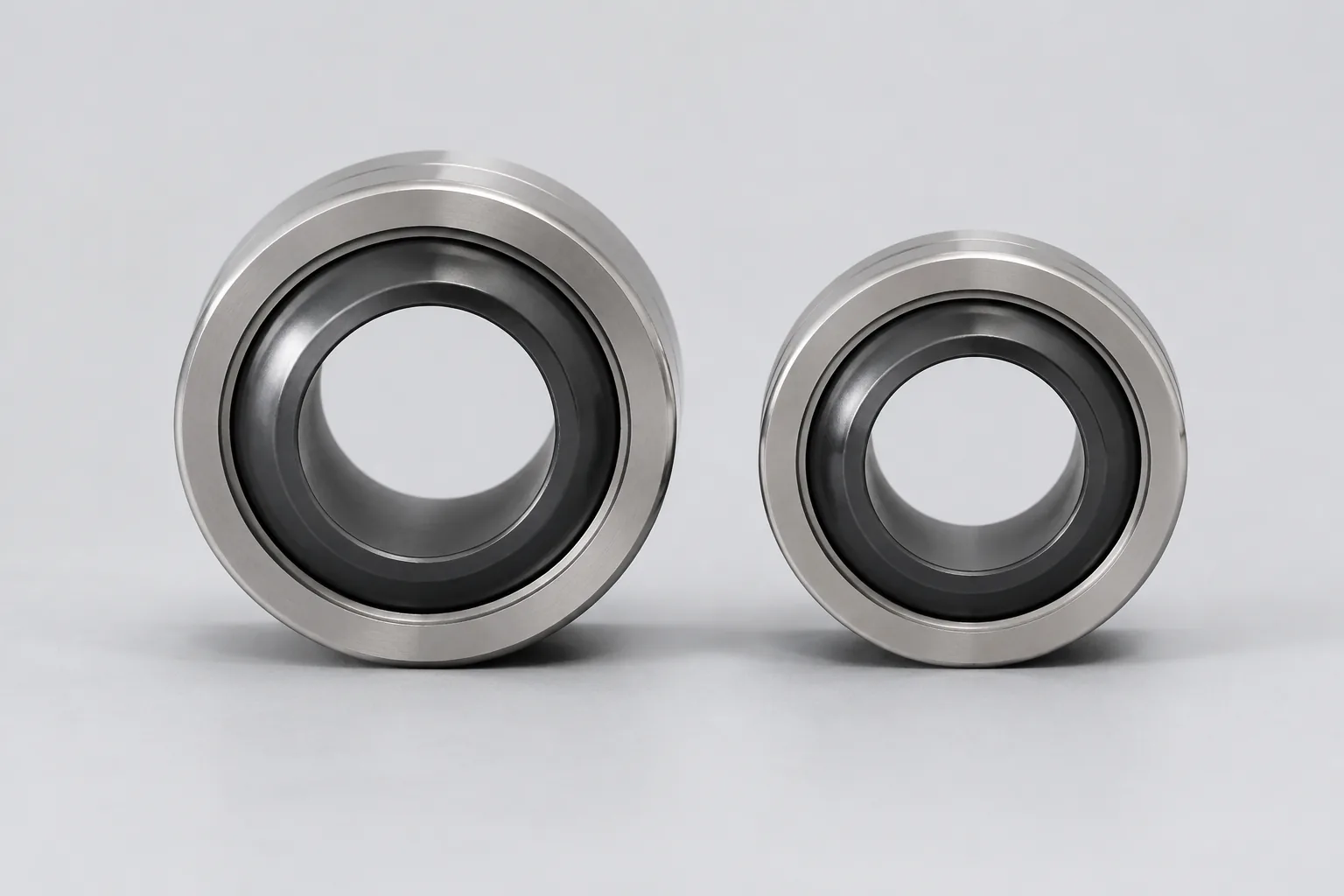
High-misalignment bearings are listed as a distinct product type. Special inner and outer ring geometry provides a larger tilt angle than standard series. The allowed angle must be confirmed by part number and size table. Do not assume a standard series will cover the joint if the required misalignment is large.
Loader-Slot Bearings
An outer-ring loading slot allows assembly with a hardened inner ring. This supports designs that need harder inner and outer rings, higher wear resistance, and higher strength. The trade-off is usually a narrower spherical inner-ring geometry, so the joint envelope and load path must be checked together.
Split-Ball Spherical Bearings
Split-ball spherical bearings are a complex, multi-piece aerospace construction and a separate product category in aerospace catalogues. Use them only when the joint design calls for that arrangement, and confirm the qualified load path, geometry, and part data directly.
Rod-End Assemblies
Rod-end assemblies are used when the bearing must integrate with a link or threaded connection. SAE AS81935 is an aerospace rod-end standard with external-thread and internal-thread configurations. Consider them only when linkage or threaded attachment is part of the joint design.
Lightweight Aluminum Bearings
Aluminum narrow and wide self-lubricating spherical bearings are listed as a separate category for weight-sensitive applications. Use them where weight reduction is a primary design driver and the load and temperature case remains within the qualified product range.
Special-Temperature Material Options
Special materials include Inconel, Stellite, A-286, and René 41. Special temperature applications may also use dry-film lubricant or silver plating on the raceway bore. Confirm actual allowable temperature and load by specific part qualification. Standard catalogue ranges do not automatically apply to special materials.
Verified Aerospace Applications
Published aerospace application lists place spherical bearings in several airframe, rotor, and engine systems:
- Airframe and control: helicopter rotor systems and landing gear, plus pylon-to-wing and engine-to-pylon attachments, flight-control actuation, and engine-accessory attachments.
- Structural and rotor: gearbox mounts and landing-gear trunnions, vertical stabilizers, and helicopter rotor-head assemblies.
- PTFE-lined duty: hydraulic actuators and landing-gear doors, vibration-damping devices, hinge and actuation links for control surfaces, flap and leading-edge-slat guides, and power-control-system drive linkages.
Selection Guide: Define the Duty First
Selection should not begin with bore diameter or envelope dimensions. Start with load, motion, life, temperature, lubrication access, environment, and installation method. The sub-sections below form the selection checklist.
Load Definition
Define the load case in writing before comparing bearings:
- Maximum static radial load.
- Maximum static axial load.
- Normal and maximum dynamic loads.
- Whether the load direction reverses.
- Shock and vibration loads.
A bearing should not be selected from bore or outline dimensions alone, because those dimensions do not describe the actual duty.
Motion Profile
The motion record should include oscillation angle, revolutions per minute or cycles per minute, and required misalignment angle. Also record the phase relationship between load and motion speed. Treat spherical plain bearings as oscillating or low-speed components unless a high-cycle standard and qualification support otherwise.
Static vs Dynamic Duty and Liner Choice
High-load static or limited-motion joints with maintainable lubrication can be evaluated first as metal-to-metal. Continuous oscillation, heavy load, and restricted maintenance usually point first to PTFE self-lubricating construction. Use AS81820 for low-speed self-lubricating oscillating duty and AS81819B for high-cycle-speed oscillation where the standard applies.
Required Life and Acceptance Criteria
State life as a defined number of oscillating cycles. The acceptance record should also set allowed wear, any radial clearance or preload change, and the maximum starting torque after test. Tie the acceptance criteria to the applicable standard and test method so that the life claim can be checked.
Temperature and Standard Compatibility
AS81820, AS81819B, and AS8976 temperature ranges are not interchangeable. Select the standard family by actual temperature, oscillation rate, lubrication scheme, and bearing construction.
| Standard | Scope | Temperature range | Publication date |
|---|---|---|---|
| SAE AS81820 | Low-speed oscillation, PTFE-lined self-lubricating | -65°F to +325°F (-54°C to +163°C) | 1998-03-01 |
| SAE AS81819B | High-cycle-speed oscillation, self-lubricating | -65°F to +160°F (about -54°C to +71°C) | 2024-11-21 |
| SAE AS8976 | All-metal structural, self-aligning | -65°F to +250°F (about -54°C to +121°C) | 1999-08-01 |
Lubrication and Maintenance
Self-lubricating PTFE or TX fabric bearings may be maintenance-free and must not receive grease when the liner design prohibits lubrication. Metal-to-metal bearings require a defined lubrication and maintenance plan. Wrong lubrication can destroy designed friction and wear performance. Check the liner and part specification before any service action.
Clearance vs Preload
Most metal-to-metal spherical bearings use small radial clearance for assembly and to avoid seizure after interference fitting. Preload can be specified where clearance is not acceptable, but preload tolerance is usually wider. The joint design, housing fit, and shaft fit must be evaluated with the clearance choice.
Materials and Load Capacity
Where space is tight and load is very high, candidate inner rings include hardened 52100 or 440C, while outer rings can use heat-treated chrome-moly steel, alloy steel, or precipitation-hardening stainless steel. Material choice affects more than strength:
- Aluminum-bronze outer rings are less prone to galling under vibration or insufficient lubrication.
- Aluminum-bronze load capacity is typically about half that of heat-treated steel outer-ring bearings.
- Special materials include Inconel, Stellite, A-286, and René 41 where temperature or environment demands them.
Environment and Corrosion
Define exposure to moisture, dust, hydraulic fluid, cleaners, deicing fluid, salt fog, and other contaminants. Evaluate surface treatment, sealing, and corrosion-resistant materials as part of the bearing specification. Corrosion-resistant plating or stainless-steel options are available, but the exact option must match the part and the application exposure.
Installation and Mounting
Specify housing fit, shaft fit, staking or swaging method, assembly tools, and post-installation starting torque. A formal bearing selection checklist should include staking method plus housing and shaft fits. A bearing that is correct on paper can still be damaged by an uncontrolled press fit or staking operation.
Quick Selection Matrix by Duty
| Duty | First evaluation |
|---|---|
| High static load, limited motion, lubrication possible | Evaluate metal-to-metal construction. |
| Continuous oscillation, heavy load, restricted maintenance | Evaluate PTFE self-lubricating construction. |
| High cycle speed | Evaluate the AS81819B high-speed oscillation family. |
| Large misalignment | Evaluate high-misalignment geometry and confirm angle by part number. |
| Weight-sensitive joint | Evaluate aluminum self-lubricating options. |
| Special temperature or environment | Evaluate special alloys and dry-film or silver-plated raceways. |
Standards, Testing, and Quality Verification
The main aerospace references for spherical plain bearings are:
- SAE AS81820: low-speed oscillation, self-aligning, PTFE self-lubricating spherical plain bearings.
- SAE AS81819B: high-speed or high-cycle oscillation self-lubricating spherical, sleeve, and thrust plain bearings.
- SAE AS8976: aerospace structural all-metal self-aligning spherical plain bearings.
- SAE AS81935: aerospace rod-end bearing series; can be combined with AS81820-type liners.
- SAE AS81936: aerospace metal-to-metal spherical bearing series.
- SAE ARP5448: aerospace structural plain bearing test method system.
Cite the appropriate test in specifications, part standards, and procurement documents. Final users must still select standard or non-standard tests according to the application.
Supplier and Certification Checks
Check whether the supplier holds the relevant aerospace approvals and Nadcap special-process accreditations. As a published example, New Hampshire Ball Bearings (NHBB) states that its aerospace spherical bearing division holds a Nadcap scope covering heat treating (AC7102), chemical processing (AC7108), nondestructive testing (AC7114), and composite/self-lubricating liner bonding (AC7118). The same division also holds ISO 14001:2015.
NHBB’s headquarters is at 175 Jaffrey Road, Peterborough, New Hampshire 03458, USA. The company is part of MinebeaMitsumi and operates under the MinebeaMitsumi Aerospace brand. Its spherical bearing division, the Astro Division, is at 155 Lexington Drive, Laconia, New Hampshire 03246, USA.
RBC Bearings separately reports four self-lubricating liner materials qualified to SAE AS81820 and offers AS81820, AS81936, AS8976, and several EN standard families.
Concrete Product-Data Example: RBC M81820/4 and M81820/1
The RBC M81820/4 and M81820/1 lined-bore narrow series shows how standard, material, liner, size, load, and temperature data appear in an aerospace bearing datasheet. These bearings use a 17-4PH stainless steel outer ring (AMS 5643, minimum HRC 28), a PH13-8Mo stainless steel inner ring (AMS 5629, minimum HRC 43), and a Fibriloid or E Uniflon liner per AS81820. Operating temperature is -65°F to +325°F.
| Property | Value |
|---|---|
| -04 size bore | About 0.2510 in (6.375 mm) |
| Oscillating radial load rating | 2,650 lbf (11.8 kN) |
| Radial limit load | 5,550 lbf (25.0 kN) |
| Axial limit load | 430 lbf (1.9 kN) |
Ratings are AS81820-based and apply to the specific datasheet part. This example is illustrative only; final selection must use the actual part-number datasheet and application duty.
Conclusion
The right aerospace spherical bearing is the one whose construction and standard match the duty. Choose metal-to-metal for high static load with maintainable lubrication, PTFE-lined self-lubricating construction for continuous oscillation with restricted maintenance, and the high-cycle standard when oscillation speed demands it. Confirm temperature, misalignment, liner wear allowance, clearance or preload, environment, and installation method before release. The safe next step is to verify the part-number datasheet, standard revision, test method, and supplier approvals against the application.
FAQs
Q1: What are aerospace spherical bearings used for?
A: They are used in airframe and engine joints that need high load capacity with self-alignment and low-speed oscillation, such as landing gear, rotor systems, flight-control linkages, pylon attachments, and gearbox mounts.
Q2: Are PTFE-lined spherical bearings maintenance-free?
A: Many PTFE-lined and TX fabric-lined designs are maintenance-free, but this depends on the liner and part specification. Confirm the part data before adding any lubricant.
Q3: Can self-lubricating spherical bearings be greased?
A: Not when the liner design prohibits lubrication. Adding grease to a PTFE-lined bearing can change friction and wear behavior and may damage the designed performance.
Q4: What is the difference between AS81820, AS81819B, and AS8976?
A: AS81820 covers low-speed oscillation, PTFE-lined, self-lubricating spherical bearings. AS81819B covers self-lubricating spherical, sleeve, and thrust bearings for high-cycle-speed oscillation. AS8976 covers all-metal structural spherical bearings.
Q5: How do I choose metal-to-metal vs PTFE-lined spherical bearings?
A: Start with duty. Metal-to-metal suits high static load, limited motion, and a maintainable lubrication plan. PTFE-lined self-lubricating construction usually fits continuous oscillation, heavy load, and restricted maintenance.
Q6: What temperature limits apply to aerospace spherical bearings?
A: AS81820 goes to +325°F (+163°C), AS81819B has a standard ambient upper limit of +160°F (+71°C), and AS8976 goes to +250°F (+121°C). These ranges are not interchangeable.
Q7: What liner wear allowance should be designed for?
A: For many PTFE composite liners, plan for roughly 0.005 in (0.127 mm) of wear over full life. The actual allowance must follow the part specification and accepted life criteria.
Q8: How is required bearing life specified?
A: State required life as a defined number of oscillating cycles, then add allowed wear, radial clearance or preload change, and maximum starting torque after test.
Q9: What does a high-misalignment spherical bearing mean?
A: It means the bearing has special inner and outer ring geometry that permits a larger tilt angle than a standard series. The allowed angle must be confirmed by part number and size table.
Q10: What does SAE ARP5448 cover?
A: SAE ARP5448 is a test-method system for aerospace structural plain bearings. The applicable test should be cited in the specification, part standard, and procurement document for the application.