Quick Answer: Pillow block bearings are ready-to-mount bearing units that support shafts running parallel to the mounting surface. Each unit pairs a housing with an insert bearing (outer spherical ball bearing) inside. Key selection criteria include shaft diameter (commonly 5/8″ to 5″), load type, operating environment, seal design, and shaft locking mechanism. Correct installation (alignment within 0.05 mm) and routine lubrication every 3-6 months can deliver service life of 30,000-50,000 hours in many installations.
Pillow block bearings show up in nearly every industrial setting, yet specifying the right one often raises more questions than answers. Should you choose a P series or a PH series? Is set screw locking sufficient, or do you need an eccentric locking collar? Will a heavy-contact seal handle your dusty environment, or do you require a labyrinth design? If you are wrestling with these decisions, this guide is written for you.
The following sections cover pillow block bearing dimensions, available configurations, housing materials, selection logic, installation procedures, and ongoing maintenance. Whether you are designing a new conveyor line or sourcing replacement units for an existing fan, the information here equips you to make a well-informed choice.
What Is a Pillow Block Bearing?
Definition and Core Components
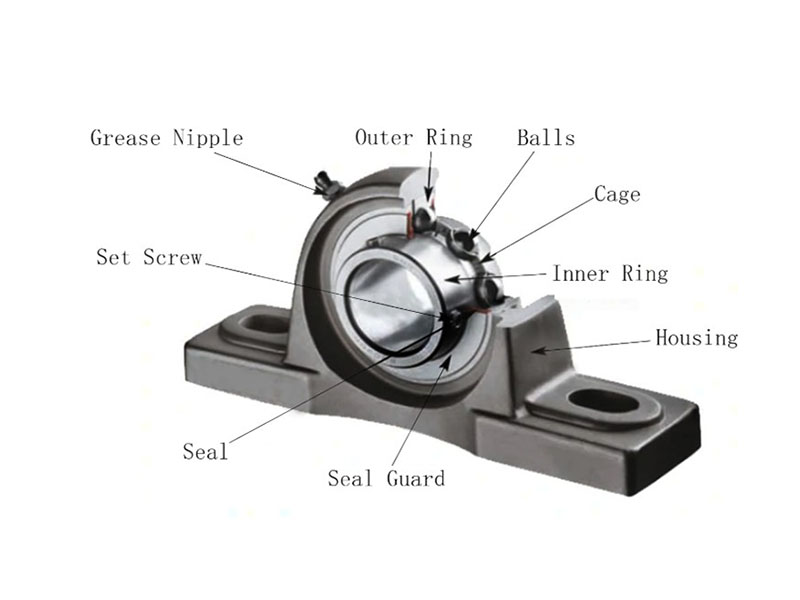
A pillow block bearing is a factory-assembled mounted bearing unit engineered to support a rotating shaft that runs parallel to the mounting surface. The name derives from the housing shape, which resembles a pillow cradling the shaft from beneath.
Every pillow block bearing consists of two primary components working together:
Mounted Bearing Unit = Housing + Insert Bearing
- Housing (the pillow block itself): The stationary outer casing that anchors the bearing to the supporting structure. It remains fixed during operation.
- Insert Bearing (the internal element): The active rolling assembly that rotates with the shaft. It carries the applied load and enables low-friction rotation.
Insert Bearing: Types and Locking Methods
Understanding the Insert Bearing (Outer Spherical Ball Bearing):
The insert bearing – also known as an outer spherical ball bearing – is based on a sealed deep groove ball bearing. Its defining feature is a convex (spherical) outer ring surface, which allows the bearing to self-align within the housing to compensate for shaft misalignment. The inner ring is typically extended to accommodate various shaft locking devices.
Common insert bearing series include UC (set screw locking), UK (tapered bore with adapter sleeve), and UEL (eccentric locking collar), distinguished by their shaft attachment methods. These bearings are factory-sealed and pre-lubricated, ready for immediate installation.
Note: Insert bearings are specifically ball bearings. Roller bearings (such as cylindrical or spherical roller bearings) and plain bearings belong to different product categories and are not used as insert bearings in standard pillow block units.
Shaft Locking Methods:
The way an insert bearing locks onto the shaft is one of the most critical selection variables. Each method suits different load conditions and installation requirements.
| Locking Mechanism | Operational Characteristics | Ideal Use Case |
|---|---|---|
| Set Screw | Simple, low-cost, widely used | Standard applications with unidirectional axial loads |
| Eccentric Locking Collar | Secure grip, handles axial loads in both directions | Vibration-prone equipment, bidirectional thrust |
| Adapter Sleeve | Mounts onto plain or unshouldered shafts | Easy installation and removal on smooth shafts |
| Tapered Bore (with adapter) | Enables radial clearance adjustment | Applications requiring precise internal clearance control |
Housing: Materials and Common Types (P, PA, PH)
Housing Material Selection:
Housing material directly influences corrosion resistance, mechanical strength, cost, and overall service life. Each material fits specific operating environments.
| Housing Material | Key Attributes | Recommended Applications |
|---|---|---|
| Cast Iron | Cost-effective, good strength, widely available | General-purpose industrial use |
| Ductile Iron | Higher tensile strength (25 kN+ load capacity), impact-resistant | Heavy loads, shock-prone installations |
| Stamped Steel | Lightweight, economical | Light loads, cost-constrained projects |
| Stainless Steel | Superior corrosion resistance | Wet environments, chemical exposure, washdown areas |
| Thermoplastic | Non-corrosive, self-lubricating, lightweight | Food processing, pharmaceutical, specialty chemical service |
Pillow Block Types: P, PA, and PH Series:
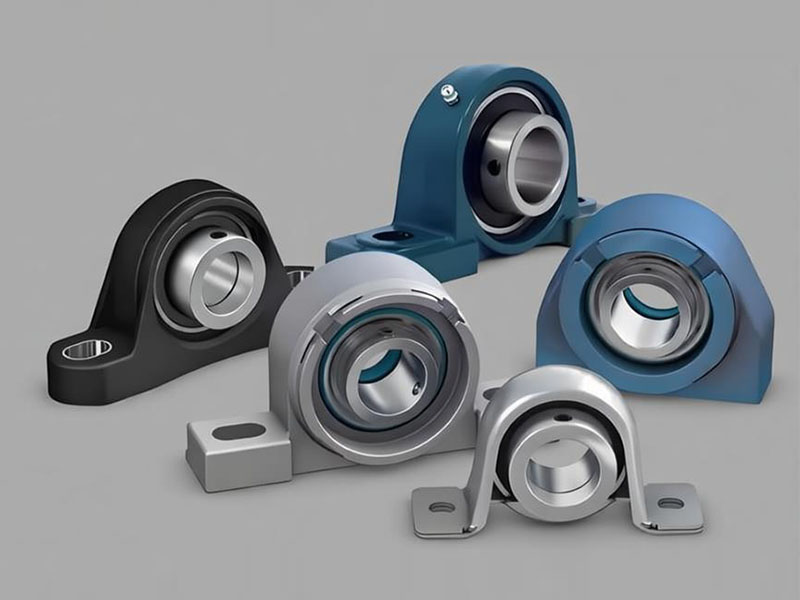
Within the pillow block bearing category, the most common types are distinguished by housing shape and mounting dimensions. The P, PA, and PH series represent the three primary configurations, each designed for different installation constraints and shaft positioning requirements.
| Type | Housing Characteristics | Typical Applications |
|---|---|---|
| P Series | Standard cast iron base with a rectangular footprint. This is the most common and versatile pillow block configuration. The mounting holes are positioned at the base corners, providing a stable, low-profile mounting solution. | General-purpose industrial equipment, conveyors, fans, and pumps where standard shaft height and standard mounting space are available. |
| PA Series | Narrower base design, often with stamped steel construction rather than cast iron. The reduced footprint makes it suitable for installations where mounting space is limited, and the lighter construction suits lower load demands. | Light-load applications, compact machinery, and spaces where the standard P series base is too wide to fit. |
| PH Series | High-center design where the “H” stands for higher. The shaft centerline is elevated relative to the mounting surface compared to the P series. This configuration is used when the shaft needs to be positioned at a greater height from the mounting base. | Applications requiring additional clearance beneath the shaft, such as when the shaft must pass over other equipment components. |
Beyond these three, variations such as UCP (unitized pillow block with set screw locking) and UCPX (heavy-duty version of UCP) are also common in the market. However, the P, PA, and PH series represent the core housing configurations from which most other pillow block variants are derived.
It is worth noting that other housing forms exist within the broader mounted bearing family, including flange-mounted units (F, FA, FB, FC, FL, FS series), take-up units (T series), and hanger units (HA series). These are separate categories within mounted bearings and are not considered pillow block types. This guide focuses exclusively on the pillow block family and its P, PA, and PH variants.
Pillow Block vs. Plummer Block: Key Differences
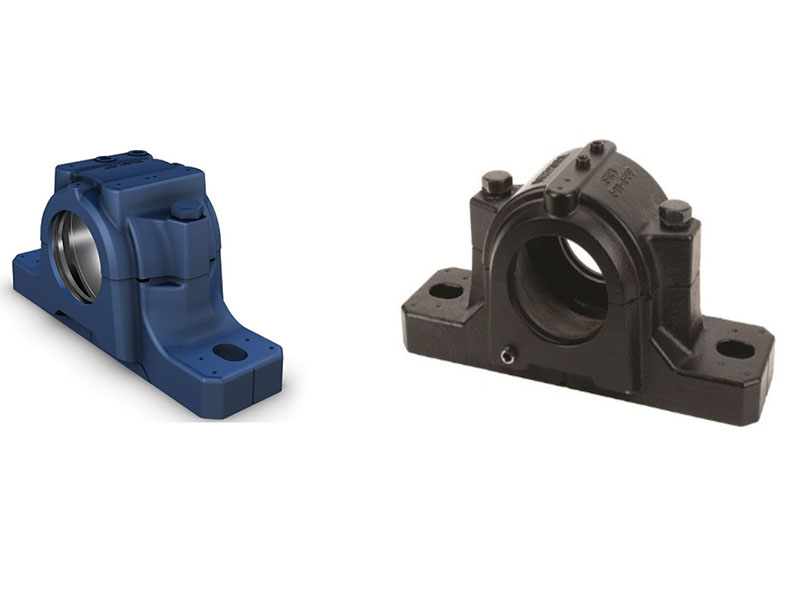
Now that the basic structure and common types of pillow block bearings are clear, it is worth addressing a frequent source of confusion: the difference between pillow blocks and plummer blocks.
Many buyers use the terms “pillow block” and “plummer block” interchangeably, but they are not the same product. Understanding the distinction prevents costly mis-specification.
| Comparison Aspect | Pillow Block Bearing | Plummer Block (Split Block) |
|---|---|---|
| Housing Construction | Typically solid (one-piece); split versions also exist | Always split into upper and lower halves |
| Typical Load Range | Light to moderate loads, low-torque applications | Heavy-duty loads, high-torque applications |
| Common Internal Bearing | Insert bearings (outer spherical ball bearings) | Spherical roller bearings or CARB bearings |
| Representative Series | P, PA, PH, UCP, Type E | SNL, SAF, SAW |
| Environmental Suitability | Standard industrial conditions | Severe, corrosive, or high-contamination environments |
The practical rule: if your application runs heavy loads or aggressive conditions, look at plummer blocks. For standard-duty jobs with light to moderate demands, pillow block bearings are the correct solution.
Size Specifications and Dimensional Standards
Correct sizing ensures proper fit, adequate load capacity, and reliable operation. Dimensional standards ISO 113 and ISO 11687-1 establish globally recognized specifications for mounted bearings, promoting interchangeability across suppliers.
Primary Sizing Inputs:
- Shaft diameter (bore size)
- Anticipated load magnitude
Bore Size Range: Standard pillow block bearings accommodate shaft diameters from 5/8″ through 5″.
Critical Dimensions to Verify Before Ordering:
- Bore diameter (d)
- Overall housing length (L)
- Overall housing width (B)
- Mounting center height (H) – distance from base to shaft centerline
- Mounting bolt size and spacing
- Dynamic load rating (C) – for rotating applications
- Static load rating (C0) – for stationary or slow-rotating applications
- Total unit weight
Series Selection Guide by Load Class:
| Series Designation | Load Capacity | Mounting Configuration |
|---|---|---|
| Type E | Heavy-duty | 2-bolt or 4-bolt base mounting |
| UCPX | Medium-duty | Standard pillow block footprint |
| Standard Cast Iron | General-purpose | Most economical, widely stocked |
| 304 Stainless Steel | General-purpose with corrosion resistance | Washdown and chemical environments |
| Thermoplastic | General-purpose | Food-grade and specialty applications |
Pillow Block Bearing Selection: Key Factors to Consider
Selecting the optimal pillow block bearing involves weighing several variables simultaneously. The table below organizes these factors into a practical decision framework.
| Selection Factor | Practical Guidance |
|---|---|
| Available Mounting Space | Choose P (standard), PA (narrow), or PH (high center) based on clearance and shaft height requirements |
| Shaft Diameter | Must match the insert bearing bore exactly – verify with calipers before ordering |
| Load Profile | Light and uniform -> standard ball bearing; heavy or shock loads -> roller bearing or Type E |
| Operating Environment | Dust/moisture -> solid housing with heavy-contact or labyrinth seal; chemical exposure -> stainless steel housing |
| Shaft Locking Preference | Low axial load -> set screw; bidirectional or vibratory loads -> eccentric collar; plain shaft -> adapter sleeve |
| Thermal Growth Management | Long shafts require an expansion (non-locating) bearing at one end to accommodate thermal lengthening |
| Housing Material | Match material to environmental corrosiveness and temperature |
Where Are Pillow Block Bearings Used?
Each pillow block type serves specific application needs. The choice among P, PA, and PH often depends on the physical constraints of the equipment rather than the operational load alone.
P series is the default choice for most industrial applications. Its standard dimensions and wide availability make it the first option to consider for conveyors, fans, pumps, and general machinery where mounting space and shaft height are not constrained.
PA series is preferred in compact equipment, light-duty conveyor sections, and machinery where base width is limited. The narrower footprint allows installation in tight spaces where a standard P series would not fit.
PH series is specified when the shaft must be elevated. Common scenarios include shafts that need to clear other equipment components, alignment requirements with existing machinery, or retrofit situations where the original mounting height must be matched.
Across these types, pillow block bearings are deployed in the following equipment categories:
- Conveyor systems: belt conveyors, roller conveyors, drive pulleys, and material-handling equipment
- Air-moving equipment: industrial fans, blowers, and ventilation units
- Pump and motor assemblies: belt-driven connections transferring power from motors to pumps
- Gearbox input/output shafts: long couplings between motors and reduction units
- Paper and pulp machinery
- Steel mill equipment
- HVAC systems: air handlers, cooling towers, and circulation fans
DUHUI Bearing has supplied pillow block units and related components into these industries for over two decades. The company’s product portfolio includes wheel hubs, wheel bearings, and complete bearing kits spanning more than 4,000 automotive models. Export operations reach over 120 countries from a manufacturing facility exceeding 10,000 square meters. DUHUI offers one-stop procurement, logistics coordination, dedicated technical support, and full OEM/ODM capabilities.
How to Install Pillow Block Bearings Correctly
Correct installation dramatically impacts bearing service life. Follow this sequence carefully.
Step 1: Shaft Preparation
Verify the shaft is clean, straight, and within dimensional tolerance. Remove any rust, burrs, or raised edges, then apply a light film of oil to ease assembly.
Step 2: Mount the Insert Bearing
Slide the insert bearing onto the shaft and position it at the designated location. If light tapping is required, apply force evenly to the inner ring only.
Step 3: Position the Housing
Place the housing onto the mounting surface and hand-tighten the mounting bolts. Do not fully torque them at this stage – you need adjustment room for alignment.
Step 4: Align the Assembly
Adjust the housing position until the shaft and bearing are properly aligned. Target alignment precision is within 0.05 mm for optimal performance.
Step 5: Torque the Mounting Bolts
Once alignment is verified, progressively tighten the housing bolts in an alternating cross-pattern to avoid distortion.
Step 6: Confirm Free Axial Movement
Rotate the shaft manually and verify it moves freely within the bearing without binding. For extended shaft runs, designate one bearing as the expansion (non-locating) position to accommodate thermal growth. Restricting axial movement on long shafts creates additional thrust loads that accelerate bearing failure.
Step 7: Lock the Shaft Fasteners
Alternate tightening of the set screws or eccentric locking collar to the torque value specified by the manufacturer.
Critical Installation Errors to Avoid:
- Applying impact to the housing or seal components (apply force only to the inner ring)
- Mounting onto a contaminated or damaged shaft surface
- Fully torquing base bolts before alignment is confirmed and locked
- Substituting rust-preventive oil for proper lubricating grease
How to Maintain Pillow Block Bearings and Diagnose Failures
Scheduled Maintenance and Expected Service Life
Consistent maintenance delivers measurable returns in bearing longevity.
- Relubrication: Every 3 to 6 months, depending on duty cycle and temperature
- Alignment verification: Quarterly checks are recommended
Typical Service Life by Equipment Type:
Bearing life varies widely across different applications. Industry data indicates these general ranges:
| Equipment Category | Expected Service Life (hours) |
|---|---|
| Conveyors | 20,000 – 30,000 |
| Pumps | 30,000 – 50,000 |
| Fans and blowers | 50,000 – 80,000 |
| Compressors | 15,000 – 25,000 |
Return on Maintenance: Well-maintained bearings often deliver three times the service life of neglected units – extending from roughly 1 year to 3 years or more in comparable service.
Failure Mode Statistics
Analysis of over 1,200 bearing failures identifies contamination as the dominant cause of premature replacement.
| Failure Origin | Share of Failures | Description |
|---|---|---|
| Contamination | 42% | Solid particles, moisture, or process chemicals entering the bearing envelope |
| Lubrication Deficiency | 33% | Insufficient grease, degraded lubricant, incompatible lubricant type |
| Misalignment | 15% | Installation alignment exceeding recommended tolerances |
| Overload | 10% | Exceeding dynamic or static load ratings |
Recognizing Common Failure Patterns
| Failure Pattern | Underlying Cause | What to Look For |
|---|---|---|
| Brinelling | Shock loading during installation or operation | Visible dents or indentations on raceway surfaces |
| Spalling / Flaking | Subsurface fatigue from sustained overload | Peeling, flaking, or pitting on raceways or rolling elements |
| Corrosion / Rust | Moisture or chemical attack | Red/brown discoloration, surface pitting, rough texture |
| Thermal Damage | Lubricant breakdown or inadequate internal clearance | Blue or brown heat discoloration, burn marks on raceways |
Replacement Indicators: Monitor for these symptoms and act promptly:
- Audible changes: grinding, squealing, or screeching sounds
- Increased vibration levels
- Housing surface temperature rise or visible burn marks
- Lubricant discoloration (blue/brown tint) or metallic particles in purge grease
Conclusion
Pillow block bearings serve as essential support elements across conveyors, fans, pumps, gearboxes, and HVAC systems. Specifying the correct unit requires understanding the three primary housing types – P, PA, and PH – and their respective mounting characteristics.
Key takeaways for specification and procurement:
- Choose P series for standard applications with normal mounting space and shaft height
- Choose PA series for compact installations where base width is limited
- Choose PH series when the shaft needs to be elevated above the mounting surface
- Verify bore diameter precisely against your shaft measurement
- Select locking method according to axial load direction and magnitude
- Choose seal category based on environmental contaminant levels
- Maintain alignment within 0.05 mm during installation
- Follow a regular lubrication and alignment check schedule
For engineers and maintenance teams, time invested in careful selection and meticulous installation directly reduces downtime and extends equipment availability. When specifications are uncertain, consult the bearing manufacturer’s technical documentation or application engineering support for guidance.
Frequently Asked Questions
Q1: What are the differences among P, PA, and PH series pillow block bearings?
P series: standard cast iron base – the most widely used variant. PA series: narrower base or stamped steel construction – suited for light loads and restricted spaces. PH series: raised center height (H = Higher) – used where the shaft must be positioned further from the mounting surface.
Q2: Are flange-mounted bearings considered pillow block bearings?
No. Flange-mounted bearings (F, FA, FB, FC, FL, FS series) are a separate category within mounted bearings. Pillow block bearings are defined by their base-mounted, horizontal housing design, while flange-mounted units have a vertical mounting face. Both fall under the mounted bearing umbrella but serve different mounting orientations.
Q3: What is the difference between a pillow block bearing and a plummer block?
Pillow blocks are typically solid housings with insert bearings (outer spherical ball bearings), suited for light to moderate loads. Plummer blocks are always split housings with spherical roller bearings, designed for heavy loads and harsh environments. See the comparison table in the dedicated section above for full details.
Q4: What is an insert bearing? Is it a ball bearing or a roller bearing?
An insert bearing – also known as an outer spherical ball bearing – is specifically a ball bearing. It is based on a sealed deep groove ball bearing with a convex (spherical) outer ring surface that allows self-alignment within the housing. Roller bearings and plain bearings belong to different product categories and are not used as insert bearings in standard pillow block units.
Q5: What seal types are available for pillow block bearings, and how do I choose?
Seal selection depends on the operating environment. The main seal categories are:
- Clearance Seal: Basic particle exclusion. Best for clean indoor settings with minimal dust.
- Light-Contact Seal: Moderate contamination barrier. Suitable for general factory environments with light dust exposure.
- Heavy-Contact Seal: High-level protection (excludes over 95% of contaminants). Recommended for dusty conditions and areas with water splash.
- Labyrinth Seal: Maximum protection (excludes over 99% of contaminants). Designed for extreme environments such as mining, cement, and aggregate processing.
Industry-standard seal configurations include Z, 2Z, RS, 2RS, RZ, and 2RZ, each offering different trade-offs between friction and protection. Seal compounds vary as well – NBR, ACM, FKM, and SIL are common choices depending on temperature range and chemical exposure. For oil-lubricated systems, oil seals serve the dual function of retaining lubricant while repelling external dirt and moisture.
Q6: Solid housing or split housing – which should I choose?
Solid (one-piece): factory-assembled and pre-lubricated, ready for immediate installation. Mounting time is roughly one-quarter that of split designs. Recommended for applications where disassembly is infrequent. Split (two-piece): upper and lower halves separate, enabling bearing replacement without removing the entire shaft assembly. Preferred where regular inspection or replacement is anticipated.
Q7: Do pillow block bearings handle axial thrust loads?
Standard deep-groove ball insert bearings are radially oriented but can manage modest bidirectional axial loads. For significant thrust loads, alternative bearing types beyond standard insert bearings would be required.
Q8: What signals indicate it is time to replace a bearing?
Watch for these warning signs: unusual operating noise (grinding, squealing, screeching), growing vibration amplitude, housing overheating or visible heat damage, lubricant color change (blue/brown tint) or metal particles in the grease.
Q9: What are the most frequently encountered installation mistakes?
Striking the housing or seal components during assembly, mounting onto a contaminated or scored shaft, fully torquing base bolts before alignment is completed and confirmed, mistaking rust-preventive coating for functional lubricating grease.
Q10: How do UC and UK series insert bearings differ?
UC series bearings use set screw locking onto the shaft. UK series bearings employ an adapter sleeve mounting system (tapered bore). Both families fit into pillow block housings (P series and others), but the locking mechanism and shaft preparation requirements differ.
Q11: What bearing types does DUHUI manufacture?
DUHUI’s production line includes wheel bearings (ball, tapered roller, cylindrical roller, and needle roller configurations), hub units (2nd and 3rd generation with integrated ABS sensors), wheel bearing kits (complete with seals, bolts, nuts, and washers), oil seals, clutch release bearings, hydraulic release bearings, center support bearings, and spherical insert bearings for mounted units.