Quick Answer
The key differences are articulation angle and axial plunge capacity. Rzeppa joints offer up to 48–50° of articulation, making them the standard for outboard/wheel-side applications where steering is involved. Tripod joints offer greater plunge travel (up to 50 mm) but limited angles (~22–31°), making them ideal for inboard/differential-side use. Choose Rzeppa for large steering angles and quieter street operation; choose Tripod for smooth plunge, compactness, and cost-effectiveness. Most passenger cars use Tripod inboard and Rzeppa outboard—always follow your vehicle’s OEM specification.
If you are replacing worn halfshaft components on your daily driver, you have likely narrowed your options down to two names: Rzeppa and Tripod. Both are widely used in passenger cars, but they are far from interchangeable. Understanding their differences is not mechanical trivia—it directly affects how your car steers, rides, and handles suspension travel.
There is a common misconception that only the ball-and-cage design qualifies as a “CV joint.” In fact, the Tripod joint is also a true constant velocity joint. So what sets them apart? Why do most front-wheel-drive cars use a Rzeppa joint on the wheel side and a Tripod on the differential side? This article answers those questions by comparing them head-to-head across every critical performance dimension, giving you a clear framework for choosing the right joint for your specific vehicle.
What Is a Constant Velocity (CV) Joint?
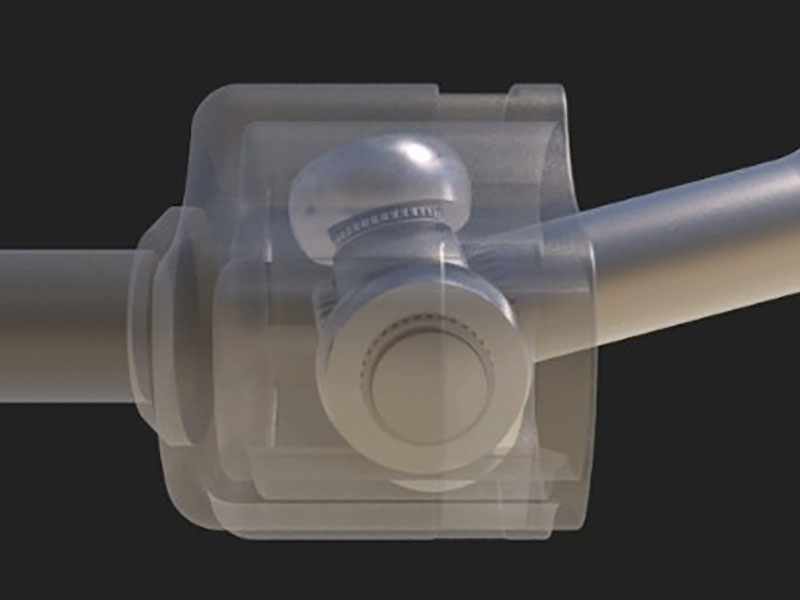
A constant velocity joint transmits torque from an input shaft to an output shaft while allowing the angle between them to vary. The term “constant velocity” means the output shaft’s rotational speed remains equal to the input shaft speed regardless of the operating angle—unlike older U-joints, which suffer speed fluctuations at angle.
In addition to angular movement, a driveshaft also experiences length changes. As the suspension compresses and rebounds over bumps, the distance between the transmission and the wheel hub changes. CV joints must accommodate this axial movement (often called “plunge”) without binding or compromising torque transfer. This single requirement—handling both angle and plunge—is what forces engineers to choose between two fundamentally different mechanical designs.
Rzeppa Joint: The Ball-Type CV Joint
Structure and Components
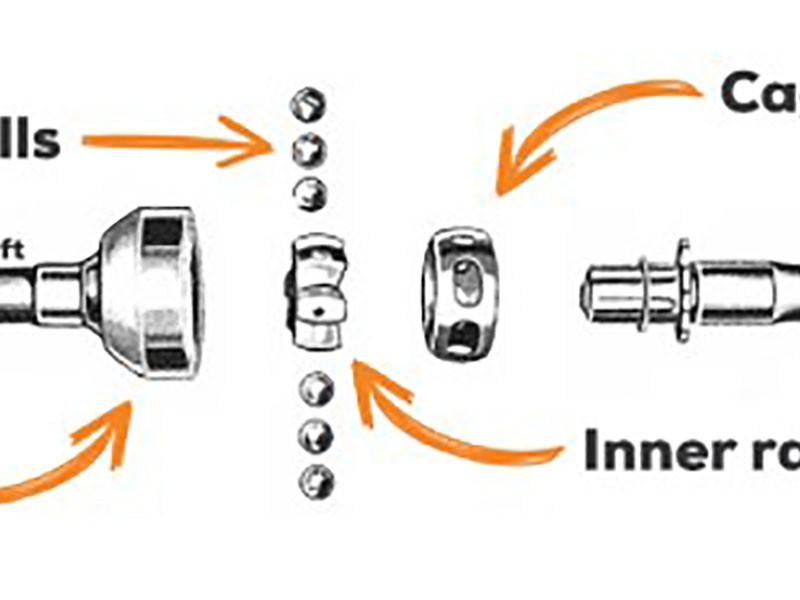
A standard fixed Rzeppa joint consists of four primary components:
- Outer race – a cup-shaped housing with internal curved grooves, typically integrated into the output flange or shaft
- Inner race – a smaller component splined on its internal bore to mount onto the axle shaft
- Six steel balls – the rolling elements that transfer torque between the inner and outer races
- Cage – a retainer that evenly spaces the six balls and keeps them positioned within the grooves
Both the inner and outer races feature curved grooves machined to a radius that matches the diameter of the steel balls. Their curved geometry is what allows angular articulation.
How It Works
When the input shaft rotates, the inner race turns and pushes against the steel balls. The balls, in turn, press against the walls of the outer race grooves, transferring rotational force from the input to the output. The cage keeps the balls positioned exactly at the midpoint between the inner and outer races. As the joint articulates, the balls roll along the curved grooves, maintaining a consistent velocity ratio—even at sharp angles.
Articulation Angle
This is where the Rzeppa joint has a clear advantage. Typical Rzeppa joints offer 45° to 48° of articulation, with some high-performance designs achieving up to 50°. Advanced variants can reach up to 54°. This large angle capacity is exactly why Rzeppa joints are used at the steering knuckle, where wheel angles are at their maximum during tight turns. No other CV joint design can match this angular range in a production passenger vehicle.
Plunging Rzeppa Variants
Standard Rzeppa joints are “fixed”—they do not slide axially. However, when axial movement is needed on the inboard side, some manufacturers use plunging variants:
- Double offset joint – features an outer race with extended longitudinal grooves, allowing the inner race and balls to slide along the axis
- Cross groove joint – uses angled grooves in both the inner and outer races, permitting axial plunge while maintaining constant velocity
Note: These plunging Rzeppa variants are more expensive to manufacture and are typically found on certain European and Asian imports. They are not interchangeable with standard Tripod joints.
Tripod Joint: The Roller-Type CV Joint
Structure and Components
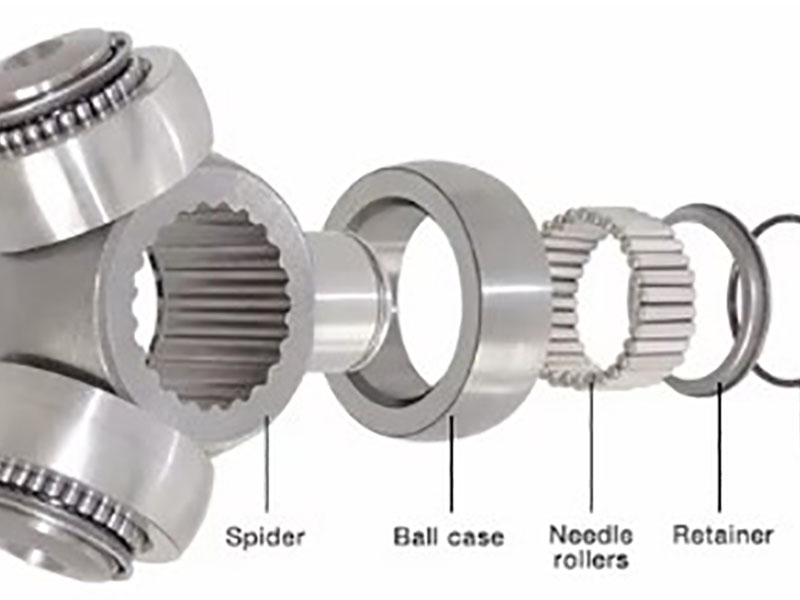
A standard Tripod joint consists of:
- Spider (tripod or trunnion) – a central component with three equally spaced arms, splined to the shaft
- Three rollers – one mounted on each arm of the spider
- Needle bearings – located inside each roller, allowing the roller to rotate freely around its axis
- Cup housing (tulip) – a cylindrical housing with three longitudinal grooves machined into its inner wall, typically integrated with a flange
How It Works
The spider fits inside the cup housing, with each roller seated in its corresponding groove. As the input shaft turns, the spider rotates and the arms press against the rollers. The rollers then press against the side walls of the cup grooves, transmitting rotation from the spider to the cup housing. Unlike the ball-and-cage design, the Tripod joint uses rolling contact (via needle bearings) between the spider arms and the cup grooves, which significantly reduces sliding friction.
Axial Plunge Capacity
This is the defining advantage of the Tripod joint for inboard use. The longitudinal grooves in the cup housing allow the spider and rollers to slide back and forth along the axis smoothly and continuously—without sacrificing torque transmission. The plunge length is customizable by changing the depth or length of the cup grooves, typically offering up to 50 mm of smooth axial travel. This is exactly what is needed to accommodate suspension movement on the differential side.
Articulation Angle
The trade-off for this excellent plunge capability is reduced angular capacity. Standard Tripod joints have a maximum articulation angle of approximately 22–31° (varying by design). Under full torque load, many manufacturers conservatively rate them at around 22–23°. This angle limitation is the fundamental reason why you never see a Tripod joint on the steering wheel side of a passenger car—it would simply bind or fail at the angles generated during a full-lock turn.
Rzeppa vs. Tripod: Head-to-Head Comparison
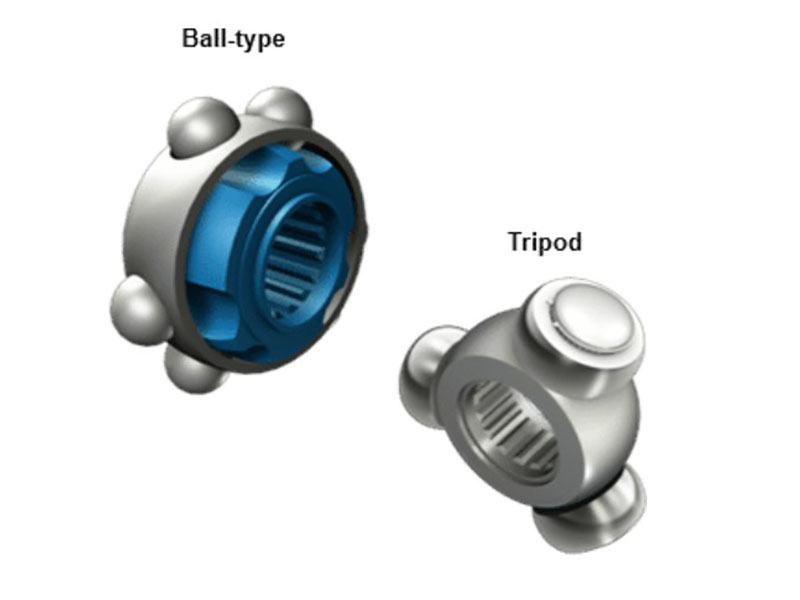
To understand which joint belongs where, you must compare them across five critical performance dimensions. This side-by-side breakdown reveals exactly why they are not interchangeable and why each is used in its specific position on your vehicle.
Articulation Angle (Steering Capability)
- Rzeppa: 48–50° (up to 54° in advanced designs). This massive angular capacity is the joint’s defining advantage. It allows the wheel to turn sharply during parking and cornering without binding.
- Tripod: 22–31° (typically rated ~23° under full load). This is a hard mechanical limit due to the roller-and-groove design. Exceed it, and the rollers will bind or pop out of the grooves.
- Verdict: Rzeppa is the clear winner for any application requiring steering.
Axial Plunge Capacity (Suspension Travel)
- Rzeppa: Fixed (zero plunge) in standard form. Plunging variants (double offset, cross groove) exist but are complex and expensive, offering limited travel compared to Tripod.
- Tripod: Up to 50 mm of smooth, continuous axial slide. The longitudinal grooves in the cup allow the spider to move in and out freely without reducing torque capacity. This is the Tripod’s defining strength.
- Verdict: Tripod is the undisputed choice for accommodating suspension-induced length changes.
Torque Capacity and Package Size
- Rzeppa: Torque is transferred through six point-contact steel balls. For a given outer diameter, it is structurally limited by the ball size and cage strength.
- Tripod: Stronger than a Rzeppa of the same outer diameter. The three large rollers distribute load over a larger surface area. This means a Tripod joint can deliver the same torque in a smaller, lighter package—a significant advantage for compact modern drivetrains.
- Verdict: Tripod wins on torque density.
Friction, Heat, and NVH
- Rzeppa: The six balls slide within curved grooves under load. While smooth, this generates more internal sliding friction. According to SAE research, roughly 70% of friction losses in a Rzeppa joint come from internal contact. This produces more heat but offers very quiet operation at high angles.
- Tripod: The rollers feature needle bearings that rotate against the cup grooves, significantly reducing sliding friction. This generates less heat and improves efficiency. However, at extreme angles, Tripod joints can produce mild axial vibrations (often felt as a slight shudder) that Rzeppa joints do not exhibit.
- Verdict: Tripod is more efficient and cooler-running; Rzeppa is quieter at extreme steering angles.
Manufacturability and Service Life
- Rzeppa: Precision-ground races and a complex cage make it more expensive to produce. It is typically sealed and replaced as a complete unit when worn.
- Tripod: Simpler geometry with fewer precision-machined surfaces makes it more cost-effective to manufacture. For passenger cars, it is also typically replaced as an assembly.
- Verdict: Tripod offers better cost-efficiency for high-volume OEM production.
Comparison Summary Table
| Parameter | Rzeppa Joint | Tripod Joint | Winner |
|---|---|---|---|
| Max Articulation Angle | 48–50° | 22–31° | Rzeppa |
| Axial Plunge | Fixed (or limited, expensive variants) | Up to 50 mm | Tripod |
| Torque per Package Size | Lower | Higher (stronger at same OD) | Tripod |
| Internal Friction / Heat | Higher (sliding contact) | Lower (needle bearings) | Tripod |
| NVH at High Angles | Quieter | Can vibrate at extreme angles | Rzeppa |
| Manufacturing Cost | Higher | Lower | Tripod |
How to Choose: Applying the Comparison to Your Vehicle
Based on the head-to-head comparison above, the selection logic for passenger cars becomes straightforward. Each joint’s strengths and weaknesses dictate its ideal mounting position:
- Outboard (wheel side): Needs maximum angle → Choose Rzeppa. Steering demands 48–50° of articulation. The Rzeppa’s superior angle capacity is non-negotiable here. Its quieter NVH characteristics also benefit cabin comfort, as the outboard joint is closest to the driver’s ears.
- Inboard (differential side): Needs maximum plunge → Choose Tripod. Suspension travel demands up to 50 mm of smooth axial movement. The Tripod’s excellent plunge capacity, combined with its lower cost and better torque density, makes it the ideal choice for this position.
Exception (not a rule): Some European and Asian imports use plunging Rzeppa variants (double offset or cross groove) on the inboard side. These are not standard Tripod replacements—they are more expensive to manufacture and are chosen specifically for NVH tuning. If your vehicle came with these, you must replace them with the same type.
Final rule for daily drivers: When replacing a worn halfshaft on a standard passenger car, always match the original OEM configuration. Do not attempt to swap a Rzeppa for a Tripod on the same axle—the splines, flanges, and housings are physically incompatible. The OEM layout exists for well-understood engineering reasons that the comparison above makes clear.
Conclusion
The Rzeppa and Tripod CV joints are both true constant velocity designs, but they are optimized for completely different mechanical demands—the Rzeppa for high articulation angles (48–50°) and the Tripod for axial plunge (up to 50 mm).
For the vast majority of passenger vehicles, the established OEM formula remains the best practice: Tripod on the inboard side and Rzeppa on the outboard side. Always verify your specific vehicle’s OEM specification before purchasing replacement parts.
FAQs
Q1: Are Rzeppa and Tripod both CV joints?
Yes. Both are true constant velocity joints. They maintain equal input and output rotational speeds regardless of the operating angle.
Q2: Why do front-wheel-drive cars use Rzeppa on the outside and Tripod on the inside?
The outboard joint must handle extreme steering angles (up to 48–50°) during tight cornering—Rzeppa is built for that. The inboard joint must accommodate suspension-induced length changes (plunge)—Tripod is built for that. Each is used where its strength matters most.
Q3: What do the needle bearings in a Tripod joint do?
They allow the rollers to rotate with minimal resistance, significantly reducing sliding friction and heat generation compared to Rzeppa joints.
Q4: Can I replace a Rzeppa joint with a Tripod joint on my car?
No. They have different spline interfaces, mounting flanges, angular capacities, and plunge characteristics. You must replace the joint with the exact type that your vehicle came with from the factory.
Q5: Why is plunge (axial movement) so important for inboard joints?
As the suspension cycles over bumps, the distance between the transmission and wheel hub constantly changes. Plunge allows the joint to extend and retract, preventing the shaft from binding or separating.
Q6: Why do some imports use a Rzeppa joint on the inboard side?
Some European and Asian manufacturers use plunging Rzeppa variants (double offset or cross groove) on the inboard side to achieve specific NVH (noise/vibration/harshness) targets. These are more expensive to manufacture but offer a smoother feel that some OEMs prefer.
Q7: Which joint is stronger for its size?
A Tripod joint is typically stronger than a Rzeppa joint of the same outer diameter. This allows it to deliver the same torque in a smaller, lighter package.
Q8: Which joint generates more heat?
Rzeppa joints generate more internal heat due to sliding friction between the balls and race grooves. Tripod joints run cooler because their needle-bearing rollers reduce sliding contact.
Q9: Do both joints require the same maintenance?
Both rely on rubber boots to retain grease and exclude contaminants. A torn boot is the leading cause of failure for either design. However, the internal mechanisms are fundamentally different and are not serviced in the same way.
Q10: How do I know which joint my vehicle uses on each side?
Refer to your vehicle’s factory service manual or consult a reputable parts supplier with your VIN (Vehicle Identification Number). Always verify the OEM specification before purchasing replacement axles or joints.